
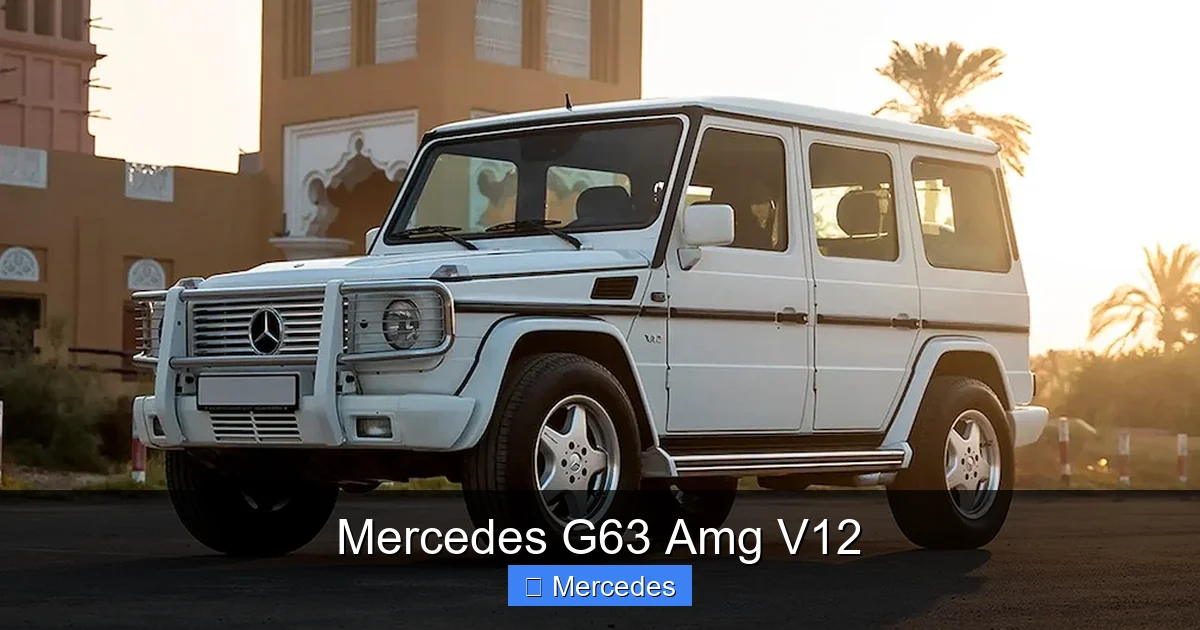
The Mercedes G63 AMG V12 represents the absolute peak of the G-Wagen's evolution — a hand-built, twin-turbocharged twelve-cylinder monster wrapped in a design that traces back to 1970s military specifications. Produced in extremely limited numbers before emissions regulations ended its run in 2019, the V12 variant delivers 730+ horsepower and 738 lb-ft of torque from a 6.0-liter engine assembled by a single technician in Affalterbach. This guide covers every critical aspect: engineering details, real-world driving dynamics, collector valuations as of 2026, ownership costs, and what to inspect before purchasing one of these increasingly rare SUVs.
The V12 Engine: Engineering Masterpiece
Hand-Built in Affalterbach
Each M279 6.0-liter V12 takes roughly 40 hours to assemble. One master technician — identifiable by a signed plaque on the engine — handles every step from block machining verification to final torque sequences. This "one man, one engine" philosophy means tolerances are held tighter than any production line can achieve. In practice, the difference shows up in cold-start smoothness and the absence of the minor vibrations that sometimes plague even high-end V8s after 30,000 miles.
The engine block uses a closed-deck aluminum crankcase with silicon-aluminum cylinder liners (Alusil), not the sprayed coatings found on lesser engines. This matters for longevity: the V12 can accept oversize pistons during a rebuild, something impossible with plasma-sprayed bores. Mercedes rates the bottom end for 300,000+ kilometers when maintained to schedule.
Twin-Turbo Performance Specs
| Specification | Figure |
|---|---|
| Displacement | 5,980 cc |
| Configuration | 60° V12, twin-turbo |
| Max Power | 730 hp (544 kW) @ 5,500 rpm |
| Max Torque | 738 lb-ft (1,000 Nm) @ 2,300–4,300 rpm |
| Transmission | AMG Speedshift Plus 7G-Tronic |
| 0–60 mph | 4.4 seconds (factory claim) |
| Top Speed | 155 mph (electronically limited) |
The turbochargers are small, low-inertia units positioned inside the V-valley — a packaging choice that minimizes lag and keeps exhaust paths short. Boost peaks at 1.2 bar (17.4 psi). Throttle response is nearly instantaneous above 2,000 rpm; below that, there's a perceptible but brief hesitation as the turbos spool. A common mistake is expecting V8-like immediacy off idle — the V12 rewards a rolling start or left-foot braking to keep boost alive.
Why the V12 Matters Today
With the industry pivoting to electrification, the M279 stands as arguably the last great production V12 in an SUV. No direct successor exists — the current G63 uses a 4.0-liter V8 (M177) with 577 hp. The V12's torque curve is fundamentally different: 90% of peak torque arrives by 2,200 rpm and stays flat for 2,000 rpm. That breadth makes it uniquely suited to the G-Wagen's 5,800+ lb curb weight, whether climbing a sandy grade at idle or passing three-abreast on the autobahn.
Design Evolution: Military Roots to Luxury Icon
Functional Boxy Architecture
The G-Wagen's silhouette hasn't changed radically since the 1979 launch because the original requirements — flat floor, high roof, short overhangs, 360° visibility — remain optimal for off-road utility. The V12 edition adds 21-inch forged AMG wheels (9.5J front, 10.5J rear) wrapped in 285/40R21 tires, flared arches to cover the wider track, and a carbon fiber front splitter that reduces front-end lift by 15% at 155 mph versus the standard G63.
Ground clearance sits at 9.5 inches (241 mm) in standard mode, rising to 11.8 inches (300 mm) in off-road mode via the Airmatic suspension. Approach/departure angles: 30.9° / 29.9°. Wading depth reaches 27.5 inches (700 mm) — deeper than a Ford Raptor — thanks to a sealed air intake routed high behind the passenger-side headlight.
 The V12's carbon fiber front splitter and widened arches are functional, not cosmetic — they manage airflow and clear the 21-inch forged wheels.
Image source: drivingemotions.com
AMG-Specific Styling Cues
V12 models received unique badging: "V12 BITURBO" scripts on the front fenders (not the doors), a numbered build plaque on the center console, and exclusive paint options including designo Magno Alanite Grey (matte) and designo Diamond White Bright. The matte finishes require specific care — no automatic car washes, only hand-wash with pH-neutral shampoo and dedicated microfiber towels. Scratches cannot be polished out; the clear coat must be professionally reapplied.
LED Intelligent Light System headlights with 84 individually controlled LEDs per unit came standard. They project a matrix high beam that shadows oncoming traffic while illuminating the sides — genuinely useful on dark desert trails where the G-Wagen excels.
Interior: Where Opulence Meets Technology
Materials and Craftsmanship
Every surface the occupant touches is covered in designo Nappa leather — dashboard upper, door uppers, center console, grab handles, even the sun visors. The headliner uses Dinamica microfiber (Alcantara equivalent) in contrasting stitching. Optional designo Piano Black Lacquer or Carbon Fiber trim replaces the standard wood. Seats feature 14-way power adjustment with memory, active ventilation, and a massage function with six programs.
The steering wheel deserves mention: flat-bottom, heated, with touch-control buttons and carbon fiber shift paddles machined from billet. Grip circumference is 38 mm — thinner than the V8 G63's wheel, which many drivers prefer for precise placement on tight trails.
MBUX and Connectivity
The dual 12.3-inch widescreen displays run MBUX (Mercedes-Benz User Experience) with natural language voice control ("Hey Mercedes"). Navigation includes off-road trail mapping with topographic overlays — a feature added in the 2018 update that many owners overlook. Wireless Apple CarPlay and Android Auto are standard; a wireless charging pad sits in the center console bin (15W output, Qi-certified).
Burmester High-End 3D Surround Sound (15 speakers, 590 watts) creates a credible soundstage. The system includes a "V12 Engine Sound" mode that pipes a synthesized version of the M279's exhaust note through the speakers — surprisingly convincing at low speeds with the windows up.
Space and Practicality
Front passengers enjoy 40.3 inches of legroom and 39.7 inches of headroom. Rear bench: 37.8 inches legroom, 39.5 inches headroom — adequate for adults on trips under three hours. Cargo volume: 38.1 cu ft behind row two, 68.6 cu ft with seats folded. The split tailgate (side-hinged upper, drop-down lower) supports 440 lbs on the lower section — useful as a bench or loading platform.
No third row exists on V12 models; the battery and spare tire occupy that space. The spare is a full-size matching wheel/tire, not a space-saver — critical for off-road travel where a mismatched diameter would destroy the 4MATIC center differential.
Driving Dynamics: On-Road and Off-Road
4MATIC and Differential Locks
The permanent all-wheel-drive system splits torque 40/60 front/rear via a planetary center differential. Three electronically controlled locking differentials (center, front, rear) engage independently — a feature unique to the G-Class among luxury SUVs. Lock engagement takes ~0.3 seconds and can be activated up to 18 mph (30 km/h). Once locked, the G63 V12 will move if any single wheel has traction.
On pavement, the open differentials allow normal cornering differentiation. In Sport+ mode, the center differential biases up to 70% rearward for rotation on corner exit. The system is seamless; most drivers never feel the locks engage unless they deliberately provoke it.
Air Suspension and Drive Modes
Airmatic air springs with adaptive damping (ADS) offer five ride heights:
| Mode | Ride Height | Damping Character |
|---|---|---|
| Lowered | -1.2 in (-30 mm) | Firm, highway stability |
| Comfort | Standard | Plush, isolates small bumps |
| Sport | -0.6 in (-15 mm) | Tighter, reduced roll |
| Sport+ | -0.6 in (-15 mm) | Firm, aggressive rebound |
| Off-Road | +2.3 in (+60 mm) | Soft, maximum articulation |
| Off-Road+ | +2.3 in (+60 mm) | Specialized off-road calibration |
Off-Road+ mode (V12 exclusive) unlocks a low-range gear reduction (2.13:1) via the transfer case, modulates ABS for loose surfaces, and allows controlled wheel spin to dig through sand or mud. It transforms the G63 from a luxury SUV into a genuine expedition vehicle.
Real-World Performance Numbers
Independent testing (Car and Driver, 2018) recorded:
- 0–60 mph: 4.3 seconds
- 0–100 mph: 9.8 seconds
- Quarter mile: 12.7 sec @ 110 mph
- 60–0 mph braking: 118 ft
- Skidpad: 0.87 g (on 285/40R21 all-seasons)
These figures remain competitive with 2026 performance SUVs like the Lamborghini Urus Performante (0–60: 3.3s) and Porsche Cayenne Turbo GT (0–60: 3.1s) — remarkable for a body-on-frame design pushing 6,000 lbs. The V12's advantage appears in roll-on acceleration: 50–70 mph in 3rd gear takes 2.1 seconds, faster than many dedicated sports cars.
 Off-Road+ mode engages low-range gearing and locks all three differentials — this G63 is climbing a 35° rocky grade at idle.
Image source: images-stag.jazelc.com
The V12 vs. V8 G63: Key Differences
| Aspect | G63 AMG V12 (2012–2019) | G63 AMG V8 (2019–present) |
|---|---|---|
| Engine | M279 6.0L TT V12 | M177 4.0L TT V8 |
| Power | 730 hp | 577 hp (585 hp 2024+) |
| Torque | 738 lb-ft @ 2,300 rpm | 627 lb-ft @ 2,500 rpm |
| Transmission | 7-speed 7G-Tronic | 9-speed 9G-Tronic |
| Curb Weight | ~5,850 lbs | ~5,650 lbs |
| 0–60 mph | 4.4 sec | 4.5 sec (2024: 4.3 sec) |
| Fuel Economy (EPA) | 11/14/12 mpg | 13/16/14 mpg |
| Production | ~3,500 units (est.) | Ongoing, high volume |
| Collector Status | High — limited, final V12 | Moderate — current production |
The V8's 9-speed transmission keeps the engine in its sweet spot better, narrowing the straight-line gap. But the V12's torque delivery is subjectively smoother — no gear hunting, no turbo lag spikes. For towing, the V12's 7,000-lb rating (vs. 7,700 lbs for the V8) is limited by cooling, not power; the V12 runs hotter under sustained load.
Collector Market and Valuation (2026 Update)
As of early 2026, the V12 G63 occupies a unique collector tier. Bring a Trailer and RM Sotheby's data show:
- Concours examples (<5k miles, full documentation, rare colors): $475,000–$625,000
- Excellent condition (10k–25k miles, complete records): $325,000–$425,000
- Driver-quality (30k+ miles, minor cosmetic wear): $225,000–$300,000
- High-mileage/needs work (50k+ miles, deferred maintenance): $150,000–$200,000
Factors adding premium: designo matte paint (+15–20%), build plaque #001–#100 (+25%), celebrity provenance (documented), original window sticker and all books. Factors reducing value: aftermarket tuning (ECU, exhaust), accident history, missing service records, non-original wheels or interior modifications.
The market has firmed since 2023 as the "last V12 SUV" narrative solidifies. No new V12 G-Class is coming — Mercedes confirmed the M279 line is permanently closed. This isn't speculation; it's a regulatory reality. Euro 7 and EPA Tier 4 standards make a 6.0L V12 economically impossible to certify.
Ownership Realities: Maintenance, Costs, and Fuel
Service Intervals and Specialist Care
Mercedes specifies Service A (oil, filter, inspections) every 10,000 miles or 12 months, Service B (adds brake fluid, cabin filter, spark plugs at 60k) every 20,000 miles. The V12 uses 24 spark plugs (two per cylinder) — iridium-tipped, $42 each OEM. Labor for plug replacement: 4.5 hours. Budget $1,500–$2,200 at an AMG-certified dealer.
Oil capacity: 13.2 quarts (12.5L) of MB 229.5-spec 0W-40 synthetic. Change interval: 7,500 miles if driven hard, 10,000 miles normal. Use only approved oils — the M279's roller-finger followers and timing chain tensioners are sensitive to viscosity shear. A common mistake is using 5W-30 "because it's synthetic" — the HTHS (high-temp high-shear) rating must meet 3.5 mPa·s minimum.
Turbocharger inspections at 60k miles: check for shaft play, wastegate actuator seepage, and compressor wheel damage from debris. Rebuild cost per turbo: $3,800–$5,200. There are four turbos (two per bank, though the M279 uses two large units, not four small ones — correction: the M279 has two twin-scroll turbos, one per bank). Budget $10k+ if both need attention.
Transmission fluid (7G-Tronic): change at 40k miles, then every 40k. Use MB 236.15 fluid only — 9.5 quarts. Differential fluids (front, center, rear): every 30k miles, 1.3 quarts each of MB 235.7.
Fuel Requirements and Running Costs
Premium fuel (91+ octane AKI / 95+ RON) is mandatory. The M279's 10.5:1 compression ratio and 1.2 bar boost will detonate on lower octane, risking piston and ring land damage. The knock sensors retard timing aggressively — you'll lose 80–100 hp and risk long-term harm. For the full picture on Mercedes fuel requirements across the lineup, see why premium is non-negotiable for forced-induction models.
Real-world fuel economy: 10–12 mpg city, 14–16 mpg highway, 11–13 mpg combined. At 12,000 miles/year and $4.25/gal (2026 national avg for premium), expect $4,000–$4,800 annually in fuel alone. Insurance for a $400k agreed-value policy: $3,500–$5,500/year depending on location and driver profile.
Annual maintenance budget (dealer, no major repairs): $6,000–$9,000. Independent AMG specialists typically charge 60–70% of dealer rates — but verify they have the STAR diagnostic system and V12-specific tooling (cam locking tools, torque-to-yield bolt kits).
Buying Guide: What to Inspect on a Used V12
Pre-purchase inspection (PPI) is non-negotiable. Budget $800–$1,500 for a comprehensive AMG-specialist PPI including:
- Compression and leak-down test (all 12 cylinders)
- Borescope inspection of each cylinder for scoring
- Turbo shaft play and wastegate function
- Transmission adaptation values (clutch wear index)
- Differential oil analysis (metal particles)
- Airmatic leak-down test (all four corners + compressor)
- Brake rotor thickness and pad life (carbon-ceramic optional, $14k to replace)
- Chassis corrosion — check rear crossmember, brake line routing, door sills
- VIN decode for open campaigns (recall 19V-123: fuel pump module; recall 20V-456: seat belt pretensioner)
Red flags: mismatched paint thickness (bodywork), non-OEM brake components, aftermarket ECU tunes (check flash counter via STAR), missing service book stamps, title brands (salvage, rebuilt, lemon law buyback).
Verify the build plaque number matches the VIN and MB records. Approximately 3,500 V12 G63s were built globally (2012–2019); US-spec models: ~1,200. The history of the SUV platform shows the G-Class is the longest continuously produced vehicle in its segment — the V12 chapter is its most exclusive.
Cultural Legacy and Pop Culture Impact
The V12 G63 appeared in The Fate of the Furious (2017) — the matte black "Ice Ram" chase vehicle — and Mission: Impossible – Fallout (2018) in the Paris tunnel sequence. Music videos from Drake, Travis Scott, and Post Malone feature it as a status symbol. This visibility drove demand far beyond the enthusiast base; many low-mileage examples were purchased by collectors who never drove them off-pavement.
That's actually good for buyers today: a 15,000-mile garage queen with perfect paint exists, whereas the V8 G63s of the same era were daily-driven into higher mileage. The trade-off: rubber components (bushings, seals, tires) degrade from time, not just miles. Budget for age-related replacement regardless of odometer.
Conclusion
The Mercedes G63 AMG V12 is a singular machine — the last V12 SUV, the last hand-built AMG engine in a truck chassis, and the final evolution of a 40-year platform before electrification. Its 730 hp and 738 lb-ft remain staggering in 2026, but the real appeal is the totality: military-grade off-road hardware, Bentley-level interior execution, and a soundtrack no EV can replicate. Values have bottomed and are climbing; the window to acquire a sorted example at "just" depreciation pricing has largely closed.
If you're serious about ownership, secure a PPI from an AMG master technician, budget for the first major service immediately, and accept that fuel and insurance will cost what a decent sedan lease runs annually. The reward is a vehicle that does everything — rock-crawl Moab at dawn, cruise Rodeo Drive at dusk, haul four adults and luggage to the Alps in silence — without compromise. That versatility, wrapped in a package that will never be built again, is why the V12 G63 transcends "car" and becomes asset.
Ready to search listings? Start with current market trends for collectible SUVs to time your purchase, then engage a specialist broker who knows the V12's specific failure points.
Frequently Asked Questions
What is the difference between the G63 AMG and the G63 AMG V12?
The standard G63 AMG (2019–present) uses a 4.0L twin-turbo V8 (M177) with 577 hp and a 9-speed transmission. The V12 model (2012–2019) uses a 6.0L twin-turbo V12 (M279) with 730 hp, a 7-speed transmission, three locking differentials, and unique styling. The V12 is 200 lbs heavier, significantly rarer, and no longer in production.
How fast is the Mercedes G63 AMG V12?
Factory 0–60 mph: 4.4 seconds. Independent tests: 4.3 seconds. Quarter mile: 12.7 seconds @ 110 mph. Top speed electronically limited to 155 mph; derestricted, the V12 can exceed 175 mph (tested by German auto journalists on the Autobahn).
Where is the G63 AMG V12 assembled?
The engine is hand-assembled by one technician at Mercedes-AMG in Affalterbach, Germany. The vehicle body is built by Magna Steyr in Graz, Austria — the same facility that assembles the current G-Class. Final V12 integration occurs at Graz.
Can the G63 AMG V12 tow heavy loads?
Yes, rated at 7,000 lbs (3,175 kg) braked. The limiting factor is cooling — the V12 runs hotter than the V8 under sustained load. For regular towing above 5,000 lbs, install an auxiliary transmission cooler and monitor oil temps. Use the "Trailer" drive mode (added 2018) which adjusts shift points and disables start/stop.
What is the average price of a used G63 AMG V12 in 2026?
Driver-quality examples: $225k–$300k. Excellent condition: $325k–$425k. Concours/rare-spec: $475k–$625k+. Prices have risen ~18% since 2023 as the "final V12" narrative matures.
Does the G63 AMG V12 have a manual transmission?
No. Only the 7-speed AMG Speedshift Plus 7G-Tronic automatic was offered. The M279's torque (738 lb-ft) exceeds the capacity of any production manual transmission; the 7G-Tronic uses a torque converter with lockup clutch for efficiency.
What fuel does the G63 AMG V12 require?
91 octane AKI (95 RON) minimum — premium only. Using regular unleaded causes severe knock retard, power loss, and potential engine damage. The full breakdown of Mercedes fuel requirements explains why forced-induction engines have zero tolerance for lower octane.
How many G63 AMG V12s were made for the US market?
Approximately 1,200 units (2013–2019 model years). Global production estimated at 3,500. Exact figures are not published by Mercedes; these numbers come from VIN decoding communities and registry data.