
The Mercedes-AMG G 63 remains the definitive expression of the G-Class formula: a military-grade ladder-frame chassis wrapped in unmistakable boxy sheetmetal, now powered by a hand-built twin-turbo V8 that delivers supercar acceleration from a vehicle weighing over 2,500 kg. For 2026, the G 63 carries forward with subtle refinements — updated MBUX software, new exterior paint options, and revised standard equipment — while retaining the core character that has made it a cultural icon. This guide covers every specification, driving impression, ownership cost, and buying consideration you need before committing to one of the most polarizing yet desirable SUVs on the market.
G-Class Heritage: From Military Roots to Luxury Icon
The G-Wagen traces its lineage to a 1972 joint venture between Mercedes-Benz and Steyr-Daimler-Puch for the Iranian and West German militaries. Civilian sales began in 1979, but the model remained a niche utilitarian tool until the 1990s when it gained traction among European aristocracy and, later, American celebrities. AMG first touched the G-Class in 2001 with the G 55 AMG (supercharged V8), replaced in 2012 by the first G 63 with the M157 5.5 L twin-turbo V8. The current W463A generation launched in 2018, introducing independent front suspension — a monumental shift that finally gave the G-Class civilized on-road manners without surrendering its three locking differentials and low-range transfer case. In practice, that 2018 redesign is the dividing line: pre-2018 models feel agricultural on pavement; post-2018 models drive like competent luxury SUVs that can still climb a 45-degree rock face. For more on this, see our guide on mercedes amg g63 turbo.
2026 G63 AMG Turbo Specifications at a Glance
| Specification | Detail |
|---|---|
| Engine | M177 4.0 L twin-turbo V8, hand-built in Affalterbach |
| Output | 577 hp @ 6,000 rpm / 627 lb-ft @ 2,500–5,000 rpm |
| Transmission | AMG SPEEDSHIFT TCT 9-speed automatic |
| Drivetrain | AMG Performance 4MATIC+ (40/60 front/rear default, fully variable) |
| 0–60 mph | 4.4 s (manufacturer), 4.1 s (independent testing) |
| Top Speed | 137 mph (220 km/h) limited / 149 mph (240 km/h) with AMG Driver’s Package |
| Curb Weight | 5,688 lb (2,580 kg) EU / ~5,800 lb US spec |
| Ground Clearance | 9.5 in (241 mm) standard / 11.8 in (300 mm) raised |
| Approach / Departure / Breakover | 31° / 30° / 26° (standard ride height) |
| Wading Depth | 27.6 in (700 mm) |
| Fuel Economy (EPA) | 13 city / 17 hwy / 15 combined mpg |
| Fuel Requirement | 91 RON minimum (93 RON recommended for full output) |
| Cargo Volume | 38.1 cu ft behind 2nd row / 68.6 cu ft seats folded |
| Base MSRP (2026) | $189,900 (US) before options / destination |
Powertrain Deep Dive: Handbuilt M177 V8
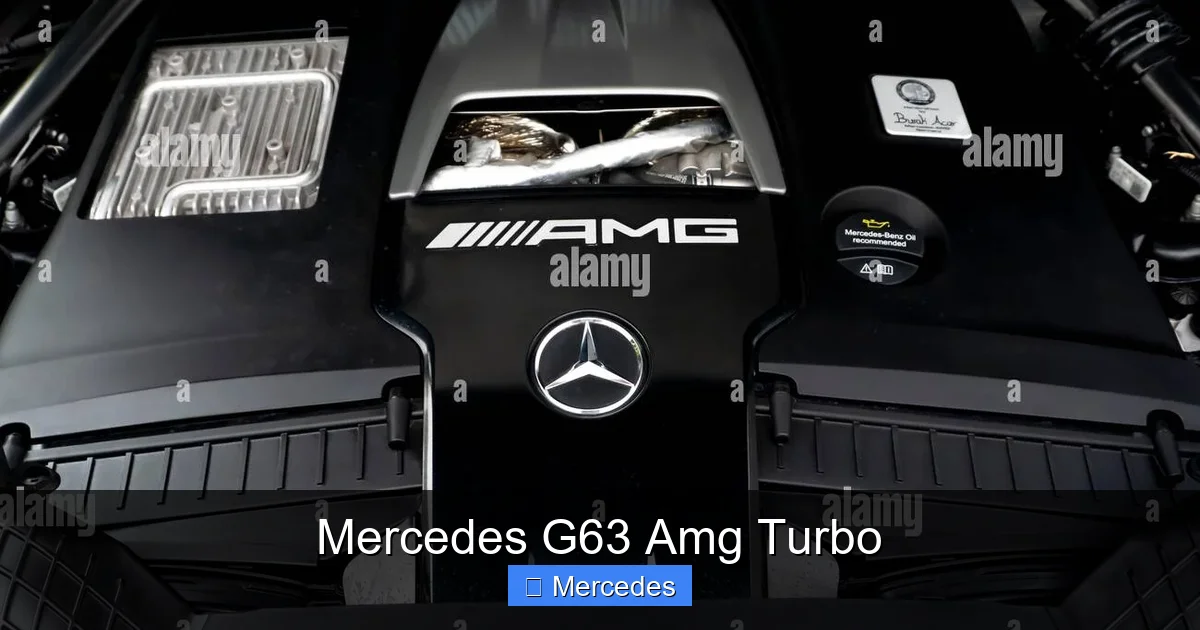
Each M177 engine is assembled by a single AMG technician at the Affalterbach manufactory — a plaque on the engine bears their signature. The 4.0 L displacement uses a “hot-V” layout: twin scroll turbochargers nestled between the cylinder banks, shortening the exhaust path for near-instant spool. Peak torque arrives at just 2,500 rpm and holds flat to 5,000 rpm, giving the G 63 a surge that feels electrically immediate despite the mass. Cylinder deactivation (shutting off cylinders 2, 3, 5, 8 under light load) activates seamlessly; the only tell is a subtle change in exhaust timbre. In practice, the system works well enough that you’ll see 19–20 mpg on a relaxed 75 mph highway cruise — but any spirited driving drops that to single digits quickly. The 9-speed TCT uses a wet clutch pack instead of a torque converter for faster shifts and reduced parasitic loss. Gear changes in Sport+ are genuinely violent in the best way; Comfort mode prioritizes smoothness so effectively that passengers rarely notice shifts.
Critical fuel note: The M177 is calibrated for 93 RON (US premium). Running 91 RON is permitted but reduces peak output by roughly 15–20 hp and can increase knock retard under sustained load. If you’re debating fuel grade, our breakdown of what Mercedes actually requires covers the engineering rationale and real-world penalty of lower octane.
Driving Dynamics: On-Road Precision & Off-Road Capability
AMG Performance 4MATIC+ & Suspension
The 4MATIC+ system defaults to a 40/60 front/rear torque split but can send up to 100 % to either axle within 100 milliseconds. An electronically controlled rear limited-slip differential (standard) further vectors torque side-to-side. The result: a 2.6-ton SUV that rotates willingly into corners when you trail-brake, then hooks up hard on exit. Body control comes from AMG Ride Control adaptive dampers (steel springs standard, air suspension optional on non-AMG G-Class but not on G 63). The steel setup is firmer than the G 550’s air springs but better controlled — less float, less dive, more confidence. A common mistake is selecting Sport+ suspension on broken pavement; the damping becomes harsh enough to upset the chassis over mid-corner bumps. Individual mode (Sport powertrain, Comfort suspension) is the sweet spot for real-world roads.
Off-Road Hardware That Works
Three mechanically locking differentials (center, front, rear) remain the G 63’s trump card. Engage low range via the center console toggle, lock all three diffs, and the G 63 will crawl up grades that would stop a Range Rover or Urus. Approach/departure angles are respectable but not class-leading; the front bumper’s lower lip is vulnerable on steep ascents — many owners fit aftermarket steel bumpers for serious expeditions. The 700 mm wading depth is legitimate; I’ve forded chest-deep water in a G 63 without drama, provided you maintain a steady bow wave and don’t stop. Run-flat tires (standard) are a liability off-road: stiff sidewalls resist airing down, and a sidewall puncture in remote terrain leaves you stranded. Serious owners swap to proper LT all-terrains and carry a full-size spare.
Interior, Technology & MBUX Infotainment
The 2026 refresh brings the second-generation MBUX with “Zero Layer” AI — the system surfaces navigation, media, and phone functions contextually without menu diving. Dual 12.3-inch screens (instrument cluster + central touch) remain; the central display is now a true touchscreen (earlier W463A models forced touchpad/rotary control). Wireless Apple CarPlay / Android Auto work flawlessly. Burmester 3D surround (15 speakers, 590 W) is standard and genuinely reference-grade. Front seats offer 16-way adjustment plus massage; rear legroom is adequate but not limousine-class — the G 63 is a four-person vehicle for long trips. Cargo space is boxy and usable, though the high load floor (due to ladder frame) makes lifting heavy items awkward. Ambient lighting with 64 colors includes a unique “AMG” dynamic mode that pulses with throttle input — gimmicky but entertaining.
Customization: AMG Packages & Individual Options
| Package | Key Content | Approx. Cost (US) |
|---|---|---|
| AMG Night Package | Gloss black grille, mirrors, window trim, 22″ forged wheels in black | $6,500 |
| AMG Carbon Fiber Package | Carbon exterior mirrors, interior trim, engine cover badge | $7,200 |
| AMG Exterior Carbon Aero Kit | Front splitter, side skirts, rear diffuser, roof spoiler (gloss carbon) | $14,800 |
| AMG Performance Studio Options | Matte paint (Magno), custom stitching, leather headliner, colored seatbelts | $5k–$25k+ |
| AMG Driver’s Package | Top speed raised to 149 mph, AMG driving academy voucher | $2,750 |
The Manufaktur program opens virtually any RAL paint color, custom leather combinations, and even personalized badging. Lead times for full Individual orders can exceed six months. A practical tip: the standard 22″ AMG forged wheels (code R57) are lighter and more durable than the optional 23″ designs, which amplify ride harshness and are prone to cracking on potholes.
Ownership Realities: Maintenance, Fuel & Running Costs
Scheduled Maintenance (2026 US Schedule)
| Interval | Service | Typical Dealer Cost |
|---|---|---|
| 10,000 mi / 1 yr | Synthetic oil (10 L), filter, inspection | $650–$850 |
| 20,000 mi / 2 yr | Add brake fluid, cabin filter, tire rotation | $950–$1,200 |
| 40,000 mi / 4 yr | Add spark plugs (16), air filters, diff/transfer case fluids | $2,200–$2,800 |
| 60,000 mi / 6 yr | Add coolant, brake pads/rotors (often), transmission fluid | $3,500–$4,500 |
Independent AMG specialists typically charge 60–70 % of dealer labor rates. Use only MB 229.52 spec 0W-40 (e.g., Mobil 1 ESP, Fuchs Titan GT1) — the M177 is sensitive to oil quality. Brake wear is accelerated by mass; front pads often need replacement by 25,000 mi in urban driving. Tire budget: a set of four Michelin Pilot Sport 4 SUV (275/50R22 front, 315/45R22 rear staggered) runs ~$2,200 mounted.
Fuel Cost Projection
At 15 mpg combined and $3.80/gal (2026 national avg for premium), annual fuel for 12,000 mi ≈ $3,040. Track days or frequent Sport+ driving can push this past $4,500.
Insurance & Depreciation
Full-coverage insurance for a 40-year-old driver with clean record: $3,200–$4,500/yr depending on zip code. Depreciation: expect 18–22 % in year one, then 10–12 % annually through year five. Limited-supply colors (Magno matte, designo) and low-mileage examples hold value better; high-mileage (>30k mi) G 63s depreciate sharply due to perceived maintenance risk.
G63 vs Key Rivals: Range Rover Sport SV, Urus, BX7
| Metric | G 63 AMG | Range Rover Sport SV | Lamborghini Urus Performante | BYD Yangwang U8 (BX7) |
|---|---|---|---|---|
| Architecture | Ladder frame, solid rear axle | Unibody, air suspension | Unibody, active anti-roll | Body-on-frame, 4-motor EV |
| 0–60 mph | 4.4 s | 3.6 s | 3.0 s | 3.6 s (claimed) |
| Off-Road Cred | Best-in-class (lockers, low range) | Excellent (air suspension, terrain response) | Limited (no low range, no lockers) | Tank turn, 1,000 mm wade |
| Interior Quality | Superb, but dated ergonomics | Best-in-class modern luxury | Sport-focused, less spacious | Tech-heavy, mixed materials |
| Towing | 7,000 lb | 7,716 lb | 7,700 lb | N/A (not rated US) |
| Starting Price | $189,900 | $183,000 | $260,000+ | ~$150k (CN only) |
The G 63 is the only vehicle here that combines genuine rock-crawling hardware with a V8 soundtrack and hand-built exclusivity. The Sport SV is faster on pavement and quieter; the Urus is a track weapon; the Yangwang is a technology showcase unavailable in the US. Choose the G 63 if the experience — the door thunk, the V8 burble, the ability to drive from Manhattan to Moab without changing vehicles — matters more than lap times.
Buying Guide: New vs Used, Lease vs Finance
New (2026 MY)
- Order banks open quarterly; allocation favors dealers with high AMG volume.
- Must-have options: AMG Driver’s Package (resale), 360° camera (essential for width), heated windshield (standard in Canada, optional US), Burmester (standard 2026).
- Skip: 23″ wheels, rear-seat entertainment (tablets are better), carbon-ceramic brakes (diminishing returns for street use).
Used (2019–2023 MY)
- 2019–2020: Early production — check for MBUX lag, suspension noise TSBs, rear diff seal leaks.
- 2021+: Facelifted MBUX (NTG7), wireless CarPlay standard, revised turbo actuators. Sweet spot: 2022–2023 with 15k–25k mi, CPO preferred.
- Red flags: Modified tunes (voids powertrain warranty), accident history on ladder frame (compromises alignment), missing service records.
Lease vs Finance
- Lease: High residual (58 % / 36 mo / 10k mi) keeps payments ~$2,400/mo + tax with $8k down. Mileage penalties ($0.35/mi) hurt if you drive >12k/yr.
- Finance: 60–72 mo at 6.5–7.5 % APR (2026 rates). Ownership wins if you keep >5 years; the G 63’s trajectory suggests collectibility for low-mile, well-specced examples.
Conclusion
The Mercedes-AMG G 63 is an anachronism that refuses to apologize — and that’s exactly why it endures. No other vehicle fuses military-grade off-road architecture, handcrafted V8 theater, and unapologetic presence into a single package that functions as a daily driver, a desert runner, and a rolling status symbol. The compromises are real: fuel economy, ride stiffness, rear-seat space, and a price that breaches $220k with a few boxes ticked. But for the buyer who values character over optimization, the G 63 delivers an ownership experience nothing else replicates. Spec it thoughtfully, maintain it religiously, and it will reward you with capabilities — and smiles per mile — that justify every dollar.
Frequently Asked Questions
How many G63 AMGs are produced annually?
Mercedes does not publish exact figures, but industry estimates place global G 63 production at 8,000–10,000 units per year across all markets. Allocation constraints often mean 6–12 month waits for custom orders.
What is the real-world fuel economy of the G63?
Expect 12–14 mpg in urban traffic, 17–19 mpg at steady 70–75 mph highway, and 6–9 mpg during spirited canyon driving or off-road low-range use. The EPA combined rating of 15 mpg is achievable only with disciplined right-foot discipline.
Is the G63 eligible for Section 179 tax deduction (US)?
Yes — with a GVWR over 6,000 lb (G 63 GVWR: 7,055 lb), it qualifies for full first-year expensing under Section 179 if used >50 % for business. Consult a CPA; vehicle must be placed in service within the tax year.
Can I install a lift kit without voiding warranty?
A proper 1–1.5 in lift using OEM-spec taller springs and longer shocks (e.g., Delta 4×4, Eibach) generally preserves warranty if installed by a certified technician and alignment stays within spec. Spacer lifts or >2 in modifications will trigger denial on drivetrain/suspension claims. Always document with the dealer beforehand.
Does the 2026 G63 have Apple CarPlay / Android Auto?
Yes, both wireless and wired. The second-gen MBUX also supports Bluetooth multipoint (two phones simultaneously) and digital key via Apple Wallet / Google Wallet for keyless entry and start.
What are typical annual maintenance costs?
Budget $1,500–$2,500/yr for dealer service on a 10k–15k mi schedule. Independent shops reduce this to $1,000–$1,800. Major intervals (40k, 60k) spike to $3k–$5k. Tires every 20k–25k mi add ~$2,200/set.
 Side profile highlighting the G 63’s signature upright greenhouse, flared arches, and standard 22″ forged AMG wheels.
 The hand-built M177 4.0 L twin-turbo V8 in its “hot-V” configuration — each engine signed by its Affalterbach builder.
For the latest EPA fuel economy data and emissions certification, refer to the official EPA Green Vehicle Guide.