
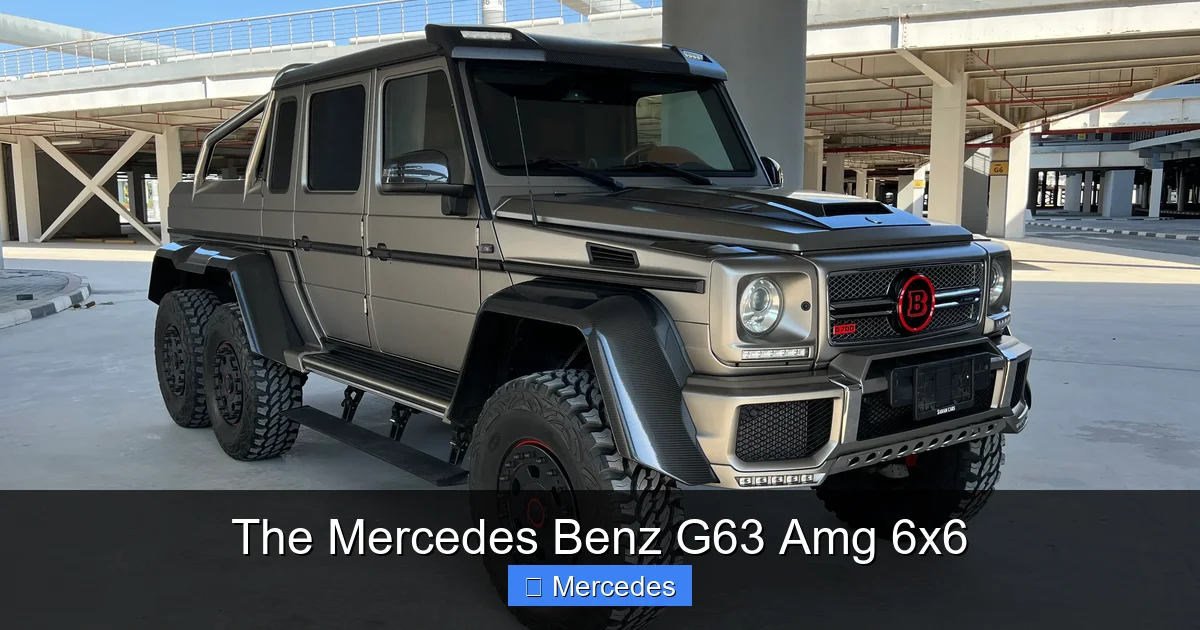
The Mercedes‑Benz G63 AMG 6×6 remains the most extreme factory‑built off‑roader ever sold to the public. Hand‑assembled between 2013 and 2015, only about 100 units left the Graz plant, each tailored to its buyer. Today the model sits at the intersection of hyper‑luxury, mechanical novelty, and serious investment potential. This guide covers every angle — technical layout, real‑world performance, cabin appointments, ownership economics, and where the market stands in 2026 — so you can decide whether the six‑wheeled icon belongs in your garage or on your watch list.
Quick Specs at a Glance
| Attribute | Detail |
|---|---|
| Production years | 2013‑2015 (≈100 units) |
| Engine | 5.5 L twin‑turbo V8 (M157) – 503 hp / 516 lb‑ft |
| Transmission | 7‑speed AMG SPEEDSHIFT PLUS 7G‑TRONIC |
| Drivetrain | Permanent 6×6 with three locking differentials |
| Portal axles | Twin, 30 mm gear reduction, 368 mm ground clearance |
| Wading depth | 990 mm (39 in) |
| 0‑100 km/h | 6.1 s (0‑60 mph ≈ 6.1 s) |
| Top speed | 160 km/h (99 mph) limited |
| Fuel consumption (combined) | ≈ 29 L/100 km (8 mpg US) |
| Kerb weight | ~3 850 kg (8 488 lb) |
| Original MSRP | US $450 k (≈ €380 k) |
| 2026 private‑sale range | US $700 k‑$1.3 M depending on spec & provenance |
Origins & Development
Military DNA meets AMG ambition
The G‑Class traces back to a 1970s NATO requirement for a light tactical vehicle. Its ladder frame, solid axles, and flat‑sided body were engineered for durability, not comfort. When AMG took over the high‑performance remit in 1999, the G‑Class gained V8 power but retained its utilitarian core. The 6×6 concept emerged from a joint study with Austrian specialist Magna Steyr and German tuner Carlsson: could the platform support a third driven axle without compromising the G’s legendary rigidity? For more on this, see our guide on mercedes benz g63 amg 6×6 price.
Hand‑built exclusivity
Every unit was assembled on a dedicated line in Graz, Austria. Buyers chose from 30 exterior paints (including matte “designo” finishes), 12 leather hides, and a catalogue of carbon‑fibre, wood, and aluminium trims. The build sheet often ran 30 pages. This bespoke process explains why no two examples are identical and why provenance documentation (build sheets, original invoices, service records) is critical for future valuation.
Six‑Wheel Drive Architecture

The 6×6’s stretched wheelbase and portal‑axle hubs are visible in this low‑angle shot.
Permanent 6×6 with three lockable diffs
Power flows from the transfer case to a centre differential (50:50 split front‑to‑rear) then to a second transfer case that drives the middle and rear axles. All three differentials — front, centre, rear — are electronically lockable via dash‑mounted switches. In practice, locking the centre and rear diffs together gives true 6‑wheel torque distribution, a decisive advantage in deep sand or axle‑twisting rock steps. For more on this, see our guide on mercedes benz g63 amg 6×6 for sale.
Portal axles: geometry & clearance
Each portal hub contains a 30 mm planetary gear set that drops the wheel centre 115 mm below the axle centreline. The result is 368 mm (14.5 in) of static ground clearance — 70 mm more than a standard G63 — while keeping the centre of gravity low because the heavy differential housings stay high. The design also reduces driveline angles, extending CV‑joint life under extreme articulation.
Adaptive air suspension with ride‑height presets
The AIRMATIC system offers five settings:
- Comfort – 210 mm clearance, soft damping for highway.
- Sport – 190 mm, firmer damping.
- Off‑road 1 – 280 mm, progressive rate.
- Off‑road 2 – 340 mm, maximum articulation.
- Wade – 368 mm, sealed air intake, raised breathers.
Drivers can switch modes at speeds up to 30 km/h; the system auto‑lowers at 80 km/h for stability.
Powertrain & Performance
Hand‑crafted M157 V8
The 5.5‑litre twin‑turbo V8 is built “one man, one engine” at AMG’s Affalterbach facility. Each unit receives a signed plaque. The engine’s 503 hp arrives at 5 500 rpm, but the 516 lb‑ft plateau from 1 750‑5 250 rpm is what moves the 3.85‑tonne mass. In practice, throttle response feels immediate below 2 000 rpm because the turbos are small and spool quickly — a trait that surprises first‑time drivers expecting turbo lag. For more on this, see our guide on mercedes benz 6×6 g63 amg.
Transmission & gearing
The 7G‑TRONIC uses a torque converter with a lock‑up clutch in all gears. First gear is extremely short (4.38:1) to exploit the low‑range portal reduction; seventh is an overdrive (0.68:1) for relaxed cruising. Manual shifts via paddles are crisp, but the transmission’s logic prefers early upshifts to protect the drivetrain — a sensible default given the torque loads.
Real‑world acceleration & braking
0‑100 km/h in 6.1 s is respectable, yet the 6×6’s party trick is 0‑50 km/h on loose gravel in under 3 s thanks to six contact patches. Braking from 100 km/h requires ~48 m (158 ft) on dry asphalt — adequate but not sports‑car territory. Carbon‑ceramic discs were never offered; the standard 390 mm front / 360 mm rear cast‑iron rotors are sized for fade resistance under repeated heavy‑load stops.
Interior, Tech & Customization
Cabin materials & ergonomics
The dashboard, door panels, and centre console are wrapped in Nappa leather with contrast stitching. Seats feature 14‑way power adjustment, heating, ventilation, and a massage function — rare for a vehicle marketed as an off‑roader. The rear bench (two individual buckets with a centre console) folds flat, creating a 1 200 L load floor when the third‑row jump seats are removed. Fit‑and‑finish rivals a Bentley Bentayga; panel gaps are consistently < 2 mm.
Infotainment & connectivity
A 12.3‑inch COMAND touchscreen runs Mercedes’ NTG5.5 system with navigation, DAB+, Apple CarPlay/Android Auto (wired), and a 15‑speaker Burmester 3D surround system. A head‑up display projects speed, navigation arrows, and off‑road pitch/roll angles. Over‑the‑air updates ceased after 2018, so map data is static unless owners retrofit a third‑party module.
Bespoke options that move the needle
Popular factory extras include:
- designo piano‑lacquer black wood (≈ €12 k)
- Carbon‑fibre exterior package (mirror caps, side steps, rear spoiler – €18 k)
- Rear‑seat entertainment with dual 10.1‑in screens (€9 k)
- Auxiliary fuel tank (120 L) mounted behind rear axle (€7 k) — extends range to ~1 200 km.
Aftermarket tuners (Brabus, Mansory, Carlsson) offer power kits up to 700 hp, but they void the original AMG warranty and can jeopardise resale collectibility.
Off‑Road Capability Deep Dive
Rock crawling & articulation
With all three diffs locked and Off‑road 2 selected, the 6×6 achieves a 100 % ramp travel index on a 20° ramp — meaning each wheel can drop or rise 368 mm independently. The long wheelbase (4 200 mm) reduces break‑over angle to 22°, so a removable front skid plate (standard) is essential for technical trails.
Sand & dune strategy
Tyre choice dominates sand performance. Factory 325/55 R22 all‑terrains work, but most owners fit 37×12.50 R17 beadlock wheels with aired‑down pressures of 0.8‑1.0 bar. The six‑wheel footprint spreads the 3.85 t load to ~0.65 kg/cm² — comparable to a dedicated sand rail. Momentum management is key: keep revs 2 500‑3 500 rpm, avoid sudden steering inputs.
Mud, snow & water fording
The 990 mm wading depth is achieved by sealing the transmission breathers, raising the air intake to the roof snorkel, and waterproofing the ECU harness. In practice, crossing a 0.9 m stream at walking pace is uneventful; deeper fording requires a custom snorkel kit. Mud‑terrain tyres with aggressive siping (e.g., BFGoodrich KM3) improve self‑cleaning, but the portal axles’ high ground clearance already prevents most chassis‑drag incidents.
Ownership Realities: Costs, Maintenance & Practicality
Annual running cost estimate (2026, US)
| Item | Approx. Cost |
|---|---|
| Insurance (agreed value $900 k) | $7 500‑$12 000 |
| Fuel (3 000 km @ 29 L/100 km, $1.10/L) | $9 600 |
| Scheduled service (oil, filters, diff fluids) | $4 500‑$6 000 |
| Tyre set (6× 37″ beadlocks) | $6 000‑$8 000 |
| Brake refresh (pads/rotors all corners) | $3 500 |
| Misc (fluids, alignment, detailing) | $2 000 |
| Total | $33 k‑$42 k |
Service network & parts availability
Only ~30 Mercedes‑AMG dealers worldwide retain the 6×6 service certification. Parts such as portal‑axle gears, centre‑diff actuators, and bespoke body panels are ordered from Graz with 6‑12 week lead times. Many owners join the G63 6×6 Owners Group (private forum) to share supplier contacts and coordinate group buys.
Daily‑driving compromises
Width (2 111 mm with mirrors folded) exceeds standard garage doors. Turning circle is 15.8 m — comparable to a city bus. Parking sensors and a 360° camera are standard, yet low‑speed maneuvering in tight urban centres remains stressful. Most collectors trailer the vehicle to events and use a conventional G‑Class or Range Rover for daily duties.
Market Values & Collectibility in 2026
Price trajectory
- 2015‑2018: $450‑$550 k (dealer demo / low‑mileage)
- 2019‑2022: $650‑$850 k (auction debut, rising enthusiast demand)
- 2023‑2025: $900 k‑$1.2 M (record Bonhams sale $1.35 M for a 2014 designo Magno Graphite example)
- 2026 YTD: Private listings cluster $1.0‑$1.3 M; cars with full service history, original build sheet, and < 5 000 km command a 15‑20 % premium.
Factors that drive premium
- Originality — unmodified drivetrain, factory paint, untouched interior.
- Provenance — single‑owner, documented mileage, celebrity history.
- Specification — designo matte paint, carbon‑ceramic brakes (rare dealer retrofit), auxiliary fuel tank.
- Condition — concours‑level detailing, no accident record, climate‑controlled storage.
Investment outlook
Analysts at Hagerty and Classic.com project 4‑6 % annual appreciation for the next five years, outpacing most modern hypercars. The finite supply (no continuation series announced) and growing interest from Middle‑East and Asian collectors underpin the thesis.
Future Outlook: Electrification & Successors
Mercedes‑Benz EQG platform
Mercedes confirmed an all‑electric G‑Class (EQG) for 2025 production, using four independent e‑motors — one per wheel. A 6×6 derivative would require two additional motors and a stretched battery pack, adding ~600 kg. Engineers have hinted at a “technical demonstrator” but no production timeline. Battery energy density in 2026 (~300 Wh/kg) still makes a 3.8‑t 6×6 EV a 5‑t vehicle, hurting off‑road agility.
Hydrogen fuel‑cell concept
A 2023 IAA concept (G‑Class F‑Cell 6×6) paired a 150 kW fuel‑cell stack with a 30 kWh buffer battery. Range ~500 km, refuel < 5 min. Infrastructure remains the blocker; only 12 H₂ stations exist in Germany, none in typical overland corridors.
Collector sentiment
Purists argue the M157 V8’s sound and mechanical theatre are irreplaceable. Until an electric 6×6 matches the portal‑axle durability and wading depth, the combustion model will retain its halo status. Owners should monitor Mercedes‑Benz media releases for any official continuation announcement — such news typically shifts values 10‑15 % within weeks.
Conclusion
The Mercedes‑Benz G63 AMG 6×6 is a singular machine: a military‑grade chassis stretched to six driven wheels, powered by a hand‑built twin‑turbo V8, and finished to a level that embarrasses many dedicated luxury limousines. Its engineering depth — portal axles, triple locking diffs, adaptive air suspension — delivers genuine off‑road supremacy, while the cabin coddles occupants with bespoke materials and modern connectivity. Ownership demands deep pockets, patience for parts, and a willingness to accept impractical dimensions. For the few who can meet those terms, the 6×6 offers an appreciating asset, a conversation‑starter at every gathering, and a capability envelope that turns deserts, dunes, and river crossings into a private playground. In 2026 it remains the benchmark against which every extreme SUV is measured.
Frequently Asked Questions
What distinguishes the G63 AMG 6×6 from a standard G63?
The 6×6 adds a third driven axle, portal hubs for 368 mm ground clearance, three lockable differentials, a 1.1 m longer wheelbase, and a hand‑built bespoke interior. It is 1 000 kg heavier and only ~100 were produced.
Can the 6×6 be driven on public roads?
Yes, it carries full EU/US type approval. Width and turning circle may restrict access to certain urban zones; check local regulations for oversized‑vehicle permits.
What is realistic fuel economy?
Expect 28‑31 L/100 km (7.5‑8.5 mpg US) combined. Off‑road low‑range driving can push consumption above 40 L/100 km.
How often does the portal‑axle oil need changing?
Mercedes specifies every 60 000 km or 4 years, whichever comes first. Use only approved 75W‑90 GL‑5 fluid; capacity is 2.5 L per axle.
Are there any known reliability weak points?
Early units (pre‑2014) occasionally suffered centre‑diff actuator water ingress — resolved by a revised seal kit (TSB 2014‑07). Otherwise the drivetrain is bulletproof when maintained per schedule.
Where can I see one in person?
Major concours events (Pebble Beach, Villa d’Este, Goodwood Festival of Speed) usually feature at least one example. Private collectors occasionally display at SUV heritage gatherings; the SUV lineage page lists upcoming meets.
Does the 6×6 require premium fuel?
Yes — 98 RON (93 AKI) minimum. The high‑compression, twin‑turbo V8 suffers knock on lower octane, risking piston damage. See the detailed breakdown of premium fuel requirements for all Mercedes models.
What insurance valuation method is recommended?
Agreed‑value policies based on recent auction results plus a 10‑15 % premium for unique specs. Standard market‑value policies under‑insure these assets.
Is there an active owner community?
A private forum (invite‑only) and a WhatsApp group coordinate parts sourcing, event attendance, and technical Q&A. Membership often requires proof of ownership.
Will Mercedes build a new 6×6?
No official program exists as of 2026. The EQG platform could theoretically support a six‑motor layout, but weight, cost, and battery packaging remain unsolved.