
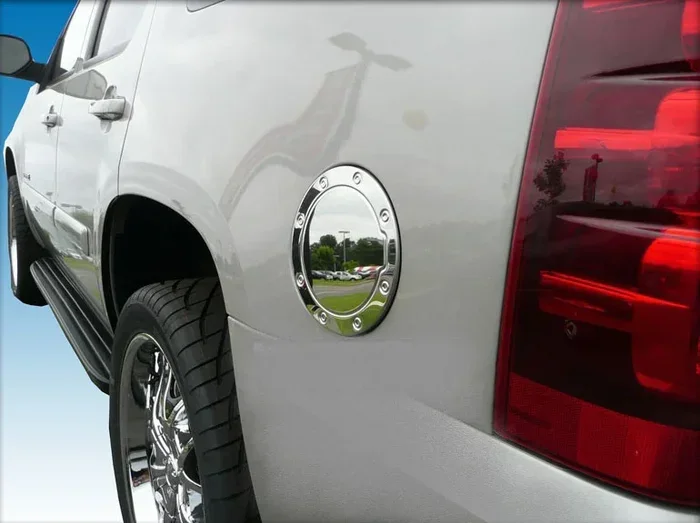
Featured image for Cadillac Escalade fuel door
Image source: theblingking.com
The Cadillac Escalade requires premium gasoline (91 octane or higher) for optimal performance and engine longevity. Using regular gas can cause engine knock, reduced power, and potential long-term damage to your 6.2L V8 engine. While the vehicle will run on lower octane in emergencies, Cadillac strongly recommends premium fuel to maintain warranty coverage and peak performance.
You pull up to the pump in your Cadillac Escalade. The premium nozzle sits there, glowing with its higher price tag. Your wallet twitches. You wonder — does Cadillac Escalade need premium gas, or can I get away with regular?
The short answer: yes, it needs premium. But the full story matters. Your Escalade represents a significant investment — often $80,000 to $120,000 or more. The fuel you choose directly affects how that investment performs, how long it lasts, and how much you actually spend over time. Let’s break down everything you need to know.
Key Takeaways
- Premium Required: Cadillac officially requires 91 octane or higher premium gasoline for all Escalade models with the 6.2L V8 engine.
- Engine Protection: Premium fuel prevents engine knock and protects high-compression engine components from premature wear.
- Performance Impact: Using regular gas reduces horsepower, torque, and fuel economy — negating any savings at the pump.
- Warranty Concerns: Consistent use of lower-octane fuel could void powertrain warranty claims related to engine damage.
- Emergency Use Only: The engine computer can adjust timing for 87 octane temporarily, but this should never become routine.
- Cost Reality: The annual premium fuel cost difference averages $300-500 — far less than potential engine repairs.
- No Alternatives: Octane boosters and fuel additives cannot reliably substitute for factory-recommended premium gasoline.
📑 Table of Contents
- What Cadillac Officially Requires for Escalade Fuel
- What Happens If You Use Regular Gas in Your Escalade
- Does Cadillac Escalade Need Premium Gas for Warranty Coverage?
- The True Cost Difference: Premium vs. Regular
- Common Myths About Escalade Fuel Requirements
- Practical Tips for Escalade Owners
- Escalade Fuel Requirements by Model Year
- Environmental and Engineering Perspective
- Frequently Asked Questions From Escalade Owners
- Conclusion: Premium Is Protection, Not Luxury
What Cadillac Officially Requires for Escalade Fuel
Every Cadillac Escalade owner’s manual since the 2015 model year states the same requirement: 91 octane premium gasoline or higher. This applies to all trims — Luxury, Premium Luxury, Sport, Platinum, and the ESV extended-wheelbase models. The requirement stems from the 6.2L V8 engine (L86/L87) that powers every modern Escalade.
Understanding Octane Ratings at the Pump
Octane rating measures a fuel’s resistance to premature detonation — what engineers call “knock” or “ping.” Think of octane like a fuel’s patience level. Higher octane fuel waits longer before igniting under pressure. Lower octane fuel gets impatient and explodes too early.
In the United States, you typically see three grades:
- Regular (87 octane): Standard grade, lowest knock resistance
- Mid-grade (89 octane): Middle ground, slightly better resistance
- Premium (91-93 octane): Highest knock resistance for high-performance engines
Did You Know? The octane number you see on U.S. pumps (like 91 or 93) uses the Anti-Knock Index (AKI), calculated as (RON + MON) / 2. In Europe and many other countries, they display only the Research Octane Number (RON), which reads higher — so European “95 RON” roughly equals U.S. “91 AKI.”
Why the 6.2L V8 Demands High Octane
The Escalade’s 6.2L V8 features a high compression ratio of 11.5:1. Compression ratio compares the cylinder volume at the bottom of the piston stroke to the volume at the top. Higher compression means more power and efficiency — but only if the fuel can handle the pressure without exploding prematurely.
Here’s an analogy: imagine squeezing a balloon. A regular balloon (regular gas) pops quickly under pressure. A thick, reinforced balloon (premium gas) withstands much more squeezing before bursting. Your Escalade’s engine squeezes the fuel-air mixture tightly — it needs the reinforced balloon.
What Happens If You Use Regular Gas in Your Escalade
Your Escalade won’t stall or refuse to start if you fill up with 87 octane. Modern engine computers (ECUs) detect knock via sensors and retard ignition timing to prevent damage. But this protection comes at a steep cost.
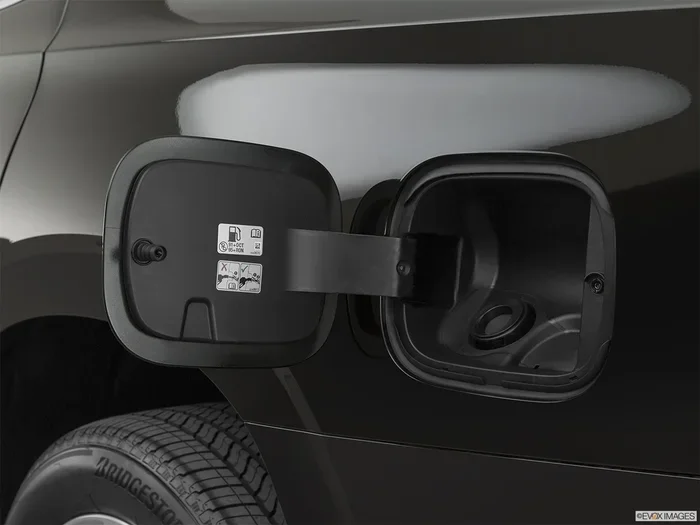
Visual guide about Cadillac Escalade fuel door
Image source: ymimg1.b8cdn.com
Immediate Performance Losses
When the ECU retards timing to prevent knock on regular gas, you lose:
- Horsepower: Up to 20-30 hp reduction from the rated 420 hp
- Torque: Noticeable drop in low-end grunt — the Escalade feels sluggish off the line
- Throttle Response: Delayed acceleration, especially when passing or merging
- Fuel Economy: 1-3 MPG decrease as the engine works less efficiently
Did You Know? General Motors engineering tests show the 6.2L V8 produces its rated 420 hp and 460 lb-ft of torque only on 91+ octane. On 87 octane, output drops to approximately 390 hp and 430 lb-ft — essentially reverting to the older 5.3L V8’s numbers while still burning more fuel.
Long-Term Engine Risks
Occasional regular gas won’t destroy your engine. But consistent use creates cumulative risks:
Carbon Buildup: Retarded timing causes incomplete combustion. Unburned fuel leaves carbon deposits on valves, pistons, and in the combustion chamber. The Escalade’s direct-injection engine already battles carbon buildup — regular gas accelerates it.
Knock Sensor Fatigue: Constant knock detection and timing adjustment wears the knock sensors and stresses the ECU’s adaptive learning system.
Piston and Ring Stress: Even with timing retard, some cylinders may experience mild knock under load (towing, climbing grades, passing). Over thousands of miles, this micro-knock damages piston lands and ring grooves.
Catalytic Converter Damage: Incomplete combustion sends raw fuel into the exhaust. This overheats and degrades the catalytic converters — a $2,000+ repair per bank.
Real-World Example: The Towing Scenario
Imagine you’re towing a 7,000-lb trailer up a mountain grade in 90°F heat. Your Escalade’s engine is under maximum load. On premium gas, the ECU runs optimal timing. On regular gas, the ECU must aggressively retard timing. Exhaust gas temperatures spike. Knock sensors scream. You lose power right when you need it most — and risk expensive damage.
Does Cadillac Escalade Need Premium Gas for Warranty Coverage?
This question matters more than most owners realize. Your powertrain warranty covers the engine, transmission, and drivetrain for 6 years or 70,000 miles (whichever comes first). But warranties have conditions.
The Fine Print on Fuel Requirements
Cadillac’s warranty booklet states that damage caused by “improper fuel” is not covered. Using fuel below the specified octane rating qualifies as improper fuel. If you bring your Escalade in for a piston knock complaint or catalytic converter failure, and the dealer’s diagnostic scan shows a history of knock sensor activity consistent with low-octane fuel, they can deny the claim.
Dealers can access the ECU’s “knock history” — a log of how often and how severely the engine detected knock. This data doesn’t lie. It shows whether you’ve been feeding your V8 the fuel it needs.
Documented Cases of Warranty Denial
While GM doesn’t publish statistics, automotive forums and consumer advocacy sites document cases where powertrain claims were denied due to fuel-related evidence. Common scenarios:
- Piston ring failure attributed to chronic knock
- Catalytic converter replacement denied due to fuel contamination codes
- Valve seat recession linked to improper combustion temperatures
The cost of a denied engine claim? A long-block replacement for the 6.2L V8 runs $12,000-$18,000 installed. That buys a lot of premium gas.
The True Cost Difference: Premium vs. Regular
Let’s talk numbers. The price gap between regular and premium averages $0.50-$0.80 per gallon nationally. Your Escalade’s tank holds 24 gallons (standard) or 28 gallons (ESV).
Annual Fuel Cost Calculation
Assume 15,000 miles per year. The Escalade averages 16 MPG combined (14 city / 19 highway). That’s 937.5 gallons annually.
- At $0.60/gallon premium surcharge: $562.50 extra per year
- At $0.80/gallon premium surcharge: $750 extra per year
Now factor in the fuel economy penalty of using regular gas. If you lose 2 MPG (conservative estimate), you burn 62 more gallons annually. At $3.50/gallon for regular, that’s $217 in extra fuel — plus the performance loss.
Net annual “savings” from using regular: $345-$533
Did You Know? Over a 6-year ownership period, the total premium fuel surcharge ranges from $2,070 to $4,500. A single denied warranty claim for engine damage exceeds this by 3-8 times. The math overwhelmingly favors premium.
Hidden Costs of Regular Gas
Beyond the pump price, regular gas costs you in ways that don’t show up on receipts:
- Reduced resale value: Engines with carbon buildup and knock history command lower trade-in offers
- More frequent maintenance: Carbon cleaning (walnut blasting) costs $400-$800 every 30-50K miles
- Towing capability loss: You paid for 8,200 lbs max towing — regular gas reduces real-world capacity
- Safety margin erosion: Passing power diminishes when you need it for emergency maneuvers
Common Myths About Escalade Fuel Requirements
Misinformation spreads fast. Let’s debunk the most persistent myths.
Myth 1: “Modern Engines Adjust Perfectly — Regular Is Fine”
Reality: ECU adjustment is a protective compromise, not an optimization. The engine survives — it doesn’t thrive. You bought a 420-hp luxury SUV. Running it on regular deliberately neuters 7-10% of the performance you paid for.
Myth 2: “Octane Boosters Work Just as Well”
Reality: Most bottle additives raise octane by 2-3 points at best — and only if you use the correct dosage for your tank size. To turn 87 into 91, you’d need multiple bottles per fill-up, costing more than premium at the pump. Worse, many boosters contain MMT (methylcyclopentadienyl manganese tricarbonyl), which fouls oxygen sensors and catalytic converters.
Myth 3: “Premium Gas Has More Energy / Better Additives”
Reality: Premium gas has nearly identical energy content (BTUs per gallon) as regular. The difference is purely knock resistance. However, Top Tier premium fuels do contain enhanced detergent packages that help prevent carbon buildup — a genuine benefit for direct-injection engines like the Escalade’s.
Myth 4: “I’ll Just Use Mid-Grade (89 Octane) as a Compromise”
Reality: 89 octane splits the difference in knock resistance, but the ECU still detects some knock and retards timing — just less aggressively. You get partial performance loss for partial savings. Cadillac’s engineers tested this. They specified 91 minimum for a reason.
Myth 5: “High Altitude Means I Can Use Lower Octane”
Reality: At elevation, air density drops, reducing effective compression pressure. This does lower octane requirement slightly. However, modern turbocharged and high-compression naturally aspirated engines (like the Escalade’s) still benefit from premium. GM’s official stance: use 91+ octane regardless of altitude.
Practical Tips for Escalade Owners
Finding Quality Premium Fuel
Not all premium gas is equal. Look for Top Tier certified retailers. Top Tier is a voluntary standard backed by GM, BMW, Honda, Toyota, and others. It guarantees enhanced detergent additives that keep intake valves and fuel injectors clean — critical for direct-injection engines.
Major Top Tier brands include: Shell, Chevron, Exxon, Mobil, BP, Costco, Kwik Trip, and many regional chains. Avoid unbranded “discount” stations for your primary fuel source.
Smart Fueling Habits
- Don’t run the tank near empty: Sediment and water accumulate at the bottom. Fill up at 1/4 tank.
- Avoid fueling during tanker deliveries: Stirred-up sediment can enter your tank. Wait 30 minutes.
- Use the same station when possible: Consistent additive packages reduce deposit variability.
- Keep receipts: Document premium fuel purchases for warranty protection.
When You Absolutely Must Use Lower Octane
Emergencies happen. You’re in a remote area. Only 87 octane is available. Here’s the protocol:
- Fill only enough to reach a premium station (half tank max)
- Drive gently — light throttle, avoid high RPM, no towing
- Refill with 91+ octane as soon as possible
- The ECU will relearn optimal timing within 50-100 miles of premium use
Tracking Your Real-World MPG
Reset your trip computer at each fill-up. Calculate actual MPG: miles driven ÷ gallons pumped. Track it for 3-4 tanks on premium, then (if you must experiment) 3-4 tanks on regular. You’ll see the difference in black and white. Most owners report 1.5-2.5 MPG improvement on premium — which offsets 30-50% of the price premium.
Escalade Fuel Requirements by Model Year
While the current 6.2L V8 has required premium since 2015, earlier generations differ. Here’s the complete breakdown:
2015-Present (GMT K2XX Platform)
- Engine: 6.2L V8 (L86 2015-2019, L87 2020+)
- Requirement: 91 octane premium minimum
- Compression: 11.5:1
- Notes: Direct injection, variable valve timing, cylinder deactivation (DFM on 2019+)
2007-2014 (GMT K2XX Platform)
- Engine: 6.2L V8 (L92 2007-2008, L94 2009, L9H 2010-2014)
- Requirement: 91 octane premium minimum
- Compression: 10.5:1 (L92/L94) or 10.4:1 (L9H)
- Notes: First Gen IV small-block in Escalade; flex-fuel capable on L9H (E85 compatible)
2002-2006 (GMT 800 Platform)
- Engine: 6.0L V8 (LQ4)
- Requirement: 87 octane regular acceptable; 91 recommended for towing
- Compression: 9.6:1
- Notes: Iron block, port injection — much more tolerant of lower octane
1999-2000 (GMT 400 Platform)
- Engine: 5.7L V8 (L31)
- Requirement: 87 octane regular
- Compression: 9.4:1
- Notes: Last of the TBI/early Vortec engines; regular gas fully acceptable
Did You Know? The 2021+ Escalade with the 3.0L Duramax diesel (LM2) requires ultra-low sulfur diesel (15 ppm) and recommends Top Tier diesel. No gasoline option exists for this engine — but it delivers 27 MPG highway and 460 lb-ft of torque at just 1,500 RPM.
Environmental and Engineering Perspective
Why do manufacturers like Cadillac push high-compression engines that demand premium fuel? The answer involves physics, regulations, and consumer expectations.
The Efficiency Imperative
Corporate Average Fuel Economy (CAFE) standards require automakers to improve fleet-wide MPG. High compression ratios extract more energy from each drop of fuel. The 6.2L V8’s 11.5:1 compression delivers thermal efficiency approaching 40% — remarkable for a gasoline engine. But this efficiency only exists with fuel that prevents knock.
If Cadillac tuned the engine for 87 octane, they’d lower compression to ~10:1. You’d lose 15-20% efficiency. The Escalade would need a larger engine or hybrid system to match performance — adding cost, weight, and complexity.
Premium Fuel Enables Downsizing
Across the industry, premium fuel requirements allow smaller engines to replace larger ones. A 3.0L twin-turbo V6 on premium can match a 5.0L V8 on regular — with better MPG. The Escalade’s 6.2L V8 is actually a “large” engine by modern standards, but its high compression makes it surprisingly efficient for its displacement.
Emissions Benefits
Complete, controlled combustion (enabled by premium fuel) produces fewer hydrocarbons, carbon monoxide, and particulate matter. The Escalade’s direct-injection system already runs lean-burn strategies at light load. Premium fuel stabilizes this combustion, reducing cold-start emissions — the dirtiest phase of any drive cycle.
Frequently Asked Questions From Escalade Owners
These questions come up constantly in Escalade forums, Facebook groups, and dealer service departments.
Can I mix premium and regular to get 89 octane?
Yes, mixing half a tank of 93 with half a tank of 87 yields roughly 90 octane — still below the 91 minimum. Mixing 2/3 premium + 1/3 regular gets you to ~91. But why bother? The hassle and inconsistency aren’t worth the few dollars saved. Just buy 91 or 93.
Does the Escalade ESV have different fuel requirements?
No. The ESV (Extended Stretch Vehicle) uses the identical 6.2L V8 and drivetrain. The only differences are a 14-inch longer wheelbase, 28-gallon tank (vs. 24), and ~300 lbs extra weight. Same 91+ octane requirement.
What about E85 / flex fuel in older models?
2010-2014 Escalades with the L9H 6.2L V8 are flex-fuel capable (yellow gas cap). They can run E85 (85% ethanol), which has ~105 octane equivalent. However, E85 contains 27% less energy per gallon — expect 25-30% worse fuel economy. Only use E85 if it’s priced at least 30% below regular gasoline.
Is Costco / Sam’s Club premium gas good enough?
Yes. Both are Top Tier certified. Their premium gasoline meets the same detergent standards as Shell, Chevron, etc. Many Escalade owners exclusively use warehouse club fuel and report excellent long-term engine cleanliness. The high turnover at these stations also means fresher fuel.
Does premium gas go bad faster?
No. Octane rating stability is similar across grades. All modern gasoline degrades after 3-6 months in the tank (oxidation, ethanol separation). If your Escalade sits for months, add fuel stabilizer (STA-BIL, Sea Foam) and fill the tank 95% full to minimize air space.
What if I accidentally put diesel in my Escalade?
Do not start the engine. Have it towed to a dealer or qualified shop. The fuel system must be drained, flushed, and filters replaced. Starting the engine circulates diesel through the high-pressure fuel pump, injectors, and rails — causing $5,000+ damage. Diesel nozzles are larger than gasoline nozzles on modern pumps, but mistakes still happen.
Conclusion: Premium Is Protection, Not Luxury
Your Cadillac Escalade represents the pinnacle of GM’s body-on-frame SUV engineering. The 6.2L V8 is a masterpiece of pushrod efficiency — but it’s engineered around a specific fuel specification. Using premium gasoline isn’t about pampering your vehicle. It’s about honoring the engineering that delivers 420 horsepower, 8,200 lbs towing, and a 0-60 time under 6 seconds in a 5,800-lb vehicle.
The annual cost difference — roughly $400-750 — amounts to $1.10-$2.00 per day. For that, you get full performance, protected warranty coverage, optimal fuel economy, and the peace of mind that comes from treating your investment the way its creators intended.
Next time you’re at the pump, reach for the premium nozzle without hesitation. Your Escalade — and your future self — will thank you.