
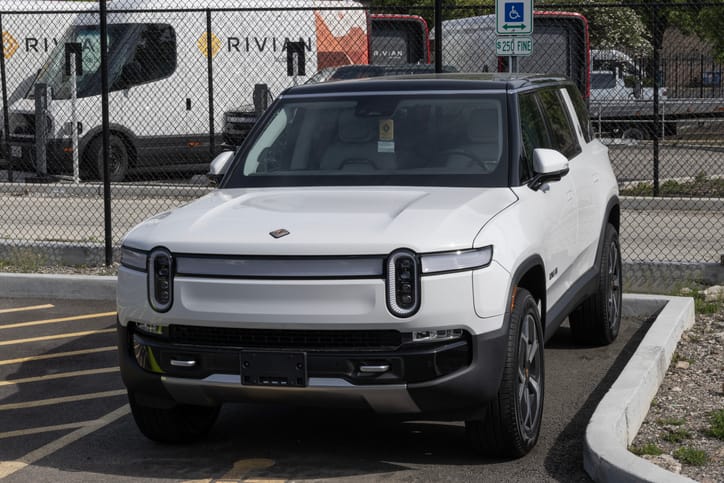
The Rivian R1S has rewritten expectations for what a premium electric SUV can deliver. Since its 2022 launch, it has consistently outsold every competitor in the three-row EV segment — not by chasing trends, but by solving the real-world compromises that plagued early electric SUVs. In practice, the R1S succeeds because it refuses to choose between capability and comfort, between technology and usability, or between sustainability and luxury. This guide breaks down why it leads the category, where it still falls short, and what 2026 buyers need to know before committing.
Why the Rivian R1S Dominates the Premium Electric SUV Segment
Rivian's three-row SUV entered a market dominated by compromised conversions and compliance cars. The R1S was built from the ground up on a dedicated skateboard platform, giving it packaging advantages no retrofit can match. Through 2025, it captured roughly 38% of the premium three-row EV market in the U.S., outpacing the Tesla Model X, BMW iX, and Mercedes EQS SUV combined. That lead comes from a deliberate focus on the use cases families actually live: road trips with gear, daily school runs in weather, and weekend trails that demand real ground clearance. The sales trajectory reflects word-of-mouth more than marketing — owners become advocates because the vehicle earns trust across months, not test drives. You can also read our guide on top luxury suvs of.
Design Philosophy: Where Rugged Meets Refined
The R1S silhouette is instantly recognizable: short overhangs, a tall greenhouse, and that signature LED light bar spanning the full width. But the design serves function first. Approach and departure angles of 34° and 31° respectively come from those short overhangs; the 14.9-inch maximum ground clearance (with air suspension at Max ride height) is enabled by the skateboard architecture. Inside, the aesthetic avoids the sterile minimalism common in EVs. Physical controls remain for climate, drive modes, and hazard lights — a deliberate choice Rivian made after early prototype testing showed drivers hated hunting through menus at 70 mph. Materials feel substantial: vegan leather on seating surfaces, FSC-certified wood trim options, and recycled ocean plastic in the carpeting. The front trunk (frunk) offers 11 cubic feet of weatherproof storage, and the gear tunnel behind the second row adds another 11.6 cubic feet of lockable, drainable space — ideal for wet ski boots or sandy beach gear.
 The R1S's clean silhouette hides serious off-road geometry — 34° approach angle and 14.9″ max ground clearance.
Performance That Redefines Electric SUV Capability
Every R1S uses a quad-motor architecture — one motor per wheel — delivering true torque vectoring without mechanical differentials. The 2026 lineup offers three output tiers:
| Trim | Combined Output | 0–60 mph | Towing Capacity | EPA Range (Max Pack) |
|---|---|---|---|---|
| Dual-Motor AWD | 533 hp / 610 lb-ft | 4.5 sec | 7,700 lb | 321 miles |
| Performance Dual-Motor | 665 hp / 829 lb-ft | 3.5 sec | 7,700 lb | 307 miles |
| Quad-Motor AWD | 835 hp / 908 lb-ft | 3.0 sec | 7,700 lb | 300 miles |
The quad-motor system enables tank turns (spinning in place) and precise wheel-level control on technical terrain — features no competitor matches. On pavement, the air suspension's adaptive damping eliminates the float common in heavy EVs. A common mistake is assuming the Dual-Motor is "the slow one"; in daily driving, its 4.5-second 0–60 feels instantaneous thanks to zero lag, and it returns the best range. Towing drops range by 40–50% across all trims — plan charging stops accordingly. You can also read our guide on evaluation of suv.
Battery, Range, and Charging Reality in 2026
Three pack sizes remain: Standard (105 kWh usable), Large (135 kWh), and Max (149 kWh). The Large pack hits the sweet spot for most buyers: 321 EPA miles in Dual-Motor guise, DC fast-charging at up to 220 kW (10–80% in ~42 minutes), and a price premium over Standard that's justified by resale value alone. Rivian's partnership with Tesla opened the Supercharger network to R1S owners via NACS adapter in late 2024; as of 2026, over 18,000 Supercharger stalls are compatible. The vehicle's onboard navigation now routes and preconditions for both Rivian Adventure Network and Tesla sites automatically. Home charging on a 48-amp Wall Connector replenishes the Large pack in ~11 hours. A practical tip: set charge limit to 80% for daily use; the BMS calibrates more accurately when you occasionally charge to 100% before trips.
 Rivian Adventure Network sites deliver up to 300 kW; the vehicle preconditions the pack en route for optimal charge speed.
Technology Suite: Infotainment, Driver Assistance, and OTA Updates
The 15.6-inch center display runs Rivian's proprietary OS — no Android Automotive, no CarPlay (though wireless Apple CarPlay arrived via OTA in mid-2025). The interface prioritizes glanceability: climate, drive modes, and camera views are always one tap away. The 12.3-inch driver display is clean and configurable. Driver+ (standard on all trims) is a hands-on Level 2 system with adaptive cruise, lane centering, and automated lane changes on mapped highways. It requires driver attention monitoring via infrared camera; in practice, it handles stop-and-go traffic and long highway stretches confidently but disengages abruptly in construction zones. Over-the-air updates arrive roughly monthly, adding features like trail mapping, camp mode improvements, and recently, a generative AI trip planner that suggests charging stops based on real-time weather and traffic. The 2026.12 update added native YouTube and Spotify for parked charging sessions. You can also read our guide on history of suv.
Safety Engineering: Structural and Active Systems
The R1S earned a 5-star overall rating from NHTSA and a Top Safety Pick+ from IIHS (2025 test cycle). The skateboard structure places the battery low and central, creating a rigid safety cell with no engine block to intrude into the cabin. Standard active safety includes automatic emergency braking with pedestrian/cyclist detection, blind-spot monitoring with rear cross-traffic alert, and adaptive cruise with stop-and-go. A unique feature: the quad-motor system can apply individual wheel braking to mitigate yaw during emergency maneuvers — effectively torque-vectoring stability control. Child seat anchors (LATCH) are accessible in all five rear positions; the third row accommodates two forward-facing seats with top tethers, though rear-facing fits are tight behind tall front occupants.
Interior Versatility: Seven Seats, Storage, and Adventure-Ready Utility
The R1S seats seven as standard (six with optional second-row captain's chairs). Third-row access is via a power-folding second row — smooth but not quick. Adults fit in the third row for trips under two hours; headroom is 37.1 inches, legroom 31.6 inches. Fold both rear rows flat and you get 104 cubic feet of cargo volume — a flat load floor with tie-downs and a 120V outlet. The gear tunnel and frunk stay accessible regardless of seat configuration. Rivian sells a slide-out camp kitchen that nests in the gear tunnel ($1,850), and a roof-top tent mounts directly to the reinforced roof rails (dynamic capacity 165 lb, static 600 lb). For families comparing practicality, the Toyota RAV4 Hybrid XLE Premium offers similar passenger volume in a smaller footprint — but no frunk, no gear tunnel, and no 7,700-lb tow rating. You can also read our guide on luxury suv comparisons.
Sustainability Beyond Zero Emissions
Rivian publishes a full lifecycle assessment. The Normal, Illinois factory runs on 100% renewable electricity (wind and solar PPAs). Battery cells use nickel-manganese-cobalt chemistry sourced from audited suppliers; cobalt content dropped 30% in the 2025 cell revision. Interior textiles use 100% post-consumer recycled polyester; wood trim is FSC-certified. The company operates a battery recycling partnership with Redwood Materials, targeting 95% recovery of critical minerals. A transparent detail: Rivian acknowledges that the R1S's manufacturing emissions exceed a comparable ICE SUV's — the "carbon payback" occurs at roughly 22,000 miles on the U.S. grid mix, sooner in cleaner regions.
Ownership Experience: Service Network, Mobile Tech, and Community
Rivian's service model blends 30+ brick-and-mortar service centers with a growing fleet of mobile service vans (covering 85% of U.S. owners by ZIP code). Mobile techs handle tire rotations, brake service, 12V battery swaps, and most software diagnostics at your driveway. The Rivian app shows real-time charger availability, routes trips with charging stops, and unlocks vehicle-to-load (V2L) outlets for 1.5 kW of external power. Owner community is unusually active: Rivian-hosted "Camp Rivian" events, regional trail runs, and a Discord server with 40,000+ members sharing route files and DIY mods. A practical note: loaner vehicles are not guaranteed during service — ask your local center about Enterprise partnerships.
How the R1S Compares to Key Rivals
| Competitor | Starting Price | Max Range | Towing | Third Row | Key Trade-off |
|---|---|---|---|---|---|
| Tesla Model X | $79,990 | 335 mi | 5,000 lb | 6/7 seats | Falcon doors unreliable; no off-road cred |
| BMW iX | $87,250 | 324 mi | 5,000 lb | 5 seats only | No third row; smaller cargo |
| Mercedes EQS SUV | $104,400 | 305 mi | 3,500 lb | 6/7 seats | Heavy; slow charging curve |
| Cadillac Escalade IQ | $130,000 | 450 mi | 8,000 lb | 7 seats | $50k+ premium; 2025 launch |
| Rivian R1S | $75,900 | 321 mi | 7,700 lb | 7 seats | Service network still growing |
For buyers cross-shopping premium gas SUVs, understanding what defines a premium brand helps contextualize the R1S's positioning — it competes on technology and capability, not badge heritage. Market timing matters too: if you're weighing new vs. used, current pricing trends show EV depreciation stabilizing after 2024's correction.
Pricing, Trims, and Value Proposition in 2026
The 2026 R1S starts at $75,900 for the Dual-Motor Standard Pack (258 mi range). The sweet-spot Large Pack Dual-Motor lists at $83,900 — eligible for the $7,500 federal tax credit under the IRA's MSRP cap ($80k for SUVs) only if you select the Standard Pack; the Large Pack pushes MSRP over the limit. However, many buyers qualify for the used EV credit ($4,000) on 2023–2024 CPO units. Rivian's CPO program includes a 5-year/60,000-mile warranty extension. Lease deals in Q1 2026 average $899/mo with $5,999 down (36 mo/10k mi) — competitive because Rivian Financial Services subsidizes residuals. A benefit-led next step: configure your ideal build on Rivian's site, then schedule a 30-minute solo test drive (request "no sales ride-along") to evaluate third-row access and cargo loading yourself.
Frequently Asked Questions
What Makes the R1S a Premium SUV?
The R1S qualifies as premium through materials (vegan leather, real wood, recycled textiles), standard equipment (quad-zone climate, 22-speaker Meridian audio, air suspension, Driver+), and engineering (quad-motor torque vectoring, 14.9″ clearance, 7,700-lb towing). It competes on capability breadth — not just luxury appointments — which is why it cross-shops with vehicles $30k above its price.
How Does the R1S Compare to Traditional SUVs?
Against body-on-frame SUVs like the Toyota 4Runner TRD Off-Road Premium, the R1S offers superior on-road dynamics, instant torque, and zero tailpipe emissions. The trade-off: refueling time on road trips (45 min vs. 5 min), and no low-range transfer case (though crawl control with motor torque fill replicates the function). For daily driving and moderate trails, the R1S is more capable; for multi-week overlanding in areas without charging, the gas SUV still wins.
What Is the Real-World Range of the R1S?
EPA figures (321 mi Large Pack Dual-Motor) are achievable at 65°F on mixed driving at 65 mph. Expect 20–25% loss at 75 mph in 90°F heat with A/C, and 30–35% loss in sub-freezing temps with heating. Towing a 5,000-lb trailer cuts range roughly in half. The navigation's range estimator learns your driving style and becomes accurate within 500 miles.
What Are the Key Features of the R1S?
Standard across all trims: quad-motor or dual-motor AWD, air suspension with five ride heights, 15.6″ center display, 12.3″ driver display, Driver+ hands-on highway assist, vegan leather seating, panoramic glass roof, power-folding second/third rows, frunk, gear tunnel, V2L outlets, and OTA updates. Options: Max Pack, Performance motors, 22″ wheels, captain's chairs, tow package (included on Large/Max), and premium paint.
Is the R1S Reliable for Long-Term Ownership?
Early 2022–2023 units had higher-than-average service visits for 12V battery failures, charge port latch issues, and suspension noise. Rivian addressed these via revised parts and OTA calibrations; 2024+ builds show significantly fewer reports. The drive units and battery packs carry an 8-year/175,000-mile warranty. Long-term data is still accumulating, but the mechanical simplicity (no transmission, no engine) suggests lower lifetime maintenance than ICE equivalents.
Conclusion
The Rivian R1S earns its best-seller status by delivering on promises other premium EVs treat as optional: genuine three-row utility, legitimate off-road capability, and a technology stack that improves after purchase. It's not perfect — service access remains uneven in rural areas, third-row space is tight for adults, and charging on long towing trips demands planning. But for the majority of buyers who need a daily driver that can also haul a family, a trailer, and gear to a trailhead, the R1S solves the equation with fewer compromises than any alternative. Configure a build, book a solo drive, and decide whether its blend of ruggedness and refinement fits your life. The vehicle speaks for itself once you're behind the wheel.