

Choosing a premium SUV today means weighing opulent comfort against the highest level of occupant protection. Safety ratings from independent agencies have become the decisive factor for buyers who want confidence on every drive, whether it’s a daily commute or a cross‑country family trip. This guide breaks down the current rating landscape, highlights the models that consistently earn top honors, and explains the technologies that make those scores possible — so you can select a vehicle that delivers luxury and peace of mind.
Flagship premium SUVs wearing IIHS Top Safety Pick+ and NHTSA 5‑star badges.
Why Safety Ratings Matter for Premium SUVs
Premium SUVs carry heavier structures, higher centers of gravity, and often transport families or valuable cargo. A strong safety rating signals that the vehicle’s engineering — crumple zones, restraint systems, and active‑avoidance tech — has been validated under repeatable, rigorous conditions. Insurers also use these scores to set premiums, and resale values tend to hold better for models with a proven safety record. You can also read our guide on luxury suv comparisons.
Two U.S. bodies dominate the conversation: the Insurance Institute for Highway Safety (IIHS) and the National Highway Traffic Safety Administration (NHTSA). Both publish results that are freely accessible, letting shoppers compare apples‑to‑apples across brands. For a deeper look at how the segment evolved, see the SUV evolution timeline.
How Safety Ratings Are Determined
IIHS Test Suite
- Crashworthiness – frontal offset, driver‑side small overlap, passenger‑side small overlap, side, roof strength, head‑restraint evaluations.
- Crash Avoidance & Mitigation – forward‑collision warning, automatic emergency braking (AEB) with pedestrian detection, lane‑departure warning, and adaptive headlights.
- Rating Scale – Good, Acceptable, Marginal, Poor for each test; a Top Safety Pick+ requires Good in all crashworthiness tests, Advanced or Superior front‑crash prevention, and Good or Acceptable headlights.
NHTSA New Car Assessment Program (NCAP)
- Star Rating – 1 to 5 stars for overall, frontal, side, and rollover resistance.
- Tests – full‑width frontal barrier, side‑pole, side‑barrier, and dynamic rollover propensity.
- Updates for 2025‑2026 – added pedestrian‑AEB scenarios and a more stringent side‑pole test.
Both agencies publish detailed methodologies; you can review the current protocols at the IIHS testing protocols and the NHTSA star rating system. You can also read our guide on ford hybrid suv.
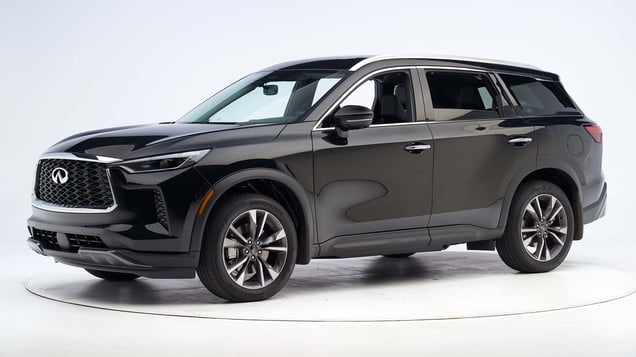
IIHS small‑overlap frontal test setup used for 2025‑2026 evaluations.
Key Safety Technologies in 2025‑2026 Premium SUVs
| Technology | What It Does | Why It Boosts Ratings |
|---|---|---|
| Automatic Emergency Braking (AEB) with Pedestrian/Cyclist Detection | Applies brakes automatically when a collision is imminent. | Directly scores in IIHS front‑crash prevention; NHTSA rewards pedestrian‑AEB. |
| Blind‑Spot Monitoring (BSM) + Rear Cross‑Traffic Alert | Warns of vehicles in adjacent lanes or crossing behind. | Reduces lane‑change crashes; contributes to IIHS “Advanced” front‑crash prevention. |
| Adaptive Cruise Control with Stop‑and‑Go | Maintains set distance, even in heavy traffic. | Lowers rear‑end collision frequency; part of IIHS “Superior” rating criteria. |
| Lane‑Keeping Assist / Lane‑Centering | Applies steering torque to keep vehicle centered. | Mitigates run‑off‑road and sideswipe crashes. |
| High‑Strength Steel & Aluminum Space Frame | Distributes impact forces away from cabin. | Improves crashworthiness scores across all IIHS/NHTSA tests. |
| Advanced Airbag Systems (including knee, far‑side, and rear‑seat inflatable belts) | Tailors deployment to occupant size and crash severity. | Critical for Good ratings in side and rear‑impact tests. |
| Matrix LED / Laser Headlights with Adaptive High‑Beam | Shapes beam pattern to avoid glare while maximizing visibility. | Headlight rating is a gatekeeper for Top Safety Pick+. |
These features are now standard or widely available on the leading premium nameplates. In practice, the difference between Good and Acceptable headlight scores often decides whether a model earns the “+” designation.
2025‑2026 Top‑Rated Premium SUVs (IIHS Top Safety Pick+ & NHTSA 5‑Star)
| Model (2025/2026 MY) | IIHS Rating | NHTSA Overall | Notable Standard Safety Suite |
|---|---|---|---|
| Volvo XC90 Recharge | Top Safety Pick+ | 5★ | Pilot Assist, City Safety, Run‑off Road Mitigation |
| Audi Q7 | Top Safety Pick+ | 5★ | Audi Pre Sense 360°, Adaptive Cruise Assist |
| Mercedes‑Benz GLE | Top Safety Pick+ | 5★ | Active Brake Assist, Evasive Steering Assist |
| BMW X5 | Top Safety Pick+ | 5★ | Driving Assistance Professional, Frontal Collision Warning |
| Porsche Cayenne | Top Safety Pick+ | 5★ | Porsche InnoDrive, Night Vision Assist |
| Lexus RX 500h | Top Safety Pick+ | 5★ | Lexus Safety System+ 3.0, Intersection Turning Assist |
| Genesis GV80 | Top Safety Pick+ | 5★ | Highway Driving Assist 2, Forward‑Collision Avoidance |
All seven models earned Good across every IIHS crashworthiness test, Superior front‑crash prevention, and Good or Acceptable headlights. NHTSA awarded each a full five‑star overall rating, reflecting strong performance in the updated side‑pole and pedestrian‑AEB tests. You can also read our guide on evaluation of suv.
Luxury Meets Safety: Detailed Model Highlights
- Volvo XC90 Recharge – Pioneered the “City Safety” suite; standard rear‑seat inflatable belts and a reinforced boron‑steel cage.
- Audi Q7 – Offers a 48‑volt mild‑hybrid system that powers the predictive active suspension, improving stability during emergency maneuvers.
- Mercedes‑Benz GLE – The Mercedes premium package details (https://premium-suv.com/mercedes-c300-premium-package-explained/) include Pre‑Safe Impulse Side, which inflates front bolsters to push occupants away from the door in a side impact.
- BMW X5 – Optional “Driving Assistance Professional” adds extended traffic‑jam assist up to 37 mph, a rarity in this class.
- Porsche Cayenne – Combines sports‑car dynamics with a full‑width front crumple zone; standard Porsche Surface Coated Brakes reduce fade under repeated hard stops.
- Lexus RX 500h – Hybrid powertrain lowers center of gravity, aiding rollover resistance; Lexus Safety System+ 3.0 adds intersection turning assist.
- Genesis GV80 – First Genesis to earn Top Safety Pick+; features a 12‑airbag layout and a driver‑monitoring camera for fatigue detection.
For buyers weighing brand perception, the Toyota premium brand insight offers a useful comparison of how mainstream brands position their upscale models.
Family‑Focused Safety Picks (Non‑Premium but Highly Rated)
While the spotlight is on premium nameplates, several mainstream SUVs deliver comparable crash‑test scores at a lower price point:
- Honda CR‑V – IIHS Top Safety Pick+, NHTSA 5★; standard Honda Sensing suite.
- Toyota RAV4 (including XLE Premium) – Consistently earns Top Safety Pick; the RAV4 XLE premium review notes standard Toyota Safety Sense 2.5+.
- Subaru Forester – Symmetrical AWD plus EyeSight driver assist; Top Safety Pick+ for 2025.
- Ford Explorer – Available Co‑Pilot360 Assist+; NHTSA 5★ overall.
These models are worth cross‑shopping if third‑row space or budget constraints outweigh badge prestige.
Electric Premium SUVs and Safety
Battery‑electric architecture brings inherent safety advantages — low center of gravity, no fuel system, and a rigid skate‑board chassis. Current standouts:
- Rivian R1S – 5‑star NHTSA, IIHS Top Safety Pick+ (2025); standard Driver+ hands‑free highway assist.
- Tesla Model X – 5‑star NHTSA; Autopilot with Full Self‑Driving capability (driver‑supervised).
- Audi e‑tron / Q8 e‑tron – Top Safety Pick+; quattro all‑wheel torque vectoring enhances stability.
- Mercedes‑EQS SUV – Pre‑Safe Impulse Side, active ambient lighting that warns of imminent collisions.
Crash‑test data for EVs is now fully integrated into both agencies’ programs, and results show parity or better performance versus ICE counterparts. The electric SUV safety rating graphic illustrates the typical high‑voltage battery protection zones. You can also read our guide on top luxury suvs of. Battery enclosure and structural reinforcements highlighted in teal.

Maintaining Your SUV’s Safety Over Time
- Tire Health – Check pressure monthly; rotate every 5,000‑7,500 mi. Replace when tread depth falls below 4/32 in.
- Brake System – Inspect pads/rotors at each service interval; flush brake fluid every 2 years.
- ADAS Calibration – After windshield replacement, suspension work, or any front‑end impact, have cameras/radar recalibrated by a certified dealer.
- Software Updates – Many OEMs push OTA updates for AEB logic, pedestrian detection, and lane‑keeping; enable automatic installs.
- Recall Monitoring – Register your VIN on the NHTSA site; set alerts for safety‑related bulletins.
- Owner’s Manual Review – Follow the manufacturer’s maintenance schedule; it often includes safety‑critical items like seat‑belt pretensioner inspections.
Consistent upkeep preserves the engineering that earned those top ratings in the first place.
Buying Considerations: Balancing Cost, Features, and Safety
- Insurance Premiums – Vehicles with Top Safety Pick+ typically qualify for lower comprehensive/collision rates; ask your agent for a quote comparison.
- Total Cost of Ownership – Factor in fuel/electricity, maintenance, depreciation, and potential safety‑tech subscription fees (e.g., advanced driver‑assist packages).
- Resale Value – Models with a consistent safety‑award history retain 5‑10 % more value after three years.
- Feature Prioritization – If you rarely drive at night, adaptive headlights may be less critical than rear‑cross‑traffic alert for urban parking.
- Market Trends – Current pricing data suggests a modest softening in the premium segment; see current market price trends for timing your purchase.
A test drive focused on visibility, seat comfort, and ADAS intuitiveness often reveals more than spec sheets alone.
Frequently Asked Questions
What are the top‑rated premium SUVs for safety in 2026?
The Volvo XC90 Recharge, Audi Q7, Mercedes‑Benz GLE, BMW X5, Porsche Cayenne, Lexus RX 500h, and Genesis GV80 all hold IIHS Top Safety Pick+ and NHTSA 5‑star overall ratings for the latest model year.
How are SUV safety ratings determined?
IIHS conducts six crashworthiness tests plus front‑crash prevention and headlight evaluations; NHTSA runs frontal, side, rollover, and new pedestrian‑AEB tests. Both publish star or letter grades that combine into an overall score. You can also read our guide on what is an suv.
Why is safety especially important in premium SUVs?
Higher mass and taller stance increase momentum in a crash and raise rollover risk. Premium buyers also expect the latest active‑safety tech, making comprehensive ratings a key purchase driver.
Which features most improve SUV safety ratings?
Automatic emergency braking with pedestrian detection, good/acceptable headlights, strong roof structure, and a full complement of airbags (including rear‑seat inflatable belts) are the biggest differentiators for Top Safety Pick+.
Do electric premium SUVs score as well as gasoline models?
Yes. The low center of gravity and rigid battery enclosure typically yield equal or better crashworthiness and rollover scores; all current electric premium SUVs listed above have earned Top Safety Pick+.
Conclusion
Safety ratings remain the most reliable shorthand for evaluating how well a premium SUV will protect its occupants. The 2025‑2026 model year delivers an unprecedented lineup where luxury, performance, and top‑tier crash‑test results coexist across multiple brands. By understanding the testing methodology, prioritizing the active‑safety features that drive the highest scores, and maintaining those systems over the vehicle’s life, you can confidently choose a model that safeguards every journey.
Next step: Schedule a comparative test drive of at least two Top Safety Pick+ candidates — experience the ADAS behavior, sightlines, and seat ergonomics firsthand before you commit.