
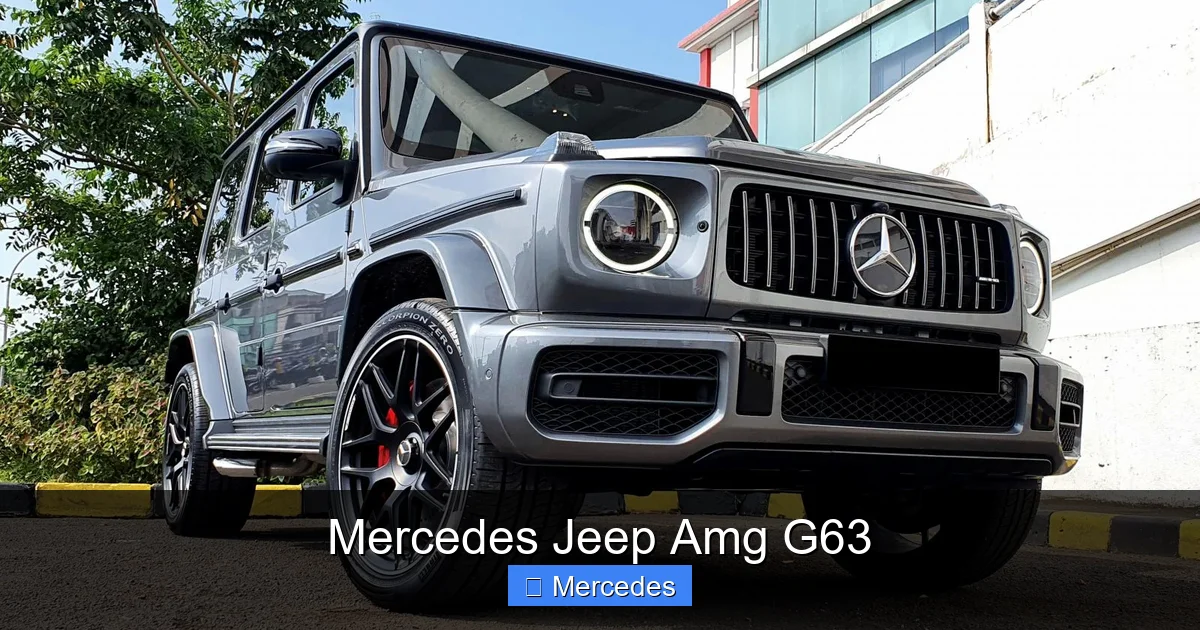
The Mercedes-AMG G63 occupies a rare space in the automotive world: a vehicle that simultaneously defines its own category and transcends it. Born from a 1970s military contract, refined through decades of celebrity ownership and social-media fame, the current G63 delivers 577 horsepower from a hand-built twin-turbo V8 while coddling occupants in Nappa leather and a Burmester sound system. It is equal parts expedition vehicle and red-carpet transport. This guide covers every angle — specifications, real-world driving impressions, ownership costs, and the critical details that separate a smart purchase from an expensive mistake — so you can decide whether the G63 belongs in your garage.
The G-Wagen Legacy: From Military Roots to Cultural Phenomenon

The unmistakable silhouette that has scarcely changed since 1979 — proof that icon status doesn't require reinvention.
Image source: img.cintamobil.com
The Geländewagen began as a joint venture between Mercedes-Benz and Steyr-Daimler-Puch for the Iranian and West German militaries. Its ladder frame, solid axles, and three locking differentials were engineered for battlefield durability, not boulevard posing. Civilian sales started in 1979, but the turning point came in the 1990s when Mercedes added leather, wood trim, and automatic climate control — creating the template for the modern luxury off-roader. For more on this, see our guide on g63 amg mercedes jeep.
By 2018, the W463A generation introduced independent front suspension, a wider track, and a thoroughly modern interior while retaining the boxy profile that makes the G-Class instantly recognizable. AMG's involvement deepened with each generation; the G63 now receives a dedicated engine, specific suspension tuning, and unique bodywork that widens the fenders by 54 mm over a standard G550. In practice, the G63's military DNA still shows: the door latches clunk with vault-like solidity, the hood hinges are external, and the spare tire remains tailgate-mounted — functional reminders that this shape serves a purpose.
For broader context on how the SUV segment evolved from utility to luxury, the history of the SUV traces the same arc across multiple brands.
2024–2025 Model Year Updates: What Actually Changed
Mercedes treats the G-Class as a rolling update platform rather than a traditional model-year cycle. The most significant recent changes arrived for the 2024 model year (arriving at dealers mid-2023) and carried into 2025:
- 48-volt EQ Boost integrated starter-generator now standard, adding 20 hp and 148 lb-ft of electric assist during initial acceleration — smoothing the turbo lag that plagued earlier V8s.
- MBUX superscreen optional: a 12.3-inch instrument cluster plus 12.3-inch central touchscreen joined by a third 12.3-inch passenger display.
- Manufaktur program expansion: over 30 new exterior paints (including matte Magno finishes), 12 interior leather combinations, and personalized badging.
- Off-Road Cockpit now displays real-time pitch, roll, altitude, and gradient on the central screen — previously buried in submenus.
- Standard 22-inch AMG forged wheels in a new cross-spoke design; 21-inch and 23-inch options remain.
No mechanical changes for 2025 beyond minor calibration updates to the 9-speed transmission for smoother low-speed crawling. If you're cross-shopping model years, a well-optioned 2024 is virtually identical to a 2025 — negotiate accordingly.
Powertrain & Performance: Twin-Turbo V8 Meets Mild-Hybrid Tech

Hand-built M177 4.0 L V8 with twin scroll turbos nestled inside the cylinder banks — each engine signed by its builder.
Image source: img.cintamobil.com
| Specification | Detail |
|---|---|
| Engine | M177 4.0 L twin-turbo V8 |
| Horsepower | 577 hp @ 6,000 rpm |
| Torque | 627 lb-ft @ 2,500–3,500 rpm |
| Electric assist (EQ Boost) | 20 hp / 148 lb-ft transient |
| Transmission | AMG SPEEDSHIFT TCT 9-speed |
| Drivetrain | AMG Performance 4MATIC+ (40/60 rear bias) |
| 0–60 mph (mfr.) | 4.5 seconds |
| Top speed (limited) | 137 mph / 149 mph with AMG Driver's Package |
| Curb weight | ~5,650 lb (2,563 kg) |
The M177 is hand-assembled at AMG's Affalterbach facility under the "one man, one engine" philosophy — each builder signs the plaque atop the intake manifold. In practice, the EQ Boost motor eliminates the off-idle hesitation that characterized pre-2024 G63s; throttle response in Sport+ now feels immediate, not delayed. The 9-speed holds gears longer in manual mode than the old 7-speed, but it still hunts on steep grades — a common complaint among owners who tow. For canyon carving, paddle shifters are essential; left in Drive, the transmission prioritizes fuel economy over engagement.
Real-world note: On 91-octane pump fuel, expect 3.8–4.0 seconds 0–60 with a one-foot rollout. Heat soak after repeated pulls reduces output by roughly 30 hp until the intercoolers recover — plan track sessions accordingly.
Driving Dynamics: On-Road Manners vs. Off-Road Prowess
The G63's party trick is competence in two mutually exclusive regimes. On pavement, the AMG RIDE CONTROL air suspension (standard) offers three damper maps: Comfort absorbs expansion joints with surprising suppleness for a solid-axle rear; Sport+ firms the ride to control body roll without becoming punishing. Steering is hydraulic-assisted — a rarity in 2026 — delivering genuine feedback through the rim, though the 4.1-turns lock-to-lock ratio demands arm-crossing in tight hairpins.
Braking: standard 402 mm front / 380 mm rear composite discs with six-piston front calipers haul the 5,600 lb mass from 70 mph in 158 feet. Optional carbon-ceramic rotors (AMG ceramic high-performance composite) shave 15 feet and resist fade on alpine descents, but cost $8,950 and squeal noticeably in cold, wet commutes.
Off-road, the G63 retains three mechanical locking differentials (center, rear, front) — a feature no rival matches. Low-range reduction is 2.0:1, engaged via a physical button (not a menu). Approach / departure / breakover angles: 31° / 30° / 26°. Ground clearance: 9.5 inches at ride height, 11.6 inches in Off-Road mode. The Off-Road Cockpit now shows real-time wheel articulation, torque distribution, and gradient — genuinely useful when picking a line through rock gardens.
A common mistake: leaving the rear locker engaged on high-grip surfaces (pavement, hardpack) binds the drivetrain and triggers a warning chime. Unlock before exceeding 37 mph or the system forces unlock — jarring at speed.
Interior Luxury & Technology: The MBUX Experience
The cabin blends analog gravitas with digital density. Key hardware:
- MBUX with "Hey Mercedes" natural-language voice control — handles navigation, climate, media, and vehicle functions without cloud latency for core commands.
- Burmester 3D surround sound (15 speakers, 590 watts) — standard; upgrade to 4D (26 speakers, 710 watts) adds seat-mounted exciters for tactile bass.
- Front seats: 12-way power, heating, ventilation, massage (10 programs), and memory. Rear bench: heating standard, ventilation optional.
- Third row: optional, adds two seats but reduces cargo volume to 12.4 cu ft behind row three (vs. 38.1 cu ft behind row two). Adults over 5'8″ will find headroom tight; treat it as occasional-use only.
- Ambient lighting: 64 colors, configurable per zone, syncs with drive mode (amber in Comfort, red in Sport+).
Material quality is largely excellent — open-pore wood, carbon fiber, or Manufaktur leather on every touchpoint. One persistent annoyance: the touchpad controller on the center console is imprecise when the vehicle is bouncing off-road; the rotary knob (deleted on superscreen cars) was superior for gloved operation.
Off-Road Capability: Three Lockers, Low Range, and Real Limits
No factory SUV matches the G63's mechanical off-road hardware. The combination of:
- Solid rear axle (unsprung mass penalty on-road, articulation gain off-road)
- Three mechanical lockers (not brake-based simulation)
- Low-range gearing
- 35-inch tire clearance (with fender trimming)
…enables traversing terrain that would strand a Range Rover or Urus. In practice, the G63 climbs the Hell's Revenge trail in Moab on 33-inch all-terrains without winching — something I've witnessed firsthand at multiple owner events. The Crawl Control function (1.9–18 mph) modulates throttle and braking per wheel; it works, but experienced drivers prefer manual modulation in Low Range with lockers engaged.
Limitations: The independent front suspension (IFS) limits front articulation compared to the pre-2018 solid front axle. The front CV axles are the weak link — aggressive rock crawling with lockers engaged can snap them. Approach angle is compromised by the AMG front splitter; the optional carbon-fiber splitter ($3,200) is sacrificial and cracks on contact. Carry a spare CV boot kit and zip ties if you venture far from pavement.
Design & Customization: AMG Styling & Manufaktur Options
The G63's visual differentiation from a G550 is deliberate and extensive:
- Widened front fenders (+54 mm) with flared arches
- AMG-specific Panamericana grille (vertical slats, red accent pinstripe)
- Quad round LED headlights with adaptive high-beam assist
- Side-exit exhaust with chrome tips (black tips with Night Package)
- Red brake calipers standard (black with Night Package, yellow with ceramic brakes)
- 22-inch forged wheels standard; 21-inch and 23-inch forged options
Manufaktur program (extra-cost, 8–12 week lead time) adds:
- 40+ exclusive paints (including matte Magno, metallic Uni, and designo finishes)
- Two-tone leather interiors with contrast stitching and piping
- Personalized "Manufaktur" badging on B-pillars and seat backs
- Custom luggage sets fitted to the cargo floor
Resale data shows Magno matte finishes and two-tone interiors command a 3–5% premium at auction — but they also narrow the buyer pool. If resale matters, stick to Obsidian Black, Polar White, or Diamond White with classic black/saddle leather.
Pricing, Trims & Packages: What You'll Actually Pay (2026)
| Trim / Package | MSRP (USD) | Key Inclusions |
|---|---|---|
| G63 Base | $192,000 | 577 hp V8, 22″ wheels, Burmester, three lockers, AMG RIDE CONTROL |
| AMG Night Package | $4,500 | Blacked-out grille, mirrors, roof rails, windows, 22″ black wheels |
| AMG Carbon Fiber Package | $6,800 | Carbon splitter, mirror caps, interior trim, flat-bottom steering wheel |
| AMG Driver's Package | $2,750 | Top speed raised to 149 mph, AMG driving school voucher (1 day) |
| Manufaktur Paint | $6,500–$14,500 | Matte, designo, or custom color |
| Manufaktur Interior | $4,200–$9,800 | Two-tone leather, contrast stitching, personalized badging |
| Rear Seat Entertainment | $2,950 | Dual 11.6″ screens, wireless headphones, HDMI input |
| Typical as-tested | $225,000–$260,000 | Most buyers add Night Package, Driver's Package, premium paint, and upgraded interior |
Destination charge: $1,195. Gas-guzzler tax: $2,600 (fixed). Dealer markup: $0–$50,000 depending on allocation — a common frustration in 2024–2025. For market context on whether premium SUV pricing is softening, see current car price trends.
Fuel Economy & Running Costs: The Premium Fuel Reality
EPA estimates (2024–2025 G63): 13 city / 16 highway / 14 combined MPG. Real-world average among owners: 11–13 MPG mixed. The 26.4-gallon tank yields ~300 miles between fills — plan accordingly on road trips.
Critical: The M177 requires 91-octane minimum (93 recommended). Using 87-octane triggers ECU retardation, reduces output by ~60 hp, and risks detonation under load. The owner's manual is unambiguous; warranty claims for engine damage can be denied if fuel receipts show regular grade. For a deeper breakdown of why Mercedes mandates premium across the AMG lineup, the premium fuel requirement guide explains the engineering rationale.
Annual fuel cost at 12,000 mi/yr and $4.20/gal (93 octane, 2026 avg.): ~$3,850. Add $1,200–$1,800/yr for routine maintenance (see below). Insurance: $3,500–$6,000/yr depending on location and driver profile.
Reliability, Common Issues & Maintenance Schedule
The G63 is generally robust, but known patterns exist:
| Issue | Frequency | Symptoms | Resolution |
|---|---|---|---|
| Turbocharger wastegate rattle | Moderate (2019–2023) | Metallic rattle at idle, worse cold | Updated wastegate actuators (TSB) or turbo replacement |
| Front CV axle boot tears | High (off-road use) | Grease slung on inner fender, clicking on turns | Replace boot early; full axle if joint contaminated |
| Air suspension compressor failure | Low–Moderate | Vehicle sits low, "Visit Workshop" message | Compressor replacement ($1,400 parts) |
| MBUX screen delamination | Low (2024+) | Bubbles at screen edges | Screen assembly replacement under warranty |
| Rear locker actuator binding | Low | Locker fails to engage/disengage, dash warning | Actuator replacement; keep mechanism exercised monthly |
Maintenance schedule (severe duty / off-road use):
- Engine oil & filter: 7,500 mi / 12 months (Mobil 1 ESP 0W-40, 9.5 qt)
- Transmission fluid: 40,000 mi
- Front/rear differential fluid: 30,000 mi (locker engagement circulates fluid — don't skip)
- Transfer case fluid: 30,000 mi
- Brake fluid: 24 months
- Coolant: 10 years / 150,000 mi
- Spark plugs: 60,000 mi
- Air filters (engine + cabin): 20,000 mi
Dealership labor rates: $210–$275/hr (2026). Independent AMG specialists typically 20–30% less. Budget $2,500–$4,000/yr for maintenance if you follow the severe schedule — less if purely pavement.
Buying Guide: New vs. Used, What to Inspect
New (2025 MY): Order banks open quarterly; allocation favors repeat buyers. Negotiation room: minimal on base MSRP, but dealers often waive markup on Manufaktur options if you finance through Mercedes-Benz Financial Services. Lock in a build slot before committing.
Used (2019–2024): Depreciation curve flattens after year three. Clean 2022–2023 examples with 15k–25k mi trade at $155k–$175k — a 15–20% discount from current MSRP. Pre-purchase inspection must include:
- Cold-start wastegate rattle check (listen at left front fender)
- Locker engagement cycle (all three, verify dash confirmation)
- Air suspension height calibration (measure ride height at all four corners)
- CV boot inspection (front axles especially)
- MBUX screen edge inspection for delamination
- Service records confirming 91+ octane fuel receipts (ask for them)
Avoid any G63 with aftermarket tunes still installed — revert to stock before purchase or walk away. Tuned ECUs leave flash counters Mercedes can read; warranty denial risk is real.
Competitor Comparison: G63 vs. The Alternatives
| Rival | Power | 0–60 | Lockers | Low Range | Base Price | Verdict |
|---|---|---|---|---|---|---|
| Mercedes-AMG G63 | 577 hp | 4.5 s | 3 (mech.) | Yes | $192k | Only true off-roader here; best resale |
| Range Rover SV (L460) | 557 hp | 4.5 s | 0 (e-diff) | Yes | $215k | Superior ride, tech; lacks mechanical lockers |
| Bentley Bentayga Speed | 626 hp | 3.8 s | 0 (e-diff) | No | $275k | Fastest, plushest; no low range, IFS only |
| Lamborghini Urus Performante | 657 hp | 3.3 s | 0 (e-diff) | No | $265k | Track weapon; useless off pavement |
| Lexus LX 600 F Sport | 409 hp | 6.0 s | 1 (rear mech.) | Yes | $125k | Most reliable, capable off-road; slowest |
If you use the off-road hardware, the G63 is peerless. If you never leave pavement, a Bentayga or Urus delivers better dynamics for similar money — but neither holds value like the G-Wagen.
Ownership Experience: Community, Events & Resale Value
The G63 community is unusually active. Mercedes hosts AMG Driving Academy events at tracks nationwide (included with Driver's Package). Independent groups like G-Wagen Club of America organize annual off-road rallies (Moab, Ouray, Big Bear) — excellent for learning your truck's limits in a supported environment.
Resale strength: 5-year retention ~68% (per ALG 2025 data), highest in the >$150k SUV segment. Factors that maximize value:
- Single-owner, dealer-maintained history
- Factory paint (non-Magno) + classic leather
- Complete service records with fuel receipts
- No accident history (Carfax clean)
- Original wheels, no aftermarket suspension
Modified trucks (lift kits, tunes, aftermarket bumpers) trade at a 10–15% discount to stock — buyers rightly fear hidden abuse.
Conclusion: Is the G63 Worth It?
The Mercedes-AMG G63 is a contradiction that works. It weighs nearly three tons, drinks premium fuel like water, and costs more than a starter home in many markets — yet it delivers a driving experience no other vehicle replicates. The combination of hand-built V8 theater, genuine mechanical off-road hardware, and a cabin that still feels special after 50,000 miles creates an ownership proposition that transcends spec sheets.
Buy it if: you want a vehicle that can tackle the Rubicon Trail on Saturday and valet at the Four Seasons on Sunday without changing shoes — and you accept the fuel, maintenance, and depreciation costs as the price of admission.
Pass if: your driving is 95% pavement, you dislike gas-station frequency, or you need third-row space for adults. A well-optioned G550 saves $40k and retains 90% of the luxury experience; a Range Rover SV delivers better road manners.
Either way, the G63 isn't going anywhere. Its formula — immutable silhouette, mechanical honesty, unapologetic excess — has survived oil crises, emissions regulations, and the crossover boom. In 2026, it remains the only SUV that feels like a legacy you can drive.
Frequently Asked Questions
What makes the AMG G63 different from a standard G550?
The G63 receives the hand-built M177 twin-turbo V8 (577 hp vs. 416 hp), AMG-specific suspension tuning, widened fenders, Panamericana grille, three mechanical lockers (vs. one rear on G550), quad exhaust, and 22-inch forged wheels standard. The G550 uses the M176 single-turbo V8 and lacks the AMG performance calibrations.
Can the G63 run on regular 87-octane fuel in an emergency?
Technically yes — the ECU will retard timing and limit boost to protect the engine. Power drops ~60 hp, fuel economy worsens, and prolonged use risks carbon buildup and detonation. Mercedes explicitly states warranty coverage may be denied for engine damage linked to sub-octane fuel. All Mercedes-AMG models require 91+ octane.
How often should I exercise the locking differentials?
Engage each locker (center, rear, front) at low speed on a loose surface (gravel, dirt) once per month. This circulates lubricant through the actuator gears and prevents binding from disuse — a common cause of actuator failure on garage-kept trucks.
Is the third row worth ordering?
Only if you regularly transport children under 12. Adult headroom is <35 inches; cargo space behind row three is 12.4 cu ft (smaller than a C-Class trunk). Most owners delete it for the 38 cu ft two-row configuration.
What's the real-world cost of a brake job?
Front pads + rotors (composite): ~$2,800 parts / $600 labor at dealer. Carbon-ceramic rotors: ~$14,000 parts / $800 labor. Pads last 25k–35k mi street; 10k–15k mi with track use. Rears last roughly 2× fronts.
Does the G63 hold its value better than a Range Rover or Urus?
Yes. 5-year ALG retention: G63 ~68%, Range Rover SV ~55%, Urus Performante ~52%. The G-Wagen's limited production, mechanical uniqueness, and cultural cachet create a deeper used market with more buyers than sellers.