

Featured image for split image lexus dealership vs independent mechanic shop
Image source: motronix.net
Dealerships offer factory-trained technicians, genuine OEM parts, and warranty compliance, but often cost 20-40% more than independent shops. Independent specialists provide personalized service, competitive pricing, and deep model-specific knowledge, though you must verify certifications and parts quality. Your choice depends on warranty status, repair complexity, and budget priorities.
You love your Lexus RX. It carries your family, handles your commute, and still looks sharp in the grocery store parking lot. But when that maintenance light illuminates or a strange noise appears, a familiar dilemma surfaces: dealership or independent shop? This decision impacts your wallet, your warranty, and your peace of mind. Let’s break down everything you need to know about the Lexus RX dealer vs independent service debate so you can choose with confidence.
The average Lexus RX owner keeps their vehicle for 8-10 years, according to industry retention data. That means you’ll face this decision dozens of times over your ownership experience. Making the right call each time could save you thousands while keeping your luxury SUV running like new. Whether you drive a 2010 RX 350 or a brand-new 2024 RX 500h F Sport Performance, the principles remain the same.
Key Takeaways
- Warranty Protection: Dealership service is required for warranty-covered repairs, but the Magnuson-Moss Warranty Act protects your right to use independent shops for maintenance without voiding coverage.
- Cost Difference: Independent shops typically charge 20-40% less for labor and may offer high-quality aftermarket parts that meet or exceed OEM specifications.
- Technician Expertise: Dealership techs receive brand-specific training, but many independent specialists are former dealership master technicians with decades of Lexus experience.
- Parts Quality: Dealerships use only genuine OEM parts, while independents can source OEM, OEM-equivalent, or premium aftermarket options based on your preference and budget.
- Convenience Factors: Dealerships often provide loaner vehicles and shuttle service, while independents may offer more flexible scheduling and direct communication with the mechanic.
- Complex Repairs: Advanced electronics, hybrid system work, and safety system calibrations often favor dealership equipment and proprietary software access.
- Long-Term Relationship: Independent shops excel at building personal relationships and maintaining comprehensive service histories tailored to your specific vehicle and driving habits.
📑 Table of Contents
- Understanding Your Warranty Rights And Protections
- Cost Comparison: Where Your Money Goes
- Technician Expertise And Training Differences
- Parts Quality And Availability Deep Dive
- Service Experience And Convenience Factors
- When To Choose Each Option: Decision Framework
- Real-World Scenarios And Owner Experiences
- Maintaining Your Service Records: The Resale Value Multiplier
- Conclusion: Your RX Deserves The Right Care
Understanding Your Warranty Rights And Protections
The Magnuson-Moss Warranty Act Explained Simply
Think of the Magnuson-Moss Warranty Act like a consumer bill of rights for car owners. Passed in 1975, this federal law prevents manufacturers from voiding your warranty simply because you chose an independent repair shop for maintenance or repairs. The dealer cannot deny a warranty claim unless they prove the independent shop’s work directly caused the failure.
Here’s the analogy: if you hire a licensed plumber to fix your kitchen sink, your home builder can’t void your roof warranty. The two systems are unrelated. Similarly, having an independent shop change your RX’s transmission fluid doesn’t give Lexus grounds to deny a future infotainment screen replacement under warranty.
What Actually Voids Your Warranty
Your warranty remains intact unless the independent shop makes a mistake that causes damage. Examples include using the wrong fluid specification, damaging a sensor during a brake job, or installing a non-OEM part that fails and damages a warrantied component. The burden of proof rests with the manufacturer, not you.
Did you know? According to the Federal Trade Commission, manufacturers deny warranty claims based on independent service less than 1% of the time when proper documentation exists. Keep every receipt, note the mileage, and record the parts used. A simple spreadsheet or app like Carfax Car Care makes this effortless.
Dealership Service Requirements For Warranty Work
If a repair is covered under your factory warranty, certified pre-owned warranty, or extended warranty, you must visit a Lexus dealership. The manufacturer pays the bill, so they control where the work happens. This includes recall repairs, which are always free at any authorized dealer regardless of where you bought the vehicle or who services it regularly.
Extended Warranty Fine Print
Third-party extended warranties often have stricter requirements than factory coverage. Some mandate dealership service for all covered repairs. Others require ASE-certified technicians and detailed records. Read your contract carefully. A $3,000 extended warranty becomes worthless if you violate a maintenance clause buried on page 12.
Cost Comparison: Where Your Money Goes
Labor Rate Differences
Dealership labor rates typically range from $150-$220 per hour depending on your region. Independent Lexus specialists usually charge $100-$150 per hour. That 30-40% difference compounds quickly on labor-intensive jobs like timing belt service (which doesn’t apply to your RX since it uses a chain) or suspension overhauls.
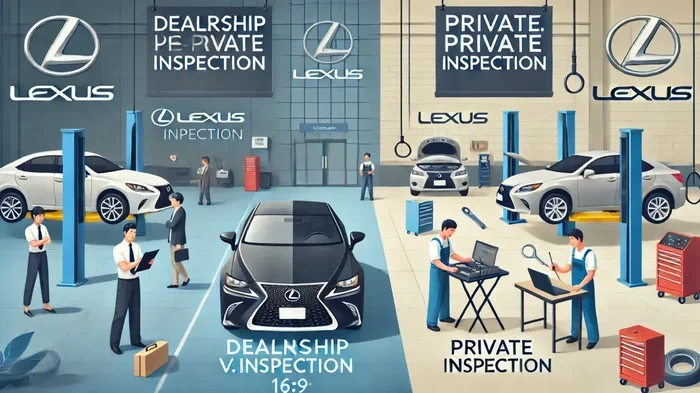
Visual guide about split image lexus dealership vs independent mechanic shop
Image source: luxeautosphere.com
For a typical 60,000-mile major service on an RX 350, expect 3-4 hours of labor. At $180/hour dealership rate, that’s $540-$720 just for labor. At $125/hour independent rate, you’re looking at $375-$500. The savings cover a nice dinner out.
Parts Pricing: OEM Vs Aftermarket Reality
Dealerships sell genuine Lexus parts at full retail MSRP plus shop markup. Independent shops access the same OEM parts through wholesale channels, often at 10-20% below retail. They can also offer premium aftermarket alternatives from manufacturers like Denso, Aisin, and Bosch—companies that actually make the parts for Lexus in the first place.
Consider brake pads. Genuine Lexus front pads for a 2020 RX 350 run about $180 at the dealer parts counter. Akebono (the OEM supplier) ceramic pads cost $95 online. Wagner ThermoQuiet, a respected aftermarket brand, costs $65. All three meet safety standards. The difference? Dust levels, noise characteristics, and pad life vary slightly.
Hidden Fees And Shop Supplies
Dealerships frequently add “shop supplies” fees (2-5% of labor, capped around $35), environmental disposal fees, and diagnostic charges even when you authorize the repair. Independents often roll these into their labor rate or waive diagnostics with repair authorization. Always ask for a written estimate breaking down every line item.
Long-Term Cost Projection
Over 100,000 miles, routine maintenance at a dealership might cost $6,000-$8,000. The same services at a quality independent shop: $4,000-$5,500. That’s $2,000-$3,000 saved—enough for a set of premium tires or a weekend getaway. Major repairs widen the gap further. A transmission replacement at the dealer: $6,500-$8,000. Independent: $4,500-$6,000 with a remanufactured unit and warranty.
Technician Expertise And Training Differences
Dealership Technician Career Path
Lexus dealership technicians follow a structured progression: Apprentice → Certified → Master → Master Diagnostic Specialist. They attend regular factory training on new models, technology updates, and service bulletins. They see the same problems repeatedly across hundreds of identical vehicles, building pattern recognition that speeds diagnosis.
However, dealership turnover averages 20-25% annually. Your “master tech” might have been hired six months ago. The technician assigned to your RX could be a first-year apprentice supervised by a master tech who’s overseeing three other cars simultaneously.
Independent Specialist Background
Many independent Lexus specialists are former dealership master technicians who left for autonomy, better pay, or work-life balance. They bring 15-30 years of brand-specific experience. They choose which cars to work on, set their own pace, and stake their reputation on every repair. Their business depends on referrals, not corporate volume targets.
Ask any independent shop owner: “Where did you train?” The answer often reveals decades of dealership experience. These technicians have seen every RX generation evolve, from the original 1999 model’s transmission quirks to the current hybrid system intricacies.
Continuing Education Access
Dealerships receive proprietary training first. New hybrid system diagnostics, safety system calibrations, and software updates flow to dealer techs months before independent access. However, the aftermarket training ecosystem (ASA, iATN, manufacturer-specific independent programs) closes this gap quickly. Top independents invest heavily in ongoing education.
The Diagnostic Equipment Gap
This is where dealerships hold a genuine advantage. Lexus proprietary scan tools (Techstream) provide bi-directional control, live data streaming, and ECU programming capabilities that generic tools approximate but don’t fully replicate. For complex issues—hybrid battery cell balancing, radar cruise control calibration, VSC system initialization—dealer-level tools are sometimes mandatory.
Did you know? As of 2023, the Right to Repair movement has forced manufacturers to provide independent shops access to the same diagnostic software and repair information as dealers, though subscription costs can exceed $10,000 annually. The best independents maintain current subscriptions.
Parts Quality And Availability Deep Dive
Genuine OEM Parts: What You’re Paying For
Genuine Lexus parts carry the Toyota/Lexus part number, packaging, and quality assurance. They’re identical to what your RX wore when it rolled off the assembly line in Ontario, Canada or Georgetown, Kentucky. Fitment is guaranteed. Materials match original specifications exactly. You’re paying for zero compromise and full traceability.
For safety-critical components—airbag modules, brake master cylinders, steering rack assemblies—genuine OEM is non-negotiable for many owners. The peace of mind justifies the premium. For wear items like filters, wiper blades, and belts, the difference is negligible.
OEM Supplier Parts: The Secret Identical Option
Here’s what dealerships don’t advertise: Denso makes your fuel injectors, Aisin makes your transmission, and Bosch makes your oxygen sensors. These same companies sell identical parts through aftermarket channels without the Lexus logo and markup. The part number often crosses directly. A Denso 234-9005 oxygen sensor is the exact same unit whether it comes in a Lexus box or a Denso box.
Smart independent shops source these OEM-supplier parts routinely. You get genuine quality at 60-80% of dealer price. Ask your shop: “Can you get OEM supplier parts for this repair?” The answer reveals their commitment to quality over margin.
Premium Aftermarket: When It Makes Sense
Brands like Bilstein (suspension), Centric (brakes), and Gates (belts/hoses) engineer parts that meet or exceed OEM specifications. Some improve on factory designs—addressing known weaknesses like the RX 350’s rear lower control arm bushing premature wear. These parts often carry better warranties than OEM.
For a 150,000-mile RX needing suspension refresh, premium aftermarket arms with upgraded bushings might outlast the original design. The independent shop can explain the trade-offs; the dealership parts counter will only sell you what Lexus catalogs.
Parts Availability And Lead Times
Dealerships stock common maintenance items but order model-specific parts from regional distribution centers. Next-day delivery is standard; backorders can take weeks. Independents use the same distribution network plus national warehouse networks (NAPA, CARQUEST, Worldpac) that often deliver same-day from local warehouses.
For older RX models (2003-2009), dealerships may classify parts as “obsolete” and refuse to order them. Independents specialize in sourcing discontinued parts through specialty networks, salvage yards with warranties, and remanufactured units. They keep your older RX viable long after dealer support wanes.
Service Experience And Convenience Factors
Dealership Amenities And Processes
Lexus dealerships invest heavily in customer experience: comfortable lounges with premium coffee, Wi-Fi, workstations, loaner vehicle fleets, shuttle service, and car wash with every visit. The process is standardized—digital check-in, video inspection reports texted to your phone, online payment, and follow-up surveys. It’s efficient, professional, and impersonal.
You’ll likely interact with a service advisor managing 15-20 customers daily. They relay information between you and the technician. Miscommunication happens. Your specific concern about “that vibration at 65 mph” becomes “customer reports vibration” on the repair order.
Independent Shop Personal Touch
At a quality independent, you often speak directly with the technician working on your car. You point out the noise, show the video you recorded, discuss the repair plan face-to-face. The shop owner remembers your RX’s history—the coolant leak fixed at 87,000 miles, the driver’s seat motor replaced last year, your preference for synthetic blend over full synthetic.
This relationship builds institutional knowledge about your specific vehicle. The technician knows your driving patterns, local conditions, and maintenance priorities. They might notice the early signs of a failing water pump because they remember the slight weep at the last visit.
Scheduling Flexibility
Dealerships often book 1-2 weeks out for non-urgent work. Independents typically offer 1-3 day availability. Many independents provide after-hours drop-off, weekend hours, and faster turnaround since they’re not managing 50+ daily appointments. For busy professionals, this flexibility alone justifies the independent choice.
Communication Style Differences
Dealerships use standardized digital inspection reports with photos and color-coded urgency ratings (green/yellow/red). It’s transparent but formulaic. Independents often call or text personally: “Hey, I’m looking at your rear brakes. Pads at 3mm. Rotors have slight lip. Want me to replace both while it’s apart? Here’s the price difference.” Conversational. Collaborative.
When To Choose Each Option: Decision Framework
Choose Dealership When:
- Warranty-covered repairs: Any issue potentially covered by factory, CPO, or extended warranty. The manufacturer pays; you lose nothing by using their facility.
- Recall work: Always free at dealers. They have the latest parts and procedures directly from engineering.
- Complex electronics: Infotainment system failures, hybrid system faults, advanced driver assistance calibration, ECU programming updates. Dealer tools and information access are superior.
- First 2-3 years of ownership: While under comprehensive warranty, dealer records create clean history for future CPO qualification or resale.
- Safety system repairs: Airbag, seatbelt pretensioner, ABS/VSC module replacement. Liability and calibration requirements favor dealer expertise.
Choose Independent Specialist When:
- Out of warranty: After 4 years/50,000 miles (basic) or 6 years/70,000 miles (powertrain), the warranty leverage disappears. Cost savings become significant.
- Routine maintenance: Oil changes, fluid exchanges, filter replacements, brake service, tire rotation, alignment. Any competent shop handles these flawlessly.
- Wear item replacement: Tires, brakes, batteries, belts, hoses, filters, wipers. No proprietary knowledge required.
- Older models (10+ years): Dealerships prioritize current models. Independents specialize in aging vehicle care and cost-effective solutions.
- Custom modifications: Suspension upgrades, performance tuning, accessory installation. Dealers rarely support modifications; independents embrace them.
- Second opinion: Dealer recommends $4,000 repair. Independent verification costs $100-150 diagnostic fee. Often reveals simpler, cheaper solution.
The Hybrid Approach: Best Of Both Worlds
Many savvy RX owners use a hybrid strategy. Dealership for warranty work, recalls, complex electronics, and safety systems. Independent for everything else. This maximizes warranty protection while minimizing long-term costs. Maintain a master file with both shops’ records. Share relevant history with each provider.
Pro tip: Establish relationships with both before you need them. Visit the independent shop for an oil change and inspection. Meet the technician. Evaluate the facility. Do the same at the dealership. When urgent repair arises, you’ll have trusted options rather than desperate searches.
Red Flags For Either Option
Avoid any shop—dealer or independent—that: pressures immediate authorization without explanation, refuses to show replaced parts, cannot provide written estimates, lacks current certifications (ASE, factory training), has no online presence or reviews, or discourages second opinions. Quality providers welcome informed customers.
Real-World Scenarios And Owner Experiences
Scenario 1: 2018 RX 350 At 65,000 Miles – Transmission Service
Sarah’s 2018 RX 350 reached 65,000 miles. The dealer quoted $489 for “transmission fluid exchange” using their machine flush system. Her independent Lexus specialist quoted $285 for drain-and-fill (3 quarts) using genuine Toyota WS fluid, repeated at 70,000 and 75,000 miles for complete exchange. The specialist explained: “Toyota doesn’t recommend machine flushes. Drain-and-fill three times over 15,000 miles replaces 95% of fluid without risk of dislodging debris.” Sarah saved $200 and got better methodology.
Scenario 2: 2021 RX 450h – Hybrid Battery Warning
Mike’s 2021 RX 450h displayed “Check Hybrid System” at 42,000 miles. Under powertrain warranty. Dealer diagnosed failed battery ECU—covered 100%. Repair took three days waiting for part. Loaner provided. Total cost: $0. Independent shop couldn’t access hybrid ECU programming even if warranty didn’t apply. Dealer was the only correct choice.
Scenario 3: 2012 RX 350 At 145,000 Miles – Suspension Refresh
David’s high-mileage RX needed struts, springs, control arms, and alignment. Dealer quote: $3,200 using all OEM parts. Independent quote: $1,950 using KYB Excel-G struts (OEM supplier), Moog control arms with upgraded bushings, and OEM springs. Independent technician noted: “The factory lower control arm bushings fail early. Moog’s design fixes the geometry issue.” David chose independent, got better parts, saved $1,250.
Scenario 4: 2023 RX 500h F Sport – First Service At 10,000 Miles
Jennifer’s brand-new RX 500h needed first service. She chose dealer: complimentary first service (Lexus covers 10k/20k/30k), loaner vehicle, car wash, and factory-trained tech on the newest hybrid turbo system. Cost: $0. Relationship established for future warranty work. Smart strategic choice.
Did You Know?
Lexus consistently ranks #1 in J.D. Power Customer Service Index for luxury brands. However, independent shops specializing in Lexus often score higher on individual technician competence surveys because they self-select for passion and expertise rather than corporate assignment.
Maintaining Your Service Records: The Resale Value Multiplier
Documentation Best Practices
Whether dealer or independent, documentation determines resale value. A 2018 RX 350 with complete dealer records sells for $1,500-$2,500 more than identical vehicle with spotty history. But complete independent records with detailed invoices (parts numbers, fluid specifications, torque values, technician notes) command nearly the same premium.
Create a digital folder: “RX Service Records.” Subfolders by year. Scan every invoice. Note mileage, date, complaint, correction, parts used. Photograph old parts if significant. Record technician name. This file becomes your vehicle’s biography—proof of care that buyers and Carfax both value.
Carfax And Service Reporting
Dealerships automatically report to Carfax. Most independents don’t. Ask your independent shop to report services to Carfax (many participate through programs like CARFAX Service Shop). Alternatively, use the Carfax “Add Service History” feature yourself with scanned receipts. Complete Carfax reports increase trade-in offers by $500-$1,500 on average.
Pre-Purchase Inspection Value
When selling privately, a recent independent pre-purchase inspection report ($150-$250) gives buyers confidence. It’s neutral third-party validation. Dealership CPO inspections serve similar purpose but cost more and only apply to dealer-retail vehicles. Your independent specialist’s inspection carries weight because they have no sales agenda.
Conclusion: Your RX Deserves The Right Care
The Lexus RX dealer vs independent service decision isn’t binary. It’s a series of informed choices based on your specific vehicle, situation, and priorities. Your RX represents engineering excellence—whether it’s the bulletproof 3.5L V6 in your 2015 RX 350 or the sophisticated hybrid turbo in the new RX 500h. Both deserve maintenance that matches their quality.
Start with warranty status. If covered, dealer wins. If not, evaluate the repair complexity. Routine maintenance? Independent saves money without compromise. Complex electronics? Dealer tools justify the premium. Safety systems? Dealer liability coverage matters. Building a relationship with a trusted independent specialist while maintaining dealer access for warranty work gives you the ultimate flexibility.
Remember: the best service provider—dealer or independent—communicates clearly, documents thoroughly, uses quality parts appropriate to the repair, stands behind their work, and respects your budget. Find shops that meet these standards. Your RX will reward you with another 100,000 miles of quiet, comfortable, reliable service. And that’s the real luxury.
Frequently Asked Questions
Does using an independent shop void my Lexus RX warranty?
No. The Magnuson-Moss Warranty Act protects your right to use independent shops for maintenance and repairs without voiding your factory warranty. The dealer must prove the independent shop’s work directly caused a failure to deny a warranty claim. Keep detailed records of all services performed.
How much money can I save using an independent Lexus specialist?
Independent shops typically charge 20-40% less for labor and can source OEM-supplier parts at significant discounts. Over 100,000 miles, owners often save $2,000-$3,000 on routine maintenance alone. Major repairs like transmission work can save $2,000+ compared to dealership pricing.
Can independent shops access Lexus proprietary diagnostic software?
Yes, through Right to Repair legislation. Quality independent Lexus specialists subscribe to Toyota/Lexus Techstream diagnostic software ($10,000+ annually) providing the same bi-directional control, live data, and ECU programming capabilities as dealerships. Always verify your shop maintains current subscriptions.
Should I use the dealership for my RX’s first few services while under warranty?
Yes, strategic owners use dealerships for the complimentary 10k/20k/30k maintenance services and any warranty-covered repairs. This creates clean factory records beneficial for future CPO qualification. Switch to independent for out-of-warranty maintenance to maximize savings.
What should I look for in a quality independent Lexus specialist?
Seek ASE-certified technicians with Lexus-specific training, current Techstream subscription, OEM-supplier parts sourcing, detailed written estimates, willingness to show replaced parts, strong online reviews from other Lexus owners, and clear warranty on parts and labor (minimum 12 months/12,000 miles).
Are aftermarket parts safe for my Lexus RX?
Premium aftermarket brands (Denso, Aisin, Bosch, KYB, Akebono, Centric, Gates) often manufacture the exact same parts supplied to Lexus factories. These parts meet or exceed OEM specifications at lower cost. Avoid economy-tier brands for safety-critical components. Your independent specialist can recommend appropriate quality levels for each repair.