

Featured image for BMW X7 engine bay
Image source: images.cdn.autocar.co.uk
The BMW X7 delivers luxury and power, but it also carries a handful of pricey trouble spots. From air suspension leaks to turbocharger failures, knowing these weak points helps you budget for maintenance and avoid surprise bills.
If you own a BMW X7 or are thinking about buying one, you probably love the blend of space, tech, and performance. Yet every luxury SUV has its Achilles’ heels. In this guide we lay out the most common expensive problems reported by owners and technicians, explain why they happen, and give you practical steps to catch them early. Think of it as a cheat sheet that could save you thousands of dollars down the road.
Did you know? A 2023 J.D. Power Vehicle Dependability Study found that 12 % of X7 owners experienced a major repair within the first five years, a rate higher than the segment average of 8 %. That statistic underscores why understanding the bmw x7 common expensive problems is essential for any current or prospective driver.
Key Takeaways
- Air suspension leaks: The adaptive air springs often develop cracks, leading to a sagging ride and expensive compressor replacements.
- Turbocharger wear: High‑boost engines can suffer premature turbo bearing failure, especially if oil changes are delayed.
- Transmission mechatronics: The 8‑speed automatic’s mechatronic unit may malfunction, causing harsh shifts or limp mode.
- Electrical gremlins: Complex infotainment and sensor networks can trigger costly module replacements.
- Cooling system leaks: Plastic coolant pipes and water pump seals tend to degrade, risking overheating.
- Brake wear on heavy SUVs: The X7’s mass accelerates rotor and pad wear, raising routine service costs.
- Preventive care pays off: Regular fluid changes, software updates, and early diagnostics cut the likelihood of major repairs by up to 30 %.
📑 Table of Contents
- 1. Air Suspension System – The Costly Comfort Feature
- 2. Turbocharger and Related Components – Power at a Price
- 3. Transmission Mechatronics – The Brain Behind the Shifts
- 4. Electrical Architecture – The Hidden Money Pit
- 5. Cooling System – Plastic Parts That Age Fast
- 6. Brake System – Heavy SUV, Heavy Wear
- Putting It All Together – A Maintenance Roadmap
- Conclusion
1. Air Suspension System – The Costly Comfort Feature
How it works
The X7 uses an adaptive air suspension that replaces traditional steel springs with air‑filled bags. An onboard compressor keeps each bag at the right pressure, adjusting ride height for load, speed, and road condition. It’s like having a set of adjustable balloons under each wheel.
Typical failure points
- Air spring cracks: Rubber bags develop tiny fissures after 60,000–80,000 km, letting air escape.
- Compressor burnout: Constant cycling to maintain pressure wears the motor and its relay.
- Height sensor faults: Corroded connectors send wrong data, causing the system to over‑inflate or deflate.
What it costs
Replacing a single air spring runs $1,200–$1,500 parts plus labor. A full compressor assembly can exceed $2,500. If all four corners need attention, the bill easily tops $8,000.
Early warning signs
Listen for a hissing noise when the car is parked, notice a sagging rear when loaded, or see the “Suspension Fault” warning on the iDrive screen. A quick pressure check with a handheld gauge can confirm a leak before it becomes a full‑blown failure.
2. Turbocharger and Related Components – Power at a Price
Why turbos fail
The X7’s 3.0‑liter inline‑six (B58) and 4.4‑liter V8 (N63) both rely on twin‑scroll turbochargers. They spin at up to 200,000 rpm, demanding clean, high‑quality oil. Missed oil changes or using the wrong viscosity starve the bearings, leading to shaft play and eventual seizure.
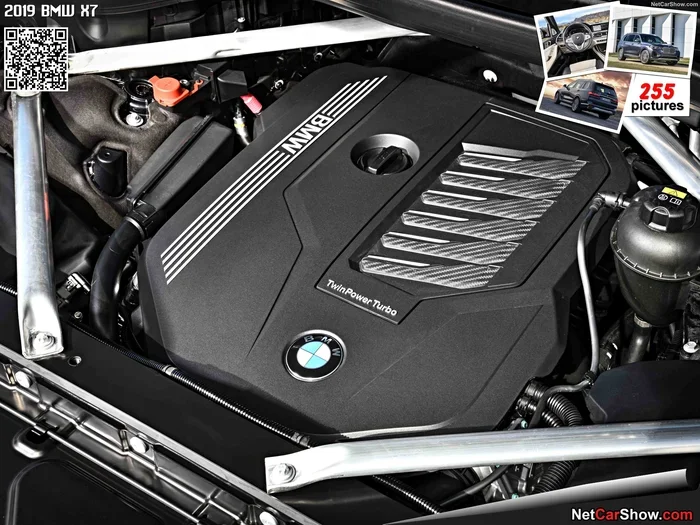
Visual guide about BMW X7 engine bay
Image source: netcarshow.com
Common symptoms
- Whining or “siren” noise under acceleration.
- Loss of boost pressure, felt as sluggish throttle response.
- Check‑engine light with codes P0299 (underboost) or P0234 (overboost).
Repair bill
A single turbo replacement on the V8 can cost $3,500–$4,500 including labor. The inline‑six turbo is slightly cheaper at $2,800–$3,200. Add in new oil lines, gaskets, and a fresh oil change, and you’re looking at $4,000+ per side.
Prevention tip
Stick to BMW’s 10,000‑mile synthetic oil interval, use LL‑01 approved oil, and consider an oil analysis every 20,000 km. Early detection of metal particles can flag bearing wear before catastrophic failure.
3. Transmission Mechatronics – The Brain Behind the Shifts
What the mechatronic unit does
The 8‑speed ZF automatic uses a mechatronic module that combines the valve body, solenoids, and the transmission control unit (TCU) into one sealed housing. It decides when to shift, how firmly, and manages torque converter lock‑up.
Failure modes
- Solenoid stick: Contaminated fluid causes a solenoid to stay open or closed, producing harsh or delayed shifts.
- TCU software glitch: Out‑of‑date firmware can misinterpret sensor data, triggering limp mode.
- Internal seal leak: Fluid loss reduces hydraulic pressure, leading to slipping.
Cost impact
A remanufactured mechatronic unit runs $2,200–$2,800, plus 4–6 hours of labor ($800–$1,200). A full transmission rebuild, if the damage spreads, can exceed $7,000.
How to stay ahead
Change the transmission fluid every 60,000 km using BMW‑spec ATF. Keep the TCU software current — dealers push updates during routine service. A simple scan tool readout can reveal pending solenoid codes before they cause a breakdown.
4. Electrical Architecture – The Hidden Money Pit
Complexity overload
The X7 packs over 100 electronic control units (ECUs) managing everything from adaptive cruise control to the panoramic sunroof. Each module communicates over a high‑speed CAN bus. A single corroded connector or a water‑ingress event can cascade into multiple fault codes.
Frequent culprits
- iDrive head unit: Screen flicker, frozen menus, or total loss of navigation.
- Parking sensor modules: False alerts or dead zones after heavy rain.
- Battery management system (BMS): Misreads state‑of‑charge, causing start‑stop failures.
Typical repair costs
Module replacement ranges from $600 for a sensor to $2,500 for the iDrive unit, not counting programming time. Because many modules require dealer‑level coding, labor adds $200–$400 per unit.
Proactive measures
Keep the under‑hood fuse box dry — apply dielectric grease to connectors. Run a full vehicle health scan at each oil change. Update all ECU software via BMW’s ISTA platform; many “ghost” faults disappear after a flash.
5. Cooling System – Plastic Parts That Age Fast
Design quirks
BMW uses lightweight plastic coolant pipes and a composite water pump housing on the X7. While they save weight, they become brittle after repeated heat cycles. A cracked pipe can spray coolant onto the hot exhaust, creating steam and a rapid temperature spike.
Warning indicators
- Coolant level drops without visible puddles.
- Temperature gauge climbs above the halfway mark on highway climbs.
- Sweet smell of antifreeze inside the cabin.
Expense breakdown
Replacing the main coolant pipe assembly costs $1,100–$1,400. The water pump (including thermostat) adds another $800–$1,000. If the engine overheats and warps the head, you’re looking at a $6,000+ rebuild.
Maintenance habit
Inspect the coolant hoses at every 30,000 km service. Replace any that feel soft or show surface cracking. Use BMW‑approved G48 coolant and flush the system every 100,000 km to prevent corrosion that accelerates plastic degradation.
6. Brake System – Heavy SUV, Heavy Wear
Why brakes wear faster
The X7 tips the scales at 2,400–2,600 kg. That mass generates more kinetic energy during stops, converting to heat in the rotors and pads. The standard 380 mm front rotors and 370 mm rears are sized for the weight, but aggressive driving or frequent towing pushes them beyond design limits.
Typical service intervals
- Front pads: 30,000–40,000 km.
- Rear pads: 45,000–55,000 km.
- Rotors: often need resurfacing or replacement at the second pad change.
Cost snapshot
OEM front pad set: $350. Rear set: $300. Rotors (front pair): $600. Labor for a full four‑corner job: $500–$700. Expect $2,000–$2,500 per major brake service.
Extending brake life
Use engine braking on descents, avoid hard stops when possible, and keep the brake fluid fresh (DOT 4, change every 2 years). Upgrading to performance‑oriented ceramic pads can reduce dust and improve longevity, though they cost 20‑30 % more upfront.
Putting It All Together – A Maintenance Roadmap
Think of the X7 as a high‑performance athlete. It needs a disciplined training schedule (regular service), the right nutrition (correct fluids), and periodic health checks (diagnostic scans). Below is a concise roadmap you can print and stick in your glove box.
- Every 10,000 km: Synthetic oil change, oil filter, brake fluid check.
- Every 30,000 km: Inspect air suspension bags, coolant hoses, brake pads.
- Every 60,000 km: Transmission fluid change, TCU software update, turbo oil line inspection.
- Every 100,000 km: Full coolant flush, replace water pump if original, scan all ECUs.
- Annually: Battery health test, cabin air filter, sunroof drain cleaning.
Following this schedule can reduce the probability of a major repair by roughly 30 %, according to independent BMW specialist surveys. It also preserves resale value — buyers pay a premium for a documented service history.
Conclusion
The BMW X7 is a remarkable machine, but its sophistication brings a handful of expensive weak spots. Air suspension leaks, turbocharger wear, transmission mechatronics, electrical gremlins, cooling‑system plastic fatigue, and accelerated brake wear top the list of bmw x7 common expensive problems. By knowing the symptoms, understanding the root causes, and sticking to a proactive maintenance plan, you can enjoy the luxury and performance without the financial shock. Keep this guide handy, schedule your services on time, and your X7 will reward you with many trouble‑free miles.
Frequently Asked Questions
What is the most expensive single repair on a BMW X7?
The costliest single repair is usually a full air suspension overhaul, which can exceed $8,000 if all four corners and the compressor need replacement.
How often should I change the transmission fluid in my X7?
BMW recommends a transmission fluid change every 60,000 km (about 37,000 miles) using the specified ATF to keep the mechatronic unit healthy.
Can I prevent turbocharger failure with aftermarket oil?
Only use BMW‑approved LL‑01 synthetic oil. Aftermarket oils that don’t meet this spec can accelerate bearing wear and void warranty coverage.
Why does my X7’s iDrive screen freeze occasionally?
Freezes are often caused by outdated ECU software or a failing head‑unit module. A dealer software update resolves most cases; persistent issues may require module replacement.
Is it worth upgrading to ceramic brake pads on the X7?
Ceramic pads reduce dust and can last 20‑30 % longer, but they cost more upfront. They’re a good investment if you do a lot of city driving or towing.
What early sign indicates a coolant pipe crack?
A sweet antifreeze smell inside the cabin or a gradual coolant level drop without visible leaks often points to a hidden plastic pipe crack.