

The premium compact SUV segment has never been more competitive. In 2026, buyers can choose from a roster that blends upscale materials, advanced driver-assistance suites, and electrified powertrains — all in a footprint that slips into tight urban parking spaces. This guide breaks down the leading models, explains what truly separates a premium cabin from a mainstream one, and gives you a practical framework for picking the right vehicle for your daily drive and weekend escapes.
What Defines a Premium Compact SUV in 2026?
A premium compact SUV typically starts between $38,000 and $55,000 before options, rides on a dedicated or shared luxury platform, and offers standard equipment that includes leather upholstery, a digital instrument cluster, and a comprehensive safety suite. Key differentiators are:
- Materials: Soft-touch surfaces on every frequently contacted panel, open-pore wood or genuine aluminum trim, and available semi-aniline leather.
- Technology: Over-the-air updates, wireless Apple CarPlay/Android Auto, and a native voice assistant that controls climate, navigation, and vehicle settings.
- Powertrain diversity: Turbocharged four-cylinders, 48-volt mild hybrids, plug-in hybrids (PHEV) with 30+ miles of EV range, and dedicated battery-electric variants.
- Chassis tuning: Adaptive dampers, rear multi-link suspension, and available torque-vectoring all-wheel drive for composed handling.
In practice, the line between “premium” and “luxury” blurs — brands like Genesis and Volvo now deliver flagship-level quietness and ride isolation in this class. You can also read our guide on evaluation of suv.
Top Contenders for 2026
European Entries
| Model | Base MSRP (est.) | Powertrain Highlights | Standout Feature |
|---|---|---|---|
| Audi Q3 | $39,800 | 2.0T (184/228 hp), 48V mild hybrid | Virtual Cockpit Plus, optional RS appearance |
| BMW X1 | $40,500 | 2.0T (241 hp), xDrive AWD standard | iDrive 9 with QuickSelect, sporty steering |
| Mercedes‑Benz GLA | $41,200 | 2.0T (221 hp), 4MATIC optional | MBUX hyperscreen available, EASY ENTRY seats |
| Volvo XC40 / XC40 Recharge | $40,000 / $53,500 | 2.0T mild hybrid / dual-motor EV (249 mi EPA) | Google built-in, class-leading safety standard |
Asian Entries
| Model | Base MSRP (est.) | Powertrain Highlights | Standout Feature |
|---|---|---|---|
| Lexus NX 350 / 350h / 450h+ | $42,000 / $43,500 / $50,000 | 2.5L hybrid, 2.5L PHEV (37 mi EV) | Tazuna cockpit, 14-in touchscreen, Mark Levinson audio |
| Acura RDX | $43,000 | 2.0T (272 hp), SH‑AWD® | True Touchpad Interface™, 16‑speaker ELS Studio 3D |
| Genesis GV70 | $45,000 | 2.5T (300 hp), 3.5T (375 hp) | Fingerprint authentication, Ergo Motion seats |
Domestic Entries
| Model | Base MSRP (est.) | Powertrain Highlights | Standout Feature |
|---|---|---|---|
| Cadillac XT4 | $38,500 | 2.0T (235 hp), 9-speed auto | Super Cruise hands-free highway assist |
| Lincoln Corsair | $40,000 | 2.0T (250 hp), 2.5L PHEV (28 mi EV) | Phone As A Key®, Revel® Ultima 3D audio |
 Video overview of top luxury compact SUV contenders.
Interior Design and Comfort Deep Dive
Craftsmanship is where the premium badge earns its keep. The Lexus NX uses laser-cut stitching on door panels; the GV70 wraps the dash in quilted Nappa leather; the X1 offers optional Sensatec dashboard with contrast stitching. Seats now go beyond heating/ventilation: BMW’s multi-contour fronts add thigh extension and shoulder support, while Genesis’ Ergo Motion seats run a seven‑airbag massage program.
Rear‑seat space remains a differentiator. The XC40’s boxy roofline yields 38.9 inches of legroom — best in class — while the sloping roof of the GLA trims that to 36.1 inches. Cargo capacity behind the second row ranges from 20.7 cu ft (GLA) to 25.7 cu ft (XC40). A common mistake is ignoring the load floor height; the NX and GV70 feature a low, flat floor that makes sliding heavy cases effortless. You can also read our guide on top luxury suvs of.
Noise, vibration, and harshness (NVH) suppression has improved across the board. Dual‑laminate acoustic glass on front and rear side windows is now standard on GV70, XC40 Recharge, and upper trims of Q3 and X1, cutting highway wind noise to near‑luxury‑sedan levels.
Safety and Driver‑Assistance Systems
Every model here earns an IIHS Top Safety Pick+ when equipped with specific headlights. Standard suites include forward collision warning with pedestrian/cyclist detection, lane‑keeping assist, blind‑spot monitoring, and rear cross‑traffic alert. The real spread appears in advanced features:
- Highway assist: Cadillac’s Super Cruise (mapped highways only), Mercedes’ Active Distance Assist Distronic with Active Steering Assist, and BMW’s Extended Traffic Jam Assistant (up to 40 mph) allow hands‑off, eyes‑on operation.
- Automated parking: Remote Park Assist (Hyundai/Kia/Genesis) and Parking Assistant Professional (BMW) handle parallel and perpendicular spots via smartphone or key fob.
- Night vision: Optional on X1 and GV70; detects pedestrians/animals beyond headlight range.
For the latest crash‑test ratings and recall data, check the NHTSA vehicle safety database.
Infotainment and Connectivity
Screen sizes have settled: 10.25–12.3 inches for the central display, 12.3 inches for the digital cluster. The interface philosophy splits two ways:
- Touch‑first (Lexus, Genesis, Cadillac, Lincoln) — large tiles, haptic feedback, minimal hard buttons.
- Rotary/click‑wheel (Audi, BMW, Mercedes) — reduces glance time, keeps hands on the armrest.
All support wireless smartphone mirroring and at least two USB‑C ports (front) plus one rear. Over‑the‑air updates now refresh navigation maps, infotainment apps, and even powertrain calibrations on Genesis, BMW, and Cadillac. Premium audio systems range from 10‑speaker (base) to 23‑speaker 3D setups (Revel Ultima, Burmester 4D, Mark Levinson). If you audition systems, bring a familiar high‑resolution track — bass extension and soundstage width vary noticeably.
Performance, Efficiency, and Powertrain Options
Turbocharged 2.0‑liter four‑cylinders dominate, producing 228–300 hp. Mild‑hybrid 48V systems (Audi, Mercedes, Volvo) smooth start‑stop and add 10–15 hp under acceleration. Plug‑in hybrids (NX 450h+, Corsair Grand Touring, XC40 Recharge PHEV) deliver 30–37 miles of EPA electric range — enough for many daily commutes gas‑free. Dedicated EVs (XC40 Recharge, upcoming X1 iX1) offer 240–250 miles per charge and DC fast charging at 150–200 kW.
All‑wheel drive is standard on BMW, Mercedes (4MATIC), Volvo, Genesis, and Cadillac; optional on Audi, Lexus, Acura. Torque‑vectoring rear differentials (SH‑AWD® on RDX, GV70 Sport) sharpen corner exit. Adaptive dampers (standard on GV70, optional elsewhere) widen the compliance/control envelope — select Comfort for potholed avenues, Sport for canyon roads.
Fuel economy spans a wide band. The EPA combined estimates for 2026 models range from 23 mpg (GV70 3.5T AWD) to 39 mpg (NX 350h AWD). For personalized estimates based on your driving mix, use the fueleconomy.gov comparison tool.
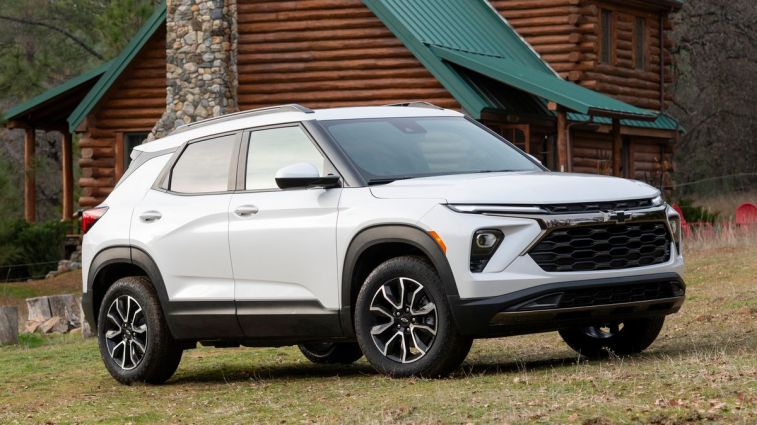 The Chevrolet Trailblazer offers a blend of style and utility.
Ownership Experience: Warranty, Maintenance, and Reliability
Warranty coverage is a tangible differentiator:
| Brand | Basic / Powertrain | Free Maintenance | Notable Perk |
|---|---|---|---|
| Genesis | 5 yr / 60k mi | 3 yr / 36k mi | Valet service, 3‑yr complimentary connected services |
| Cadillac | 4 yr / 50k mi | 1 visit | Super Cruise 3‑yr trial |
| Lincoln | 4 yr / 50k mi | 1 visit | Pickup/delivery for service |
| BMW | 4 yr / 50k mi | 3 yr / 36k mi | Ultimate Care+ extends to 7 yr |
| Mercedes | 4 yr / 50k mi | None standard | Prepaid maintenance plans available |
| Lexus | 4 yr / 50k mi | 1 visit | 24/7 roadside, loaner fleet |
| Audi | 4 yr / 50k mi | None standard | Audi Care prepaid plans |
| Acura | 4 yr / 50k mi | None standard | Precision Crafted Performance warranty |
| Volvo | 4 yr / 50k mi | 3 yr / 36k mi | Digital key, OTA updates for life |
Reliability data from Consumer Reports and J.D. Power consistently place Lexus, Genesis, and Acura at the top of the premium compact segment. European brands tend to show higher repair frequency after year three, making extended warranties or certified pre‑owned (CPO) purchases a prudent consideration.
Buying Guide: How to Choose the Right Premium Compact SUV
- Set a realistic budget — include destination, options, and dealer fees. Target a monthly payment (loan/lease) that leaves room for insurance and charging/fuel.
- Prioritize your must‑haves — EV range, third‑row (none here), specific safety tech, audio brand, seat massage.
- Shortlist three models — schedule back‑to‑back test drives on the same day. Bring your phone, a child seat if applicable, and a golf bag or luggage to test cargo flexibility.
- Evaluate the dealer experience — loaner policy, service hours, and proximity matter for long‑term satisfaction.
- Compare total cost of ownership — depreciation, fuel/electricity, insurance, maintenance, and tire replacement over 5 years/75k miles.
A common mistake is fixating on 0‑60 times; daily drivability (low‑speed transmission smoothness, brake pedal feel, visibility) affects enjoyment far more.
Comparative Market Analysis: Pricing and Value Retention
| Brand | Avg. Transaction Price (2026 est.) | 3‑Year Residual % (ALG) |
|---|---|---|
| Genesis GV70 | $52,000 | 58% |
| Lexus NX | $48,500 | 60% |
| BMW X1 | $49,000 | 55% |
| Mercedes GLA | $50,500 | 54% |
| Volvo XC40 | $47,000 | 52% |
| Acura RDX | $46,500 | 56% |
| Cadillac XT4 | $44,000 | 49% |
| Lincoln Corsair | $45,500 | 50% |
Residual values assume average mileage (12k/yr) and clean condition. Lexus and Genesis lead due to strong brand perception and lower incentive spending. European models lease aggressively, which can lower effective monthly cost despite softer residuals.
Future Trends: Electrification and Software‑Defined Vehicles
By 2027, every nameplate here will offer a battery‑electric variant on a dedicated EV platform (e.g., BMW Neue Klasse, Mercedes MMA, Genesis e‑G80‑derived). Expect 300+ mile ranges, 800‑volt charging, and bidirectional power. Software subscriptions will expand — heated seats, advanced driver assist, and performance unlocks may shift to monthly fees. Over‑the‑air updates will become the primary delivery method for new features, reducing the need for dealer visits.
 Mazda's CX-50 Turbo Premium Plus showcases upscale design.
Frequently Asked Questions
What Are The Top Features Of Compact Premium SUVs?
Compact premium SUVs typically offer advanced technology, luxurious interiors, and strong performance. They often come equipped with safety features like adaptive cruise control and lane‑keeping assist. Additionally, many models provide ample cargo space and comfortable seating for passengers, making them ideal for both city driving and longer trips.
How Do Compact SUVs Compare To Sedans?
Compact SUVs generally provide more versatility than sedans. They offer higher ground clearance, better visibility, and additional cargo space. While sedans may excel in fuel efficiency, compact SUVs often provide superior comfort and all‑wheel‑drive options, making them suitable for various driving conditions and terrains.
What Is The Fuel Efficiency Of Premium Compact SUVs?
The fuel efficiency of premium compact SUVs varies by model. On average, they range from 23 to 39 miles per gallon combined. Hybrid and plug‑in hybrid options deliver even better economy, with some PHEVs achieving 70+ MPGe. It's essential to consider the engine type and your typical driving conditions when evaluating overall efficiency.
Are Premium Compact SUVs Worth The Price?
Yes, premium compact SUVs often justify their price with superior quality and features. They typically offer a blend of performance, comfort, and technology that enhances the driving experience. Additionally, their resale value tends to remain strong — especially for Lexus, Genesis, and Acura — making them a worthwhile investment for many buyers.
Which Premium Compact SUV Has The Best Warranty?
Genesis currently leads with a 5‑year/60,000‑mile basic warranty, 10‑year/100,000‑mile powertrain warranty, and three years of complimentary scheduled maintenance. Cadillac and Lincoln offer four‑year/50,000‑mile coverage with one free service visit. BMW and Mercedes provide four‑year/50,000‑mile basic warranties; BMW includes three years of free maintenance.
Conclusion
Choosing the right premium compact SUV means balancing badge prestige, daily usability, and long‑term value. The 2026 lineup delivers an unprecedented mix of electrified powertrains, semi‑automated driving, and cabin quietness that rivals full‑size luxobarges. Start by defining your non‑negotiables — electric range, seat comfort, tech interface — then test‑drive your top three back‑to‑back. Pay attention to the details that spec sheets miss: control ergonomics, sightlines, and how the suspension absorbs your local potholes. For deeper dives on individual models, explore our Toyota RAV4 XLE Premium review, 2025 RAV4 XLE Premium updates, or the hybrid variant breakdown. Ready to experience the difference? Schedule a test drive at your local dealer this week — your perfect daily driver is waiting.