

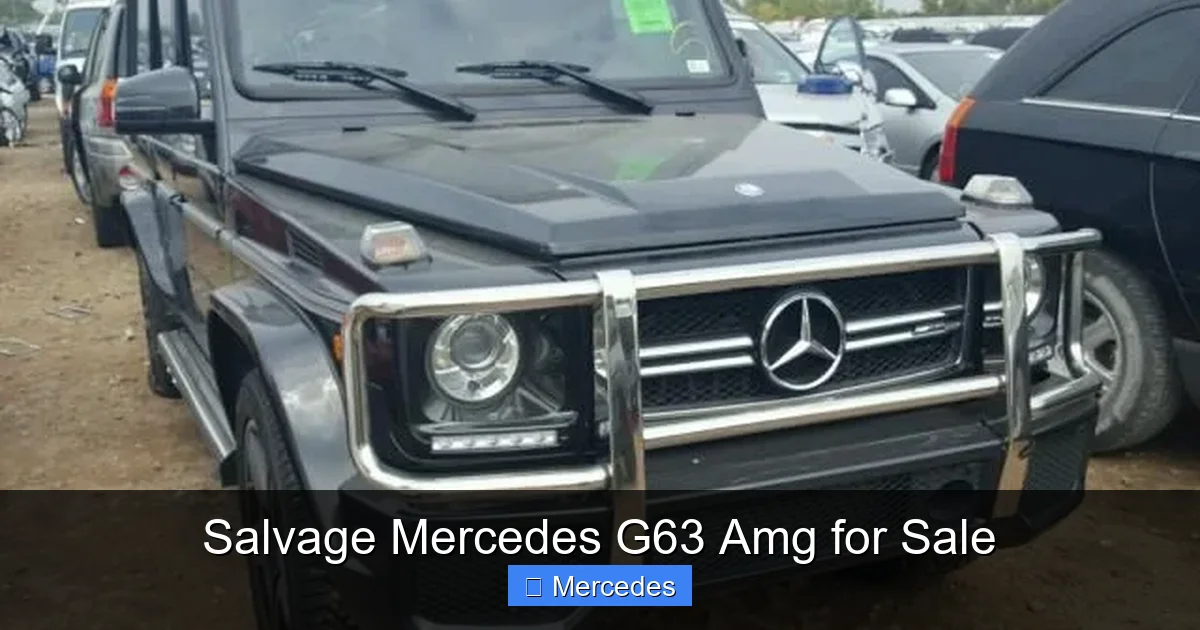
Salvage Mercedes G63 AMG for sale offers a rare opportunity to own one of the most powerful luxury SUVs at a fraction of new car costs. These high-performance vehicles come with a salvage title, meaning they’ve been in accidents or totaled but can often be repaired and restored to excellent condition. With proper documentation and skilled mechanics, you can drive home a fully functional G-Wagen that turns heads on every street.
Key Takeaways
- Salvage Title Impact: A salvage title affects insurance and resale value but doesn’t mean the car is undrivable—many are fully repairable.
- High Performance Potential: The Mercedes G63 AMG delivers 585+ horsepower, making it ideal for enthusiasts seeking power and luxury.
- Restoration Costs: Expect $10,000–$30,000 for major repairs depending on damage type (collision, flood, fire).
- Inspection Is Crucial: Always get a pre-purchase inspection by a certified mechanic familiar with AMG models.
- Market Demand: Used G63 AMGs, especially salvage ones, are increasingly popular due to limited production and exclusivity.
- Financing Options: Some lenders offer loans for rebuilt-title vehicles with higher interest rates and down payments.
- Safety & Reliability: Despite past reliability concerns, modern G63 AMGs feature advanced safety tech and robust engineering.
Quick Answers to Common Questions
What does “salvage title” mean for a Mercedes G63 AMG?
A salvage title means the vehicle was declared a total loss due to accident, flood, fire, or theft. It doesn’t imply the car is unusable—many are fully repairable and can be legally driven after inspection and rebuilding.
How much cheaper is a salvage G63 compared to a clean title?
You can expect to save 40–50% on a salvage Mercedes G63 AMG. For example, a 2019 model might cost $70,000–$90,000 as a salvage versus $130,000+ for a clean title with similar mileage.
Can I insure a rebuilt salvage Mercedes G63 AMG?
Yes, but standard insurers may reject it. Look for specialty providers like Hagerty or Grundy, which offer policies tailored to classic, modified, or rebuilt high-value vehicles.
How do I verify if a G63 AMG was properly repaired?
Request repair invoices, photos of work performed, and a VIN report from Carfax. Also, hire a mechanic experienced with Mercedes AMG models to inspect structural integrity, paint quality, and mechanical function.
Is it worth restoring a salvage G63 AMG myself?
If you have mechanical skills and enjoy hands-on projects, yes—restoring yourself saves labor costs. Otherwise, hiring professionals ensures quality and avoids costly mistakes, especially with complex electronics and body alignment.
📑 Table of Contents
- The Allure of the Salvage Mercedes G63 AMG
- Understanding Salvage Titles and Their Implications
- Where to Find Salvage Mercedes G63 AMG for Sale
- How to Inspect a Salvage Mercedes G63 AMG Before Buying
- Restoring Your Salvage Mercedes G63 AMG
- Cost Breakdown: What to Expect
- Financing and Insurance Considerations
- Long-Term Value and Ownership Experience
The Allure of the Salvage Mercedes G63 AMG
There’s something undeniably magnetic about the Mercedes-Benz G-Class. Known as the “G-Wagen” worldwide, this boxy, rugged SUV has been a symbol of off-road dominance and luxury since its debut in the 1970s. But when you hear “salvage Mercedes G63 AMG for sale,” your first thought might be: “Can I even drive this?” Or worse—“Will it fall apart on me?”
The truth is, more people are discovering that buying a salvage Mercedes G63 AMG for sale isn’t just possible—it’s smart. With prices for used G63s often exceeding $150,000 new, finding one with a salvage title can save you tens of thousands. Of course, there are risks. But with the right knowledge, patience, and due diligence, turning a damaged G-Wagen into a showroom-worthy machine is absolutely within reach.
In this guide, we’ll walk you through everything you need to know—from understanding what a salvage title means, to inspecting a vehicle, negotiating price, and restoring it to peak performance. Whether you’re a collector, off-roader, or just someone who loves big engines and bold design, this deep dive will help you make an informed decision.
Understanding Salvage Titles and Their Implications
Visual guide about Salvage Mercedes G63 Amg for Sale
Image source: i.pinimg.com
Before diving into listings or contacting sellers, it’s essential to understand what a “salvage” designation really means. In the U.S., Canada, and many international markets, a salvage title indicates that a vehicle has been declared a total loss—either by an insurance company or a government agency—due to significant damage from accidents, floods, fires, or theft.
This label doesn’t automatically mean the car is junk. Many salvage Mercedes G63 AMGs have only minor front-end collisions, rear bumper replacements, or cosmetic scratches. Others may have suffered water damage or engine fires but were fully restored using OEM parts. The key difference lies in how well the repairs were done and whether all components meet safety standards.
Types of Salvage Designations
Different regions use slightly different terms:
- Salvage: Common in the U.S.; means the repair cost exceeded a percentage (usually 70–75%) of the vehicle’s actual cash value (ACV).
- Rebuilt/Reconstructed: Used after the car has passed state inspections and been re-titled.
- Junk/Scrap: Reserved for cars beyond economical repair.
For buyers, a properly rebuilt salvage Mercedes G63 AMG can become a legal, roadworthy vehicle. However, it cannot be sold as new again—and some states require special disclosure forms before transfer.
Why Buy a Salvage G63 Instead of a Clean Title?
Let’s do a quick comparison:
| Factor | New G63 AMG | Used Clean Title | Salvage G63 |
|——–|————-|——————|————–|
| Price Range | $180,000+ | $120,000–$170,000 | $60,000–$90,000 |
| Depreciation | High first-year loss | Moderate | Lowest |
| Availability | Limited stock | Widely available | Rare but growing |
| Insurance | Full coverage easier | Standard rates | Higher premiums |
As you can see, the savings are substantial. For example, a 2019 Mercedes G63 AMG listed as salvage might cost $75,000—compared to over $140,000 for a clean 2022 model. That’s nearly half the price for similar age and mileage!
Where to Find Salvage Mercedes G63 AMG for Sale

Visual guide about Salvage Mercedes G63 Amg for Sale
Image source: cimg0.ibsrv.net
Finding a salvage Mercedes G63 AMG requires knowing where to look. Unlike regular dealerships, these vehicles often appear on specialized platforms. Here are the best sources:
Online Auction Sites
Websites like Copart, IAAI (Insurance Auto Auctions), and Manheim host thousands of salvage vehicles each month. You can filter by make, model, year, and damage type. While bidding online can be competitive, you often get access to detailed condition reports and photos.
Tip: Set up alerts for “Mercedes G63” or “AMG” keywords so you’re notified instantly when new listings go live.
Private Sellers and Forums
Many enthusiasts sell their damaged G-Wagens privately after repairs are complete. Platforms like Facebook Marketplace, Craigslist, or even Reddit communities (like r/GClass or r/cars) are goldmines. Be sure to ask for:
- Vehicle Identification Number (VIN) trace results
- Photos of repair invoices
- Proof of rebuild inspection
Dealerships That Specialize in Rebuilt Vehicles
Some auto dealers focus exclusively on certified pre-owned (CPO) rebuilt titles. They inspect, repair, and warranty certain models—including luxury SUVs like the G63. Brands like CarMax and Carvana now offer rebuilt-title options, though AMG models remain rare.
How to Inspect a Salvage Mercedes G63 AMG Before Buying
This is arguably the most critical step. A salvage title doesn’t tell the whole story. One car might have a replaced hood; another could have a compromised frame or electrical system.
Conduct a VIN Check First
Use services like Carfax or AutoCheck to pull accident history, title brand details, odometer readings, and service records. Look for red flags:
- Multiple prior owners in short time
- Flood or fire damage history
- Discrepancies between reported mileage and wear
Bring a Mechanic or Specialist
Never skip the professional inspection. Hire a trusted mechanic experienced with German luxury vehicles—especially those familiar with AMG performance packages. They’ll check:
- Engine block integrity (cracks, warping)
- Differential and transfer case condition
- Suspension components (struts, shocks, bushings)
- Electrical systems (infotainment, lighting, sensors)
Expect to pay $100–$200 for a thorough evaluation—but it could save you $20,000 in future repairs.
Test Drive with Caution
Even if the seller says the car runs fine, take it for a spin. Listen for:
– Unusual noises from underbody or drivetrain
– Steering wobble or vibration
– Brake pedal feel (spongy = possible hydraulic leak)
Note: If the car was flooded, interior smells mildew or mold are warning signs.
Restoring Your Salvage Mercedes G63 AMG
Once you’ve secured your G63 AMG, restoration begins. This isn’t a weekend project—it’s a multi-month journey requiring skill, parts, and budgeting.
Step 1: Assess Repair Needs
Get a detailed damage report from the original insurer (if available). This helps prioritize tasks:
- Structural damage (frame, pillars, floor pan)
- Bumper and body panels
- Mechanical components (engine mounts, axles)
- Interior electronics and trim
Step 2: Source Quality Parts
OEM (Original Equipment Manufacturer) parts are ideal but expensive. Aftermarket options exist, but choose reputable brands like Dorman, Meyle, or Febi Bilstein. Avoid cheap Chinese knockoffs—they rarely match fitment or durability.
Tip: Join online forums like G-Class Club or AMG Planet to connect with restorers who share part recommendations.
Step 3: Address Rust Early
The G-Wagen’s boxy shape hides rust easily, but it’s common behind wheel arches, under fenders, and near door sills. Use a rust converter, sandblast, and apply anti-corrosion coatings before painting.
Step 4: Rebuild Documentation
After major repairs, obtain a state inspection certificate to re-title the vehicle. Requirements vary by location—some states allow “rebuilt” titles after passing smog/emissions tests and structural checks.
Cost Breakdown: What to Expect
Restoring a salvage Mercedes G63 AMG varies widely based on damage severity. Below is a realistic estimate:
| Category | Low Damage ($) | Medium Damage ($) | Severe Damage ($) |
|———|—————-|——————-|——————-|
| Bodywork & Paint | 5,000–10,000 | 10,000–18,000 | 20,000–30,000 |
| Mechanical Repairs | 3,000–6,000 | 6,000–12,000 | 12,000–20,000 |
| Interior Refurbishment | 2,000–5,000 | 5,000–8,000 | 8,000–15,000 |
| Electrical & Electronics | 1,500–4,000 | 4,000–7,000 | 7,000–12,000 |
| Miscellaneous (Fluids, Filters, etc.) | 500–1,000 | 1,000–2,000 | 2,000–3,000 |
| **Total Estimated Cost** | **12,000–26,000** | **26,000–45,000** | **47,000–80,000** |
Remember: These are repair costs only. Add the purchase price (e.g., $70,000) to get total investment.
Financing and Insurance Considerations
Buying a salvage Mercedes G63 AMG isn’t always straightforward when it comes to financing and coverage.
Can You Get a Loan?
Most banks won’t lend on salvage-title vehicles unless they’re classified as “rebuilt.” However, credit unions like PenFed or specialty lenders such as Westlake Financial sometimes offer loans with higher interest rates (12%–18%) and larger down payments (often 20%+).
Pro Tip: Save aggressively upfront. Most experts recommend keeping at least 30% of the car’s value as equity.
Insurance Challenges
Standard comprehensive and collision coverage may be denied due to the salvage title. Instead, consider:
- Classic car insurance (if you plan to keep it long-term)
- Limited liability-only policies (for older models)
- Garage coverage while restoration is ongoing
Companies like Hagerty, Grundy, or American Collectors Insurance specialize in high-value or modified vehicles.
Long-Term Value and Ownership Experience
Despite initial hurdles, owning a restored salvage Mercedes G63 AMG can be incredibly rewarding.
Resale Potential
Once rebuilt and titled correctly, your G63 gains marketability. Well-documented restorations with OEM parts can fetch 70–85% of a comparable clean-title example. Enthusiasts love the story behind a “salvage-born” AMG.
Performance and Driving Joy
Underneath that rugged exterior lies a twin-turbo V8 producing 585 hp and 627 lb-ft of torque. 0–60 mph in under 4 seconds? Yes, please. The nine-speed automatic transmission shifts smoothly, and the locking differentials conquer trails like nothing else.
Plus, features like Burmester surround sound, adaptive cruise control, and heated/cooled Nappa leather seats make daily driving luxurious.
Community and Support
Joining G-Class clubs opens doors to group buys, tech support, and events. Owners often share repair tips, discount codes, and even loaner parts during busy seasons.
Conclusion: Is a Salvage Mercedes G63 AMG Right for You?
If you’re passionate about German engineering, crave exclusivity, and don’t mind rolling up your sleeves, then yes—a salvage Mercedes G63 AMG for sale could be your perfect match. It’s not for everyone. There’s paperwork, risk, and effort involved. But for the right buyer, the payoff is immense: driving a legendary SUV that few others own—at a price that feels almost criminal.
Start small. Research. Inspect thoroughly. Budget wisely. And remember: every great machine once sat in a scrapyard. Your job is to bring it back to life.
Frequently Asked Questions
Are salvage Mercedes G63 AMGs safe to drive?
Yes, provided they’ve been properly inspected and repaired. Ensure all airbags deploy correctly, brakes function well, and the frame hasn’t been compromised. A post-repair inspection is essential.
How long does it take to restore a salvage G63 AMG?
It typically takes 3–6 months depending on damage extent. Minor cosmetic fixes take weeks; major structural or mechanical overhauls may require 4–5 months with parts delays factored in.
Do salvage titles affect resale value?
They reduce immediate resale value by 20–30%, but a well-documented restoration can recover much of it. Clean-title examples still command higher prices, but salvage cars appeal to budget-conscious collectors.
What’s the biggest risk when buying a salvage G63?
The biggest risk is hidden damage—like rust, electrical faults, or misaligned frames—that aren’t visible at first glance. Always get a professional inspection before purchasing.
Can I register a rebuilt salvage G63 in my state?
Most U.S. states allow registration if you pass a state inspection, provide proof of repairs, and submit the original salvage title. Requirements vary, so check your DMV guidelines early.
Should I avoid flooded G63 AMGs entirely?
Flood-damaged vehicles are generally not recommended due to corrosion and electrical issues. Even “dry” repairs don’t eliminate long-term risks. If you do buy one, replace all fluids, wiring harnesses, and interior components.