

Featured image for Audi Q7 engine bay closeup
Image source: motozite.com
The Audi Q7 offers luxury and performance, but certain model years suffer from costly issues like timing chain failure, air suspension leaks, and transmission woes. Knowing these patterns helps you budget for maintenance or negotiate a better purchase price. This guide breaks down the top failures by generation, typical repair bills, and proactive steps to protect your wallet.
Buying a used Audi Q7 feels like adopting a thoroughbred racehorse. It looks stunning, performs beautifully, and turns heads everywhere. But just like that racehorse, it demands specialized care, premium fuel, and a budget for unexpected vet bills. If you are shopping for a Q7 or already own one, you need to know exactly where the expensive landmines hide. This guide lays out the most common costly repairs, which model years are riskiest, and how to keep your ownership experience from turning into a financial nightmare.
We analyzed repair databases, technical service bulletins (TSBs), owner forums, and independent shop data to rank the problems by frequency and average cost. The goal is simple: give you the knowledge to make smart decisions, whether you are negotiating a purchase price, planning a maintenance budget, or diagnosing a weird noise right now. Let’s dive in.
Key Takeaways
- Timing chain tensioner failure plagues early 3.0T V6 engines (2007–2015), often costing $3,000–$5,000+ if catastrophic damage occurs.
- Air suspension compressor and bag leaks are nearly inevitable on 2007–2015 models, with full system overhauls reaching $2,500–$4,000.
- Mechatronic unit and torque converter issues affect the 8-speed Tiptronic (2011–2015), leading to $4,000–$7,000 transmission rebuilds.
- Carbon buildup on intake valves hits direct-injection V6 and V8 engines hard by 60,000 miles, requiring $800–$1,500 walnut blasting.
- Coolant leaks from plastic flanges and water pumps are common across all generations; deferred maintenance risks overheating and head gasket failure.
- Electrical gremlins (MMI screen delamination, sensor failures, battery drain) add up quickly due to high module replacement costs.
- Best value years are 2017+ (second-gen facelift) with updated components, but always get a pre-purchase inspection (PPI) from an Audi specialist.
📑 Table of Contents
- First Generation (2007–2015): The “Wallet Drain” Era
- Second Generation (2016–2019): Improved but Not Immune
- Third Generation / Facelift (2020–Present): Early Data Trends
- Cross-Generational Expensive Problems (All Years)
- Model Years to Avoid vs. Best Years to Buy
- Pre-Purchase Inspection (PPI) Checklist: What to Demand
- Ownership Cost Mitigation Strategies
- Conclusion
First Generation (2007–2015): The “Wallet Drain” Era
The original Q7 (Typ 4L) debuted for the 2007 model year. It was Audi’s first full-size SUV, built on the Volkswagen Group PL71 platform shared with the Porsche Cayenne and VW Touareg. While ambitious, the first generation is notorious for complex systems that age poorly. If you are looking at a 2007–2015 model, treat this section as your survival checklist.
3.0L TFSI V6 Timing Chain Tensioner Failure
This is the single most feared issue on early Q7s equipped with the supercharged 3.0T engine (2009–2015). The timing chain system uses plastic guide rails and a hydraulic tensioner that can fail prematurely. When the tensioner loses pressure or the guides shatter, the chain slackens, jumps teeth, or snaps. The result? Bent valves, damaged pistons, and often a total engine replacement.
Did You Know? Audi issued a Technical Service Bulletin (TSB 2011737) extending the warranty on tensioners to 10 years/100,000 miles for certain VINs, but that coverage has expired for almost every vehicle on the road today.
Symptoms: Cold-start rattle (like marbles in a tin can) lasting 2–5 seconds, check engine light with codes P000A/P000B (camshaft position correlation), rough idle.
Typical Repair Cost: $3,500–$5,500 for chains, guides, tensioners, and labor if caught early. $8,000–$12,000+ for a used engine install if the chain jumps.
Pro Tip: Change your oil every 5,000 miles with approved VW 502 00 / 504 00 spec oil. The tensioner is oil-pressure actuated; sludged oil kills it fast. Ask for receipts proving this interval was followed.
Air Suspension Compressor and Air Spring Failure
Every first-gen Q7 came standard with four-corner air suspension. It delivers a magic carpet ride and load-leveling capability, but the rubber air springs dry-rot and crack, usually around 80,000–100,000 miles. The compressor then runs constantly to compensate, overheating and burning out its internal relay or piston ring.
Analogy: Think of the air springs like balloons. Over time, the rubber gets brittle and develops tiny pinholes. The compressor is the pump trying to keep those leaky balloons inflated 24/7. Eventually, the pump gives up.
Symptoms: “Suspension Fault” warning on dash, vehicle sitting low on one corner (especially overnight), compressor running loudly for minutes after startup, “Vehicle too low” message.
Typical Repair Cost: $1,200–$1,800 per corner for OEM air spring + labor. Compressor assembly: $900–$1,400. Full four-corner conversion to coil springs (popular delete): $2,500–$3,500 installed.
Pro Tip: If you plan to keep the car long-term, a coil-over conversion kit (like Arnott or Bilstein) eliminates the system entirely. Ride quality is slightly firmer but reliability becomes a non-issue.
8-Speed Tiptronic Mechatronic Unit & Torque Converter Shudder
The 0C8 8-speed automatic (built by ZF) is generally robust, but the mechatronic unit (valve body + TCU combined) and torque converter lock-up clutch are weak points on 2011–2015 models. Wear in the valve body bores causes pressure loss, leading to harsh shifts, flare between gears, or the dreaded “torque converter shudder” felt as a vibration at 35–45 mph under light throttle.
Did You Know? ZF recommends a fluid and filter change every 60,000 miles (or 8 years). Audi called it “lifetime fluid.” That discrepancy has killed countless transmissions.
Symptoms: Harsh 2-3 or 3-4 upshifts, delayed engagement from Park to Drive, shudder at light throttle (feels like driving over rumble strips), transmission fault codes P0730/P0741/P189F.
Typical Repair Cost: Mechatronic unit replacement: $3,500–$5,000. Torque converter replacement (requires transmission removal): $4,500–$6,500. Full rebuild: $6,000–$8,000.
Pro Tip: Do a “fluid flush and adapt” service every 40,000–50,000 miles using genuine ZF LifeGuard Fluid 8. It’s the cheapest insurance you can buy.
Carbon Buildup on Intake Valves (Direct Injection)
The 3.0T and 4.2L FSI V8 use direct injection only. Fuel never washes the back of the intake valves. Oil vapor from the PCV system bakes onto the valves, forming a hard crust that restricts airflow. By 60,000–80,000 miles, misfires, rough idle, and power loss appear.
Analogy: Imagine cholesterol building up in arteries. The “blood” (air) can’t flow freely, so the heart (engine) works harder and stumbles.
Typical Repair Cost: Walnut shell blasting (media blast): $800–$1,500. Chemical cleaning (less effective): $400–$700. Some shops remove the intake manifold for manual scraping: $1,200+.
Pro Tip: Install an aftermarket oil catch can (like 034Motorsport or IE) to reduce vapor entering the intake. It doesn’t stop buildup completely but extends the interval significantly.
Coolant System Plastic Components
The Q7’s cooling system uses numerous plastic flanges, a plastic water pump housing, and a plastic thermostat housing. Heat cycles make them brittle. A hairline crack sprays coolant onto hot exhaust, causing steam, overheating risk, and potential head gasket failure on the aluminum block.
Common Failure Points: Coolant flange on rear of cylinder head (nightmare access), water pump housing, thermostat housing, expansion tank crack at the seam.
Typical Repair Cost: Water pump + thermostat + flange kit (parts): $400–$700. Labor (intake manifold removal often needed): $800–$1,500. Total: $1,200–$2,200.
Pro Tip: Replace the entire coolant circuit (pump, thermostat, flange, tank, hoses) as preventive maintenance at 90,000 miles. Use G13 (purple) coolant only. Mixing coolant types creates gel that clogs passages.
Second Generation (2016–2019): Improved but Not Immune
The 2016 redesign (Typ 4M) moved to the MLB Evo platform, shedding 700 lbs and switching to a standard 3.0T V6 (now turbocharged, not supercharged) paired with the 8-speed Tiptronic. Reliability improved dramatically, but a few expensive gremlins remain.
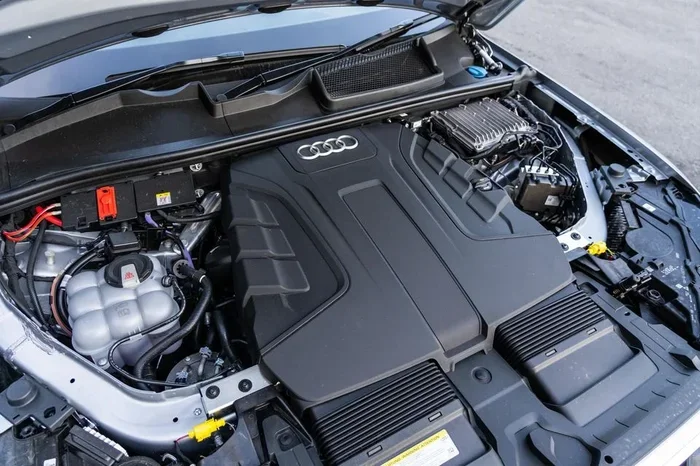
Visual guide about Audi Q7 engine bay closeup
Image source: images.carexpert.com.au
Turbocharger Wastegate Actuator Rattle / Failure
The new turbocharged 3.0T (EA839) uses an electronic wastegate actuator. The internal gear teeth strip or the position sensor fails, causing boost control errors. The turbo itself is usually fine, but the actuator is not sold separately by Audi—you must buy the whole turbocharger assembly.
Symptoms: Rattling noise from engine bay at idle/low rpm (sounds like a loose heat shield), check engine light with P0299 (underboost) or P0234 (overboost), limp mode.
Typical Repair Cost: OEM turbocharger assembly: $2,200–$3,000. Labor (tight engine bay): $800–$1,200. Total: $3,000–$4,200. Aftermarket upgraded actuators exist but require ECU tuning.
Pro Tip: Let the engine idle 30 seconds before shutting off after hard driving. This lets oil cool the turbo bearings and actuator, reducing thermal shock.
Virtual Cockpit / MMI Screen Delamination
The 12.3″ Virtual Cockpit (standard on Premium Plus/Prestige) and the 8.3″ MMI center screen suffer from adhesive failure between the glass and LCD layer. Bubbles or a “milky” appearance spread from the edges. It’s purely cosmetic but drives owners crazy. Audi extended warranty to 7 years/100,000 miles for some VINs (TSB 2048771), but many are now out of coverage.
Typical Repair Cost: Dealer replacement: $1,800–$2,500 per screen. Third-party refurbishers: $400–$700 with mail-in service.
Pro Tip: Avoid parking in direct sun with a black interior. Heat accelerates the adhesive breakdown. A windshield sunshade is a $20 investment that saves thousands.
Panoramic Sunroof Drain Clogs & Water Intrusion
The massive panoramic roof has four drain tubes that route water down the A- and C-pillars. Pine needles, pollen, and debris clog them. Water then overflows into the headliner, dripping onto the MMI control module (under the front passenger seat) or the rear entertainment system. Module replacement + water damage cleanup is pricey.
Typical Repair Cost: Drain cleaning: $150–$300. Headliner replacement (stained/moldy): $1,200–$2,000. MMI module (J523) replacement + coding: $800–$1,400.
Pro Tip: Blast compressed air down the drains (front corners of sunroof tray) every oil change. Pour a cup of water in the tray to verify flow exits behind front wheels and in front of rear wheels.
Third Generation / Facelift (2020–Present): Early Data Trends
The 2020 facelift brought mild-hybrid (MHEV) 48-volt systems, revised styling, and updated tech. It’s too early for high-mileage patterns, but early adopters report a few concerns.
48-Volt Belt Alternator Starter (BAS) Issues
The MHEV system uses a BAS unit mounted on the engine to provide mild electric assist and start-stop function. Early units show bearing noise or communication faults with the 48V control module. Replacement requires significant labor due to packaging.
Estimated Repair Cost: $2,500–$4,000 (limited data).
Pro Tip: Ensure all software updates (campaigns) are applied. Many “hardware” faults are resolved by updated calibration files.
Matrix LED Headlight Module Failure
The HD Matrix LED units are sealed assemblies. Internal LED driver failure or moisture ingress requires full unit replacement. They are VIN-coded and require online adaptation at the dealer.
Estimated Repair Cost: $2,000–$3,500 per side.
Pro Tip: Check for condensation inside the lens during PPI. Even a small amount warrants rejection or price reduction.
Cross-Generational Expensive Problems (All Years)
Some issues transcend generations. They are design characteristics of the platform or brand.
Brake Rotor Warping / Premature Wear
The Q7 is heavy (4,800–5,300 lbs). The factory rotors are relatively thin to save unsprung weight. They warp easily under heat, causing steering wheel shake under braking. Many owners upgrade to two-piece floating rotors (StopTech, AP Racing, 034Motorsport) for track use or mountain driving.
Typical Repair Cost: OEM pads + rotors (all four corners): $1,200–$1,800 at dealer. Aftermarket performance kit: $2,000–$3,500 but lasts 2–3x longer.
Wheel Bearing Failure
Unitized hub bearings on all four corners tend to growl by 70,000–100,000 miles. The rear bearings require a massive 12-point 36mm socket and 200+ ft-lbs torque. DIY is possible but needs serious tools.
Typical Repair Cost: $600–$900 per corner at shop. DIY parts: $150–$250 per bearing.
AdBlue / DEF System Crystallization (Diesel Models Only)
If you own the 3.0L TDI (2009–2012, 2014–2016), the Selective Catalytic Reduction (SCR) system uses Diesel Exhaust Fluid (DEF). The injector, pump, and tank heater fail frequently. Crystallized urea blocks lines. The tank heater recall (emissions fix) helped but didn’t eliminate failures.
Typical Repair Cost: DEF injector: $800–$1,200. Pump/heater assembly: $1,500–$2,500. Tank replacement: $1,200+.
Pro Tip: Use only API-certified DEF (blue jugs at truck stops). Cheap fluid crystallizes faster. Keep tank >25% full to prevent pump overheating.
Model Years to Avoid vs. Best Years to Buy
Based on complaint density (NHTSA, CarComplaints.com), repair frequency (RepairPal, TrueDelta), and TSB volume, here is the quick verdict:
Years to Approach with Extreme Caution (or Avoid)
- 2007–2009: First-year teething pains. 4.2L V8 timing chain guides, air suspension, electrical gremlins, brake wear. Highest complaint volume.
- 2011–2012: Introduction of 8-speed transmission + 3.0T supercharged. Mechatronic issues peak here. Fuel pump control module recalls.
- 2014–2015: Last year of gen 1. Still carries all gen 1 issues but with higher mileage now. Diesel emissions scandal uncertainty (TDI models).
Sweet Spot Years (Best Balance of Depreciation & Reliability)
- 2017–2019: Gen 2 with early bugs ironed out. Turbo 3.0T is stronger than supercharged. Virtual Cockpit standard on higher trims. Apple CarPlay/Android Auto added mid-2017.
- 2021+: Facelift with MHEV, updated infotainment (MMI Touch Response), better materials. Still depreciating hard—good used value emerging.
Did You Know? The 2016 model year is a “transition” year. It has the new body but the old MMI interface (rotary knob only, no touchscreen). Some buyers prefer the knob; others want the modern touchscreen. Prices are often lower than 2017+ for similar mileage.
Pre-Purchase Inspection (PPI) Checklist: What to Demand
Never buy a used Q7 without a PPI from an independent Audi/VW specialist (not the selling dealer). Bring this checklist. A thorough PPI costs $200–$400 and saves thousands.
Engine & Drivetrain
- Cold start video (owner starts it after sitting overnight). Listen for timing chain rattle.
- Scan for stored/pending codes with VCDS or ODIS (generic OBDII misses Audi-specific codes).
- Check timing chain deviation values (blocks 208/209 in VCDS). Should be < 3° crank / < 6° cam.
- Verify transmission fluid change history. Demand receipts. Dark/burnt fluid = walk away.
- Test drive for torque converter shudder at 35–45 mph light throttle.
- Check for oil leaks: valve cover gaskets, rear main seal, turbo oil feed/return lines.
Suspension & Brakes
- Measure ride height at all four corners (spec in owner’s manual). Sagging = bad air spring.
- Soapy water spray on air springs/lines to find leaks.
- Compressor duty cycle check (VCDS measuring block). >50% after leveling = failing compressor or leak.
- Brake rotor thickness measurement. Minimum spec stamped on rotor hat.
- Wheel bearing play check (dial indicator or shake test on lift).
Electronics & Body
- Test every button, screen, camera, sensor, seat motor, sunshade, door lock.
- Check Virtual Cockpit / MMI for delamination (shine flashlight at angle).
- Sunroof drain test: pour 16 oz water in each front tray corner, confirm exit at rocker panels.
- Battery health test (conductance tester). Q7 hates low voltage; throws ghost codes.
- Check for water in spare tire well (clogged sunroof drains or tail light gaskets).
- Verify all recalls completed (NHTSA VIN lookup).
Ownership Cost Mitigation Strategies
You love the Q7. You accept the risk. Now, how do you survive financially?
1. Find an Independent Audi/VW Specialist
Dealer labor rates run $180–$250/hr. Good independents charge $110–$150/hr and use OEM or equivalent parts (Mahle, Lemförder, Continental, ZF). They know the common faults and have the tools (VCDS/ODIS). Build a relationship. They will prioritize your car and give honest advice on what can wait.
2. Do Your Own Maintenance (The “Easy” Stuff)
Oil changes, brake pads/rotors, cabin/engine air filters, wiper blades, battery registration (with VCDS/OBDeleven), sunroof drain cleaning, coolant top-off. YouTube channels like “Humble Mechanic,” “FCP Euro,” and “Europian Auto Source” have step-by-step Q7 guides. A $300 tool kit pays for itself in one brake job.
3. Use Quality Parts, Not Cheap Parts
RockAuto “Economy” control arms last 15,000 miles. Lemförder (OEM supplier) last 80,000. The labor is the same. Buy once, cry once. FCP Euro offers a lifetime replacement guarantee on everything they sell—even wear items. That alone justifies their slightly higher price.
4. Consider an Extended Warranty (Carefully)
Third-party warranties (CARCHEX, Endurance, CarShield) are hit-or-miss. Read the contract. Look for: “wear and tear” coverage, no “betterment” clause, direct pay to shop, choice of repair facility. Exclusionary (bumper-to-bumper) plans are best. Expect $3,000–$5,000 for 3yr/36k on a used Q7. Do the math: one transmission claim pays for it.
5. Set Up a “Car Repair Fund”
Automate $150–$200/month into a high-yield savings account. When the air suspension goes, you pay cash. No credit card interest, no stress. Treat it like a subscription to driving a German luxury SUV.
Conclusion
The Audi Q7 is a magnificent machine. It hauls seven people in leather-clad silence, tows 7,000 lbs, and carves corners like a sport sedan. But it is a complex German engineering showcase, and complexity has a price tag. The first generation (2007–2015) is a minefield of timing chains, air bags, and mechatronics. The second generation (2016–2019) fixes most mechanical sins but introduces screen delamination and turbo actuator quirks. The newest models add 48-volt mild-hybrid complexity we are still watching.
Knowledge is your best tool. Know the symptoms. Keep the maintenance receipts. Find a great independent shop. Budget for the inevitable. If you do those things, the Q7 rewards you with an ownership experience few SUVs can match. If you ignore them, well… you’ll be donating to your mechanic’s retirement fund. Drive smart, maintain proactively, and enjoy the view from that commanding driver’s seat.
Frequently Asked Questions
What is the most expensive common repair on an Audi Q7?
The most expensive common repair is timing chain system failure on the 3.0T supercharged engine (2009–2015), which can cost $8,000–$12,000+ if the chain jumps and destroys the engine. A full transmission rebuild on the 8-speed Tiptronic runs a close second at $6,000–$8,000.
Which Audi Q7 model years are the most reliable?
The 2017–2019 model years (second generation, post-facelift) are widely considered the most reliable. They benefit from the turbocharged 3.0T engine, proven 8-speed transmission, and resolved early electronics bugs, while avoiding the new 48-volt mild-hybrid complexity of 2020+ models.
How much does it cost to replace the air suspension on an Audi Q7?
Replacing a single air spring costs $1,200–$1,800 at a dealer. Replacing all four corners plus the compressor can total $4,000–$6,000. Many owners opt for a coil-spring conversion kit ($2,500–$3,500 installed) to eliminate the system permanently.
Does the Audi Q7 have timing belt or timing chain issues?
All Q7 engines use timing chains. The 3.0T supercharged V6 (2009–2015) has a well-documented tensioner and guide rail failure issue. The newer turbocharged 3.0T (2017+) and 4.0T V8 have significantly fewer timing chain reports but should still be inspected at higher mileage.
Is the Audi Q7 expensive to maintain compared to other luxury SUVs?
Yes. RepairPal rates the Q7 2.5/5 for reliability with an average annual repair cost of $1,185, significantly higher than the $800 luxury SUV average. Complex systems (air suspension, 48V mild-hybrid, Matrix LEDs) and high labor rates drive costs up.
Can I prevent carbon buildup on my Q7’s intake valves?
You cannot fully prevent it on direct-injection engines, but you can slow it significantly. Use top-tier fuel, change oil every 5,000 miles with correct spec, install a quality oil catch can, and avoid excessive idling. Plan on walnut blasting every 60,000–80,000 miles as routine maintenance.