

Featured image for Range Rover engine repair
Image source: i.ytimg.com
Range Rovers offer unmatched luxury but come with notorious reliability issues that can cost thousands. From air suspension failures to timing chain defects, this guide breaks down the most expensive problems by model year so you can budget wisely and avoid buyer’s remorse.
You have dreamed about owning a Range Rover for years. The commanding view. The whisper-quiet cabin. That unmistakable silhouette in your driveway. Then the repair bills start arriving. Suddenly, that dream feels more like a financial hostage situation.
Let’s be honest. Range Rovers are engineering marvels wrapped in British leather. They are also famously complex machines that punish deferred maintenance without mercy. If you own one, plan to buy one, or just want to understand why your mechanic drives a nicer car than you do, this guide is for you. We will walk through the most expensive common problems, what causes them, what they cost to fix, and how to spot trouble before it bankrupts you.
Key Takeaways
- Air suspension failure is the #1 expensive repair: Expect $2,500-$4,000 per corner for compressor and bag replacement on 2013-2022 models.
- Timing chain issues plague V8 engines: 2010-2019 Supercharged V8s often need $3,000-$5,000 chain tensioner repairs before 80,000 miles.
- Electrical gremlins drain wallets fast: Module failures, pixelating screens, and battery drain issues average $1,200-$3,500 per incident.
- Transmission valve body failures are common: 8-speed ZF transmissions in 2013-2019 models may need $2,800-$4,500 rebuilds.
- Coolant leaks hide in plain sight: Supercharger coolant pumps and plastic crossover pipes fail regularly, risking $8,000+ engine replacement if ignored.
- Pre-purchase inspections save thousands: A $300 specialist inspection catches 90% of major issues before you sign paperwork.
- Extended warranties often pay for themselves: Third-party coverage costs $3,000-$5,000 but one air suspension repair covers the premium.
📑 Table of Contents
- The Air Suspension Nightmare
- The Timing Chain Ticking Time Bomb
- Electrical System: The Ghost in the Machine
- Transmission Valve Body and Mechatronics Failures
- Cooling System: The Silent Engine Killer
- Brake System: Big Rotors, Big Bills
- Model Year Guide: What to Avoid, What to Seek
- Ownership Strategies: How to Survive and Thrive
- Conclusion
The Air Suspension Nightmare
If you talk to ten Range Rover owners, nine will mention air suspension. The tenth is probably lying or leasing. The system is brilliant when it works. It lowers the truck for easy entry, raises it for off-road clearance, and keeps the ride flat as a billiard table on the highway. When it fails, your SUV sits on its bump stops looking like a sad lowrider.
How the System Works
Think of air suspension like four heavy-duty balloons, one at each corner. An electric compressor fills them. Height sensors tell the computer how much air each corner needs. Solenoid valves release air to lower the truck. It is a pneumatic ballet controlled by software. When any dancer misses a step, the show stops.
Common Failure Points
The air springs (those balloons) dry rot and crack. The compressor burns out from overworking to compensate for leaks. The valve block corrodes internally. Height sensors snap off when you hit a pothole. The air lines chafe against the frame and leak. Any single failure triggers a fault code and disables the whole system.
Real World Costs
Replacing one air spring costs $800-$1,200 installed. The compressor runs $600-$900. The valve block is $400-$700. Labor adds up fast because everything is buried behind heat shields and subframes. A full four-corner overhaul at a dealer hits $4,000-$6,000. Independent specialists charge $2,500-$3,500. Did you know? The 2013-2019 L405 generation uses a revised compressor that still fails at roughly 70,000-90,000 miles.
Warning Signs to Watch
- Morning sag on one corner
- Compressor running longer than 30 seconds at startup
- “Suspension Fault” message that clears after restart
- Vehicle leaning in corners
- Hissing sound near wheel wells
Pro Tip: The Soapy Water Test
Mix dish soap and water in a spray bottle. Spray the air springs, lines, and valve block connections while the system is pressurized. Bubbles reveal leaks instantly. This $2 test saves hours of diagnostic time.
The Timing Chain Ticking Time Bomb
Range Rover V8 engines use timing chains instead of belts. Chains are supposed to last the life of the engine. On paper, that sounds great. In reality, the chain tensioners and guides on certain engines wear out shockingly fast. When they fail, the chain slaps around like a loose belt in a dryer. Best case: catastrophic noise. Worst case: the chain jumps teeth, valves hit pistons, and your engine becomes a very expensive paperweight.
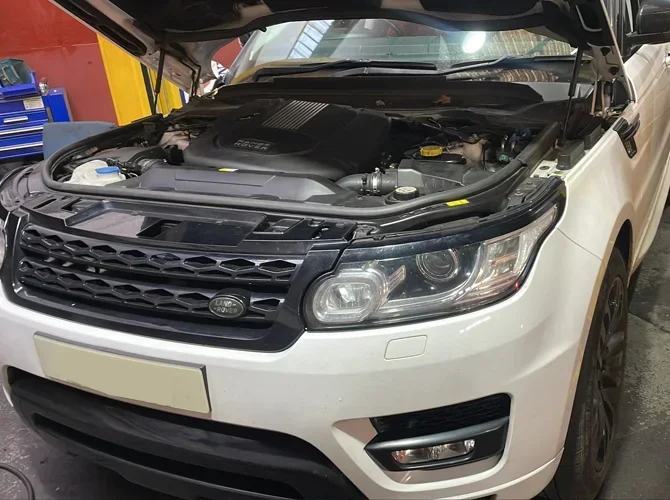
Visual guide about Range Rover engine repair
Image source: rangeroverengine.co.uk
The Affected Engines
The 5.0-liter Supercharged V8 (LR-V8) in 2010-2019 models is the main culprit. The naturally aspirated 5.0-liter in 2010-2013 models shares the same tensioner design. Jaguar F-Type and XJ models with this engine suffer identical issues. Did you know? Land Rover issued a technical service bulletin updating the tensioner design in 2018, but many 2019 models still received the old parts.
Why It Happens
The original tensioners use a plastic guide shoe that wears prematurely. Oil pressure activates the tensioner, but the ratchet mechanism can stick. Supercharged engines produce massive torque at low RPM, hammering the chain constantly. Short trips prevent oil from reaching full temperature, accelerating wear. It is a perfect storm of design flaw and driving conditions.
Symptoms and Diagnosis
Cold start rattle lasting 2-5 seconds is the classic sign. It sounds like marbles in a tin can. The noise vanishes once oil pressure builds. A mechanic’s stethoscope on the timing cover confirms it. Some owners report a check engine light with camshaft correlation codes (P0016, P0017). Do not ignore these. The repair window between noise and destruction can be as short as 500 miles.
Repair Reality
Timing chain replacement requires removing the supercharger, intake manifolds, valve covers, and front engine cover. It is a 15-20 hour job. Parts kits run $1,200-$1,800 for quality components. Labor at $150-$200 per hour brings the total to $3,500-$5,500. Dealers charge $6,000-$8,000. Pro tip: Replace the water pump, thermostat, and drive belts while everything is apart. It adds $300 in parts but saves 10 hours of future labor.
Electrical System: The Ghost in the Machine
Modern Range Rovers contain over 100 electronic control modules. They talk to each other on multiple CAN bus networks. They manage everything from adaptive dynamics to the glovebox light. When communication breaks down, weird things happen. Your seat moves backward while driving. The radio forgets your presets. The truck won’t start because it thinks the key fob is inside when it’s in your pocket.
Module Failure Patterns
The Gateway Module (central communication hub) fails frequently on 2013-2019 models. Symptoms include random warning lights, non-functional features, and battery drain. The Body Control Module controls locks, windows, and lights. Water intrusion from clogged sunroof drains kills these regularly. The InControl Touch Pro infotainment system suffers from pixelating screens, frozen navigation, and Bluetooth amnesia.
Battery Drain Mysteries
Parasitic draw is the silent killer. A module fails to “sleep” when you lock the doors. It keeps drawing 500 milliamps instead of 20. Your battery dies in three days. Dealers often replace the battery ($400-$600 for AGM) without finding the draw. Two weeks later, the new battery is dead. Proper diagnosis requires a thermal camera or amp clamp to isolate the awake circuit.
Software Updates: The Double-Edged Sword
Jaguar Land Rover releases software updates constantly. Some fix bugs. Others introduce new ones. The 2019-2020 infotainment update bricked thousands of screens, requiring $1,800 replacement units. Always research an update on owner forums before authorizing it. Did you know? A 2021 study by Consumer Reports found Range Rover electrical complaints were 3x higher than the luxury SUV average.
Budgeting for Electrical Gremlins
Diagnostic time alone costs $200-$400. Module replacement runs $800-$2,500 plus programming. Infotainment screen replacement is $1,800-$2,800. Battery replacement with registration is $400-$600. Set aside $2,000 annually for electrical surprises on any out-of-warranty Range Rover.
Transmission Valve Body and Mechatronics Failures
The 8-speed ZF 8HP transmission is a masterpiece of engineering. It shifts faster than you can blink. It handles 500+ lb-ft of torque smoothly. But the mechatronic unit (valve body plus integrated TCU) has a weak spot. Internal solenoids stick. Pressure regulators wear. The plastic oil pan/warmer assembly cracks. When this unit fails, you lose gears, get harsh shifts, or the truck enters limp mode.
Which Models Are Affected
All 2013-2019 L405 Range Rovers and 2014-2019 Sport models use the 8HP70 or 8HP90. The 2020+ models received updated mechatronics with revised solenoids and a metal oil pan. Early 2013-2015 units are the most failure-prone. Did you know? ZF recommends fluid changes every 60,000 miles. Land Rover calls it “lifetime fluid.” Guess who pays for the difference?
Failure Symptoms
- Harsh 2-3 or 3-4 upshifts when cold
- Flare between gears (RPM spikes)
- Delayed engagement from Park to Drive
- Transmission fault message, limited to 3rd gear
- Shudder at light throttle (torque converter clutch issue)
Repair Options and Costs
A new mechatronic unit from ZF costs $2,200-$2,800. Remanufactured units with warranties run $1,500-$2,000. Labor is 6-8 hours. Total installed: $2,800-$4,500. Some specialists can rebuild your original unit for $1,200-$1,800 if the housing isn’t damaged. Critical tip: Always replace the plastic oil pan/warmer ($350) and fill with genuine ZF LifeGuard Fluid 8 ($40/liter, needs 8-10 liters) during any transmission service.
Prevention Is Cheap
A transmission fluid and filter service every 50,000-60,000 miles costs $400-$600 at an independent shop. It replaces the filter integrated into the oil pan and refreshes the fluid. This single service prevents 80% of mechatronic failures. Think of it as $500 insurance against a $4,000 repair.
Cooling System: The Silent Engine Killer
Range Rover cooling systems are complex. Multiple electric water pumps. Plastic crossover pipes. Supercharger intercooler circuits. Thermostat housings that warp. When any component fails, the aluminum block and heads overheat fast. Aluminum does not forgive overheating. Warped heads, blown head gaskets, and cracked blocks follow quickly.
Supercharger Coolant Pump Failure
The supercharged V8 has a dedicated electric pump for the intercooler circuit. It runs after shutdown to heat-soak the supercharger. These pumps fail around 60,000-80,000 miles. The pump seizes, the circuit overheats, and the supercharger rotors warp. A new supercharger is $3,500-$4,500. The pump is $350. Do the math.
Plastic Crossover Pipe Syndrome
The coolant pipe connecting the two cylinder heads across the back of the engine is plastic. It becomes brittle from heat cycles. It cracks without warning, dumping all coolant in seconds. If the driver doesn’t shut down instantly, the engine destroys itself. Replacement pipe kits use aluminum. Cost: $400 parts, 4 hours labor. Pro tip: Replace this pipe proactively at 70,000 miles or during any major engine service.
Thermostat Housing Wars
The thermostat housing is plastic. The temperature sensor threads strip. The housing warps and leaks. The thermostat itself fails stuck open (poor heat, bad fuel economy) or closed (overheating). Updated aluminum housings exist. Insist on them. Cost: $250 parts, 2 hours labor.
The $8,000 Lesson
A 2016 Range Rover Sport owner ignored a “Coolant Level Low” message for two weeks, topping off occasionally. The crossover pipe burst on the highway. She drove two miles “to find a safe spot.” The engine seized. Dealer quote: $18,000 for a remanufactured long block. Used engine install: $8,500. Total loss on a $45,000 vehicle. Did you know? The dashboard coolant warning gives you roughly 30 seconds before damage begins. Pull over immediately.
Brake System: Big Rotors, Big Bills
Range Rovers are heavy. A 2020 Autobiography tips the scales at 5,500 pounds. Stopping that mass requires massive brakes. Front rotors are 380mm or 398mm. Rear are 365mm or 380mm. They work brilliantly. They also wear like pencil erasers.
Rotor Warping Reality
The rotors are drilled or slotted for cooling. They are also relatively thin for weight savings. Heat cycling warps them. You feel it as steering wheel vibration during braking. Resurfacing removes too much material. Replacement is mandatory. Front rotor set: $600-$900. Rear: $500-$700. Pads: $300-$500 per axle. Labor: 2-3 hours. A four-corner brake job runs $1,800-$2,800 at a dealer. Independents charge $1,200-$1,800.
Electronic Parking Brake Actuators
The EPB motors on the rear calipers fail. They seize or strip gears. The dash shows “Parking Brake Fault.” The car won’t release the brake or won’t apply it. Replacement actuators are $400-$600 each. Labor is 1.5 hours per side. Both sides usually fail within 6 months of each other. Budget $1,500-$2,200 for the pair.
Brake Fluid: The Forgotten Fluid
Range Rover brake systems are hygroscopic magnets. The fluid absorbs water fast. Water lowers boiling point. Hard braking boils the fluid. Pedal goes to floor. Change fluid every 2 years regardless of mileage. Use DOT 4 LV (low viscosity) only. Cost: $120-$180 at a shop. Cheap insurance.
Model Year Guide: What to Avoid, What to Seek
Not all Range Rovers are created equal. Model year changes dramatically affect reliability. Here is your cheat sheet.
2010-2012 (L322 Final Years)
Ford-era build quality. Simple 6-speed ZF transmission. Hydraulic power steering (reliable). But: timing chain tensioners on all V8s. Air suspension compressors fail early. Brake rotors warp fast. Electrical connectors corrode. Good if priced right and chains are done.
2013-2015 (L405 Launch)
All-new aluminum body. 8-speed transmission. Electric power steering. First-year electronics glitches. Transmission mechatronics weakest here. Infotainment system (InControl Touch) is slow and buggy. Air suspension revised but still fails. Avoid unless heavily discounted and documented repairs exist.
2016-2018 (Mid-Cycle Refresh)
Improved infotainment (Touch Pro). Revised transmission solenoids. Better air spring material. But: timing chain tensioners still old design. Supercharger coolant pumps still fail. Electrical modules still sensitive. Sweet spot if chains updated and coolant pump replaced.
2019 (Final Supercharged V8)
Last year of the 5.0 SC V8. Some got updated tensioners (check build date). Android Auto/Apple CarPlay standard. Still has plastic coolant pipe. Still has mechatronic issues. Prices high due to “last V8” demand. Verify tensioner update documentation.
2020-2021 (New Inline-6 Mild Hybrid)
All-new 3.0L inline-6 with 48V mild hybrid. No timing chain issues (chain is robust). New 8-speed with updated mechatronic. Metal transmission pan. Electronic air suspension (no compressor). Too new for long-term data. Early software bugs. Complex 48V system adds failure modes.
2022+ (Facelift, PHEV Options)
Updated styling. P400e plug-in hybrid adds high-voltage complexity. Meridian Signature sound system (amp failures reported). Still early. Depreciation steep. Warranty coverage helps.
Ownership Strategies: How to Survive and Thrive
You can enjoy Range Rover ownership without financial ruin. It requires discipline, knowledge, and a good specialist.
Find a Specialist, Not a Dealer
Dealers charge $200-$250/hour. They follow flowcharts. They replace entire assemblies. Independent Land Rover specialists charge $120-$160/hour. They diagnose root causes. They rebuild instead of replace. They know the common faults intimately. A specialist saves you 30-50% on major repairs. Find one via Rover forums, not Google reviews.
The Pre-Purchase Inspection (PPI) is Non-Negotiable
Spend $300-$500 on a specialist PPI before buying any used Range Rover. No exceptions. The PPI must include: cold start video for chain noise, air suspension leak test, transmission adaptation values check, module fault code scan (all modules, not just engine), coolant pressure test, brake rotor runout measurement, and battery health test. A clean PPI is worth $3,000 in negotiating power. A dirty PPI saves you from a $15,000 mistake.
Maintenance Schedule: The Real One
Ignore the dealer “lifetime fluid” schedule. Follow this instead:
- Engine oil: 7,500 miles or 12 months (full synthetic 0W-20 or 5W-20)
- Transmission fluid/filter: 50,000 miles
- Transfer case fluid: 50,000 miles
- Front/rear differential fluid: 50,000 miles
- Brake fluid: 2 years
- Coolant: 5 years / 100,000 miles (use OEM pink concentrate)
- Spark plugs: 60,000 miles (supercharged), 90,000 miles (naturally aspirated)
- Supercharger oil: 60,000 miles (separate reservoir)
- Air suspension inspection: every oil change (visual + leak test)
Extended Warranty: Do the Math
Third-party warranties (CARCHEX, Endurance, etc.) cost $3,000-$5,000 for 3-4 years on a 50,000-mile truck. One air suspension compressor replacement pays for the warranty. One timing chain job pays for it twice. Read the fine print: “wear and tear” exclusions often deny air spring claims. “Sealed system” clauses deny transmission claims. Choose a policy with “breakdown” coverage, not “wear.” Get it in writing.
DIY What You Can
You can save thousands doing simple work yourself. Cabin air filters (20 mins, $40). Engine air filters (30 mins, $60). Battery registration with a $50 OBD tool. Brake fluid flush with a $30 motive bleeder. Wiper blades. Light bulbs. Software updates via JLR SDD/Pathfinder (if you invest in a $200 VCI interface). Every hour you turn a wrench is $150 you keep.
Conclusion
Range Rovers are not appliances. They are high-performance luxury machines that demand respect, attention, and a healthy repair fund. The problems we covered — air suspension, timing chains, electrical gremlins, transmission mechatronics, cooling system failures, brake costs — are real. They are expensive. They are also predictable.
Knowledge changes everything. When you know the weak spots, you watch for early signs. You budget for the inevitable. You find a specialist who knows these trucks better than the engineers who designed them. You perform preventive maintenance on a realistic schedule. You buy smart with a thorough PPI.
Do these things, and a Range Rover delivers an ownership experience nothing else matches. That commanding view. That whisper-quiet cabin. That feeling of effortless capability whether you’re navigating a blizzard or a valet line. The bills are the price of admission for automotive excellence. Pay them wisely, and the journey is worth every penny.
Now go check your air suspension. I’ll wait.
Frequently Asked Questions
What is the most expensive common repair on a Range Rover?
The most expensive common repair is engine replacement due to timing chain failure or overheating, costing $8,000-$18,000. Air suspension overhauls ($3,000-$6,000) and transmission mechatronic replacement ($3,000-$4,500) are the next most costly frequent repairs.
Which Range Rover years are most reliable?
The 2016-2018 model years (L405 generation) are generally considered the most reliable of the supercharged V8 era, provided the timing chain tensioners have been updated and the supercharger coolant pump replaced. The 2020+ inline-6 models show promise but lack long-term data.
How much should I budget annually for Range Rover maintenance?
Budget $3,000-$5,000 per year for maintenance and repairs on an out-of-warranty Range Rover with 60,000+ miles. This covers fluid services, brake work, tire replacements, and provides a reserve for inevitable electrical or suspension issues.
Can I convert Range Rover air suspension to coil springs?
Yes, aftermarket coil spring conversion kits exist ($1,500-$2,500 installed) and eliminate air suspension failures permanently. However, you lose adjustable ride height, load leveling, and the “Access” entry mode. Resale value may decrease as many buyers want factory air suspension.
What causes Range Rover battery drain overnight?
Parasitic draw from a module failing to sleep is the most common cause. The gateway module, body control module, and infotainment system are frequent culprits. A healthy Range Rover should draw less than 30 milliamps after 30 minutes asleep. Anything over 50 milliamps will kill the battery in days.
Is the Range Rover 3.0L inline-6 engine reliable?
Early data suggests the 2020+ 3.0L inline-6 (Ingenium) with 48V mild hybrid is significantly more reliable than the supercharged V8. It uses a robust timing chain design, has no supercharger coolant pump, and features a metal transmission pan. Long-term durability beyond 100,000 miles is still being established.