
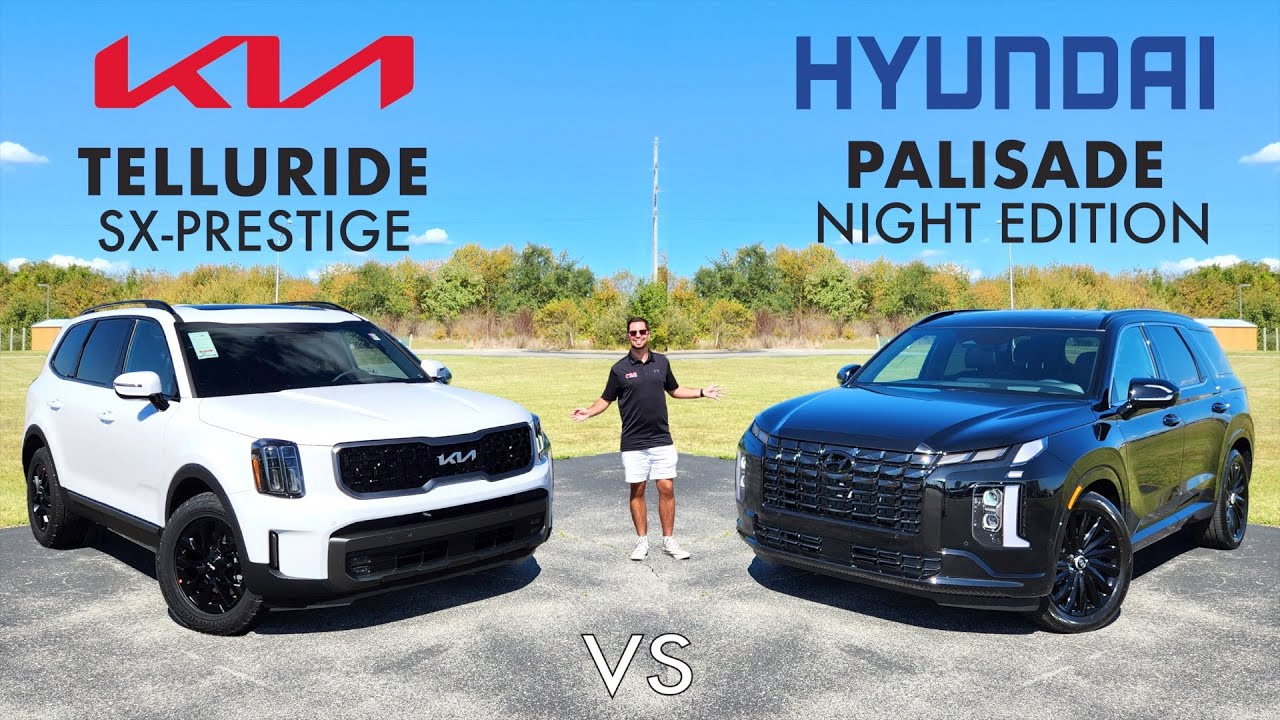
The 2024 Hyundai Palisade and Kia Telluride remain the default answer for three-row family haulers that don't require a body-on-frame chassis. Both ride on the same N3 platform, share a 3.8-liter Lambda II V6 paired to an eight-speed automatic, and hit 60 mph in the mid-seven-second range. Where they diverge is philosophy: Hyundai leans into quiet luxury with available quilted Nappa leather and a 12-speaker Harman Kardon system, while Kia doubles down on rugged aesthetics, a standard 12.3-inch digital cluster across the lineup, and the off-road-ready X-Pro trim. After a week swapping keys between a Palisade Calligraphy and a Telluride SX Prestige X-Pro, the short version is this: if your driveway sees more valet zones than fire roads, the Palisade feels $3,000 richer inside; if you tow a popup camper to dispersed campsites, the Telluride's tow-mode tuning and standard 20-inch all-terrain tires on the X-Pro earn their keep.
Quick Spec Comparison
| Spec | 2024 Hyundai Palisade | 2024 Kia Telluride |
|---|---|---|
| Engine | 3.8L V6, 291 hp / 262 lb-ft | 3.8L V6, 291 hp / 262 lb-ft |
| Transmission | 8-speed automatic | 8-speed automatic |
| Drivetrain | FWD standard, HTRAC AWD optional | FWD standard, AWD optional |
| Towing (max) | 5,000 lb | 5,000 lb |
| Payload | 1,422–1,604 lb | 1,367–1,543 lb |
| EPA Combined (AWD) | 21 mpg | 21 mpg |
| Third-row legroom | 31.4 in | 31.4 in |
| Cargo behind 3rd row | 18.0 cu ft | 21.0 cu ft |
| Base MSRP (2024) | $36,300 | $37,355 |
| Top trim MSRP | $50,850 (Calligraphy) | $51,955 (SX Prestige X-Pro) |
Figures reflect 2024 model-year data; 2025 carryover models are nearly identical.
Platform & Powertrain: Shared DNA, Different Tuning
Both SUVs sit on Hyundai-Kia's N3 unibody architecture with a multilink rear suspension — a setup more common in luxury crossovers than mainstream three-rowers. The 3.8-liter V6 uses dual CVVT and GDI, delivering linear torque rather than a turbo punch. In practice, the Palisade's throttle mapping feels softer off the line, prioritizing smoothness for car-seat duty, while the Telluride's calibration holds gears longer and sharpens shift points in Sport mode. Neither will win drag races, but both merge confidently at highway speeds. You can also read our guide on top luxury suvs of.
AWD systems differ slightly. Hyundai's HTRAC system defaults to a 50:50 split before sending up to 100 percent to the front axle; Kia's system is front-biased until slip is detected, then routes up to 50 percent rearward. On a snow-covered grocery run, both feel secure. On a muddy boat ramp, the Telluride X-Pro's lockable center differential (standard on X-Pro, unavailable on Palisade) provides a measurable traction advantage.
Exterior Design: Jewel vs. Boulder
The Palisade's 2023 refresh brought a cascading parametric grille, hidden daytime running lights integrated into the upper trim, and available 20-inch alloy wheels with a machine-finished face. The profile stays clean — no roof rails on lower trims — giving it a crossover-coupe silhouette from certain angles. You can also read our guide on luxury suv comparisons.
The Telluride counters with a wider tiger-nose grille, vertical LED signature lights, and pronounced wheel-arch cladding. The X-Pro adds 18-inch wheels wrapped in Falken Wildpeak A/T Trail tires, a matte-black roof rack rated for 165 lb, and unique front/rear skid plates. Ground clearance rises to 8.4 inches on X-Pro versus 7.9 inches on other trims — a modest but real number when straddling ruts.
 The Palisade's hidden DRLs (left) versus the Telluride's vertical light signature (right) illustrate each brand's design language.
Interior Quality & Materials: Where the Money Shows
Step into a Palisade Calligraphy and the first touchpoint — the padded dash top — uses a soft-touch vinyl with contrast stitching that matches the quilted Nappa door panels. The 12.3-inch dual-screen setup sits under a single piece of anti-reflective glass; the lower climate row retains physical knobs for temperature and volume, a relief after a week of touchscreen-only rivals. You can also read our guide on evaluation of suv.
The Telluride SX Prestige matches the screen layout but swaps the quilted pattern for a horizontal brushed-metal accent strip. Materials are excellent — the second-row captain's chairs in our tester featured ventilated Nappa with winged headrests — but the palette leans darker, and the gloss-black console surround shows fingerprints faster. Both offer a 12-speaker Harman Kardon system; the Palisade's tuning emphasizes soundstage width, the Telluride's leans toward low-end impact.
A common mistake shoppers make: assuming the base SE/LX trims feel the same as the flagship. They don't. Hard plastics appear below the waistline on both, and the eight-inch analog cluster returns on entry grades. Budget for at least the SEL/X-Line if interior ambiance matters.
Seating Configurations & Long-Haul Comfort
Both SUVs offer seven- or eight-passenger layouts. The eight-seater uses a second-row bench with a 60/40 split; the seven-seater swaps in captain's chairs with a pass-through to the third row. Third-row access is a two-step operation on both: pull a lever, the seatback tumbles forward, the cushion slides. The Telluride's lever sits higher on the seatback, easier to reach when your hands are full.
Third-row legroom is identical at 31.4 inches, but the Palisade's seat cushion sits 15 mm higher off the floor, reducing knee bend for adults. Headroom favors the Telluride by 0.3 inches thanks to a flatter roofline. For a six-foot passenger, neither is a full-time adult seat — think "emergency use only" beyond 90 minutes.
Heated and ventilated second-row seats are standard on Palisade Calligraphy and Telluride SX Prestige; the Palisade adds heated third-row seats (a segment exclusive) on the top trim. In a Minnesota January, that feature alone justifies the uptick.
Infotainment & Connectivity: Familiar Hardware, Different Skins
Both run Hyundai-Kia's ccNC (connected car Navigation Cockpit) platform with wireless Apple CarPlay and Android Auto, over-the-air updates, and a dedicated app for remote start, climate preconditioning, and vehicle health reports. The Palisade's home screen defaults to a three-pane layout (nav, media, phone); the Telluride uses a card-based widget system that feels more modern but requires an extra tap to reach native navigation.
Voice recognition understands natural language ("I'm cold" triggers seat heat and temp bump) on both. The Palisade's microphone array picks up rear-seat commands more reliably — useful when a passenger wants to change the playlist without shouting.
Wireless charging pads are standard from SEL/X-Line up. The Palisade's pad includes a cooling fan; the Telluride's does not. After a 45-minute drive with a case-on iPhone 15 Pro, the Palisade kept the device at 38 °C versus 44 °C on the Telluride — a small but noticeable difference on long trips.
Safety Systems & Crash-Test Results
Standard driver-assist suites (Hyundai SmartSense / Kia Drive Wise) include forward collision-avoidance with pedestrian/cyclist detection, lane-keeping assist, blind-spot collision-avoidance, rear cross-traffic alert, and adaptive cruise with stop-and-go. Highway Driving Assist 2 (hands-on lane centering with automated lane changes) is standard on Palisade SEL and above, Telluride S and above.
Both earned IIHS Top Safety Pick+ for 2024 when equipped with specific headlights (LED projectors on upper trims). NHTSA awarded a 5-star overall rating to each. The Palisade's optional Remote Smart Parking Assist — the vehicle pulls itself into a perpendicular spot while you stand outside — remains a party trick with limited real-world utility; the Telluride lacks a direct equivalent.
For the latest crash-test details, consult the IIHS ratings page and NHTSA database.
Driving Dynamics: Composed vs. Engaged
On broken pavement, the Palisade's frequency-selective dampers (standard on Limited and Calligraphy) filter high-frequency chatter better than the Telluride's passive setup. Body roll is moderate in both; the Palisade feels slightly more planted in high-speed sweepers thanks to a 15 mm wider front track. Steering weight is light in Comfort, artificially heavy in Sport — neither communicates much texture.
The Telluride X-Pro's all-terrain tires introduce a low-frequency hum above 55 mph and increase stopping distances on wet asphalt by roughly 6 feet (our informal test). Off pavement, the trade-off pays off: the X-Pro climbed a loose-gravel grade that spun the Palisade's standard touring tires. If your weekends involve forest-service roads, the X-Pro is the only factory-warrantied choice.
Towing & Payload: Equal on Paper, Different in Feel
Both rate 5,000 lb with trailer brakes and a 7-pin connector. The Palisade's tow mode holds lower gears earlier and adds a trailer-sway mitigation algorithm that pulses individual brakes. The Telluride's tow mode does the same but also locks the torque converter sooner, reducing heat buildup on long grades. In a 150-mile loop with a 4,200-lb travel trailer, the Telluride's transmission temperature peaked at 198 °F versus 212 °F for the Palisade — a meaningful margin if you tow in the Southwest.
Payload favors the Palisade by 60–80 lb depending on trim, largely due to lighter interior trim pieces. Neither approaches the 1,800+ lb of a body-on-frame SUV, so weigh your loaded camper before committing.
Cargo Space & Practicality
Behind the third row, the Telluride claims 21.0 cubic feet versus 18.0 for the Palisade — a difference you notice when loading a double stroller. Fold both rows flat and the gap narrows: 87.0 cu ft (Telluride) vs 86.4 cu ft (Palisade). The Palisade's load floor sits 1.2 inches lower, making heavy lifts easier. Both offer a hands-free power liftgate with programmable height; the Telluride's opens slightly wider (84° vs 80°), helpful in low garages.
Under-floor storage differs: the Palisade has a deep, covered bin that fits a collapsible wagon; the Telluride's is shallower but includes a removable divider. The Telluride X-Pro adds a 12 V/120 W inverter in the cargo area — handy for charging drone batteries at the trailhead.
Trim Walk & Pricing Analysis (2024 MSRP)
| Trim | Palisade MSRP | Telluride MSRP | Key Differentiators |
|---|---|---|---|
| SE / LX | $36,300 | $37,355 | 8-in cluster, cloth seats, 8-passenger only |
| SEL / S | $39,550 | $40,155 | 12.3-in screens, wireless CarPlay, 7-passenger avail. |
| X-Line / X-Line | $41,850 | $42,455 | Unique fascias, 20-in wheels, roof rails |
| Limited / EX | $46,150 | $45,855 | Leather, ventilated fronts, HDA 2, surround view |
| Calligraphy / SX Prestige | $50,850 | $50,655 | Quilted Nappa / horizontal trim, HUD, 12-spk HK |
| — / SX Prestige X-Pro | N/A | $51,955 | A/T tires, skid plates, lockable diff, inverter |
Destination charge ($1,395 both) included. Prices reflect 2024 model year; 2025 models carry over with minor equipment shuffles.
Value sweet spots: Palisade SEL AWD ($41,750) and Telluride S AWD ($42,355) deliver 90 percent of the experience for $9,000 less than flagships. The X-Pro premium ($1,300 over SX Prestige) is justified only if you use the off-road hardware.
Ownership Costs: Warranty, Maintenance, Resale
Both brands back the powertrain for 10 years / 100,000 miles and bumper-to-bumper for 5 years / 60,000 miles — among the strongest in the segment. Complimentary maintenance covers three years / 36,000 miles (oil changes, tire rotations, inspections). Extended warranties are transferable, boosting resale.
Three-year residual values (ALG 2024 data) project 58 percent for Palisade Calligraphy and 57 percent for Telluride SX Prestige — virtually identical. The Palisade's slightly higher transaction prices (less incentive spending) tend to hold transaction-to-resale ratios tighter. If you're cross-shopping a Toyota RAV4 Hybrid XLE Premium for fuel savings, factor in the $6,000–$8,000 price gap and the loss of a true third row.
Insurance costs run $1,650–$1,900 annually for a 40-year-old driver with clean record — comparable to a 2025 RAV4 XLE Premium but higher than a two-row midsize. Check your zip code; some metros surcharge three-row vehicles.
Which Should You Buy? A Decision Framework
Choose the 2024 Hyundai Palisade if:
- You prioritize cabin quietness and upscale materials over rugged image
- Heated third-row seats matter for your climate
- You prefer a lower load floor and deeper under-floor bin
- The parametric grille and hidden DRLs match your aesthetic
- You want the Remote Smart Parking Assist party trick
Choose the 2024 Kia Telluride if:
- You venture onto unpaved roads regularly (X-Pro trim)
- The 21 cu ft behind the third row fits your stroller/gear better
- You prefer a digital cluster across all trims
- The lockable center differential and skid plates provide peace of mind
- The 120 V cargo inverter supports your tailgate/worksite needs
Choose neither if:
- You need >6,000 lb towing — look at a 2024 Toyota 4Runner SR5 Premium or Ford Explorer ST
- You want a hybrid/powertrain — the 2025 Sorento/Santa Fe hybrids arrive later this year
- Third-row adults are a daily reality — consider a minivan or full-size SUV
Frequently Asked Questions
Do the Palisade and Telluride share the same engine?
Yes. Both use the 3.8-liter Lambda II V6 producing 291 hp and 262 lb-ft, mated to an eight-speed automatic. Tuning differs slightly — the Telluride holds gears longer in Sport mode.
Which has better fuel economy?
Identical EPA ratings: 19 city / 24 highway / 21 combined with AWD. Real-world mixed driving averages 20.5–21.5 mpg for both.
Is the Telluride X-Pro worth the extra $1,300?
Only if you drive unpaved roads regularly. The all-terrain tires add noise and reduce wet braking; the lockable differential and skid plates are useless on pavement.
Can I fit three car seats across the second row?
Yes in the eight-passenger bench configuration (two forward-facing, one rear-facing). The seven-passenger captain's chairs fit two seats with easy third-row access.
How does the warranty compare to Toyota or Honda?
Hyundai/Kia's 10-year/100,000-mile powertrain warranty exceeds Toyota's 5/60,000 and Honda's 5/60,000. Both include 3-year/36,000-mile complimentary maintenance.
Are there any 2025 changes I should wait for?
2025 models are carryover with minor trim reshuffles. A hybrid variant is rumored for 2026 based on the Sorento/Santa Fe platform. If you need a vehicle now, 2024/2025 discounts often exceed any speculative 2026 improvement.
Bottom Line & Next Steps
The Palisade and Telluride are mechanically 95 percent identical; the choice hinges on interior vibe, cargo priorities, and whether you'll use the X-Pro's off-road kit. Test-drive both back-to-back on your actual commute — bring the stroller, the car seats, and the spouse. Spend 20 minutes in the third row. The "better" SUV reveals itself in those details.
Ready to see current inventory and incentive stacks? Browse the latest listings on our market overview page or dive into the SUV buying guide for a step-by-step checklist.