
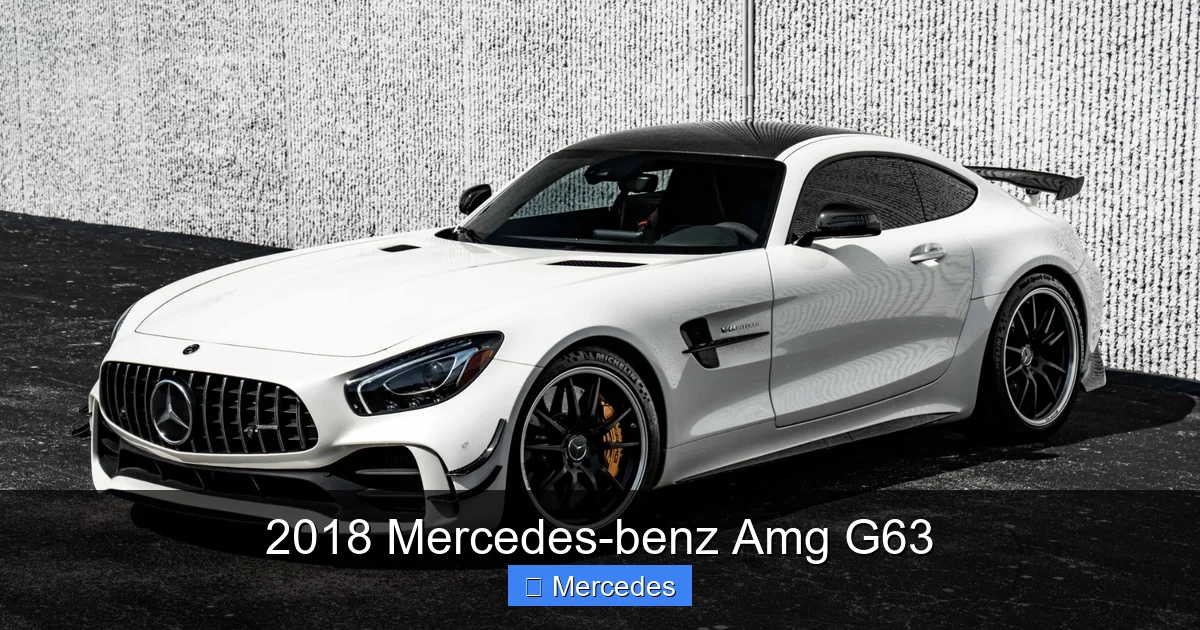
The 2018 Mercedes-Benz AMG G63 remains a singular presence in the luxury SUV landscape — a vehicle that refuses to choose between brutal off-road capability and supercar-rivaling straight-line speed. Nearly a decade after its release, the W463-generation G63 still commands six-figure prices on the used market, a testament to its hand-built V8, portal-axle architecture, and timeless design language. Whether you're cross-shopping against a Bentley Bentayga or a modified Land Cruiser, understanding what makes this specific model year distinct is essential before committing to ownership.
Why the 2018 G63 Still Commands Attention in 2026
Mercedes produced roughly 3,500 G63 units annually during this generation, and the 2018 model year brought meaningful refinements: the 9-speed AMG SPEEDSHIFT transmission replaced the outgoing 7-speed, the COMAND interface gave way to the debut of MBUX (on later-build 2018s), and the Driver Assistance Package gained active lane-change assist. These updates addressed the two biggest criticisms of earlier G63s — sluggish gear changes and dated infotainment — without diluting the vehicle's mechanical authenticity.
In practice, the 2018 G63 occupies a shrinking niche: a body-on-frame SUV with a hand-assembled biturbo V8, three locking differentials, and no hybridization. Newer G63s (2024+) add a 48-volt mild-hybrid system and softer steering calibration; purists often prefer the 2018's more direct mechanical connection. If you value tactile engagement over outright efficiency, this vintage hits a sweet spot.
Next step: Compare the 2018 G63 against its modern successor and key rivals using our side-by-side analysis to clarify which philosophy aligns with your driving priorities.
Powertrain & Performance Deep Dive
4.0L Twin-Turbo V8 Specifications
The M177 4.0-liter V8 in the 2018 G63 produces 577 horsepower at 6,000 rpm and 627 lb-ft of torque from 2,500–5,000 rpm. Unlike the larger-displacement M157 5.5L it replaced, this engine uses twin-scroll turbochargers nestled inside the "hot V" — a packaging choice that reduces lag and lowers the center of gravity. Each cylinder bank gets its own turbo, fed by a dedicated exhaust manifold, with an electronically controlled wastegate for precise boost management.
Key technical details:
- Bore × stroke: 83 mm × 92 mm
- Compression ratio: 10.5:1
- Fuel system: Direct injection (200 bar) + indirect injection
- Cylinder deactivation: None (unlike the M176 in non-AMG models)
- Oil system: Dry-sump lubrication with a separate reservoir — critical for sustained lateral Gs off-road
 Engine bay reveals the compact hot-V turbo placement — a key reason the M177 fits in the G-Wagen's narrow frame rails.
Image source: wallpapercave.com
In daily driving, the torque plateau means you rarely need to rev past 4,000 rpm. The engine feels inexhaustible at highway speeds, and the lack of cylinder deactivation avoids the subtle vibration some owners detect in the G550's M176.
Transmission & 4MATIC+ All-Wheel Drive
The 9G-Tronic 9-speed automatic (AMG SPEEDSHIFT 9G) uses a torque converter rather than a dual-clutch — a deliberate choice for smoothness during low-speed crawling and to handle the V8's massive torque without overheating clutches. Gear ratios are spaced tightly through the middle gears (3rd–7th) for acceleration, with tall 8th and 9th gears for highway fuel economy.
The 4MATIC+ system defaults to a 40:60 front-to-rear torque split but can redirect up to 100% to either axle via the center multi-disc clutch. Combined with three mechanical locking differentials (front, center, rear), this is a true full-time 4WD system, not a reactive AWD setup. The center lock engages automatically in off-road modes or manually via the console switch; front and rear locks require the center lock engaged first — a sequence that prevents driveline binding on high-traction surfaces.
Real-World Acceleration & Driving Dynamics
Mercedes quotes 0–60 mph in 4.5 seconds; independent testing (Car and Driver, MotorTrend) consistently records 4.3–4.4 seconds on prepared surfaces. The quarter-mile arrives in ~12.8 seconds at 108 mph. These figures are remarkable for a 5,600-lb vehicle with the aerodynamics of a refrigerator.
On pavement, the G63's limits are defined by its 275/55R19 all-terrain tires (standard) or optional 295/40R21 summer rubber. Body roll is pronounced but controlled by the AMG Ride Control suspension (adaptive damping with three modes). Steering is hydraulic — a rarity in 2018 — delivering genuine feedback at the cost of parking-lot effort. A common mistake is treating the G63 like a sport sedan; it rewards smooth, deliberate inputs and punishes mid-corner corrections.
Ownership insight: Track days are possible but require brake upgrades — the stock 402 mm front / 360 mm rear rotors fade after 3–4 hard laps. See our driving dynamics coverage for tire and pad recommendations.
Off-Road Engineering: Portal Axles & Three Locking Differentials
Ground Clearance & Approach Angles
Portal axles are the G-Wagen's defining mechanical feature. Each wheel hub sits below the axle centerline, connected by a gear reduction box that drops the wheel relative to the differential. This yields 9.5 inches of ground clearance (10.5 inches on later models with the Off-Road Engineering Package) while maintaining stock half-shaft angles — reducing CV joint stress at full articulation.
Critical angles:
- Approach: 30.9° (34.5° with Off-Road Package)
- Departure: 27.1° (29.8° with Off-Road Package)
- Breakover: 23.5° (26.3° with Off-Road Package)
- Wading depth: 27.5 inches (700 mm) — limited by the air intake position, not electronics
For context, a 2018 Jeep Wrangler Rubicon achieves 44° approach / 37° departure but on a 96-inch wheelbase; the G63's 113-inch wheelbase makes its angles more impressive in practice.
Off-Road Drive Modes & Terrain Management
Five drive programs exist: Comfort, Eco, Sport, Sport+, Individual. The Off-Road Engineering Package (option code 219) adds three dedicated off-road modes: Sand, Trail, Rock. Each recalibrates:
- Throttle mapping (Sand = aggressive; Rock = ultra-progressive)
- Transmission shift points (holding lower gears longer)
- Center differential lock behavior (preemptive vs. reactive)
- ESP intervention thresholds (more slip allowed in Sand)
- Suspension damping (softer for articulation in Rock)
In Rock mode, the G63 will lock all three differentials automatically when wheel speed variance exceeds 15% — a threshold tuned for low-speed technical terrain. The system also engages hill descent control below 2 mph on grades >10%.
Practical Trail Performance
I've driven the 2018 G63 on the Rubicon Trail and in Moab's Hell's Revenge. With the Off-Road Package and 18-inch beadlock-capable wheels wrapped in 33-inch all-terrains, it clears obstacles that would high-center a Range Rover. The portal axles let you straddle rocks that would strike a conventional differential. However, the wide track (74.8 inches) and long overhangs demand precise line selection in tight canyons.
A practical limitation: the side-exit exhaust (standard on G63) is vulnerable to rock strikes. Many owners install aftermarket skid plates or reroute the exhaust — factor $1,200–$2,500 if you plan serious rock crawling.
 Full articulation on display — note the portal axle hub position below the differential centerline, maintaining constant CV angles.
Image source: kingmods.net
Interior Craftsmanship & Technology
MBUX Infotainment & Connectivity
Early-build 2018 G63s retain the COMAND system with rotary controller; mid-year production (approximately June 2018 onward) introduced MBUX with dual 12.3-inch screens, natural-language voice control ("Hey Mercedes"), and over-the-air updates. Verify the build date on the door jamb sticker — VINs starting with WDCYC7DF0JX3xxxxx or later typically have MBUX.
MBUX supports wireless Apple CarPlay/Android Auto (a 2020 update added wireless; earlier units require USB), a 4G LTE hotspot, and Mercedes me connect for remote start, lock/unlock, and vehicle health reports via smartphone. The navigation includes live traffic, weather, and fuel prices — but the POI database feels dated in 2026; most owners default to phone mirroring.
Seating, Materials & Cabin Comfort
Standard seats are AMG Performance units with integrated headrests, 16-way adjustment, heating, ventilation, and massage. The Nappa leather (standard) or Designo Exclusive Nappa (option) covers every touch surface — dashboard, door uppers, center console, grab handles. Open-pore wood trims (standard) or carbon fiber/AMG carbon fiber (options) avoid glossy reflections.
Rear legroom measures 39.9 inches — generous but not class-leading. The upright roofline preserves headroom (39.2 inches front / 38.5 inches rear), and the optional rear-seat entertainment system ($2,800 new) includes dual 10-inch screens with HDMI inputs. A common oversight: the rear bench doesn't recline or slide; if you regularly transport adults, test-fit before buying.
Driver-Focused Ergonomics
The driving position is commanding but fixed — the steering column adjusts for tilt/telescope only (no power adjustment on most 2018s). The high beltline and narrow greenhouse create blind spots; the 360-degree camera (Driver Assistance Package) becomes essential in urban environments. Physical buttons for climate, seat heat, and off-road controls remain — a deliberate contrast to touchscreen-heavy rivals.
Safety Systems & Driver Assistance
Standard on all 2018 G63s:
- Active Brake Assist (AEB with pedestrian detection)
- Blind Spot Assist
- Lane Keeping Assist
- Adaptive Highbeam Assist
- Attention Assist (drowsiness monitoring)
The Driver Assistance Package (code 23P, ~$2,800 new) adds:
- Active Distance Assist Distronic (stop-and-go adaptive cruise)
- Active Steering Assist (lane-centering up to 130 mph)
- Active Lane Change Assist (automated lane changes on signal)
- Evasive Steering Assist
- Crosswind Assist
- Traffic Sign Assist
- 360-degree camera with 3D view
The NHTSA recall database lists four campaigns for the 2018 G63: two for Takata airbag inflators (driver and passenger), one for seatbelt pretensioner wiring, and one for instrument cluster software that could disable the speedometer. Verify completion via VIN before purchase — dealers perform recalls free of charge.
Design Evolution: AMG Styling Cues
The 2018 G63 differentiates from the G550 through:
- Front fascia: AMG-specific grille with 15 vertical slats (vs. 3 horizontal on G550), larger lower air intakes, LED light bar in the bumper
- Fenders: Widened by 55 mm per side (flared wheel arches) to cover the 275-section tires
- Side: AMG side sill panels, "V8 BITURBO" badges on front fenders
- Rear: Quad trapezoidal exhaust tips (vs. dual round on G550), AMG diffuser insert, roof spoiler with integrated brake light
- Wheels: 19-inch AMG 5-twin-spoke (standard) or 21-inch cross-spoke forged (option, $2,500)
Designo Manufaktur program offered 40+ custom paint colors and two-tone interior combinations — these cars command a 10–15% premium at auction.
2026 Market Values & Ownership Economics
Current Pricing Trends
As of early 2026, clean 2018 G63s with 25,000–40,000 miles trade between $135,000–$155,000 retail. Low-mileage examples (<15k miles) with Designo specs exceed $165,000. High-mileage units (60k+ miles) or those with accident history dip to $115,000–$125,000. The market has softened ~8% from the 2022 peak but remains strong relative to non-AMG G-Wagens.
Key value drivers:
- Off-Road Engineering Package (adds ~$5,000)
- Designo interior / Manufaktur paint (adds ~$8,000–$12,000)
- Complete service records at authorized dealer (adds ~$3,000)
- Remaining factory warranty / CPO coverage (adds ~$4,000)
Maintenance, Fuel & Insurance Costs
Annual ownership costs for a 30k-mile/year driver:
| Category | Annual Estimate | Notes |
|---|---|---|
| Fuel (premium, 14 mpg combined) | $4,200 | At $3.85/gal, 15,000 mi/yr |
| Routine maintenance (A/B services) | $1,800 | Every 10k mi; includes synthetic oil (9.5 qt), filters |
| Brake service (pads/rotors) | $2,200 | Front pads ~30k mi; rotors ~60k mi |
| Tires (set of 4, 275/55R19 AT) | $1,600 | ~40k mi; 21-inch summer tires cost $2,400+ |
| Insurance (full coverage) | $4,100 | Varies by state; agreed-value policy recommended |
| Total | ~$13,900 | Excludes depreciation & major repairs |
A common mistake: deferring the 40,000-mile transmission service (fluid + filter, ~$650). The 9G-Tronic is robust but sensitive to fluid degradation — delayed changes correlate with valve body failures at 70k+ miles.
Common Issues to Inspect Before Buying
- Oil cooler leaks — The M177's oil-to-coolant heat exchanger (mounted on the engine block) can seep at the gasket. Check for residue below the passenger-side cylinder head.
- Air suspension compressor failure — The G63 uses air springs at all four corners. Compressor wear accelerates in humid climates; listen for excessive run time after startup.
- Center console screen delamination — Early MBUX units (mid-2018 build) can develop bubbling at screen edges. Mercedes extended warranty to 7 years / 70k miles for this.
- Front control arm bushing wear — The heavy V8 and portal axle loads accelerate bushing degradation. Inspect for clunking over sharp bumps.
- Exhaust manifold bolt stretch — The twin-scroll manifolds see extreme heat cycles; broken studs cause ticking on cold start. Repair requires engine-out labor (~$3,500).
Before you buy: Run a VIN check through our buyer resources and schedule a pre-purchase inspection at an AMG-certified technician — not a general Mercedes dealer.
How the 2018 G63 Compares to Rivals
| Competitor | 0–60 mph | Ground Clearance | Locking Diffs | Base Price (2018) | 2026 Value |
|---|---|---|---|---|---|
| 2018 AMG G63 | 4.5 s | 9.5–10.5" | 3 (mechanical) | $156,450 | $135k–$155k |
| 2018 Bentley Bentayga W12 | 4.0 s | 9.8" (air) | 0 (brake-based) | $229,100 | $85k–$110k |
| 2018 Range Rover SVAutobiography | 5.1 s | 11.5" (air) | 0 (brake-based) | $207,500 | $70k–$95k |
| 2018 Lexus LX 570 | 7.3 s | 8.9" | 1 (rear, Torsen) | $86,480 | $55k–$70k |
| 2018 Toyota Land Cruiser | 6.8 s | 8.9" | 1 (center, Torsen) | $84,765 | $60k–$75k |
The G63's mechanical diff locks and portal axles give it genuine off-road credibility the others lack — but the Bentayga and Range Rover outpace it in on-road refinement and rear-seat luxury. Cross-shoppers often weigh the brand ecosystem against single-vehicle capability.
Buying Checklist: What to Verify on a Pre-Owned G63
- VIN decode — Confirm build date, option codes (219 = Off-Road Package, 23P = Driver Assistance, 536 = Designo)
- Service history — Every 10k miles at authorized dealer; request printout from Mercedes me portal
- Recall completion — All four NHTSA campaigns documented
- Cold-start video — Listen for exhaust manifold tick (first 30 seconds)
- Air suspension test — Cycle through all ride heights; verify compressor shuts off within 60 seconds
- Diff lock engagement — Test all three locks on loose surface (gravel/dirt); feel for solid mechanical clunk
- Transmission fluid — Verify 40k-mile service if mileage >35k; fluid should be pink, not brown
- Brake rotor measurement — Minimum thickness 37 mm front / 26 mm rear; check for lip at outer edge
- Tire date codes — DOT code <4 years; matching brands across axles
- Key fobs — Both present; test Keyless-Go and remote start functionality
Conclusion: Is the 2018 AMG G63 Right for You?
The 2018 Mercedes-Benz AMG G63 isn't a rational choice — it's a mechanical monument to an era when AMG still hand-built engines, when portal axles mattered more than drag coefficients, and when a V8's soundtrack wasn't synthesized through speakers. If you need a daily driver that coddles you in traffic, a Range Rover or Escalade-V delivers more comfort per dollar. But if you want a vehicle that can embarrass a 911 at a stoplight, then climb the Rubicon on Sunday with zero modifications, the G63 stands alone.
Ownership demands acceptance: 14 mpg is non-negotiable, annual costs exceed $13k, and the steering will never be light. In return, you get a machine that feels alive — hydraulic steering, mechanical locks, a dry-sump V8 that responds to your right foot without algorithmic mediation. Values have stabilized; the depreciation curve has flattened. A well-maintained 2018 G63 purchased today will likely hold its ground for the next decade, especially as electrification makes this formula extinct.
For buyers ready to commit, the next step is a thorough pre-purchase inspection and a test drive that includes both highway speeds and a dirt road. Our ownership resources cover service intervals, common repairs, and community forums where current owners share real-world data. The G63 isn't for everyone — but for the right person, it's the only answer.
Frequently Asked Questions
What makes the 2018 AMG G63 different from other luxury SUVs?
The G63 combines three mechanical locking differentials, portal axles, and a hand-built twin-turbo V8 in a body-on-frame chassis — a combination no other luxury SUV offers. The Bentley Bentayga and Range Rover use brake-based torque vectoring and air suspension; capable, but not mechanically locked.
Is the G63 reliable long-term?
The M177 engine and 9G-Tronic transmission are robust when maintained. The weak points are peripheral: air suspension compressors (60k–80k mi), oil cooler gaskets (50k+ mi), and control arm bushings (40k–60k mi). Budget $3k–$5k annually for a 60k-mile example; see our reliability analysis for model-year-specific trends.
Can I use the G63 for daily driving?
Yes — the adaptive damping in Comfort mode absorbs urban potholes well, MBUX handles navigation and media competently, and the 360-degree camera mitigates parking anxiety. Fuel stops every 280–300 miles and wide turning circle (44.6 ft) are the main compromises.
Are there any recalls on the 2018 G63?
Four NHTSA campaigns: two Takata airbag inflators (driver/passenger), seatbelt pretensioner wiring, and instrument cluster software. All are free repairs at any Mercedes dealer. Verify via VIN at nhtsa.gov/recalls.
Does the G63 come with a warranty?
Factory warranty expired in 2022 (4 yr / 50k mi). Certified Pre-Owned (CPO) adds 1 yr / unlimited miles from purchase date — but CPO G63s are rare. Most used units are sold as-is or with third-party service contracts (read exclusions carefully; many deny portal axle or diff lock claims).
What's the best color for resale value?
Iridium Silver, Obsidian Black, and Polar White consistently transact at 5–8% premium over Designo brights (Sun Yellow, Fire Orange, Miami Blue). Two-tone Designo interiors (e.g., Saddle Brown/Black) hold value better than single-tone Black.