

The 2017 Mercedes-Benz AMG G63 remains one of the most distinctive vehicles on the road today — a hand-built, twin-turbo V8 powered icon that traces its DNA directly to a military off-roader. Unlike most modern SUVs that prioritize pavement manners, the G63 delivers genuine rock-crawling hardware wrapped in a cabin that rivals a flagship sedan. This review covers every angle: powertrain reality, daily drivability, off-road credibility, ownership costs in 2026, and what to inspect before buying used.
Quick Specs at a Glance
| Specification | Detail |
|---|---|
| Engine | 4.0L twin-turbo V8 (M176), hand-built in Affalterbach |
| Output | 549 hp @ 5,500 rpm / 561 lb-ft @ 1,750–5,250 rpm |
| Transmission | 9-speed AMG SPEEDSHIFT TCT automatic |
| Drivetrain | Full-time 4MATIC with three locking differentials |
| 0–60 mph | 4.4 seconds (manufacturer) |
| Top Speed | 130 mph (limited) / 149 mph with AMG Driver’s Package |
| EPA Fuel Economy | 11 city / 15 highway / 12 combined mpg |
| Towing Capacity | 7,000 lbs (properly equipped) |
| Ground Clearance | 9.5 in (241 mm) standard; up to 11.2 in with lift |
| Curb Weight | ~5,600 lbs (2,540 kg) |
Powertrain: Hand-Built V8 Character
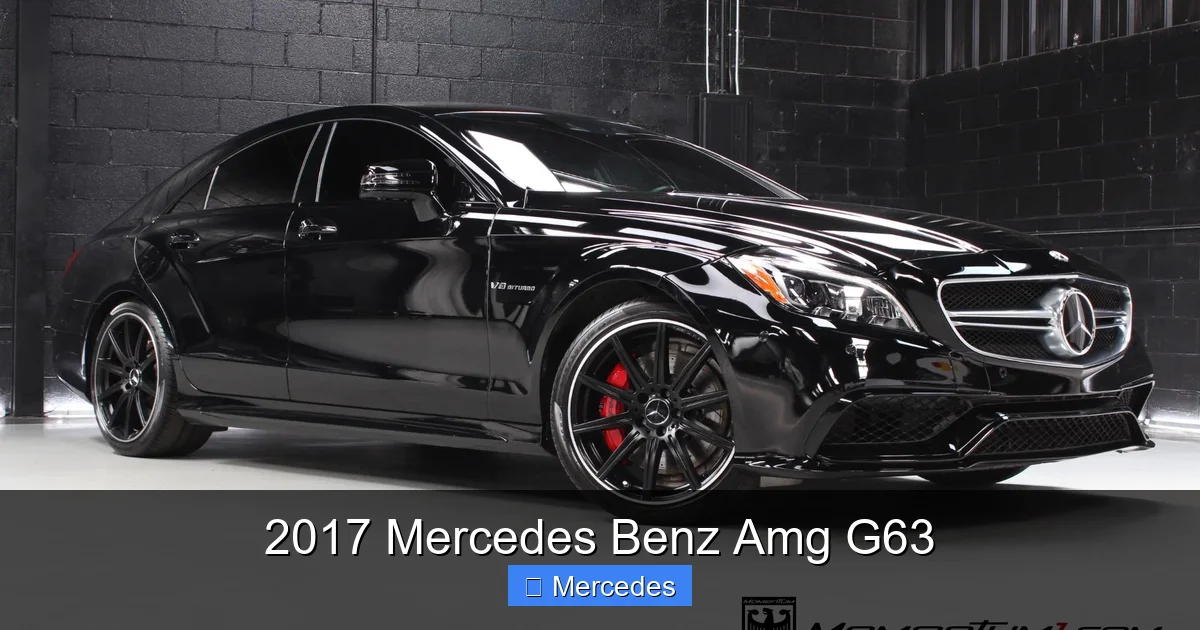 Momentum Motor Cars — the G63’s upright stance hides a 549-hp twin-turbo V8.
Each M176 engine is assembled by a single technician at AMG’s Affalterbach facility — a plaque on the engine bears their signature. The 4.0-liter displacement (down from the prior 5.5L) uses twin-scroll turbochargers mounted inside the valley of the V for compact packaging and rapid spool. Peak torque arrives at just 1,750 rpm and holds flat past 5,000 rpm, giving the G63 surprising shove from any gear.
In practice, the 9-speed transmission shifts imperceptibly in Comfort mode but snaps ratios aggressively in Sport+. The torque converter locks up early to reduce slip, which helps both acceleration and highway fuel economy. A common misconception: the G63 does not have a low-range transfer case. Instead, it relies on the three locking differentials (front, center, rear) and a short first gear (5.35:1) for low-speed traction. This works remarkably well on sand and snow, but serious rock crawling demands aftermarket gear reduction.
Real-world note: The engine drinks premium fuel exclusively. Mercedes specifies 91 octane minimum; 93 octane yields noticeably smoother throttle response in hot weather. For a deeper look at why this matters across the lineup, see the premium fuel requirement and weighing the trade-offs of regular vs. premium in modern Mercedes engines.
Driving Dynamics: Heavy but Agile
At 5,600 pounds with a high center of gravity, the G63 defies physics better than it should. The AMG Ride Control air suspension uses adaptive dampers that firm up within milliseconds — Comfort mode absorbs potholes with limousine grace, while Sport+ reduces body roll to near-sedan levels. Steering is hydraulic (not electric), delivering genuine feedback rare in this segment. The variable ratio quickens off-center, making parking-lot maneuvers easier without sacrificing highway stability.
Five drive programs (Comfort, Sport, Sport+, Individual, and G-Mode for off-road) adjust throttle mapping, shift points, suspension stiffness, steering weight, and ESP intervention. G-Mode unlocks the differential locks below 37 mph and softens the stability control for loose surfaces. One quirk: the exhaust note changes with each mode via active flaps — Sport+ unleashes a theatrical V8 bark that penetrates the cabin even with windows up.
Off-Road Capability: More Than Cosplay
The G63’s ladder frame, solid axles, and three lockers are legitimate off-road hardware. Approach/departure/breakover angles of 36°/31°/26° best most “soft-roaders.” In G-Mode, the center diff locks 100/50 front/rear; pressing the locker buttons engages front and rear axles mechanically. The system works automatically — wheel-speed sensors detect slip and lock within 100 milliseconds.
Ground clearance is adjustable: standard ride height is 9.5 inches; “High Level” raises it 1.6 inches for obstacles; “Low Level” drops it 0.8 inches for loading. Wading depth is 27.5 inches — deeper than a Wrangler Rubicon. Factory 20-inch wheels with 275/50R20 all-season tires limit rock work; serious owners swap to 18-inch beadlocks with 33-inch all-terrains. The spare tire on the tailgate swings clear for rear access but adds 80 lbs behind the rear axle — noticeable in tight corners.
For historical context on how this platform evolved from military utility to luxury icon, explore the G-Class lineage that shaped every modern SUV.
Interior: Analog Controls Meet Digital Displays
 Richmonds — dual 12.3-inch screens flank physical climate and volume knobs.
The 2017 model year introduced the optional dual 12.3-inch widescreen cockpit (standard on later builds). The left screen serves as a configurable instrument cluster; the right runs COMAND with navigation, Apple CarPlay, and Android Auto. Crucially, Mercedes retained physical buttons for climate, hazard lights, and drive-mode selection — a deliberate choice for gloved off-road use. Voice control (“Hey Mercedes”) arrived with the MBUX update in 2018; 2017 cars rely on the older COMAND rotary controller.
Materials are top-tier: Nappa leather on all touchpoints, open-pore wood or carbon-fiber trim, and metal switchgear with damped action. Front seats offer 14-way power, heating, ventilation, and a surprisingly effective massage function. Rear legroom is adequate (36.1 inches) but the upright seatback and high floor make long trips less comfortable than a Range Rover. Cargo space: 38.1 cu ft behind rear seats, 68.6 cu ft folded — less than a Chevrolet Tahoe due to the boxy shape and spare tire mount.
Burmester 3D surround sound (15 speakers, 590 watts) is standard and excellent. Wireless charging arrived mid-year; earlier cars require a snap-in adapter. A known annoyance: the glovebox is tiny and the center console bin is shallow — the transmission tunnel intrudes significantly.
Safety Ratings & Driver Assistance
The 2017 G-Class earned a 5-star overall rating from NHTSA and a “Good” rating in all IIHS crashworthiness tests (the highest). Standard active safety includes:
- Active Brake Assist — autonomous emergency braking with pedestrian detection
- Blind Spot Assist — visual and audible alerts
- Lane Keeping Assist — gentle steering correction
- Adaptive Highbeam Assist Plus — 84 individual LEDs per headlight
- Attention Assist — monitors steering inputs for fatigue
- Crosswind Assist — applies individual brakes to counter gusts
Optional Driver Assistance Package adds Distronic Plus adaptive cruise with stop-and-go, Active Steering Assist (lane centering up to 130 mph), and Pre-Safe Plus (rear-end collision preparation). In 2026 terms, this suite feels dated — no hands-free highway driving, no automated lane change — but the core crash protection remains robust.
Fuel Economy & Running Costs
EPA figures (11/15/12 mpg) are optimistic for mixed driving. Expect 10–11 mpg in urban traffic, 13–14 mpg on highway at 75 mph. The 26.4-gallon tank yields roughly 300 miles between fills. Annual fuel cost at $3.80/gal premium: ~$4,200 for 12,000 miles. Maintenance is predictable: 10,000-mile/1-year services alternate between minor (oil, filters, inspection ~$600) and major (spark plugs, brake fluid, diff fluids ~$1,800). Brake pads last 30–40k miles; rotors often need replacement with pads due to minimum-thickness specs.
Extended warranty (Mercedes-Benz Extended Limited Warranty) covers up to 7 years/100k miles and is transferable — highly recommended given the complexity of the air suspension, active dampers, and twin-turbo architecture. Independent specialists can reduce labor costs 30–40% versus dealers, but verify they have the STAR diagnostic system for AMG-specific coding.
Ownership Experience in 2026
Values have stabilized after the 2022–2023 peak. Clean, low-mileage (under 30k) examples trade $135k–$155k; 40k–60k mile cars sit $115k–$130k. High-mileage (80k+) units dip below $100k but often need deferred maintenance. The current market trends show gradual softening for ultra-luxury SUVs as newer G63 (W463a, 2019+) supply increases.
Common issues to audit:
- Air suspension compressor — listen for prolonged run times; replacement $1,200+
- Turbo wastegate actuators — rattle on cold start; updated parts available
- Center console command controller — rotary knob wear; $400 repair
- Rear differential oil leaks — seepage at axle seals; monitor at every service
- Battery drain — parasitic draw from aftermarket trackers; test resting voltage
Community knowledge is deep — AMG forums and G-Class-specific groups document every failure mode. Join before buying; sellers often post maintenance logs there.
Buying Checklist for 2026 Shoppers
| Item | Why It Matters |
|---|---|
| Build date | Post-June 2017 = dual-screen cockpit standard |
| Service records | Dealer stamps preferred; verify diff fluid changes at 40k |
| Tire brand/age | OEM ContiSportContact 5P age poorly; budget $2,500 for set |
| Paint inspection | Designo matte finishes require specialist care |
| Locker function test | Engage all three on gravel; confirm dash lights cycle |
| Suspension height check | Measure all four corners; variance >10mm = bag leak |
| VIN decode | Confirm AMG Driver’s Package (top speed limiter raise) |
A pre-purchase inspection by an AMG-certified technician costs $300–$500 and pays for itself. Request a cold-start video from the seller — smoke on startup suggests turbo seal wear.
How It Compares
| Rival | Price (Used) | Key Difference |
|---|---|---|
| 2017 Range Rover Autobiography | $95k–$120k | Better ride, worse reliability, no lockers |
| 2017 Bentley Bentayga W12 | $130k–$160k | Faster, plusher, 6,000 lbs, no off-road cred |
| 2017 Lexus LX 570 | $75k–$95k | Bulletproof V8, dated tech, softer off-road |
| 2017 Porsche Cayenne Turbo S | $85k–$110k | Track-capable, unibody, no low-range |
The G63 occupies a unique niche: military-grade architecture with AMG performance and S-Class materials. Nothing else does all three. If your priority is Mercedes premium features in a more practical shape, the GLE 63 S shares the engine but adds third-row seating and modern MBUX.
Conclusion
The 2017 Mercedes-AMG G63 is an anachronism that works — a ladder-frame, solid-axle, hand-built V8 SUV that somehow passes modern crash tests, offers genuine off-road prowess, and coddles occupants in Nappa leather. Its flaws (thirst, wind noise, dated infotainment, tight rear quarters) are the direct byproducts of its strengths. In 2026, it remains a compelling used buy for enthusiasts who value mechanical authenticity over efficiency. Verify maintenance, budget for consumables, and you’ll own a vehicle that appreciates in character every mile.
Frequently Asked Questions
Does the 2017 G63 require premium gasoline?
Yes. Mercedes specifies 91 octane minimum; 93 octane is recommended for full output and knock protection in hot climates. Using regular risks long-term engine damage and voids powertrain warranty.
What is the real-world 0–60 mph time?
Independent testing (Car and Driver, Motor Trend) recorded 4.3–4.5 seconds on prepared surfaces. On street tires in cold weather, expect 4.7–5.0 seconds.
Can the G63 be flat-towed behind an RV?
No. The 4MATIC system and locking differentials require all four wheels off the ground. Use a flatbed or trailer.
How often does the air suspension need service?
Inspect bags and lines annually. Compressor filter replacement every 40k miles. Full compressor replacement typically occurs at 80k–100k miles.
Is the 2017 model year a good investment?
Values have plateaued. Well-maintained, low-mileage Designo editions may appreciate slowly; high-mileage drivers will depreciate normally. Buy to drive, not to flip.
What tires come factory?
Continental SportContact 5P (275/50R20). Many owners switch to Michelin Latitude Sport 3 for longer wear and quieter ride.
Does it have Apple CarPlay / Android Auto?
Yes, standard on all 2017 G63 models via COMAND. Wireless CarPlay requires a hardware retrofit (aftermarket modules exist).
How reliable is the M176 engine?
Very. The twin-turbo V8 architecture has proven durable past 150k miles with oil changes every 7,500 miles using MB 229.5 spec oil. Turbo failures are rare but expensive ($3,500+/side).