

The 2015 Mercedes-Benz AMG G63 remains a singular proposition in the luxury SUV segment: a hand-built, ladder-frame off-roader powered by a twin-turbo V8 that produces 544 hp and 561 lb-ft of torque. It combines G-Class ruggedness with AMG performance, delivering a driving experience that feels both vintage and violently modern. Whether you are a collector, an enthusiast seeking a capable adventure vehicle, or a buyer comparing used luxury SUVs, this guide covers every critical angle — design, performance, reliability, ownership costs, and 2026 market reality.
Iconic Exterior Design: Heritage Meets AMG Aggression
The G63’s silhouette is instantly recognizable — a boxy, upright greenhouse that has changed little since 1979. For 2015, AMG added visual aggression without compromising the model’s utilitarian roots. The front fascia features a blacked-out radiator grille with chrome pins, flanked by bi-xenon headlights with LED daytime running lights. Flared wheel arches cover 20-inch AMG twin-spoke alloys wrapped in 275/50R20 tires, while the rear wears a quad-exit exhaust integrated into a revised bumper. Approach and departure angles of 30.7° and 26.9° remain class-leading for a factory luxury SUV. For more on this, see our guide on mercedes benz g63 amg.
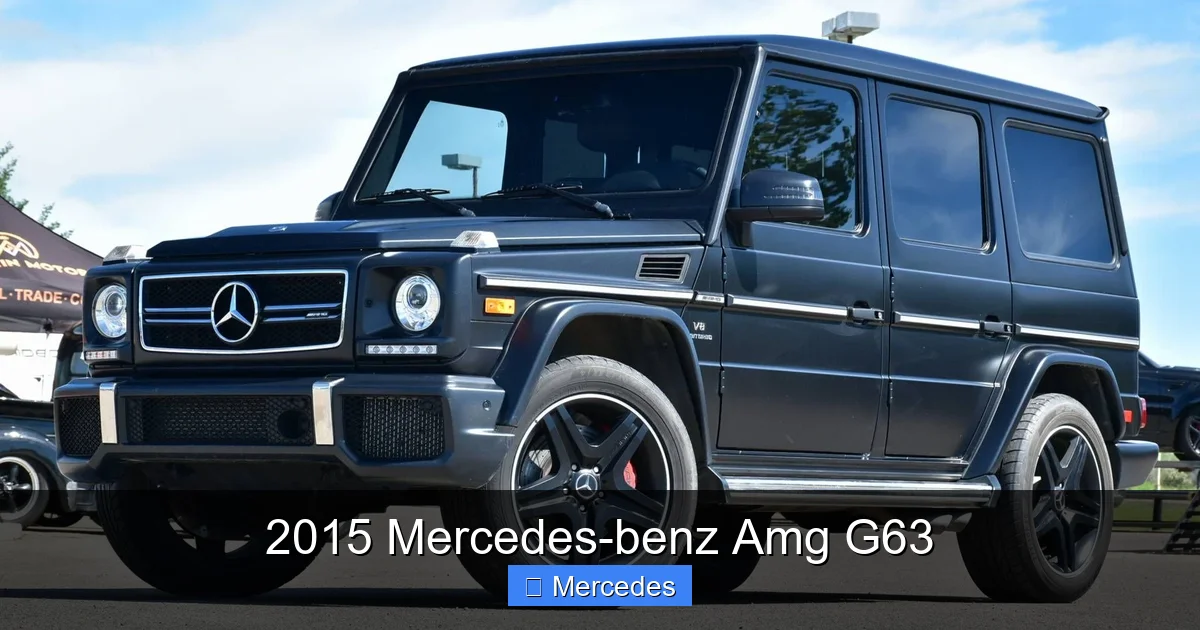 Front three-quarter view showing flared fenders and quad exhaust tips.
Image source: cdn.dealeraccelerate.com
Powertrain & Performance: Hand-Built V8 Specs
Every M157 5.5-liter twin-turbo V8 is assembled by a single technician at AMG’s Affalterbach facility — a “one man, one engine” philosophy that ensures meticulous tolerances. The engine uses a cross-plane crankshaft, dual-scroll turbochargers, and direct injection to deliver peak torque from 1,750 to 5,250 rpm. Power routes through a 7-speed AMG SPEEDSHIFT Plus 7G-TRONIC transmission with a torque converter (not a dual-clutch) chosen for smoothness and off-road durability. Mercedes quotes 0–60 mph in 5.2 seconds and an electronically limited top speed of 130 mph (137 mph with the optional AMG Driver’s Package).
 Hand-built 5.5L twin-turbo V8 with AMG plaque.
Image source: cdn.dealeraccelerate.com
Driving Modes & Transmission Logic
The transmission offers four selectable programs: Controlled Efficiency (C), Sport (S), Sport+ (S+), and Manual (M). In C mode, shifts occur early and the throttle map is softened for city driving. S+ sharpens response, holds gears longer, and enables faster downshifts with rev-matching. Manual mode locks out automatic upshifts — useful when crawling technical terrain where precise gear selection matters. For more on this, see our guide on mercedes benz g class g63 amg.
Driving Dynamics: On-Road Manners & Off-Road Prowess
On-Road Behavior
Despite a 5,600-lb curb weight and a solid rear axle, the G63 feels surprisingly composed on pavement. Adaptive damping (standard) adjusts firmness in real time; the optional AMG Performance Steering quickens the ratio for tighter cornering. Body roll is present but well-controlled, and the hydraulic power steering provides genuine feedback — a rarity in modern SUVs. Braking is handled by 15.4-inch front and 13.0-inch rear ventilated discs with six-piston front calipers; stopping distances from 60 mph average 115 ft, respectable for the mass.
Off-Road Hardware
The G63’s off-road credibility is engineering fact, not marketing. Full-time 4MATIC splits torque 40/60 front/rear under normal conditions. Three electronically locking differentials (front, center, rear) can be engaged independently via dashboard switches, even at speeds up to 12 mph. Low-range gearing (ratio 2.08:1) multiplies torque for steep ascents. Ground clearance sits at 9.7 inches with the standard air suspension in “Off-Road” mode, which also raises the body 1.6 inches. The solid rear axle and live front axle deliver maximum wheel articulation — critical for rock crawling. For more on this, see our guide on mercedes benz g63 amg suv.
Interior, Comfort & Technology
Materials & Craftsmanship
The cabin blends old-world craftsmanship with contemporary tech. Standard designo Nappa leather covers seats, door panels, and the dashboard; contrast stitching and piping are hand-applied. Carbon-fiber trim (optional) replaces the standard piano black on the center stack and door sills. Front seats offer 12-way power adjustment, heating, ventilation, and three-position memory. Rear passengers enjoy generous headroom (40.3 in) and legroom (36.4 in), though the high floor reduces foot space.
Infotainment & Connectivity
The COMAND NTG 4.5 system operates a 7-inch high-resolution display controlled via a rotary knob and touchpad. Navigation includes 3D maps and real-time traffic. Bluetooth audio streaming and USB connectivity are standard. Important for 2026 buyers: Factory Apple CarPlay and Android Auto were not offered on 2015 models; retrofit modules (e.g., from CarPlay MMI or aftermarket head units) are the only path to native smartphone mirroring. The optional Burmester surround sound system (12 speakers, 610 watts) remains a benchmark for clarity.
Cargo & Practicality
Behind the second row, cargo volume measures 38.1 cu ft; folding the 60/40 split rear seats expands it to 63.0 cu ft. A lockable under-floor compartment secures valuables. The tailgate swings sideways (not upward), requiring lateral clearance — a consideration for tight garages.
Safety Features & Driver Aids
Standard equipment includes:
- Electronic Stability Program (ESP) with trailer stabilization
- Brake Assist (BAS) and Hill Start Assist
- Tire Pressure Monitoring System (TPMS)
- Rain-sensing wipers and automatic high beams
- Dual-stage front airbags, front side airbags, and window curtain airbags
Optional packages added:
- Blind Spot Assist and Lane Keeping Assist (using radar and camera)
- Night View Assist Plus (infrared camera with pedestrian detection on the instrument cluster)
- Active Parking Assist with Parktronic (ultrasonic sensors front/rear)
The 2015 G63 has not been crash-tested by NHTSA or IIHS due to low sales volume. Structural rigidity benefits from the ladder frame, but modern small-overlap protection is absent. Buyers prioritizing the latest passive safety should factor this in.
Reliability, Common Issues & Maintenance
Known Trouble Spots
| Component | Symptom | Typical Mileage | Notes |
|---|---|---|---|
| Turbocharger oil lines | Oil leaks, smoke on startup | 40k–70k mi | Updated lines released by Mercedes; verify replacement |
| Transmission conductor plate | Harsh shifts, limp mode | 50k–80k mi | Often misdiagnosed as valve body; plate replacement is cheaper |
| Air suspension compressors | Vehicle leans, “Visit Workshop” message | 60k+ mi | Compressor relay failure common; relay kit is inexpensive |
| COMAND screen delamination | Bubbles, touch failure | 5–7 years | Heat-related; replacement screens available aftermarket |
| Rear differential lock actuator | Lock fails to engage | 30k–60k mi | Wiring harness chafing near actuator; inspect loom |
Maintenance Schedule (Severe Service)
- Engine oil & filter: Every 5,000 miles or 12 months (MB 229.5 spec, 9.5 qt)
- Transmission fluid & filter: Every 40,000 miles
- Transfer case & differential fluids: Every 30,000 miles
- Brake fluid: Every 2 years
- Coolant: Every 10 years / 150,000 miles (MB 325.0)
- Spark plugs: Every 60,000 miles (NGK 90654)
- Air filters (engine & cabin): Every 30,000 miles
Dealership labor rates exceed $180/hr in most metros; independent Mercedes specialists typically charge 30–40% less. Budget $3,000–$5,000 annually for a well-maintained example driven 8,000 miles/year.
Buying a Used 2015 G63: What to Check
- Service records: Demand a complete history. Missing intervals for differential/transfer case fluids are a red flag.
- Turbo line updates: Confirm the revised oil feed/return lines (part # 1571800901 / 1571801001) have been installed.
- Air suspension: Cycle through all ride heights; listen for compressor noise. Verify the “Off-Road” level raises the body.
- Diff locks: Engage each lock on loose surface (gravel/snow) — they should audibly clunk and the dash lights should illuminate solid (not flash).
- Frame corrosion: Inspect the ladder frame inner rails behind the front wheels; road salt accelerates rot.
- Paint & body: Check panel gaps; the G is hand-assembled in Graz, Austria, and fitment varies. Non-factory paint often hides accident repairs.
- Tires: All four must match brand/model and be within 2/32″ tread depth to avoid 4MATIC damage.
A pre-purchase inspection by a shop familiar with the W463 platform is non-negotiable. Expect to pay $400–$600 for a thorough evaluation.
2026 Market Values & Resale Outlook
As of early 2026, clean 2015 G63 examples (30k–50k miles, full books, no accidents) trade between $85,000 and $110,000 at retail. Low-mileage (<20k) designo Edition or “Edition 30” models can exceed $130,000. High-mileage (>80k) or accident-history units bottom out near $60,000. Values have stabilized after the 2021–2023 peak; the market now differentiates sharply on condition and documentation. For broader market context, track current market trends to time your purchase.
Ownership Costs: Fuel, Insurance & Maintenance
Fuel Economy & Requirements
EPA estimates: 11 mpg city / 15 mpg highway / 13 mpg combined. Real-world mixed driving averages 12–13 mpg. The M157 requires 91-octane minimum (93 recommended). Running lower octane risks detonation and voids warranty coverage on the powertrain. For a deeper dive on Mercedes fuel requirements, see the guide on premium fuel requirements.
Insurance
Expect $2,200–$3,500 annually for full coverage on a 2015 G63 (varies by state, driver profile, and agreed-value vs. actual-cash-value policy). Specialty insurers (Hagerty, Grundy) often offer agreed-value policies for collector-grade examples.
Annual Cost Summary (Typical 8k mi/yr)
| Expense | Estimated Cost |
|---|---|
| Fuel (13 mpg @ $3.80/gal) | $2,340 |
| Insurance | $2,800 |
| Routine maintenance | $1,800 |
| Tires (set of 4 Michelin Latitude Sport 3) | $1,200 / 25k mi |
| Misc repairs (turbo lines, sensors) | $1,500 |
| Total | ~$9,640 |
Community, Resources & Next Steps
Active forums include G-Wagen.com, MBWorld.org G-Class section, and the AMG Private Lounge (Facebook group, 12k+ members). Parts sources: FCP Euro (lifetime replacement guarantee on most items), ECS Tuning, and Mercedes-Benz Classic Center for discontinued trim. If you’re ready to shop, start with certified pre-owned listings at franchised dealers — they include a 1-year/unlimited-mile warranty after a 165-point inspection.
Frequently Asked Questions
How does the 2015 G63 differ from the 2016–2018 models?
The 2016 refresh brought a new steering wheel, updated COMAND with a larger 8-inch screen (still no CarPlay), and minor interior trim changes. Mechanically identical.
Can the G63 tow?
Yes — rated at 7,000 lbs with the factory hitch. Tongue weight limit is 700 lbs. The solid rear axle and low-range make it a stable tow vehicle, but fuel economy drops to 8–9 mpg.
Is the G63 a good daily driver?
If you accept 12 mpg, wide turning circle (44.6 ft), and sideways-opening tailgate, yes. Visibility is excellent, seats are supportive for long trips, and the V8 soundtrack never gets old.
What are the “Edition 30” and “Designo” models?
Edition 30 (2015 only) celebrates 30 years of the G-Class: matte olive paint, exclusive 20″ wheels, designo saddle brown interior with contrasting stitching. Designo offers custom paint/leather combos ordered through Mercedes’ customization program.
How long will the M157 engine last?
With religious oil changes (5k intervals) and updated turbo lines, 200k+ miles is achievable. Neglect cuts that in half.
Conclusion
The 2015 Mercedes-Benz AMG G63 occupies a unique intersection of heritage, performance, and exclusivity. It is not a practical family hauler, nor a canyon carver — it is a purpose-built icon that delivers genuine off-road capability alongside supercar acceleration and a cabin built to a standard few modern SUVs match. Prices have settled into a rational band where condition and paperwork dictate value. Buy the best-documented example you can afford, budget for specialist maintenance, and you’ll own a vehicle that appreciates in both monetary and experiential terms.