
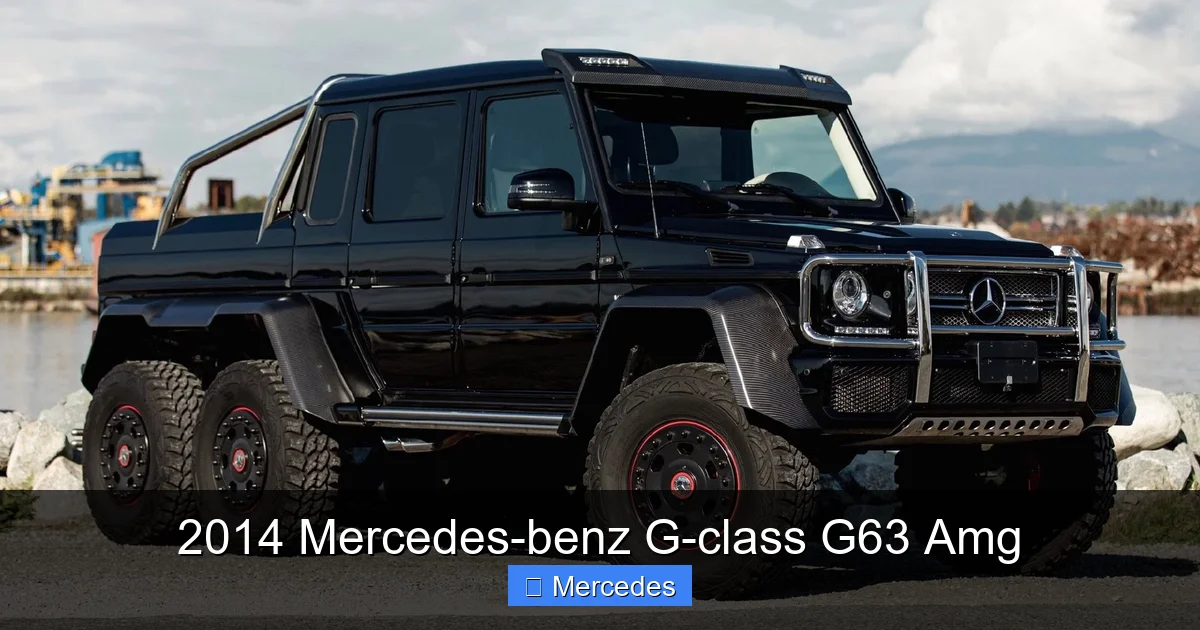
The 2014 Mercedes-Benz G-Class G63 AMG remains a singular vehicle in the used market: a hand-built, ladder-frame SUV wearing a luxury badge and powered by a handcrafted twin-turbo V8. Twelve years after its debut, it still commands attention and strong residual values. This guide covers every angle — performance, design, off-road hardware, ownership costs, and what to inspect before buying in 2026 — so you can decide whether the “G-Wagen” legend fits your garage.
Engine & Performance: Hand-Built V8 Muscle
At the heart of every G63 sits the M157 5.5-liter twin-turbo V8, assembled by a single technician at AMG’s Affalterbach facility. In 2014 tune it produces 536 hp at 5,500 rpm and 561 lb-ft of torque from 1,750–5,250 rpm. Power routes through a seven-speed AMG Speedshift Plus 7G-Tronic automatic with paddle shifters and a torque converter — not a dual-clutch — chosen for durability and smooth low-speed crawling.
 The hand-built 5.5L twin-turbo V8 under the hood
Real-world acceleration: 0–60 mph in 5.2 seconds, quarter-mile in 13.7 sec @ 101 mph — impressive for a 5,600-lb brick. Top speed is electronically limited to 130 mph (210 km/h) or 150 mph with the optional AMG Driver’s Package.
Fuel reality: EPA figures read 12 mpg city / 14 mpg highway / 13 mpg combined. Expect 10–11 mpg in mixed driving; the 26.4-gallon tank yields roughly 300 miles per fill. Premium fuel is mandatory — see the factory fuel-door label and our guide on premium fuel requirements for the engineering reasons.
Transmission behavior: The 7G-Tronic holds gears longer in Sport/Sport+ modes and blips downshifts convincingly. In Comfort it shifts early for quiet cruising. Manual mode via paddles is responsive, but the torque converter prevents the instant snap of a dual-clutch — a deliberate trade-off for towing and rock-crawling smoothness.
Design & Exterior: Iconic Box on Purpose
The G-Class silhouette hasn’t changed fundamentally since 1979. The 2014 G63 adds AMG-specific cues: a twin-louver front grille, flared wheel arches covering 20-inch forged multi-spoke wheels, quad exhaust tips, and a roof-mounted spoiler. Approach/departure angles sit at 36°/27°; breakover is 24° — respectable for a factory luxury SUV.
 Iconic boxy silhouette with AMG styling cues
Lighting: Bi-xenon headlamps with LED daytime running lights were standard; full LED adaptive headlights were a rare option. The round bezels are a design mandate, not nostalgia — they clear snow better than complex shapes.
Paint & protection: Metallic finishes (Obsidian Black, Polar White, Selenite Grey) dominate the used market. Factory-applied clear coat is thick; many owners add paint-protection film on the leading edges because the flat front end collects chips at highway speed.
Interior & Technology: Analog Luxury Meets Early Digital
Step inside and the contrast hits immediately: grab handles on the dash, exposed door-hinge bolts, and a floor-mounted shifter remind you of the military roots. Yet every surface is wrapped in Nappa leather (Designo two-tone optional), with carbon-fiber or open-pore wood trim.
Infotainment: COMAND NTG 3.5 with a 7-inch non-touch display, rotary controller, and hard-button shortcuts. Navigation includes 3D maps and traffic. No Apple CarPlay/Android Auto — retrofit modules exist but require fiber-optic harness work. Bluetooth audio streaming and USB/iPod integration work reliably.
Comfort features: Heated/ventilated front seats with three-position memory, multicontour massage function, dual-zone automatic climate control, and a Harman Kardon Logic 7 surround system (12 speakers, 600 W). Rear passengers get generous headroom and heated outboard seats.
Safety tech (2014 standard): Attention Assist drowsiness monitor, Adaptive Brake Assist, Pre-Safe pre-collision tensioning, crosswind assist, and a backup camera. Blind Spot Assist and Distronic Plus adaptive cruise were optional; verify window-sticker codes (23P, 22B) when shopping.
Off-Road Capability: Serious Hardware Under the Bling
Unlike most “luxury SUVs,” the G63 retains a full ladder frame, solid rear axle, and three mechanical locking differentials (front, center, rear). The 4MATIC+ system defaults to a 40/60 front/rear torque split; engaging low range (2.93:1 reduction) via the console lever multiplies torque for technical terrain.
Key specs:
- Ground clearance: 11.8 in (300 mm)
- Wading depth: 27.5 in (700 mm) — snorkel required for deeper crossings
- Articulation: 12.6 in front / 11.8 in rear wheel travel
- Locking diffs: Engage sequentially (center → rear → front) at ≤ 2 mph; disengage in reverse order
On the trail: The G63 climbs steep ruts that would high-center independent-suspension rivals. The solid rear axle maintains traction when a wheel lifts, and the lockers eliminate wheelspin entirely. Downsides: turning radius widens to 44.6 ft with diffs locked, and the heavy V8 over the front axle reduces approach-angle effectiveness on steep descents. Carry recovery boards and a kinetic rope — the factory tow eyes are rated for 7,700 lb.
Ownership Experience: Costs, Reliability & Real-World Quirks
Maintenance schedule & costs (2026 estimates)
| Service | Interval | Typical Independent Shop Cost |
|---|---|---|
| Synthetic oil change (9 qt) | 10,000 mi / 1 yr | $350–$450 |
| Brake fluid flush | 2 yr | $180–$250 |
| Coolant replacement | 15 yr / 150k mi | $300–$400 |
| Spark plugs (16) | 60,000 mi | $600–$800 |
| Transmission fluid & filter | 60,000 mi | $450–$600 |
| Front/rear diff fluid | 30,000 mi | $250–$350 |
| Transfer case fluid | 30,000 mi | $200–$300 |
Annual budget: $3,000–$5,000 for a well-kept example; defer maintenance and bills climb fast. Specialized tools (e.g., 12-point 14 mm socket for diff drain plugs) and proprietary diagnostic software (Xentry) push many owners toward AMG-certified indies rather than dealers.
Common failure points
- Turbocharger oil feed lines crack from heat cycles; updated hoses are cheap insurance.
- ABC (Active Body Control) hydraulic lines leak at the front struts — a $2,500–$3,500 repair if both sides go.
- Center console command controller rotary knob fails; used replacements abound.
- Rear door check straps snap, denting the quarter panel; revised straps are a $40 DIY fix.
- Battery drain from faulty SAM (signal acquisition module) — parasitic draw test is routine.
Insurance & registration
Expect $3,500–$5,500/year for full coverage on a clean-title 2014 G63 (varies by state, driver profile, agreed-value vs. actual-cash-value policy). Many owners choose specialty insurers (Hagerty, Grundy) for agreed-value policies that reflect the model’s appreciation.
Market Comparison: Where the G63 Stands in 2026
| Metric | 2014 G63 AMG | 2014 Porsche Cayenne Turbo | 2014 Range Rover Supercharged | 2014 Lexus LX 570 |
|---|---|---|---|---|
| Layout | Ladder frame, solid rear axle | Unibody, independent suspension | Unibody, air suspension | Body-on-frame, solid rear axle |
| Engine | 5.5L TT V8 (536 hp) | 4.8L TT V8 (523 hp) | 5.0L SC V8 (510 hp) | 5.7L V8 (383 hp) |
| 0–60 mph | 5.2 s | 4.4 s | 5.8 s | 7.3 s |
| Towing | 7,000 lb | 7,716 lb | 7,716 lb | 7,000 lb |
| Low range & triple lockers | Yes | No (electronic only) | Yes (electronic) | Yes (center + rear) |
| 2026 avg. private-party price* | $75k–$95k | $45k–$60k | $40k–$55k | $50k–$70k |
*Prices for clean-title, 50k–80k mi examples; concave down for accidents/mods.
Takeaway: The G63 trades outright track speed for genuine off-road architecture and a scarcity-driven value curve. The Cayenne is faster and cheaper to run; the Range Rover matches luxury but lacks the G’s mechanical simplicity; the LX 570 is the only other V8 body-on-frame rival but lacks AMG performance.
Buying Guide: Inspecting a 2014 G63 in 2026
1. Verify the VIN & service history
- VIN prefix WDC = Graz, Austria (Magna Steyr) build — correct for all G-Class.
- Pull a Carfax/AutoCheck and request the Mercedes Digital Service Record (DSR) from any dealer. Gaps > 12 months or missing major services (spark plugs, diff fluids) are red flags.
2. Cold-start inspection
- Listen for timing-chain rattle (M157 chains are robust but tensioners can bleed down after sitting).
- Watch for blue smoke on startup — indicates turbo seal wear.
- Check ABC suspension self-leveling: car should rise evenly within 15 seconds.
3. Undercarriage & drivetrain
- Diff locker actuators: Engage each locker on a lift; confirm indicator lights switch from blinking to solid.
- Transfer case: Drain a few ounces — milky fluid = water intrusion (common after deep fording).
- Frame rust: Inspect the rear cross-member and front spring perches; surface rust is normal, perforation is not.
4. Electronics & interior
- Test every button: seat massage, ventilation, memory, COMAND navi, camera, parktronic.
- Sunroof drains clog easily; pour water in the track — it should exit behind front wheels.
- Key fobs: Both should remote-start (if equipped) and trigger Keyless Go.
5. Tires & brakes
- OEM size: 275/50R20. Mismatched brands = alignment/4MATIC stress.
- Front rotors: 380 mm six-piston; rear: 360 mm four-piston. Measure thickness — minimum 34 mm front / 30 mm rear.
6. Negotiation levers
- No DSR → deduct $3k–$5k.
- Deferred spark plugs/diff fluids → deduct $1.5k.
- ABC leak → deduct $3k.
- Aftermarket tunes/lift kits → often hide abuse; prefer stock.
Frequently Asked Questions
How fast is the 2014 G63 AMG 0–60?
The factory figure is 5.2 seconds; independent tests range 5.0–5.4 s depending on surface and temperature.
Does the 2014 G63 require premium gasoline?
Yes. The high-compression twin-turbo V8 demands 91 octane minimum; lower octane risks detonation and voids warranty coverage. See our breakdown of which models need premium.
Can the G63 AMG be daily-driven comfortably?
Absolutely — heated/ventilated seats, quiet cabin at 70 mph, and good visibility make it viable, though 12 mpg and 78-in width challenge tight garages.
What is the real-world towing capacity?
7,000 lb braked, 750 lb tongue weight. The ladder frame and low range handle it well, but expect 8–9 mpg while towing.
Are parts still available from Mercedes?
Most mechanical parts remain in production; body panels and some interior trim require 4–6 week backorders from Germany. Budget extra time for collision repairs.
Should I buy a modified G63?
Lift kits > 2 in stress CV joints and alter 4MATIC torque split. Stick to OEM suspension or reputable 1.5-in leveling kits with corrected control arms.
Conclusion
The 2014 Mercedes-Benz G-Class G63 AMG is a rare blend: a military-grade off-roader wrapped in AMG performance and handcrafted luxury. Its ladder frame, three mechanical lockers, and hand-built V8 give it capabilities no unibody rival can match, while its iconic shape keeps values buoyant. Ownership demands a healthy maintenance budget and tolerance for thirst, but the reward is a vehicle that feels special every time you turn the key — and likely will for decades. If you want a collectible SUV that can still conquer the Rubicon Trail on Sunday and valet at a five-star hotel on Monday, the G63 earns its place in the short list.
Ready to explore the broader SUV lineage that shaped icons like the G-Class? Dive into the SUV heritage that started it all.
Future Outlook: The G63’s Trajectory Through 2030
Values for the 2014 G63 have bottomed and are now climbing — Hagerty’s price guide shows a 14 % rise in #2 (excellent) condition cars over the past 24 months. Three factors drive the trend: finite supply (≈ 2,200 U.S. units for MY 2014), the model’s status as the last G63 with the M157 engine before the 4.0 L M177 arrived in 2019, and growing collector appetite for “analog” AMG experiences. Expect well-documented, sub-50 k mi examples to cross $100 k within three years; higher-mileage drivers will hover in the $65 k–$75 k band but require stricter maintenance records to transact.
Electrification pressure is real: Mercedes has confirmed a fully electric G-Class (EQG) for 2025 production, and Euro 7 emissions may end V8 G-Class sales in Europe by 2027. U.S. regulations lag, but the writing is on the wall — internal-combustion G63s are a finite resource. If you buy, treat it as a preserve-and-enjoy asset rather than a flip candidate.
For technical reference on the M157 engine family, Mercedes-Benz’s own classic division archive publishes factory specifications and service bulletins — a trustworthy primary source when verifying torque values or fluid capacities.
If you’re weighing the G63 against newer AMG SUVs, our breakdown of the current GLE 63 S highlights what a decade of chassis evolution changes — and what it doesn’t. Curious about fuel flexibility for high-output Mercedes V8s? Our guide to premium fuel alternatives explains when you can deviate from 91 octane.