

The 2003 Lincoln Aviator Luxury AWD arrived as Ford's premium division made its first serious push into the luxury SUV segment. Built on the Ford U platform shared with the Explorer and Mercury Mountaineer, the Aviator distinguished itself with a 302-horsepower 4.6-liter V8, standard all-wheel drive, and an interior trimmed to compete with the Acura MDX and BMW X5. Two decades later, it remains a compelling used purchase for buyers who prioritize V8 smoothness, three-row practicality, and a traditional body-on-frame ride over modern crossover handling. This guide covers every angle — design, performance, ownership costs, and what to inspect before buying in 2026.
Historical Context and Market Position
Lincoln launched the Aviator for the 2003 model year as a 2003-only "early" release, then continued production through 2005. It slotted above the Explorer in price and refinement, targeting buyers who wanted domestic luxury without the Cadillac SRX's polarizing styling or the BMW X5's maintenance complexity. The Luxury AWD trim sat at the top of the range, adding leather seating, a premium audio system, and unique exterior trim. Understanding the evolution of the SUV segment helps explain why the Aviator's blend of truck-based durability and car-like amenities resonated with early-2000s families. You can also read our guide on invention of suv.
Exterior Design: Formal Presence With Purpose
The Aviator's silhouette is unmistakably Lincoln: upright grille, squared-off roofline, and crisp character lines that convey permanence rather than trend-chasing. The chrome waterfall grille — flanked by rectangular HID headlamps — gives the front end a formal posture, while the rear features vertical taillamps and a prominent liftgate spoiler. Ground clearance sits at 8.3 inches, and the approach/departure angles (27°/24°) are respectable for light off-pavement use. All Luxury models rode on 17-inch machined-aluminum wheels with P255/65R17 all-season tires.
 Side profile highlights the upright greenhouse and chrome accent trim exclusive to the Luxury trim.
Interior Comfort, Materials, and Packaging
Step inside and the Aviator's age shows most in its control layout — rotary HVAC knobs, a single-DIN radio aperture, and a column shifter — but material quality holds up. The Luxury trim wraps the first two rows in perforated "Premium" leather (the third row gets vinyl), with genuine wood appliqués on the dash and doors. Front seats offer 10-way power adjustment with lumbar; second-row captain's chairs (standard on Luxury) recline and slide fore-aft. Third-row access is via a tilt-and-slide second row — functional but tight for adults. You can also read our guide on mercedes suv.
| Specification | Measurement |
|---|---|
| Passenger volume | 155.6 cu ft |
| Cargo behind 3rd row | 16.7 cu ft |
| Cargo behind 2nd row | 51.6 cu ft |
| Max cargo (rows 2 & 3 folded) | 89.8 cu ft |
| Seating capacity | 7 (2/2/3) |
Noise isolation was a headline figure: Lincoln claimed 68 dB at 70 mph, aided by triple-sealed doors, acoustic glass, and a heavy-duty dash insulator. In practice, wind noise is well suppressed; tire roar on coarse pavement is the primary intruder.
Powertrain: The 4.6L Modular V8
The centerpiece is Ford's 4.6-liter SOHC 24-valve V8 (engine code 6), rated at 302 hp @ 5,750 rpm and 300 lb-ft @ 3,750 rpm. It pairs exclusively with a 5-speed 5R55S automatic — no manual option existed. The all-wheel-drive system uses a two-speed transfer case with a viscous center coupling (approximately 40/60 front/rear split) and no low-range gearing. This is an on-road AWD setup, not a rock-crawler.
Real-world performance context (2026 perspective):
- 0–60 mph: ~8.2 seconds (Motor Trend, 2003)
- Quarter mile: ~16.2 sec @ 86 mph
- EPA fuel economy: 14 city / 19 highway / 16 combined
- Towing capacity: 7,300 lbs (requires factory tow package with 3.73 axle and transmission cooler)
The V8's torque curve makes highway merging effortless, and the 5-speed holds gears sensibly. However, the transmission is the drivetrain's weak link — see the Ownership section.
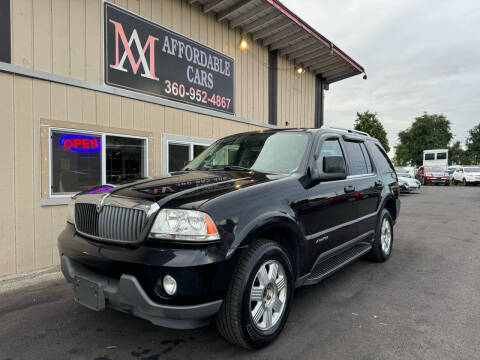 Front three-quarter view showcases the HID headlamps, chrome grille, and Luxury-specific 17-inch machined wheels.
Technology and Safety: 2003 Standard, 2026 Baseline
The Aviator's feature set was competitive in 2003 but reads as sparse today. Standard on Luxury:
- 6-disc in-dash CD changer with Mach Audio 5-speaker system (subwoofer in rear cargo)
- Dual-zone automatic climate control with rear auxiliary controls
- Electrochromic auto-dimming rearview mirror
- Universal garage-door opener (HomeLink)
- Power-adjustable pedals with memory
Safety equipment included dual-stage front airbags, front seat-mounted side airbags, Safety Canopy side-curtain airbags covering all three rows, four-wheel anti-lock disc brakes, and AdvanceTrac stability control with roll-stability mitigation — advanced for its class at launch. NHTSA awarded a 5-star frontal crash rating for both driver and passenger; IIHS rated the structure "Good" in the moderate-overlap frontal test. You can verify current ratings on the NHTSA database.
Notable absences: no backup camera, no blind-spot monitoring, no adaptive cruise, and no smartphone integration. Aftermarket upgrades (CarPlay/Android Auto head units, license-plate cameras) are straightforward thanks to the single-DIN opening and accessible wiring behind the dash.
Driving Dynamics: Truck Roots, Luxury Tuning
The Aviator rides on a fully boxed frame with independent SLA front suspension and a solid rear axle on leaf springs — a traditional SUV layout. Luxury models receive specific spring rates, softer bushings, and a rear air-leveling suspension (automatic load-leveling) that maintains ride height when towing or fully loaded. Steering is hydraulic recirculating-ball, 3.2 turns lock-to-lock, with a 38.7-foot turning circle.
On the road, the Aviator feels substantial rather than sporty. Body roll is noticeable in quick transitions, but the damping controls it progressively. The AWD system eliminates torque steer and provides confident foul-weather traction; the viscous coupling reacts within milliseconds of slip detection. Brake pedal feel is firm with a short travel; panic stops from 60 mph average 135 feet — adequate for a 4,800-lb vehicle.
Ownership Reality: Reliability, Maintenance, and Costs
Known Issue Patterns (Validated by 20+ Years of Field Data)
| Component | Typical Failure Mileage | Symptom | Approx. Repair Cost (2026) |
|---|---|---|---|
| 5R55S transmission | 100k–150k mi | Harsh 2–3 shift, flare, loss of forward gears | $2,800–$4,200 rebuild |
| Rear air suspension bags | 80k–120k mi | Sagging rear overnight, compressor runs constantly | $600–$1,100 (pair + labor) |
| Intake manifold (plastic crossover) | 90k–130k mi | Coolant leak at heater hose fitting, overheating | $450–$800 |
| Spark plug threads (aluminum heads) | 100k+ mi | Plug ejection, misfire, ticking noise | $300–$600 per head (Timesert kit) |
| Ball joints (lower) | 70k–100k mi | Clunk over bumps, uneven tire wear | $400–$700 per side |
| Door ajar switches (latch assembly) | 60k+ mi | Dome light stays on, false "door ajar" chime | $80–$150 per door |
A common mistake is deferring transmission fluid changes. The 5R55S holds ~12 quarts total; a drain-and-fill replaces only ~4.5 quarts. Shops familiar with the platform recommend a full fluid exchange (cooler-line flush) every 30k miles using Mercon V — it materially extends transmission life.
Maintenance Schedule Essentials
| Service | Interval | Notes |
|---|---|---|
| Engine oil & filter (5W-20, 6 qt) | 5,000 mi / 6 mo | Synthetic blend acceptable; full synthetic preferred |
| Transmission fluid exchange | 30,000 mi | Use Mercon V only; avoid "universal" fluids |
| Transfer case fluid (Mercon V) | 60,000 mi | Often overlooked; same fluid as transmission |
| Front/rear differential fluid (75W-140 synthetic) | 60,000 mi | Add friction modifier for limited-slip rear |
| Coolant (Motorcraft Gold, yellow) | 100,000 mi / 5 yr | Do not mix with green/orange coolants |
| Spark plugs (Motorcraft SP-463) | 100,000 mi | Use anti-seize sparingly on threads only |
| Brake fluid (DOT 3) | 3 years | Flush all four corners; ABS module cycles during bleed |
Annual maintenance budget for a well-kept example: $1,200–$1,800 including tires, fluids, and wear items. Budget $3,000+ in reserve for the transmission or air suspension if service history is unknown.
2026 Buying Guide: What to Inspect, What to Pay
Pre-Purchase Inspection Checklist (Bring a Scan Tool)
- Transmission health — Command a cold 1–2, 2–3, 3–4, 4–5 shift sequence; watch for flare >200 rpm or harsh engagement. Check fluid: pink/red, no burnt odor, no metal on magnet.
- Air suspension — With engine running, measure rear ride height at wheel center (should be ~14.5″). Shut off engine; re-measure after 30 min. Drop >1″ = leaking bag or solenoid.
- Cooling system — Pressure-test at 16 psi; inspect intake manifold crossover for seepage. Verify coolant is yellow (Gold), not contaminated.
- Drivetrain — Check front driveshaft U-joints and center support bearing for play. Verify transfer case engages 4L (if equipped) and 4H smoothly.
- Chassis — Inspect frame rails behind rear wheels for rust perforation (common in salt-belt states). Tap with hammer; dull thud = thin metal.
- Electrical — Cycle all power accessories (windows, locks, mirrors, seats, pedals, sunroof). Test rear HVAC blower at all speeds — resistor pack fails often.
- Tires — Matching brand/model, ≥4/32″ tread, DOT date <6 years. Mismatched tires stress the viscous coupling.
Market Values (Private Party, Clean Title, 120k–160k mi, 2026)
| Condition | Price Range | Notes |
|---|---|---|
| Concours (show-quality, <50k mi, documented) | $12,000–$16,000 | Rare; mostly collector-held |
| Excellent (no needs, full records, 100k–130k mi) | $7,500–$10,500 | Strong demand from enthusiasts |
| Good (current maintenance, minor cosmetic flaws) | $4,500–$7,000 | Sweet spot for daily drivers |
| Fair (deferred maintenance, check-engine lights) | $2,000–$4,000 | Budget for $2k+ immediate repairs |
| Parts/mechanic special | $500–$1,800 | Transmission or frame issues |
Prices have firmed over the last three years as clean V8 body-on-frame SUVs dwindle. For broader market context, see our analysis of whether car prices are trending down.
Fuel Economy Reality Check
EPA combined: 16 mpg. Real-world Mixed: 14–15 mpg (city-heavy), 17–18 mpg (highway steady 70 mph). The 22-gallon tank yields ~300–350 miles per fill. Premium fuel is not required — the 4.6L runs on 87 octane per the owner's manual — but 89+ may reduce knock-retard events in hot weather under load. For official figures, consult the EPA fuel economy database.
Frequently Asked Questions
Does the 2003 Aviator require premium gasoline?
No. The 4.6L V8 is calibrated for 87 octane regular unleaded. Using premium provides no measurable benefit in stock form.
Is the Aviator's all-wheel-drive system full-time?
Yes. The viscous center coupling operates continuously; there is no 2WD mode. The transfer case offers 4H (default) and 4L (low-range) via a dash-mounted rotary switch.
Can the third row accommodate adults?
For short trips only. Legroom is 32.1″ with the second row at its rearmost position — tight for anyone over 5'8″. The third row folds flat into the floor (power-fold on Luxury).
What is the timing chain service interval?
The modular V8 uses a timing chain, not a belt. No scheduled replacement; inspect guides and tensioners at 150k+ miles if rattling on cold start.
Are parts still available?
Most mechanical parts (Motorcraft, Moog, Dorman) are in production. Trim-specific items (chrome grille inserts, Mach Audio components, Luxury leather) are dwindling — check salvage yards and enthusiast forums early.
Conclusion
The 2003 Lincoln Aviator Luxury AWD delivers a specific proposition: a V8-powered, body-on-frame luxury SUV with three usable rows, genuine towing capability, and an interior that still feels special. Its faults — transmission fragility, air-suspension leaks, thirst — are well documented and manageable with proactive maintenance. For buyers who value traditional SUV attributes over crossover efficiency, a sorted example remains one of the most characterful vehicles of its era. If you're comparing it against modern premium alternatives, our luxury SUV comparison guide outlines how the segment has evolved.
Next step: Join the Lincoln Aviator Owners Group on Facebook or the "Aviator Nation" forum — both have sticky threads with vetted mechanic recommendations by region and a collective parts spreadsheet that saves hours of hunting.