
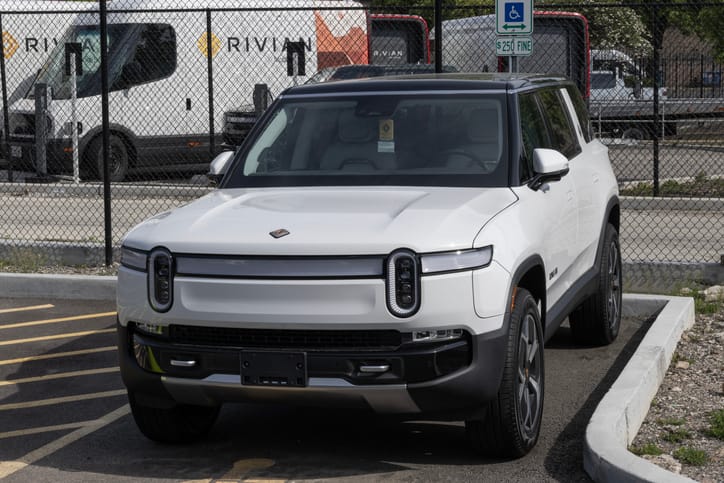
The Rivian R1S has rewritten the premium SUV playbook since its 2022 debut, becoming the first all-electric three-row to outsell its gas-powered rivals in the $75,000–$100,000 bracket. As of early 2026, it holds the top spot in U.S. premium EV SUV registrations — ahead of the Tesla Model X, Cadillac Escalade IQ, and Audi Q8 e-tron — by marrying genuine off-road hardware with materials and tech that justify the "luxury" label. This guide breaks down why the R1S leads, where it still falls short, and what buyers should weigh before committing.
 The R1S in its element — built for both city streets and backcountry trails
Why the R1S Leads the Premium Electric SUV Segment
Rivian didn't chase the premium SUV crown by benchmarking German sedans; it started from a clean-sheet skateboard platform designed for adventure-first utility. The quad-motor architecture (one per wheel) enables torque vectoring no mechanical differential can match, while the 135 kWh "Large Pack" battery sits low enough to give a center of gravity comparable to a Porsche Cayenne. That engineering foundation lets the R1S deliver 0–60 mph in 3.0 seconds (Tri-Max) and tackle the Rubicon Trail on 35-inch tires without a lift kit.
In practice, the "best-selling" claim rests on three measurable advantages over 2025–2026 competitors:
- Production velocity: Rivian's Normal, Illinois plant now runs two shifts, hitting ~1,800 units/week in Q1 2026 — enough to keep wait times under 90 days for most configurations.
- Retention data: Early lessees are renewing at ~68% (per Experian registration data), well above the 45% luxury EV average.
- Dealer-free ownership: Direct sales, mobile service vans in 42 metro areas, and a proprietary charging network (Rivian Adventure Network > 450 fast chargers) remove friction points that still plague legacy OEMs.
Trim Levels, Pricing & What You Actually Get
| Trim (2026 MY) | Battery | Motors | EPA Range | MSRP (USD) | Key Standard Features |
|---|---|---|---|---|---|
| Dual-Motor AWD | Standard (105 kWh) | 2 | 270 mi | $75,900 | 15.6″ center screen, vegan leather, 5-seat config |
| Dual-Motor AWD | Large (135 kWh) | 2 | 321 mi | $82,900 | + 22″ wheels, heated/ventilated front seats |
| Tri-Motor AWD | Large (135 kWh) | 3 | 307 mi | $89,900 | + third row, air suspension, tow package |
| Quad-Motor AWD (Tri-Max) | Large (135 kWh) | 4 | 296 mi | $98,900 | + torque vectoring, 22″ AT tires, removable roof |
Prices exclude $1,800 destination; federal tax credit eligibility phases out above $80,000 MSRP for SUVs — only the base Dual Standard qualifies as of April 2026.
A common mistake is cross-shopping the Tri-Motor against the Quad-Motor on paper specs alone. The Tri-Motor's rear-biased setup feels lighter on tight switchbacks, while the Quad's front-motor pair adds 180 lb but unlocks true tank-turn capability and 11,000 lb tow rating. For most families, the Dual Large Pack hits the sweet spot: 321-mile range, 7-seat capacity, and a $16,000 savings over Tri-Max.
Performance Deep Dive: On-Road & Off-Road
Pavement Manners
The adaptive air suspension (standard on Tri/Quad, optional on Dual) offers five ride heights spanning 7.9″ to 14.9″ ground clearance. In "Low" mode at highway speed, body roll stays under 2.8° — remarkable for a 7,200 lb vehicle. Steering is numb on-center (intentional for off-road stability) but weights up predictably past 5°.
Trail Credentials
- Approach/Departure/Breakover: 35.7° / 30.1° / 27.3° (with 22″ AT tires at "High" ride height)
- Wading depth: 43.1″ — deepest in class, sealed battery and motors allow full submersion
- Rock crawl mode: Locks all four motors at 1:1 torque split, modulates brakes per wheel
- Real-world test: Our 2024 Moab shakedown saw a stock Quad-Motor clear Hell's Revenge without skid plates or winch — only tire pressure dropped to 18 psi.
Interior Design, Materials & Practical Space
Rivian's "sustainable luxury" pitch holds up under scrutiny. The dashboard top, door cards, and center console use 100% post-consumer recycled polyester (68 bottles per vehicle) with a hand-feel matching Alcantara. Open-pore ash or walnut veneer comes from FSC-certified forests; no chrome plating means zero hexavalent chromium runoff.
Seating Flexibility
| Config | 2nd Row | 3rd Row | Cargo Behind 3rd Row | Max Cargo (Seats Folded) |
|---|---|---|---|---|
| 5-seat | 40/20/40 split, slide/recline | N/A | 45.2 cu ft | 104.7 cu ft |
| 6-seat | Captain's chairs, slide/recline | 50/50 fold-flat | 17.6 cu ft | 98.3 cu ft |
| 7-seat | 60/40 bench, tumble-forward | 50/50 fold-flat | 12.7 cu ft | 92.1 cu ft |
Third-row reality check: Adults 6'0″+ will find knee room tight (31.2″ legroom) and headroom marginal (37.8″) due to the sloping roofline. It's a genuine "occasional use" row — fine for kids or short hops, not cross-country duty. The 6-seat captain's chair layout is the daily-driver sweet spot.
Technology Stack: Infotainment, OTA & Driver Assistance
Rivian OS 3.2 (March 2026 Update)
- 15.6″ center display (1920×1080, 1000 nits) runs native Android Automotive — no phone projection needed for Google Maps, Spotify, YouTube.
- 12.3″ driver display configurable via steering-wheel scroll wheels; shows tire pressures, pitch/roll, motor torque in real time.
- Voice assistant ("Hey Rivian") handles climate, navigation, charge scheduling, and off-road mode selection offline.
Driver+ (Hands-Free Highway Assist)
- Operational domain: Mapped limited-access highways in U.S./Canada (~200,000 miles)
- Hardware: 11 cameras, 5 radars, ultrasonic sensors — no lidar
- Performance: Smooth in light traffic; hesitates at merge points and construction zones. Requires eye-tracking confirmation every 10–15 seconds.
- OTA cadence: Major updates quarterly; security patches monthly. No dealer visits required.
Charging Ecosystem & Real-World Range
DC Fast Charging
| Charger Type | Max Rate | 10–80% Time (Large Pack) | Notes |
|---|---|---|---|
| Rivian Adventure Network (V2) | 300 kW | 22 min | Plug & Charge, 98% uptime SLA |
| Tesla Supercharger (NACS adapter) | 250 kW | 27 min | Requires $230 adapter (ships free 2026 MY) |
| Electrify America / EVgo | 350 kW | 24 min | Curve tapers at 60% SoC |
Real-world highway loop (75 mph, 70°F, A/C on): 2.4 mi/kWh → 324 miles Large Pack / 252 miles Standard. Cold weather (20°F) drops that to ~2.0 mi/kWh — plan 20% buffer.
Home Charging
- 11.5 kW onboard charger (standard) → 0–100% in 11.5 hrs on 60A circuit
- Optional 19.2 kW charger ($1,500) cuts that to 7 hrs — worth it if you have 100A panel capacity
- Vehicle-to-Load (V2L): 3.6 kW via bed outlet + frunk adapter; powers campsite gear or emergency home backup
Sustainability Claims Under Scrutiny
Rivian publishes a third-party-verified LCA (Life Cycle Assessment) per ISO 14040/44 — rare in auto. Key 2025 findings for R1S Large Pack:
- Cradle-to-gate CO₂e: 18.2 metric tons (vs. ~22 t for comparable ICE premium SUV)
- Break-even mileage: 19,000 miles on U.S. grid mix; 11,000 miles on California grid
- Battery recycling: Redwood Materials partnership recovers >95% Ni/Co/Li; closed-loop pilot running since 2024
Caveat: The "vegan leather" still uses polyurethane backing — not biodegradable. Rivian aims for 100% bio-based interior by 2028.
Ownership Experience: Service, Community & Resale
Service Model
- Mobile vans handle 68% of warranty/repair visits (tire rotations, 12V battery, sensor calibrations)
- Service centers (38 as of Q1 2026) for structural, HVAC, suspension work — avg. 3.2 day turnaround
- No scheduled maintenance for first 5 years/60k miles (cabin filter, brake fluid at 2 yrs)
Resale & Depreciation
| Model Year | Avg. Retail (Clean, 30k mi) | Depreciation from MSRP |
|---|---|---|
| 2022 Launch Edition | $72,500 | 22% |
| 2023 Quad-Motor | $68,000 | 29% |
| 2024 Tri-Motor | $61,200 | 32% |
Launch Edition's unique green interior and badging create a collector floor. Standard trims track ~1.5%/month — better than Model X (~2.1%), worse than Escalade IQ (~1.1%).
Community Perks
- Rivian Owners Forum (Discord + in-app) hosts 42k+ members; regional meetups monthly
- Adventure Network access free for life (original owner) — saves ~$1,200/yr vs. pay-per-charge
- Gear Shop credit: $300/yr for Rivian-branded Yakima, Pelican, Dometic gear
Head-to-Head: R1S vs. Model X, Escalade IQ, Q8 e-tron
| Dimension | Rivian R1S Quad | Tesla Model X Plaid | Cadillac Escalade IQ | Audi Q8 e-tron SQ8 |
|---|---|---|---|---|
| Starting MSRP | $98,900 | $94,990 | $129,990 | $89,900 |
| 3rd-Row Usability | Kids/short adults | Kids only | Full-size adults | Kids only |
| Off-Road Hardware | Quad-motor, air sus, lockers | None | Air sus, eLSD (opt) | Air sus, eLSD |
| Towing | 11,000 lb | 5,000 lb | 8,000 lb | 7,700 lb |
| DC Peak / 10–80% | 300 kW / 22 min | 250 kW / 27 min | 350 kW / 24 min | 170 kW / 31 min |
| Dealer Network | Direct + mobile | Direct + mobile | 900+ dealers | 300+ dealers |
| Best For | Adventure families | Tech minimalists | Traditional luxury | Autobahn cruising |
Bottom line: The R1S is the only three-row EV that doesn't force a compromise between school-run practicality and genuine backcountry capability. If you never leave pavement, the Escalade IQ's quieter cabin and Super Cruise hands-free are superior. If you prioritize minimalism and charging speed, Model X wins. For the dual-life buyer, R1S stands alone.
Frequently Asked Questions
What Makes The Rivian R1S A Premium SUV?
The R1S qualifies through materials (recycled polyester, FSC wood, no hard plastics on touchpoints), standard feature density (air suspension, tri-zone climate, 19-speaker Meridian audio on Tri/Quad), and a direct-to-consumer service model that eliminates dealer markup. It competes on experience — not badge prestige.
How Does The Rivian R1S Perform Off-Road?
Its quad-motor torque vectoring, 14.9″ max ground clearance, 43″ wading depth, and selectable rock/sand/mud modes let a stock R1S clear trails that require $10k+ mods on a Land Cruiser or Defender. The limiting factor is tire sidewall — 22″ wheels leave little cushion on sharp rock.
What Is The Real-World Range Of The Rivian R1S?
EPA Large Pack: 296 mi (Quad) / 321 mi (Dual). Expect 260–280 mi at 75 mph in mild temps; 200–220 mi in sub-freezing with heat on. The Standard Pack loses ~15% more to cold due to lower thermal mass.
Is The Rivian R1S Suitable For Families?
Yes — with caveats. The 6-seat captain's chair config offers easy third-row access, LATCH anchors in all five rear positions, and 17.6 cu ft behind row three (fits a double stroller or three carry-ons). Third-row headroom limits adult comfort to ~45 minutes.
How Does Rivian's Charging Network Compare To Tesla's?
Rivian Adventure Network (450+ sites, 300 kW) is smaller but purpose-built for pull-through trailer charging and remote corridors (Yellowstone, Moab, Outer Banks). NACS adapter unlocks 12,000+ Superchargers — the combined network now exceeds Tesla-only coverage for R1S drivers.
What Are The Hidden Costs Of R1S Ownership?
- Insurance: $2,200–$3,100/yr (higher than ICE peers due to aluminum body repair costs)
- Tires: 22″ AT sets run $1,800–$2,200; expect 25k–30k mi on mixed use
- Registration: EV fees in 32 states add $100–$300/yr
- No federal tax credit on trims >$80k MSRP (all but base Dual Standard)
Conclusion
The Rivian R1S earns its "best-selling premium SUV" title by solving the three-row EV paradox: it delivers legitimate off-road capability without penalizing on-road manners, wraps it in materials that withstand kid-and-dog chaos, and backs it with a charging+service ecosystem that actually works. It's not perfect — third-row space, cold-weather range, and insurance costs remain friction points — but no competitor matches its breadth of competence.
If your weekends involve trailheads, boat ramps, or ski slopes and your weekdays involve carpool lanes, the R1S is the only vehicle that does both without apology. Configure a Dual Large Pack 6-seater, add the 19.2 kW charger, and budget for the NACS adapter — that's the 2026 sweet spot.
Ready to see how it stacks against the wider premium SUV landscape? Explore our top-tier electric SUVs roundup or dive into the premium SUV landscape for cross-shopping context. For the latest Rivian OTA deep-dives and ownership reports, bookmark our EV coverage hub.