
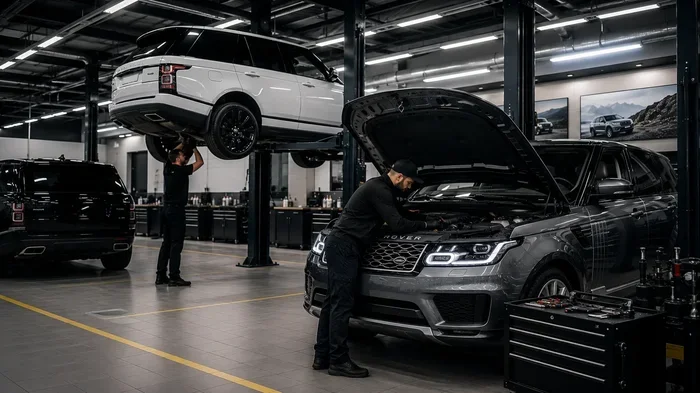
Featured image for Range Rover service center
Image source: cargarageexpert.com
Range Rover extended warranties typically cost $2,500-$5,000 for 3-5 years of additional coverage beyond the factory warranty. Given the brand’s below-average reliability ratings and expensive repair costs (often $1,000+ per visit), many owners find the warranty pays for itself after just one major repair.
You’re standing at the service desk. The advisor slides the estimate across the counter: $3,200 for an air suspension compressor replacement. Your Range Rover has 52,000 miles. The factory warranty expired two months ago. Your stomach drops.
This scenario plays out daily at Land Rover dealerships across the country. Range Rovers deliver unmatched luxury, capability, and presence—but they demand a premium for maintenance. An extended warranty transforms that $3,200 surprise into a $100 deductible. The question isn’t whether repairs will happen. It’s whether you’d rather pay for them one massive bill at a time, or in small, predictable monthly installments.
Key Takeaways
- Factory warranty covers 4 years/50,000 miles: After this expires, you’re responsible for all repair costs on a vehicle with complex electronics and air suspension.
- Extended warranty costs $2,500-$5,000: Price varies by model, mileage, coverage level, and provider—dealer plans cost more than reputable third-party options.
- Average Range Rover repair costs $1,200+: Common issues like air suspension failure ($2,500), timing chain problems ($3,000), and electrical gremlins make coverage financially sensible.
- Third-party providers often offer better value: Companies like Endurance, CarShield, and CARCHEX provide comparable coverage at 30-40% less than Land Rover’s factory-backed plan.
- Best time to buy is before factory warranty expires: Prices increase significantly once your vehicle passes 50,000 miles or 4 years of age.
- Read the fine print on exclusions: Wear items, pre-existing conditions, and maintenance neglect are universally excluded—know what’s actually covered.
- Consider your ownership timeline: If you’ll keep the vehicle 3+ years past factory coverage, a warranty makes mathematical sense for most owners.
📑 Table of Contents
- Understanding Range Rover’s Factory Warranty Baseline
- Real-World Extended Warranty Pricing Breakdown
- The Mathematics: When Does It Pay Off?
- Coverage Deep Dive: What’s Actually Protected
- Choosing the Right Provider: Dealer vs. Third-Party
- Strategic Timing: When to Buy for Maximum Value
- Real Owner Experiences: The Good, Bad, and Ugly
- Alternative Strategies: Self-Insuring and Maintenance Plans
- Making Your Final Decision: A Framework
- Conclusion
Understanding Range Rover’s Factory Warranty Baseline
What the Standard Coverage Includes
Every new Range Rover leaves the factory with a 4-year/50,000-mile bumper-to-bumper warranty. This covers virtually everything except routine maintenance items like oil changes, brake pads, and wiper blades. The powertrain warranty matches this duration. Corrosion perforation gets 6 years/unlimited miles. Roadside assistance runs for 4 years.
Here’s what many owners miss: the clock starts ticking on the original in-service date, not your purchase date if buying certified pre-owned. A 2021 model sold in December 2021 might have only 3 years of coverage remaining when you buy it in 2024.
The Certified Pre-Owned Difference
Land Rover’s CPO program adds 1 year/unlimited miles to the remainder of the original warranty, plus a 7-year/100,000-mile powertrain warranty from the original in-service date. This sounds generous until you realize most CPO Range Rovers already have 30,000-40,000 miles. You’re gaining perhaps 2 years of meaningful coverage before the expensive components start failing.
Did You Know? According to Consumer Reports’ 2023 reliability survey, Land Rover ranked 28th out of 30 brands. Only Mercedes-Benz and Chrysler scored lower. The average repair visit for a 5-year-old Range Rover costs $1,247—nearly triple the industry average of $456.
Real-World Extended Warranty Pricing Breakdown
Dealer-Backed Land Rover Plans
The manufacturer’s extended service contract—often called “Land Rover Extended Warranty” or “Vehicle Service Contract”—typically runs $3,500-$5,500 for 3-5 years of additional coverage on a vehicle with under 50,000 miles. Pricing factors include:
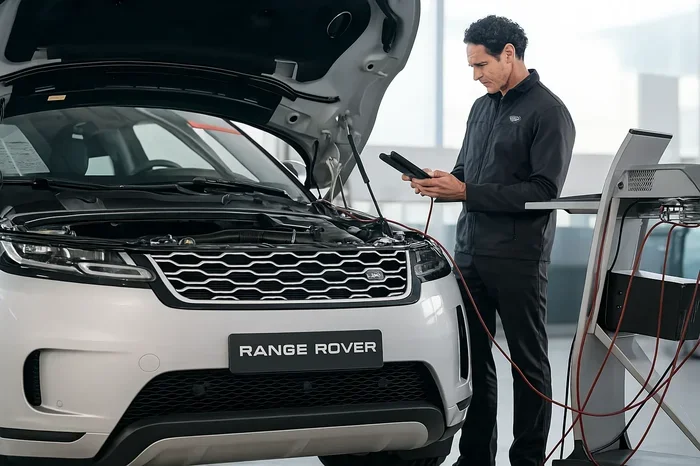
Visual guide about Range Rover service center
Image source: carserviceexpert.com
- Model (Velar costs less than full-size Range Rover)
- Current mileage (under 30K gets best rates)
- Coverage tier (Premium vs. Powertrain Plus vs. Wrap)
- Deductible choice ($0, $100, $250, $500)
- Term length (3, 4, or 5 additional years)
A 2022 Range Rover Sport with 28,000 miles might see these dealer quotes: $3,800 for 5-year/100,000-mile Premium coverage with $100 deductible, or $2,900 for Powertrain Plus (major components only). The Wrap coverage—essentially bumper-to-bumper—can exceed $5,000.
Third-Party Provider Comparison
Reputable aftermarket companies consistently undercut dealer pricing by 30-40%. Current market rates for comparable coverage:
- Endurance: $2,200-$3,800 for 5-year plans with $100 deductible
- CarShield: $1,800-$3,200 (monthly payment options available)
- CARCHEX: $2,400-$4,000 with strong customer service ratings
- Protect My Car: $2,000-$3,500 including maintenance benefits
The trade-off? Dealer plans use only OEM parts and dealer labor rates. Third-party plans may specify aftermarket or remanufactured parts and pay lower labor rates, potentially leaving you with a balance. However, many top-tier third-party providers now offer “dealer-approved” options that eliminate this gap.
Hidden Costs That Catch Owners Off Guard
Beyond the contract price, watch for: diagnostic fees (often $150-200 not covered), fluid disposal charges, shop supplies fees, and rental car limits (typically $35-50/day for 5-10 days max). Some contracts require you to pay upfront and wait for reimbursement—cash flow matters.
Pro Tip: Negotiate the warranty price when buying the vehicle. Dealers have significant markup on these contracts—often 100-200% over cost. A 20-30% discount is common if you push during the vehicle purchase negotiation.
The Mathematics: When Does It Pay Off?
Probability-Based Analysis
Let’s run the numbers. A 2020 Range Rover with 45,000 miles faces these common repair probabilities over the next 5 years (based on RepairPal and CarComplaints data):
- Air suspension compressor failure: 35% probability, $2,800 average cost
- Timing chain tensioner failure (V8 models): 22% probability, $3,200 average cost
- Infotainment system replacement: 18% probability, $2,100 average cost
- Turbocharger replacement: 15% probability, $3,500 average cost
- Transfer case failure: 12% probability, $4,200 average cost
- Electrical module failures (various): 40% probability, $800-1,500 each
Expected value of repairs = (0.35 × $2,800) + (0.22 × $3,200) + (0.18 × $2,100) + (0.15 × $3,500) + (0.12 × $4,200) + (0.40 × $1,150) = $980 + $704 + $378 + $525 + $504 + $460 = $3,551 in expected repair costs.
If your warranty costs $3,000 with a $100 deductible, you’re mathematically ahead. But this assumes average luck. One transfer case failure alone exceeds the warranty cost.
The “Peace of Mind” Variable
Math doesn’t capture the 2 AM breakdown on a family road trip. Or the stress of choosing between a proper repair and a cheaper patch job. Extended warranties convert unpredictable, budget-destroying events into a known line item. For many owners, that certainty alone justifies the cost—even if they never file a claim exceeding the premium.
Model-Specific Risk Profiles
Not all Range Rovers carry equal risk. The V8-powered full-size Range Rover and Range Rover Sport see the highest repair frequency. The Ingenium 4-cylinder models (Velar, Evoque, Discovery Sport) prove notably more reliable. The plug-in hybrid P400e adds high-voltage battery and inverter complexity—components that cost $8,000-12,000 to replace but carry 8-year/100,000-mile federal emissions warranties.
If you drive a 2023 Range Rover Sport P530 V8, the warranty makes more sense than on a 2023 Velar P250 4-cylinder. Adjust your decision accordingly.
Coverage Deep Dive: What’s Actually Protected
Bumper-to-Bumper vs. Powertrain Plus vs. Wrap
Three main coverage tiers exist across virtually all providers:
Powertrain Plus covers engine, transmission, transfer case, drive axles, and sometimes turbochargers. Think “what makes it move.” Cost: $1,800-$2,800. Best for: budget-conscious owners accepting electronics risk.
Wrap Coverage adds electrical, climate control, suspension, steering, brakes, fuel system, and infotainment to Powertrain Plus. Essentially everything except wear items. Cost: $2,800-$4,200. Best for: most owners—covers the expensive electronic gremlins.
Bumper-to-Bumper/Exclusionary covers everything EXCEPT a short listed exclusion list. Highest cost: $3,500-$5,500. Best for: maximum peace of mind, high-mileage drivers.
Range Rover-Specific Critical Components
Ensure your contract explicitly covers these high-failure items:
- Air suspension system: Compressor, valve block, air springs, height sensors, control module
- Terrain Response system: Control module, sensors, actuator motors
- Meridian audio system: Amplifier, head unit, speaker modules (surprisingly failure-prone)
- Gesture tailgate/hands-free liftgate: Sensors, motors, control modules
- Matrix LED headlights: Control modules, individual LED arrays
- Panoramic roof mechanisms: Motors, tracks, control modules, drainage system
Many cheaper contracts exclude “seals and gaskets” which on a Range Rover means the air suspension bags—exactly what fails. Read the exclusions list before the inclusions list.
Technology and Electronics Coverage
Modern Range Rovers run 50+ electronic control units (ECUs). The Pivi Pro infotainment system alone integrates navigation, vehicle settings, climate, off-road controls, and smartphone mirroring. A single module failure can brick multiple systems. Verify your contract covers:
- All ECUs and modules (not just “computer”)
- Wiring harnesses and connectors
- Sensors (parking, radar, camera, ultrasonic)
- Software updates required for repair (some contracts exclude)
Choosing the Right Provider: Dealer vs. Third-Party
Land Rover Factory-Backed Plan Advantages
- OEM parts guaranteed
- Dealer labor rates paid in full
- No reimbursement hassles—dealer bills Land Rover directly
- Transferable to next owner (increases resale value)
- Nationwide dealer network acceptance
- No risk of provider bankruptcy
Third-Party Advantages
- 30-50% lower upfront cost
- Choice of repair facility (independent specialists often know Range Rovers better than dealers)
- Monthly payment plans without financing fees
- Additional perks: trip interruption, rental car, roadside assistance often included
- Coverage available on older/higher-mileage vehicles dealers won’t touch
Red Flags: Providers to Avoid
Steer clear of companies with: less than 10 years in business, BBB rating below A-, frequent “claim denied” complaints citing vague exclusions, requirement to use specific shops, or contracts written in deliberately confusing language. The industry has bad actors. Stick to Endurance, CARCHEX, CarShield (Diamond/Platinum tiers only), Protect My Car, or Olive.
Vetting Checklist Before Signing
- Verify the administrator (not just the marketer) is financially stable—check AM Best rating
- Confirm your preferred repair shop accepts the plan or get written authorization for dealer repairs
- Read the actual contract, not the brochure—request a sample contract before paying
- Check transferability terms and fees if you might sell
- Understand the cancellation policy—pro-rata refund minus admin fee is standard
- Confirm deductible is per-visit, not per-repair (huge difference for multi-system failures)
Strategic Timing: When to Buy for Maximum Value
The Sweet Spot: 3 Years/36,000 Miles
The optimal purchase window falls 6-18 months before your factory warranty expires. At this point:
- Vehicle still qualifies for best tier pricing
- No pre-existing condition concerns
- You’ve experienced the vehicle’s quirks
- Provider competition is highest
- You can negotiate from position of knowledge
Buying at vehicle purchase (often pushed by finance managers) means paying for overlapping coverage. Buying after factory expiry means higher prices, potential inspection requirements, and 30-day waiting periods before claims allowed.
Mileage Tier Pricing Cliffs
Most providers have sharp price increases at mileage thresholds:
- Under 30,000 miles: Best rates
- 30,001-50,000 miles: 15-25% increase
- 50,001-75,000 miles: 40-60% increase, fewer coverage options
- 75,001-100,000 miles: Limited to powertrain only, 2-3x base cost
- Over 100,000 miles: Very few providers, exclusionary terms
If you’re at 48,000 miles, buy now. Waiting until 51,000 could cost $1,000 more for less coverage.
Seasonal and Promotional Opportunities
Third-party providers run promotions around tax refund season (Feb-Apr), Black Friday, and end-of-quarter (Mar/Jun/Sep/De). Dealer plans sometimes discount during slow service months (Jan-Feb, Jul-Aug). A 10-15% promotional discount on a $3,500 contract saves $350-525—worth timing if you’re not in immediate need.
Real Owner Experiences: The Good, Bad, and Ugly
Success Stories
Michael, 2020 Range Rover Sport HSE (Colorado): “Purchased Endurance 5-year wrap at 42,000 miles for $2,800. At 58,000 miles, air suspension compressor failed—$3,100 claim paid minus $100 deductible. At 71,000 miles, timing chain tensioners—$3,800 claim. Warranty paid for itself twice over. Process was smooth: dealer diagnosed, called Endurance, got authorization in 2 hours.”
Sarah, 2019 Range Rover Velar (Florida): “CARCHEX Titanium plan at 35,000 miles, $2,200. Infotainment system bricked at 49,000 miles—$2,400 repair covered. Then panoramic sunroof drain clogged and leaked into headliner—$1,800 covered. Two claims, $4,200 in repairs for $2,200 plus deductibles. Would buy again.”
Cautionary Tales
David, 2018 Range Rover Autobiography (Texas): “Bought dealer plan at purchase—$4,200. At 54,000 miles, transfer case failed. Dealer said ‘wear item’ not covered. Fought for 3 weeks, got regional rep involved, finally covered at 80/20 split. Still paid $1,200 out of pocket. Read the exclusions list.”
Jennifer, 2021 Discovery Sport (California): “Cheap third-party plan, $1,500. Water pump failed at 45,000 miles. Provider required teardown inspection at MY expense ($400) to prove not pre-existing. Then paid only $600 toward $1,800 repair citing ‘reasonable and customary’ rates below dealer pricing. Canceled, got $400 refund. Lesson: you get what you pay for.”
Common Threads in Denied Claims
Analysis of denied claims reveals patterns: missed scheduled maintenance (keep every receipt), modifications (tunes, lifts, spacers), pre-existing conditions (symptoms before contract start), wear items mischaracterized as failures, and using non-approved shops without prior authorization. Document everything. Photograph service records. Get pre-authorization in writing.
Alternative Strategies: Self-Insuring and Maintenance Plans
The Dedicated Repair Fund Approach
Instead of paying $3,000 to a warranty company, put $150/month into a high-yield savings account. In 3 years, you have $5,400+ earning interest. If repairs stay minor, you keep the money. If a $4,000 repair hits, you’re covered. This works best for:
- Mechanically inclined owners who can DIY some repairs
- Owners with trusted independent specialists charging 40-50% less than dealers
- Lower-risk models (4-cylinder, non-air suspension)
- Those with emergency funds already established
The risk: a $12,000 engine failure at month 18 leaves you $9,000 short. Warranty companies pool risk across thousands of vehicles. You can’t.
Prepaid Maintenance Plans vs. Extended Warranties
Don’t confuse these. Prepaid maintenance covers oil changes, brake fluid, filters, wipers—wear items. Extended warranties cover unexpected failures. Some dealers bundle them. Separate them in your analysis. A $1,200 prepaid maintenance plan saves perhaps $200 vs pay-as-you-go. A $3,000 warranty protects against $5,000+ surprises. Different tools for different jobs.
Hybrid Strategy: High Deductible + Repair Fund
Buy a $2,000 warranty with $500 deductible. Put the $1,000 savings vs $100 deductible plan into your repair fund. You’re covered for catastrophes, self-insure for smaller items. Many providers offer $250, $500, even $1,000 deductibles that drop premium significantly. This balances peace of mind with cost efficiency.
Making Your Final Decision: A Framework
Decision Matrix: Answer These 7 Questions
- How long will you keep the vehicle past factory warranty? Under 2 years: probably skip. 3+ years: strongly consider.
- What’s your monthly budget shock tolerance? Can you absorb a $3,000 repair next Tuesday without stress?
- Which model/engine do you have? V8/air suspension: higher need. 4-cylinder/coil springs: lower need.
- Do you have a trusted independent Land Rover specialist? Yes: third-party works. No: dealer plan safer.
- What’s your current mileage? Under 50K: buy now. 50-75K: evaluate carefully. Over 75K: likely too expensive.
- Is the vehicle modified? Tunes, lifts, spacers void most coverage. Stock: full eligibility.
- Can you negotiate? At purchase: yes. Later: limited leverage.
Quick Reference: Warranty Worth It If…
- You drive a V8 model with air suspension
- You plan to keep the vehicle 3+ years past factory coverage
- You lack a $5,000+ emergency repair fund
- You value predictable costs over potential savings
- You buy before 50,000 miles from a reputable provider
- You maintain the vehicle per manufacturer schedule
Consider Skipping If…
- You drive a 4-cylinder model without air suspension
- You’ll sell/trade before 70,000 miles
- You have a trusted independent shop and healthy repair fund
- You’re comfortable with DIY diagnostics and repairs
- The vehicle already has 75,000+ miles
- You’re purchasing a cheap plan from an unknown provider
Conclusion
A Range Rover extended warranty isn’t a universal yes or no—it’s a calculated decision based on your specific vehicle, finances, and risk tolerance. The data shows most V8 and air suspension-equipped models will incur at least one major repair between 50,000-100,000 miles. For those owners, a quality warranty purchased at the right time from a reputable provider delivers genuine financial protection and peace of mind.
The sweet spot: buy a wrap/exclusionary plan from a top-tier third-party provider (Endurance, CARCHEX) at 3-4 years/30,000-45,000 miles with a $100-250 deductible. Expect to pay $2,500-$3,500. Read the actual contract. Keep meticulous maintenance records. Drive confidently knowing that when—not if—that air suspension compressor or timing chain or infotainment module fails, you’ve already paid for the repair in manageable installments.
Your Range Rover represents a significant investment. Protecting it with the right extended warranty isn’t about fear—it’s about preserving the ownership experience that made you choose the brand in the first place. The luxury shouldn’t end when the factory warranty does.
Frequently Asked Questions
How much does a Range Rover extended warranty cost on average?
Dealer-backed plans typically cost $3,500-$5,500 for 3-5 years of additional coverage. Reputable third-party providers like Endurance and CARCHEX offer comparable coverage for $2,200-$3,800. Pricing depends on model, mileage, coverage tier, deductible, and term length.
Is the Range Rover extended warranty worth it for a Velar?
The Velar’s 4-cylinder Ingenium engine and simpler electronics make it more reliable than V8 models. However, air suspension, infotainment, and electrical issues still occur. A mid-tier wrap plan at $2,000-$2,800 often makes sense if keeping the vehicle past 60,000 miles.
Can I buy an extended warranty after my factory warranty expires?
Yes, but options narrow and prices increase significantly. Most providers require a vehicle inspection and impose a 30-day waiting period before claims are allowed. Expect to pay 40-60% more than purchasing before factory expiry, with fewer coverage tiers available.
What’s the difference between Land Rover’s factory extended warranty and third-party plans?
Factory plans guarantee OEM parts, dealer labor rates, and direct billing but cost 30-50% more. Top third-party plans now offer “dealer-approved” options with similar benefits at lower cost. Key differences: claims process, repair facility choice, and financial stability of the administrator.
Does a Range Rover extended warranty cover air suspension?
Only wrap/exclusionary and bumper-to-bumper tiers cover air suspension components (compressor, valve block, air springs, height sensors, control module). Powertrain-only plans explicitly exclude suspension. Verify “air suspension” appears in the covered components list before purchasing.
Can I transfer my Range Rover extended warranty when selling the vehicle?
Most dealer-backed and reputable third-party plans are transferable for a nominal fee ($50-$100), which increases resale value and appeal. Some budget third-party plans are non-transferable. Always confirm transfer terms and fees in writing before purchasing if resale is a possibility.