
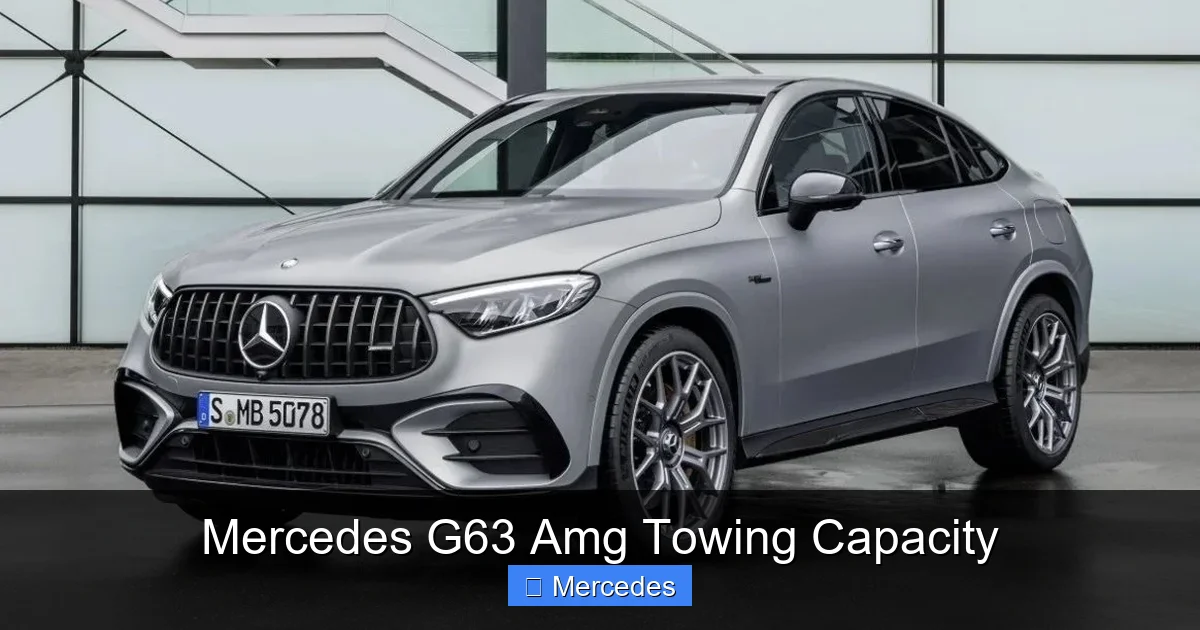
The Mercedes G63 AMG remains one of the few vehicles that can genuinely claim super‑SUV performance while still wearing a proper tow hitch. Since the current W463A generation launched in 2019, its factory‑rated maximum has held steady at 7,000 lb (3,175 kg) when the optional towing package is fitted. Without that package the figure drops to roughly 3,500–4,500 lb, a limitation many owners discover only after they’ve hitched up. This guide breaks down the official numbers, the hardware that makes them possible, real‑world scenarios, and the preparation steps that keep both the SUV and its cargo safe.
Official Towing Capacity by Configuration
| Model Year | Engine | Towing Package | Max Towing | Notes |
|---|---|---|---|---|
| 2019–2026 | 4.0 L twin‑turbo V8 (M179) | Equipped | 7,000 lb | Includes heavy‑duty cooling, Class IV hitch, 7‑pin wiring |
| 2019–2026 | 4.0 L twin‑turbo V8 (M179) | Not equipped | 3,500–4,500 lb | Limited by standard cooling and hitch rating |
The 7,000 lb ceiling applies only when the gross combined weight rating (GCWR) — typically around 12,000 lb for the G63 — is not exceeded. Curb weight sits between 5,500 and 5,700 lb depending on options, so payload (passengers, gear, tongue weight) must be subtracted from the GCWR to find the true available trailer weight.

The G63 AMG with factory towing package pulling a mid‑size boat — note the level stance and integrated hitch.
What the Towing Package Actually Adds
Mercedes bundles several hardware and software changes under the towing package code (often listed as “Trailer Hitch” or “Towing Equipment” on the window sticker):
- Class IV receiver (2‑inch, 5,000 lb tongue‑weight rating) with integrated trailer‑sway control logic in the ESP® system.
- Heavy‑duty cooling: larger radiator, auxiliary transmission‑oil cooler, and power‑steering cooler.
- Upgraded rear‑axle components including reinforced carrier and differential mounts.
- 7‑pin wiring harness with dedicated circuits for trailer brakes, reverse lights, and battery charge line.
- ECU calibrations that modify shift points, torque‑converter lock‑up, and fan‑speed maps for sustained high‑load operation.
Retrofitting the package after delivery is possible through a certified dealer, but it requires parts plus several hours of labor and a software flash. Verify the package by checking for the 7‑pin socket at the rear bumper and the “Trailer” menu in the instrument cluster.
Payload vs. Towing Capacity: A Quick Calculation
- Find the GCWR on the driver‑door jamb sticker (e.g., 12,000 lb).
- Weigh the loaded SUV (fuel, passengers, cargo) on a CAT scale — assume 6,200 lb.
- Subtract: 12,000 − 6,200 = 5,800 lb maximum trailer weight for that specific load.
- Confirm the trailer’s tongue weight (10–15 % of trailer weight) does not push the SUV’s axle loads past their GAWR limits.
Exceeding payload is the most common mistake; the G63’s generous engine torque masks an overloaded chassis until braking or cornering reveals the deficit.
Real‑World Towing Scenarios
| Trailer Type | Typical Loaded Weight | G63 Suitability | Notes |
|---|---|---|---|
| Single‑axle utility trailer (6×10 ft) | 2,500–3,500 lb | Excellent | Well within 80 % rule; minimal sway |
| 20‑ft travel trailer (dry 4,200 lb) | 5,000–5,500 lb loaded | Good | Requires weight‑distributing hitch; monitor transmission temps |
| 22‑ft pontoon boat on tandem‑axle trailer | 4,800–5,500 lb | Good | Launch ramps demand low‑range engagement; watch front‑overhang clearance |
| Two‑horse gooseneck (loaded 6,500 lb) | 6,500+ lb | Marginal | Exceeds 80 % guideline; only for short, flat trips with upgraded cooling |
| 24‑ft enclosed car hauler (loaded 7,200 lb) | 7,200+ lb | Not recommended | Surpasses factory rating; GCWR and braking limits violated |
Owners who tow regularly in mountainous regions (Colorado, Appalachia) report transmission temperatures climbing above 230 °F on long grades even with the factory cooler. An aftermarket auxiliary transmission cooler (e.g., Derale Hyper‑Cool or B&M SuperCooler) drops those peaks by 30–40 °F and is a prudent investment for frequent tower.
Safety Checklist Before Every Tow
- Verify hitch hardware — ball size matches coupler (2″ or 2‑5/16″), lock pin seated, safety chains crossed under tongue.
- Check tire pressures — inflate rear tires to the “max load” PSI on the sidewall; front tires to door‑placard spec.
- Confirm lighting — run a full lamp test (brake, turn, running, reverse) with a helper or trailer‑light tester.
- Load distribution — 60 % of cargo weight forward of trailer axle(s); tongue weight 10–15 % of total.
- Engage tow/haul mode — select “C” (Comfort) or “S” (Sport) on the drive‑program dial; the transmission will hold gears longer and lock the converter earlier.
- Plan fuel stops — expect 8–10 mpg while towing near capacity; range drops below 250 miles on the 26.4‑gal tank.
- Carry spares — trailer tire, wheel chocks, jack rated for trailer weight, and a basic tool kit.
Upgrades That Extend Capability
| Upgrade | Benefit | Typical Cost (installed) |
|---|---|---|
| Auxiliary transmission cooler | Lowers ATF temp 30–40 °F on grades | $600–$950 |
| Weight‑distributing hitch (e.g., Equal‑i‑zer) | Restores front‑axle load, reduces sway | $500–$800 |
| Integrated brake controller (Redarc Tow‑Pro Elite) | Proportional electric‑brake actuation | $350–$500 |
| Heavy‑duty rear shocks (Bilstein B8 5160) | Improves ride quality under load | $700–$1,000 |
| Performance tune (conservative map only) | Slightly better low‑end torque | $600–$1,200 (use with caution) |
Aggressive ECU tunes raise exhaust‑gas temperatures and can void powertrain warranty if a failure is traced to the modification. Stick to maps that preserve factory torque‑limiter thresholds.
How the G63 Compares to Key Rivals (2026 Specs)
| Vehicle | Max Towing (lb) | GCWR (lb) | Standard Towing Hardware |
|---|---|---|---|
| Mercedes G63 AMG | 7,000 | ~12,000 | Optional package |
| BMW X7 M60i | 7,500 | 12,500 | Standard hitch prep |
| Land Rover Defender 110 P400 | 7,700 | 12,800 | Standard receiver |
| Lexus LX 600 | 8,000 | 13,000 | Standard hitch + wiring |
| Ford F‑150 Platinum 3.5L EcoBoost | 13,200 | 18,000+ | Standard Max Tow pkg |
The G63 trades absolute tow rating for a unique combination of portal‑axle off‑road geometry, handcrafted V8 character, and iconic styling. If your primary use is highway hauling, a body‑on‑frame truck or large SUV will do the job with less drama.
Common Myths — Debunked
- “Luxury SUVs can’t tow.” False. The G63, X7 M60i, and LX 600 all exceed 7,000 lb when properly equipped.
- “You can tow at the exact rating every trip.” Environmental factors (heat, altitude, wind) and payload consume margin; the 80 % rule exists for a reason.
- “Towing voids the warranty.” Mercedes covers towing within factory specs. Damage from overloading, missing cooling, or unauthorized tunes is excluded.
- “The G63’s air suspension can’t handle tongue weight.” The adaptive damping (AMG Ride Control) compensates well up to the 770 lb tongue‑weight limit; a weight‑distributing hitch is still advised above 500 lb.
Maintenance Intervals for Towing Duty
| Service | Standard Interval | Towing Interval |
|---|---|---|
| Engine oil & filter | 10,000 mi / 1 yr | 7,500 mi / 6 mo |
| Transmission fluid | 40,000 mi | 30,000 mi |
| Rear differential fluid | 40,000 mi | 30,000 mi |
| Brake fluid | 2 yr | 1 yr |
| Coolant flush | 10 yr / 150,000 mi | 5 yr / 75,000 mi |
| Inspect hitch bolts & wiring | — | Every oil change |
High‑load operation accelerates fluid degradation. Document each service; a complete record protects warranty claims and resale value.
Fuel Considerations When Towing
The M179 V8 requires 91‑octane minimum (93 recommended) for peak output and knock resistance under load. Running 87 octane while towing can trigger timing retard, reducing power and increasing cylinder temperatures. For a deeper look at fuel requirements across the lineup, see our breakdown of premium fuel requirements, which models need premium, alternatives to premium gasoline, and the pros and cons of regular fuel.
Final Thoughts
The Mercedes G63 AMG proves that a 5,700‑lb, 577‑hp icon can also be a competent tow vehicle — if you respect its engineering boundaries. Spec the factory towing package, add an auxiliary transmission cooler for serious work, weigh every load, and service fluids on the accelerated schedule. Do that, and the G63 will haul your boat, camper, or trail rig with the same authoritative composure it brings to the autobahn.
Next step: Before your first tow, locate the payload sticker on your driver’s door jamb and run the GCWR calculation above. It takes five minutes and prevents the most common (and expensive) towing mistakes.
Frequently Asked Questions
What is the maximum towing capacity of the Mercedes G63 AMG?
7,000 lb (3,175 kg) with the optional towing package; 3,500–4,500 lb without it.
Does the G63 AMG come with a towing package standard?
No. It is a standalone option (or part of a package group) that must be selected at order or retrofitted by a dealer.
Can I tow a jet ski with my G63 AMG?
Yes. A single jet ski on a lightweight trailer (typically < 1,500 lb total) is well within the base rating.
What happens if I exceed the towing limit?
Risks include overheating, transmission failure, loss of directional stability, extended stopping distances, and potential denial of warranty coverage.
Should I use cruise control while towing?
Only on flat, dry highways. On grades or in variable conditions, manual gear selection and speed modulation are safer.
Are software updates required for towing?
The towing package installation includes an ECU flash. After that, no periodic updates are mandated, though dealers may apply revised transmission calibrations during routine service.
Where can I find official towing guidelines?
Mercedes‑Benz USA publishes model‑specific towing guides at mbusa.com. For federal safety standards, consult the NHTSA towing safety page.

Close‑up of the factory Class IV receiver and 7‑pin connector — clean integration preserves departure angle. Explore more SUV guides and reviews on our main blog.