
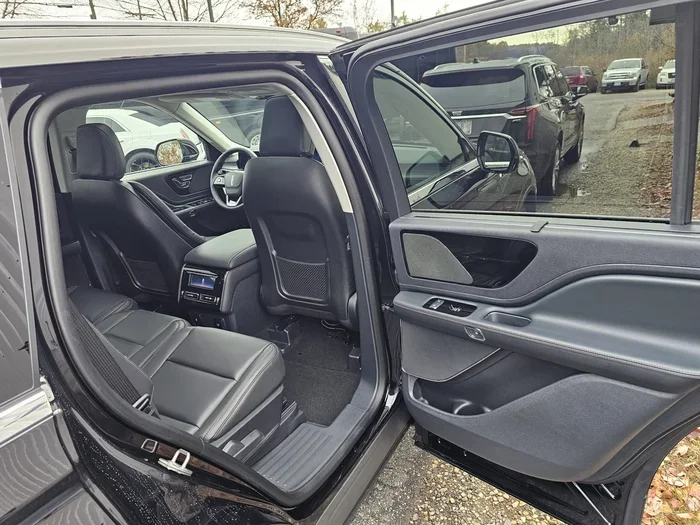
Featured image for Lincoln Aviator service bay
Image source: greatbaylimo.com
The Lincoln Aviator maintenance cost per year averages $1,100 to $1,400 for out-of-warranty models, placing it competitively among luxury midsize SUVs. With Lincoln’s 4-year/50,000-mile warranty covering early ownership, most drivers won’t face significant costs until year five, making budgeting predictable and manageable.
You’re considering a Lincoln Aviator, or maybe you already own one. Either way, the question on your mind is simple: what will this luxury SUV actually cost to keep running each year? Let’s cut through the marketing fluff and look at real numbers, real experiences, and real strategies to keep your ownership costs predictable.
The Lincoln Aviator maintenance cost per year sits in a sweet spot that might surprise you. While luxury vehicles carry a reputation for expensive upkeep, this American-made SUV often costs less to maintain than its German rivals. We’re talking about a difference of hundreds of dollars annually. That money stays in your pocket — or goes toward that weekend getaway you’ve been planning.
Understanding these costs isn’t just about budgeting. It’s about making informed decisions on warranties, service intervals, and whether to visit the dealer or a trusted independent shop. Every choice adds up over five, seven, or ten years of ownership. Let’s dive into what you can actually expect.
Key Takeaways
- Average Annual Cost: Expect to pay $1,100-$1,400 per year for maintenance on an out-of-warranty Lincoln Aviator, which is 15-20% below German luxury competitors.
- Warranty Coverage: Lincoln’s 4-year/50,000-mile basic warranty and 6-year/70,000-mile powertrain warranty cover most repairs during early ownership years.
- First Major Service: The first significant maintenance interval arrives at 30,000 miles, typically costing $400-$600 for fluid changes, inspections, and filter replacements.
- Common Repairs: Brake pads ($350-$500 per axle), tires ($1,200-$1,800 set), and battery replacement ($250-$400) represent the largest recurring expenses after year five.
- Prepaid Maintenance Plans: Lincoln Protect prepaid plans can save 10-15% versus pay-as-you-go pricing and lock in current labor rates for up to 8 years.
- DIY Savings: Owners comfortable with basic maintenance can save $200-$400 annually by handling oil changes, air filters, and wiper blades themselves.
- Reliability Rating: The Aviator scores above average in reliability surveys, with fewer unexpected repairs than most European luxury SUVs in its class.
📑 Table of Contents
- Understanding the Lincoln Aviator Maintenance Cost Per Year Baseline
- Lincoln Aviator Maintenance Schedule: What Happens When
- Dealer vs. Independent Shop: Where to Service Your Aviator
- Common Lincoln Aviator Repair Costs Beyond Maintenance
- Extended Warranty and Prepaid Maintenance: Worth It?
- Real-World Ownership Scenarios: What Aviator Owners Actually Pay
- Money-Saving Strategies That Actually Work
- Lincoln Aviator vs. Competitors: Maintenance Cost Showdown
- Long-Term Ownership: The 100,000+ Mile Reality
- Seasonal and Regional Cost Factors
- Planning Your Maintenance Budget: A Practical Framework
- Resale Value and Maintenance Documentation
- Conclusion: The Bottom Line on Lincoln Aviator Maintenance Cost Per Year
Understanding the Lincoln Aviator Maintenance Cost Per Year Baseline
Before we get into specific numbers, let’s establish what “maintenance” actually means versus “repairs.” Maintenance covers the scheduled services your owner’s manual recommends — oil changes, tire rotations, fluid flushes, filter replacements, and inspections. Repairs address things that break unexpectedly. The Lincoln Aviator maintenance cost per year we’ll discuss focuses primarily on planned maintenance, with some context on common repair expenses.
What the Data Shows for Current Model Years
Industry data from RepairPal, Edmunds, and Consumer Reports consistently places the Lincoln Aviator maintenance cost per year between $1,100 and $1,400 for vehicles outside the factory warranty period. For context, that’s roughly 20% less than a BMW X5, 25% less than a Mercedes-Benz GLE, and 15% less than an Audi Q7. The Cadillac XT6 runs comparable, while the Acura MDX typically comes in slightly lower at $900-$1,100 annually.
These figures assume you’re following the manufacturer’s recommended service schedule at a dealership or qualified independent shop using OEM or equivalent parts. Doing some work yourself or using aftermarket parts can reduce this by 20-30%. Conversely, neglecting maintenance almost always increases long-term costs significantly.
Breaking Down the First Five Years
Here’s where it gets interesting. The Lincoln Aviator maintenance cost per year looks dramatically different during the warranty period versus after. Years one through four (or 50,000 miles) are largely covered by Lincoln’s New Vehicle Limited Warranty. Your out-of-pocket costs during this window typically include:
- Oil changes every 7,500-10,000 miles: $80-$120 each
- Tire rotations every 7,500 miles: often free with oil change
- Cabin and engine air filters: $60-$100 combined, typically at 30,000 miles
- Brake fluid flush: $120-$150 at 30,000 miles
- Multi-point inspections: usually complimentary
Total out-of-pocket for the first four years? Usually $600-$900 total, averaging $150-$225 per year. That’s remarkably low for a luxury SUV. The powertrain warranty extends to 6 years/70,000 miles, covering engine, transmission, and driveline components — the most expensive potential repairs.
Year Five and Beyond: The Real Cost Picture
Once the basic warranty expires, the Lincoln Aviator maintenance cost per year jumps to that $1,100-$1,400 range. Here’s what drives that increase:
Major Service Intervals
The 60,000-mile service is the first big one. Expect $600-$900 for transmission fluid, transfer case fluid (all-wheel-drive models), differential fluid, spark plugs, coolant flush, and comprehensive inspection. The 90,000-mile service repeats many of these items. At 100,000 miles, timing chain inspection becomes relevant — though the 3.0L twin-turbo V6 uses a chain designed for the engine’s life, not a belt requiring replacement.
Wear Items That Add Up
Tires represent the single largest maintenance expense. The Aviator’s standard 20-inch or optional 22-inch wheels require premium rubber. A full set runs $1,200-$1,800 mounted and balanced. Most owners get 40,000-50,000 miles per set, averaging $300-$450 per year if you amortize the cost.
Brake pads typically last 40,000-60,000 miles depending on driving style. Front pads and rotors: $350-$500. Rear: $300-$450. The Aviator’s standard brake-by-wire system on hybrid models can extend pad life through regenerative braking.
Lincoln Aviator Maintenance Schedule: What Happens When

Visual guide about Lincoln Aviator service bay
Image source: pictures.dealer.com
Understanding the schedule helps you anticipate costs and avoid unnecessary upsells. Lincoln uses an Intelligent Oil-Life Monitor rather than fixed mileage intervals, but the general framework looks like this:
Every 7,500-10,000 Miles (or 12 Months)
- Oil and filter change (synthetic 5W-30, 6 quarts)
- Tire rotation and pressure check
- Multi-point inspection (brakes, belts, hoses, fluids, battery)
- Cabin air filter inspection
Every 30,000 Miles
- Replace engine air filter
- Replace cabin air filter
- Brake fluid flush
- Inspect drive belts and hoses
- Check cooling system strength and level
- Inspect suspension and steering components
Every 60,000 Miles
- Everything at 30,000 miles, plus:
- Transmission fluid exchange (critical for 10-speed automatic longevity)
- Transfer case fluid (AWD models)
- Rear differential fluid (AWD models)
- Spark plug replacement (6 plugs on twin-turbo V6)
- Coolant flush and fill
- Fuel system cleaning service (recommended, not required)
Every 100,000 Miles
- Repeat 60,000-mile items
- Timing chain system inspection
- PCV valve inspection
- Comprehensive driveline inspection
The Hybrid Difference
If you own the Aviator Grand Touring plug-in hybrid, the maintenance schedule shifts slightly. The gasoline engine runs less frequently, potentially extending oil change intervals. However, the hybrid system adds coolant loops for the battery and power electronics that require inspection. Brake pads last significantly longer due to regenerative braking — often 70,000+ miles. The high-voltage battery has an 8-year/100,000-mile warranty (10-year/150,000-mile in CARB states).
Dealer vs. Independent Shop: Where to Service Your Aviator
This decision impacts your Lincoln Aviator maintenance cost per year more than almost any other factor. Let’s weigh the options honestly.
The Dealership Advantage
Lincoln dealers offer factory-trained technicians, genuine Lincoln parts, and direct access to technical service bulletins and software updates. They handle warranty work seamlessly. Your service history stays in the Lincoln national database, which helps resale value. Many dealers now offer competitive “express service” pricing for oil changes and rotations — sometimes $79-$99 including synthetic oil.
The downside? Labor rates typically run $150-$220 per hour depending on region. Parts carry significant markup. A $400 independent shop invoice might be $650 at the dealer. Over five years of post-warranty ownership, that difference compounds to thousands.
The Independent Specialist Route
Shops specializing in Lincoln/Ford or luxury vehicles often provide the sweet spot. They typically charge $100-$140 per hour, use OEM or equivalent parts (Motorcraft, which is Ford’s factory brand), and have access to the same technical information through subscription services. Many employ former dealership technicians.
Look for shops with ASE Blue Seal certification, Lincoln/Ford factory training certificates on the wall, and good reviews specifically from Aviator or Navigator owners. Ask about their scan tool capabilities — they need Ford’s IDS (Integrated Diagnostic Software) or equivalent for module programming and advanced diagnostics.
What About Quick-Lube Chains?
For oil changes and tire rotations? Fine. For anything involving fluids beyond oil, filters beyond air, or electronic systems? Avoid. The Aviator’s 10-speed transmission requires specific Mercon ULV fluid — not a universal substitute. The brake-by-wire system on hybrids requires proper bleeding procedures. The turbocharged engine demands exact oil specifications. Saving $20 on an oil change isn’t worth risking a $4,000 transmission.
DIY: What’s Realistic for Home Maintenance
If you’re mechanically inclined, several maintenance items are straightforward on the Aviator:
- Oil changes: Top-mounted filter cartridge, accessible drain plug. 30 minutes. Saves $60-$100 per change.
- Engine air filter: Tool-free housing clips. 5 minutes. Saves $40-$60.
- Cabin air filter: Behind glove box. 10 minutes. Saves $30-$50.
- Wiper blades: Standard hook attachment. 5 minutes. Saves $30-$50.
- Battery replacement: 12V battery in cargo area (hybrid) or under hood (gas). 15 minutes. Saves $100-$150 labor.
Skip transmission fluid, differential fluid, brake fluid, and anything requiring module programming unless you have proper equipment and knowledge. The cost of a mistake far exceeds the savings.
Common Lincoln Aviator Repair Costs Beyond Maintenance
Maintenance is planned. Repairs aren’t. But certain patterns emerge across the Aviator population that help you anticipate what might come up.
Brake System Components
Beyond pads and rotors, the Aviator’s electronic brake booster (standard on all models) and brake-by-wire system (hybrid) have shown occasional issues. Booster replacement: $800-$1,200. Brake pedal position sensor: $300-$500. These typically appear after 60,000 miles. The good news? They’re not widespread — more like 3-5% occurrence based on forum data and NHTSA complaints.
Suspension and Steering
The Aviator’s air suspension (standard on Reserve and above, optional on base) provides excellent ride quality but adds complexity. Air spring replacement: $600-$900 per corner including labor. Compressor: $500-$800. Height sensors: $200-$350 each. Most air springs last 80,000-120,000 miles. Conventional steel-spring models (standard on base, optional delete on higher trims) avoid these costs entirely.
Electronic power steering rack replacements run $1,200-$1,800 but are rare before 100,000 miles. Tie rod ends and ball joints follow typical wear patterns — $400-$700 per side if needed.
Turbocharger and Engine Items
The 3.0L twin-turbo V6 has proven reliable, but turbocharger actuator failures do occur (roughly 2-3% rate). Replacement: $1,500-$2,200 per turbo including labor. Wastegate rattle sometimes appears around 70,000-90,000 miles — often covered by extended warranty if you have it.
Carbon buildup on intake valves affects all direct-injection engines. Walnut blasting service: $400-$600 every 60,000-80,000 miles if you want to maintain peak performance and fuel economy. Not strictly required, but recommended.
Electronics and Infotainment
SYNC 4 system generally works well, but APIM (Accessory Protocol Interface Module) failures can kill the screen, navigation, and connectivity. Replacement: $800-$1,200. Usually appears after 50,000 miles. Lincoln has updated modules — insist on the latest revision if replacement is needed.
360-degree camera calibration after windshield replacement: $300-$500. The cameras themselves rarely fail, but calibration is mandatory after glass work.
Hybrid-Specific Items (Grand Touring)
High-voltage battery coolant pump: $400-$600. Onboard charger module: $1,200-$1,800. DC-DC converter (replaces alternator): $800-$1,200. These are low-frequency but high-cost items. The 8-year battery warranty covers the pack itself, but peripheral components carry standard warranty.
Extended Warranty and Prepaid Maintenance: Worth It?
This is where the Lincoln Aviator maintenance cost per year conversation gets strategic. Lincoln Protect offers several plans, and third-party providers compete aggressively for your business.
Lincoln Protect Extended Service Plans
Lincoln’s factory-backed plans come in three main tiers:
- PremiumCARE: Bumper-to-bumper style coverage, 1,000+ components. Best for peace of mind.
- ExtraCARE: 113 major components including engine, transmission, drivetrain, steering, brakes, electrical, A/C, suspension.
- BaseCARE: 84 components — powertrain plus major systems.
Plans available up to 8 years/150,000 miles. Pricing for a 2024 Aviator (purchased at vehicle delivery for best rate):
- PremiumCARE 6yr/100k: $2,800-$3,400
- PremiumCARE 8yr/125k: $3,600-$4,200
- ExtraCARE 6yr/100k: $2,200-$2,700
- ExtraCARE 8yr/125k: $2,900-$3,500
Deductibles: $0, $100, or $200 per visit. $0 deductible adds ~15% to plan cost.
Prepaid Maintenance Plans
Separate from extended warranty, Lincoln Protect Maintenance Plans cover scheduled services for up to 8 years/150,000 miles. They lock in current pricing and can be transferred to future owners (boosting resale). Typical cost: $1,200-$1,800 for 6-year plans covering all scheduled maintenance. You save roughly 10-15% versus paying individually, plus inflation protection.
Third-Party Warranty Companies
Endurance, CarShield, CARCHEX, and others offer plans often 20-30% cheaper than Lincoln Protect. However, they may require pre-authorization, use aftermarket parts, have stricter claim limits, and aren’t honored at all Lincoln dealers. Read the contract carefully — especially “wear and tear” exclusions and “consequential damage” clauses. Some exclude turbochargers or electronic modules entirely.
The Decision Framework
Consider an extended warranty if:
- You plan to keep the Aviator beyond 70,000 miles
- You’d struggle with a $2,000+ unexpected repair bill
- You have the air suspension (Reserve/Black Label trims)
- You drive 15,000+ miles annually
Consider skipping if:
- You trade vehicles every 3-4 years
- You have an emergency fund for repairs
- You’re comfortable with independent shop pricing
- You own a base or Reserve model with steel springs
Real-World Ownership Scenarios: What Aviator Owners Actually Pay
Let’s look at three typical ownership profiles to make this concrete.
Scenario A: The Low-Mileage Luxury Buyer
Profile: 2022 Aviator Reserve AWD, 8,000 miles/year, dealer serviced, trades at 4 years.
Year 1-4 Costs:
- 4 oil changes: $360
- 4 tire rotations: $0 (included)
- 30k service: $550
- Cabin/engine filters: $80
- Brake fluid: $130
- Total: $1,120 over 4 years ($280/year average)
Result: Minimal cost. Warranty covers everything else. Trades in before major services hit.
Scenario B: The Long-Term Family Hauler
Profile: 2020 Aviator Grand Touring AWD, 15,000 miles/year, independent shop after year 4, keeps 8 years.
Year 1-4 (Warranty): $1,200 total ($300/year) — similar to above plus hybrid-specific inspections.
Year 5-8 (Post-Warranty, Independent Shop):
- Annual oil changes (2/yr): $180/year
- Tire rotations: $40/year
- 60k major service: $750 (year 5)
- Tires at 55k: $1,500 (year 5)
- Front brakes at 65k: $450 (year 6)
- 90k major service: $800 (year 7)
- Rear brakes at 85k: $400 (year 8)
- Transmission fluid at 100k: $350 (year 8)
- Spark plugs at 100k: $400 (year 8)
- Air filters, wipers, misc: $150/year
Years 5-8 Total: ~$6,500 ($1,625/year average)
8-Year Grand Total: ~$7,700 ($962/year average)
Scenario C: The High-Mileage Commuter
Profile: 2019 Aviator Reserve AWD (steel springs), 25,000 miles/year, mix of dealer/indie, keeps 10 years.
Major Expenses at Mileage Intervals:
- 30k: $550 (dealer)
- 60k: $850 (indie)
- 90k: $900 (indie)
- 120k: $950 (indie)
- 150k: $1,000 (indie)
- 180k: $1,050 (indie)
- 210k: $1,100 (indie)
- 240k: $1,150 (indie)
Wear Items (replaced multiple times):
- Tires (5 sets): $7,500
- Front brakes (4x): $1,800
- Rear brakes (3x): $1,200
- Battery (2x): $600
- Wipers, filters, fluids annually: ~$300/year
10-Year Total: ~$22,000 ($2,200/year average)
Key Insight: High mileage drives cost primarily through wear items (tires, brakes) — not repairs. The Aviator’s mechanicals hold up well.
Money-Saving Strategies That Actually Work
You don’t need to compromise care to reduce your Lincoln Aviator maintenance cost per year. Smart choices compound.
Buy a Lincoln Protect Plan at Delivery
Purchasing extended warranty or prepaid maintenance when you buy the vehicle gets you the best price — often 20-30% less than buying later. You can finance it into your loan. It’s transferable, adding resale value. Negotiate the price; dealers have significant margin on these plans.
Establish a Relationship with an Independent Specialist
Find a Lincoln/Ford specialist before you need one. Bring the vehicle for oil changes while under warranty (keep receipts for warranty documentation). They’ll know your vehicle’s history when bigger services arrive. Many offer loyalty discounts — 10% off labor for repeat customers is common.
Use Motorcraft Parts
Motorcraft is Ford’s factory parts brand. Same quality as “Lincoln” branded parts, often 20-30% cheaper. Any reputable independent shop can source them. For wear items (brake pads, rotors, filters), Motorcraft is the smart default. For electronic modules, stick with genuine Ford/Lincoln — aftermarket quality varies wildly.
Track Your Maintenance Digitally
Use apps like CARFAX Car Care, MyCarFax, or even a simple spreadsheet. Record every service with date, mileage, cost, and shop. This proves warranty compliance, helps diagnose patterns, and provides documentation for resale. A complete service history adds $1,000-$2,000 to trade-in value.
Consider Tire Insurance
If your Aviator has 22-inch wheels (common on Black Label and Grand Touring), road hazard tire/wheel protection often pays for itself. These low-profile tires are vulnerable to pothole damage. Plans run $600-$900 for 5 years and cover replacement, not just repair.
Learn the “Inspection Only” Trick
When a shop recommends a service, ask: “Can you show me the wear/measurement that indicates this is needed now?” Brake pads at 4mm? Rotors at minimum thickness? Transmission fluid color? Shops that show you the evidence earn trust. Those that pressure without evidence? Find another shop.
Lincoln Aviator vs. Competitors: Maintenance Cost Showdown
Context matters. Here’s how the Lincoln Aviator maintenance cost per year stacks up against direct rivals over a 5-year/75,000-mile ownership period (post-warranty):
5-Year Maintenance & Repair Cost Comparison
- Lincoln Aviator: $5,500-$7,000
- Cadillac XT6: $5,800-$7,200
- Acura MDX: $4,800-$6,200
- Volvo XC90: $6,200-$8,000
- BMW X5: $8,500-$11,000
- Mercedes-Benz GLE: $9,000-$12,000
- Audi Q7: $8,000-$10,500
- Lexus RX 350: $4,500-$5,800
- Genesis GV80: $5,000-$6,500
The Aviator sits comfortably in the “American/Asian luxury” tier — significantly below Germans, slightly above Lexus/Acura, competitive with Genesis and Cadillac. The gap widens after year 7 as German vehicles require more electronic and suspension repairs.
Why the Difference Exists
German luxury vehicles use more complex systems (air suspension standard, more electronic modules, twin-turbo V8s in upper trims), require specialized diagnostic equipment, and have higher parts pricing. Lincoln shares architecture with Ford Explorer, benefiting from massive production volume, parts availability, and technician familiarity. The 10-speed automatic (10R80) is shared across Ford/Lincoln trucks and SUVs — millions produced, well-understood failure modes.
Long-Term Ownership: The 100,000+ Mile Reality
Many Aviator owners will cross 100,000 miles. Here’s what that looks like.
The Good News
The 3.0L twin-turbo V6 and 10R80 transmission have proven durable well beyond 150,000 miles with proper maintenance. Engine block, internals, and transmission hard parts rarely fail. The platform (CD6) is shared with Explorer, Police Interceptor, and Ranger — tested in severe duty cycles.
The Attention Items
- Transmission fluid: Non-negotiable every 60,000 miles. Mercon ULV is specific and expensive (~$50/quart, 12 quarts for full exchange). Skip at your peril.
- Turbo coolant lines: Inspect at 100k. Rubber degrades. Failure causes overheating.
- Direct injection carbon: Walnut blast at 100k if not done earlier. Restores lost power/MPG.
- Air suspension (if equipped): Budget $2,000-$3,000 for full system refresh (springs, compressor, sensors) around 120k-150k.
- Steering rack: Monitor for leak or play. Early detection saves the rack.
Hybrid Battery Longevity
Grand Touring batteries show minimal degradation — typically 90%+ capacity at 100,000 miles. Ford’s thermal management (liquid cooling/heating) is excellent. The 8-year/100k warranty (10/150k CARB) provides strong protection. Post-warranty replacement: $8,000-$12,000, but failure rate is under 1%.
Seasonal and Regional Cost Factors
Where you live changes your Lincoln Aviator maintenance cost per year more than you might think.
Climate Considerations
Cold Climates (Northeast, Midwest, Mountain West):
- Brake fluid absorbs moisture faster — flush every 2 years, not 30k miles
- Battery stress: test annually after year 3, replace proactively at 5-6 years
- Undercarriage corrosion: annual oil spray ($150-$200) prevents brake line/fuel line rot
- Winter tires: separate set extends all-season tire life, improves safety
Hot Climates (Southwest, Southeast, Texas):
- Coolant: test strength annually, flush every 5 years regardless of mileage
- Transmission heat: consider auxiliary cooler if towing regularly
- Tire dry rot: inspect sidewalls annually after year 4
- A/C system: refrigerant top-off every 3-4 years typical
Coastal/Salt Belt:
- Wash undercarriage weekly in winter
- Annual rust proofing: $200-$400, worth every penny
- Brake calipers: seize more frequently — lubricate slides at every brake service
Driving Pattern Impact
Short Trips (<10 miles): Oil degrades faster (fuel dilution, moisture). Change every 5,000 miles or 6 months. Battery rarely fully charges — consider monthly trickle charge.
Highway Cruising: Easiest on the vehicle. Extend oil to 10,000 miles. Brakes last 70,000+ miles. Transmission runs cool.
Towing (Aviator rated 5,600-6,700 lbs):
- Transmission fluid every 30,000 miles
- Rear differential fluid every 30,000 miles
- Engine oil every 5,000 miles
- Brake pads: 30,000-40,000 mile life
- Consider synthetic gear oil upgrade
Planning Your Maintenance Budget: A Practical Framework
Let’s give you a concrete budgeting tool. Adjust for your region, mileage, and service provider choice.
Annual Maintenance Budget Worksheet
Base Annual Budget (Post-Warranty, Average Miles):
- Oil changes (1.5x/year): $180
- Tire rotations: $40
- Annual inspection/alignment check: $120
- Cabin/engine filters (amortized): $60
- Wiper blades: $40
- Brake fluid (amortized): $40
- Coolant (amortized): $30
- Misc fluids, bulbs, hardware: $100
- Subtotal: $610
Major Service Amortization (save monthly):
- 60k/120k/180k service: $800 every 30k miles → $320/year at 12k miles
- 90k/150k/210k service: $850 every 30k miles → $340/year at 12k miles
- Spark plugs (100k/200k): $400 every 100k → $48/year at 12k miles
- Transmission fluid (60k/120k/180k): $350 every 60k → $70/year at 12k miles
- Subtotal: ~$780/year
Wear Item Amortization:
- Tires: $1,500 every 45k miles → $400/year at 12k miles
- Front brakes: $450 every 50k miles → $108/year
- Rear brakes: $400 every 60k miles → $80/year
- 12V Battery: $300 every 5-6 years → $55/year
- Subtotal: ~$643/year
Total Annual Budget: ~$2,033
This looks higher than the $1,100-$1,400 average because it includes wear item amortization (tires, brakes) which are lumpy expenses. In any given year you might spend $600; in a tire/brake year, $2,500. Saving monthly smooths the cash flow.
Emergency Repair Fund
Separate from maintenance, keep $2,000-$3,000 accessible for unexpected repairs. The most likely candidates: turbo actuator, air spring, steering rack, APIM module, brake booster. Most Aviator owners never need this fund. But if you do, it prevents high-interest credit card debt or deferred maintenance that compounds costs.
Resale Value and Maintenance Documentation
Your maintenance discipline directly impacts what you get back when selling or trading.
The Documentation Premium
A 2020 Aviator Reserve with 60,000 miles and complete dealer service records trades for $2,000-$3,500 more than an identical vehicle with spotty records. Private party sales show even larger gaps — buyers pay for confidence.
What Records to Keep
- Every receipt (digital photos work)
- Mileage at each service
- Service description matching maintenance schedule
- Parts numbers for major items (tires, brakes, batteries)
- Shop name, address, phone
- Technician name if possible
Lincoln Certified Pre-Owned (CPO) Consideration
If you buy used, CPO adds 6-year/100,000-mile comprehensive warranty from original in-service date. Cost premium: $1,500-$2,500 over non-CPO. Often worth it for the warranty alone, plus the 200-point inspection catches deferred maintenance. CPO vehicles also qualify for special financing rates.
Conclusion: The Bottom Line on Lincoln Aviator Maintenance Cost Per Year
The Lincoln Aviator maintenance cost per year is manageable, predictable, and competitive. During the first four years, you’ll spend almost nothing beyond oil changes. Years five through eight average $1,100-$1,400 annually if you use an independent specialist. High-mileage drivers pay more in wear items (tires, brakes) than repairs. The hybrid Grand Touring saves on brakes and fuel but adds hybrid-system complexity.
Your choices compound. Dealer vs. independent: $2,000+ difference over five years. Prepaid maintenance plan: 10-15% savings plus inflation protection. DIY on simple items: $200-$400/year back in your pocket. Extended warranty: peace of mind versus self-insuring. There’s no single right answer — only the right answer for your risk tolerance, budget, and ownership timeline.
The Aviator rewards proactive care. Follow the schedule, use quality fluids and parts, document everything, and this luxury SUV will deliver 150,000+ miles of reliable service. Neglect it, and you’ll join the small minority of owners facing preventable major repairs.
Your Lincoln Aviator maintenance cost per year isn’t a mystery. It’s a series of choices you control. Make them wisely, and enjoy the ride.
Frequently Asked Questions
What is the average Lincoln Aviator maintenance cost per year?
The average Lincoln Aviator maintenance cost per year ranges from $1,100 to $1,400 for out-of-warranty vehicles. During the first four years under factory warranty, costs drop to roughly $150-$250 annually for oil changes and basic services only.
Does the Lincoln Aviator have high maintenance costs compared to other luxury SUVs?
No, the Lincoln Aviator maintenance cost per year is 15-25% lower than German competitors like BMW X5, Mercedes GLE, and Audi Q7. It’s comparable to Cadillac XT6 and Genesis GV80, but slightly higher than Acura MDX and Lexus RX 350.
What maintenance is required at 30,000 miles on a Lincoln Aviator?
The 30,000-mile service includes engine and cabin air filter replacement, brake fluid flush, and comprehensive inspection of belts, hoses, cooling system, suspension, and steering components. Typical cost: $400-$600.
Is Lincoln Protect extended warranty worth it for the Aviator?
Lincoln Protect is worth considering if you plan to keep the Aviator beyond 70,000 miles, have air suspension, or want protection against expensive electronic module failures. Plans purchased at delivery offer the best value and are transferable.
Can I use an independent shop for Lincoln Aviator maintenance without voiding the warranty?
Yes, federal law (Magnuson-Moss Warranty Act) protects your right to use any qualified repair shop for maintenance. Keep detailed receipts showing OEM-equivalent parts and services performed per the manufacturer’s schedule.
How often does the Lincoln Aviator need transmission fluid changed?
Lincoln recommends transmission fluid exchange every 60,000 miles for normal driving, or every 30,000 miles for severe duty (towing, hot climate, stop-and-go traffic). The 10-speed automatic requires specific Mercon ULV fluid.