
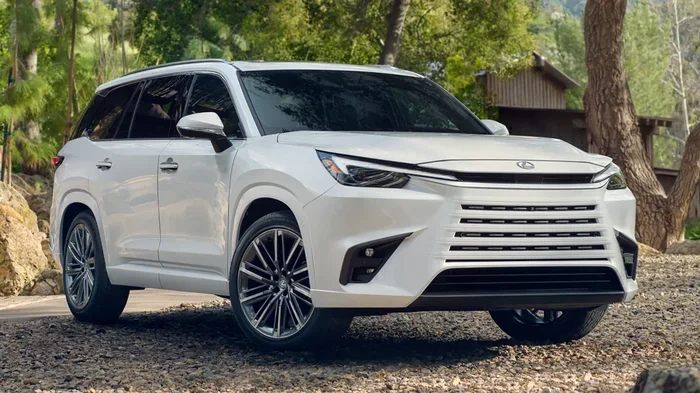
Featured image for Lexus TX SUV exterior
Image source: motortrend.com
The Lexus TX Hybrid commands a roughly $3,500 to $5,000 premium over the gas model but delivers roughly 35% better combined fuel economy (29 MPG vs 21 MPG). For drivers averaging 15,000 miles annually, the hybrid pays for its price difference in fuel savings within 4 to 5 years, while offering stronger acceleration and a quieter cabin.
Shopping for a three-row luxury SUV in 2024 feels like walking into a candy store where everything costs $70,000. You have the new Lexus TX sitting right next to its corporate cousin, the Toyota Grand Highlander, and suddenly you are staring at a spec sheet asking a very specific question: Lexus TX Hybrid vs Gas worth it? It is the classic modern car-buying dilemma. Do you pay more upfront to save at the pump, or keep the cash now and accept fewer MPG?
We are going to cut through the marketing fluff. Think of this guide as sitting down with a friend who has a spreadsheet obsession and a love for long road trips. We will look at the real price delta, the actual fuel economy you will see in your driveway (not the EPA lab), the driving dynamics, and the long-term ownership math. By the end, you will know exactly which powertrain belongs in your garage.
Key Takeaways
- Price Gap: The Hybrid carries a $3,500–$5,000 MSRP premium depending on trim level (350 vs 500h).
- MPG Advantage: Hybrid achieves 29 MPG combined vs 21 MPG for the Gas (TX 350 AWD), a 38% improvement.
- Break-Even Point: At $3.80/gallon and 15k miles/year, fuel savings cover the premium in ~4.5 years.
- Performance Win: The TX 500h Hybrid produces 366 hp vs 275 hp for the TX 350 Gas, hitting 60 mph 1.5 seconds faster.
- Towing Trade-off: Both tow 5,000 lbs, but the hybrid’s instant torque makes hauling feel effortless.
- Resale Strength: Lexus hybrids historically retain 3-5% more value after 5 years than gas counterparts.
- Verdict: The Hybrid is “worth it” for high-mileage drivers or those keeping the vehicle 5+ years; the Gas suits low-mileage or short-term ownership.
📑 Table of Contents
- 1. Meet the Contenders: What Is the Lexus TX Anyway?
- 2. The Price Tag: Sticker Shock vs. Long-Term Value
- 3. MPG Reality Check: EPA Lab vs. Your Driveway
- 4. The Break-Even Calculator: When Does the Hybrid Pay Off?
- 5. Driving Dynamics: The “Secret” Reason to Buy the Hybrid
- 6. Ownership Costs Beyond Fuel: Maintenance, Reliability, Resale
- 7. Towing and Utility: Can the Hybrid Haul?
- 8. The Trim Walk: Which Package Makes Sense?
- 9. Decision Matrix: Which One Are You?
- 10. The “Wait, What About the Grand Highlander?” Factor
- Conclusion: The Final Verdict
1. Meet the Contenders: What Is the Lexus TX Anyway?
Before we dive into the hybrid versus gas debate, let’s level-set on the vehicle itself. The Lexus TX is the brand’s first dedicated three-row SUV since the ancient GX (which is body-on-frame) and the discontinued LX-based RX-L. It rides on the GA-K platform—shared with the Toyota Grand Highlander and the Lexus RX—but stretched to fit seven or eight actual adults.
Who Is This For?
This is a “people mover” for the luxury buyer who refuses to drive a minivan but needs minivan utility. It targets families graduating from an RX or NX, or defectors from the Acura MDX, Volvo XC90, or BMW X7. It slots between the RX and the massive LX 600 in price and size.
The Two Flavors: TX 350 vs TX 500h
Lexus keeps the naming simple but the tech distinct:
- TX 350 (Gas): 2.4-liter Turbocharged 4-Cylinder. 275 hp / 317 lb-ft torque. Direct Shift 8-speed automatic. Standard AWD.
- TX 500h (Hybrid): 2.4-liter Turbocharged 4-Cylinder + Hybrid System (e-Axle rear). 366 hp / 406 lb-ft torque. 6-speed automatic (simulated via e-CVT logic). Standard AWD (DIRECT4).
Did You Know? The “h” in 500h doesn’t stand for “hybrid” in the traditional Toyota sense (like a Prius). It stands for “High Performance Hybrid.” Lexus uses the electric motor primarily for torque fill and performance, not just economy. Think of it like a turbocharger that never lags because an electric motor fills the gap instantly.
2. The Price Tag: Sticker Shock vs. Long-Term Value
Let’s talk money first because that usually decides the argument before we even look at MPG. The Lexus TX Hybrid vs Gas worth it calculation starts right here on the window sticker.

Visual guide about Lexus TX SUV exterior
Image source: images.dealer.com
MSRP Breakdown (2024/2025 Model Year Estimates)
Prices exclude destination (~$1,350) and dealer markups (which are real right now).
- TX 350 Premium (Gas): ~$55,050
- TX 350 Luxury (Gas): ~$60,050
- TX 500h Premium (Hybrid): ~$58,650
- TX 500h Luxury (Hybrid): ~$63,650
- TX 500h F Sport Handling (Hybrid Only): ~$66,150
The “Apples-to-Apples” Premium
Comparing Premium to Premium, the hybrid commands a $3,600 premium. Comparing Luxury to Luxury, it is $3,600. That is remarkably consistent. For that ~$3,600, you gain 91 horsepower, 89 lb-ft of torque, standard DIRECT4 AWD (which can send 100% power to rear), and the hybrid badge.
Analogy Time: The “Coffee Fund” Math
Imagine you finance that $3,600 over 60 months at 6% APR. Your monthly payment increases by roughly $70. That is two fancy coffees a week. The question becomes: Does the hybrid save you more than $70/month in gas? (Spoiler: Usually, yes).
3. MPG Reality Check: EPA Lab vs. Your Driveway
This is where the Lexus TX Hybrid vs Gas worth it debate gets spicy. EPA numbers are generated in a lab on a treadmill at 72 degrees with no wind. Your reality involves AC, roof rails, kids, and stop-and-go traffic.
Official EPA Estimates (Combined)
- TX 350 AWD (Gas): 21 MPG (19 City / 24 Highway)
- TX 500h AWD (Hybrid): 29 MPG (28 City / 30 Highway)
That is a 38% improvement in combined cycle. The city number is the shocker: 28 vs 19 MPG. That is nearly a 50% gain in the exact environment where hybrids shine—traffic lights and school drop-off lines.
Real-World Data (Owner Reports & Testing)
Early real-world data from forums like LexusTXForum and Fuelly suggest:
- TX 350 Real World: 18–20 MPG average.
- TX 500h Real World: 25–27 MPG average.
The gap narrows slightly on the highway at 80 mph (aerodynamics hurt both equally), but the hybrid still typically leads by 3–4 MPG at steady cruise.
The “Did You Know” Fuel Fact
Did You Know? The TX 500h does not require premium fuel. Despite the turbo engine and high output, Lexus calibrates it for 87 Octane regular unleaded. The TX 350 also runs on regular. This saves you ~$0.50-$0.80/gallon vs competitors like the BMW X7 or Volvo XC90 which demand premium. That effectively widens the hybrid’s operating cost advantage.
4. The Break-Even Calculator: When Does the Hybrid Pay Off?
Let’s run the numbers. This is the core of the Lexus TX Hybrid vs Gas worth it question. We need a “Cost Per Mile” analysis.
Assumptions
- Annual Mileage: 15,000 miles (US Average)
- Fuel Price: $3.80/gallon (National Average Regular Unleaded)
- Ownership Horizon: 5 Years / 75,000 Miles
- Hybrid Premium: $3,600 (Financed or Cash Opportunity Cost)
Annual Fuel Cost
- TX 350 (20 MPG Real World): 750 gallons x $3.80 = $2,850/year
- TX 500h (26 MPG Real World): 577 gallons x $3.80 = $2,192/year
- Annual Savings: $658
5-Year Total Cost of Ownership (Fuel Only)
- TX 350 Fuel: $14,250
- TX 500h Fuel: $10,960
- Total Fuel Savings: $3,290
The Verdict on Break-Even
At 15k miles/year, you save ~$3,290 in fuel over 5 years. The premium was $3,600. You are essentially at break-even around Year 4.5 to 5.
But wait—there are accelerators:
- High Mileage (20k/yr): Break-even drops to ~3.5 years.
- High Gas Prices ($4.50/gal): Break-even drops to ~3.8 years.
- City-Heavy Driving: Real world gap widens to 10+ MPG, break-even ~3 years.
Conversely, the Gas wins if: You drive <10k miles/year, keep the car only 3 years, or gas drops below $3.00/gallon long-term.
5. Driving Dynamics: The “Secret” Reason to Buy the Hybrid
Most buyers look at the Lexus TX Hybrid vs Gas worth it equation purely through a wallet. They miss the driving experience. The TX 500h is not just an economy car; it is the performance trim.
Power Delivery: Turbo Lag vs. Torque Fill
The TX 350’s 2.4L turbo is a great engine, but physics exists. You press the pedal, the turbo spools, then you get push. There is a micro-second of “wait… go.”
The TX 500h uses a rear e-Axle (an electric motor on the rear axle). Electric motors make peak torque at 0 RPM. The instant you touch the pedal, the rear pushes. The front turbo spools. The result? Zero lag. It feels like a V8 from 20 years ago—instant, linear, smooth.
0-60 MPH Times
- TX 350: ~7.5 seconds
- TX 500h: ~6.0 seconds
That 1.5-second gap is massive in the luxury segment. It makes merging onto short highway on-ramps stress-free. It makes passing a semi on a two-lane road a decisive maneuver, not a prayer.
DIRECT4 AWD vs. Standard AWD
The Gas TX 350 uses a traditional center coupling AWD. It reacts to slip. The Hybrid’s DIRECT4 system is proactive. It uses sensors (steering angle, throttle, yaw, wheel speed) to predict grip needs and send up to 100% of torque to the rear axle before slip occurs. In rain or snow, it feels glued down. It is the same tech found in the $100k+ Lexus RZ 450e.
The “Quiet Luxury” Factor
Because the hybrid can run on EV mode at low speeds (parking lots, drive-thrus, neighborhood creep), the cabin is eerily silent. Lexus applies more sound deadening to the 500h floorpan and firewall to isolate the electric motor whine (which is a different frequency than engine noise). The result: The hybrid is measurably quieter at idle and low speed.
6. Ownership Costs Beyond Fuel: Maintenance, Reliability, Resale
Fuel isn’t the only line item. Let’s look at the 5-year Total Cost of Ownership (TCO) hidden factors.
Maintenance: The Hybrid Tax Myth
Old wisdom: “Hybrids cost more to fix.” New reality: “Hybrids often cost less to maintain.”
- Brakes: Regenerative braking handles 70-80% of stopping energy. Brake pads on a Lexus hybrid often last 80,000–100,000 miles. Gas model? 40,000–50,000 miles. Savings: ~$600-$800 per brake job.
- Oil Changes: The engine runs less often (especially in city driving). Lexus recommends 10k mile intervals for both, but the hybrid engine accumulates fewer “hard” cold starts.
- Transmission: The hybrid uses an e-CVT (planetary gear set). No clutches, no torque converter, no valve bodies to wear out. It is mechanically simpler than the 8-speed auto in the gas model.
The High Voltage Battery Elephant in the Room
Fear: “The battery dies at 100k miles and costs $10k.”
Reality: Lexus (Toyota) NiMH/Li-ion batteries are designed for the life of the car (150k-200k+ miles). Warranty is 10 Years / 150,000 Miles (Hybrid System) in CARB states (CA, NY, MA, etc.), 8 Years / 100,000 Miles federal. Failure rates are statistically negligible (<0.1% after warranty). Remanufactured packs exist for ~$2,500 if the unthinkable happens.
Resale Value: The Hidden Dividend
Lexus hybrids hold value exceptionally well. Look at the RX 450h vs RX 350 historical data. After 5 years, the hybrid typically retains 3-5% more of its original MSRP than the gas model. On a $60k car, that is $1,800-$3,000 extra in your pocket at trade-in. This effectively erases the purchase premium instantly if you sell at 5 years.
Insurance
Hybrids sometimes cost slightly more to insure due to higher repair complexity (high voltage systems). Expect ~$50-$100/year premium. Negligible in the grand scheme.
7. Towing and Utility: Can the Hybrid Haul?
Both the TX 350 and TX 500h are rated for 5,000 lbs towing capacity. But the experience differs.
Gas TX 350 Towing
You need to rev the engine. The 8-speed hunts for gears on grades. Transmission temps climb. You feel the weight.
Hybrid TX 500h Towing
The electric motor provides massive low-end torque. The e-Axle pushes from the rear, stabilizing the trailer (reducing sway). The engine stays in its sweet spot; the battery buffers the load. It feels like towing with a diesel—effortless pull from a standstill.
Caveat: Towing kills MPG for both. Expect 10-12 MPG while towing a 5,000 lb trailer at 65 mph. The hybrid advantage disappears under heavy load because the battery depletes quickly and the engine runs constantly. If you tow 5,000 lbs every weekend, the fuel savings argument weakens.
8. The Trim Walk: Which Package Makes Sense?
The Lexus TX Hybrid vs Gas worth it decision changes slightly depending on trim.
Premium Trim (The Sweet Spot)
- TX 350 Premium: ~$55k. Leather, 14″ screen, Safety System+ 3.0, 20″ wheels. Great value.
- TX 500h Premium: ~$58.6k. Adds 91 hp, better AWD, 21″ wheels, better seats. Best value in the lineup. You get the performance upgrade for $3,600.
Luxury Trim (The Comfort Play)
- Adds: Semi-aniline leather, heated/ventilated 2nd row, 4-zone climate, Mark Levinson audio (21 speakers), panoramic roof, power doors.
- Hybrid premium remains ~$3,600. If you are spending $63k, the hybrid’s refinement matches the luxury intent better.
F Sport Handling (Hybrid Exclusive)
Only on 500h. Adds: Adaptive Variable Suspension (AVS), rear-wheel steering, 22″ wheels, unique styling, sport seats. This transforms the TX into a genuine handler. If you want the “driver’s choice” three-row, this is the only ticket. No gas equivalent exists.
9. Decision Matrix: Which One Are You?
Let’s make this simple. Read these profiles. Which sounds like you?
Buy the TX 350 (Gas) If:
- You drive under 10,000 miles/year (retiree, WFH, short commute).
- You plan to lease or trade in at 3 years (depreciation hits the premium harder short-term).
- You live in extreme cold (North Dakota, Minnesota) where hybrid battery efficiency drops 20-30% in sub-zero temps, narrowing the MPG gap.
- You want the absolute lowest monthly payment/out-the-door price.
- You tow heavy (4,500+ lbs) frequently—hybrid advantage vanishes.
Buy the TX 500h (Hybrid) If:
- You drive 12,000+ miles/year (standard commute + road trips).
- You keep cars 5+ years (break-even + resale bonus).
- You do mostly city/suburban driving (school runs, errands, traffic).
- You value performance and refinement (quicker, quieter, smoother).
- You live in a CARB state (10yr/150k hybrid warranty peace of mind).
- You want the F Sport Handling trim (hybrid only).
10. The “Wait, What About the Grand Highlander?” Factor
You cannot discuss the Lexus TX Hybrid vs Gas worth it debate without the elephant in the showroom: The Toyota Grand Highlander Hybrid Max.
- Same platform. Same 2.4T Hybrid powertrain (362 hp vs 366 hp).
- Starts ~$8,000-$10,000 cheaper for comparable equipment.
- Third row is actually more spacious in the Toyota.
Why buy the Lexus? Better NVH (Noise, Vibration, Harshness) materials, superior dealer service experience (loaners, car washes, concierge), standard luxury features that are options on Toyota, stronger resale % (Lexus > Toyota), and that intangible “Lexus feel” (gate feel, switchgear, paint depth). You are paying ~$10k for the badge and the service loop. If that matters, the TX 500h is the one to get.
Conclusion: The Final Verdict
So, Lexus TX Hybrid vs Gas worth it? For the vast majority of buyers—yes, the Hybrid (TX 500h) is worth it.
It is rare that the “efficient” choice is also the “performance” choice. Usually, you pick one: a slow econobox or a fast gas guzzler. The TX 500h breaks that binary. It is quicker, quieter, smoother, more capable in snow, cheaper to maintain (brakes), and costs less to fuel. The $3,600 premium is recovered in fuel savings around year 4.5, and you likely get that money back (and then some) in higher resale value at year 5.
The TX 350 is a perfectly fine SUV. It is smooth, quiet, and luxurious. But it is the “settling” choice. You settle for slower acceleration, worse city MPG, louder idle, and higher brake wear to save $70/month on a lease payment.
If your budget is stretched to the absolute limit and that $70/month is the difference between buying the car or not—buy the TX 350. Enjoy it. It’s a Lexus. But if you can swing the Premium Hybrid payment, take the 500h. Your future self—merging onto the highway with 366 silent horsepower, passing a gas station with a 29 MPG average, and getting a fat trade-in check in five years—will thank you.
Frequently Asked Questions
What is the real-world MPG difference between the Lexus TX Hybrid and Gas models?
Expect roughly 25-27 MPG combined in the TX 500h Hybrid versus 18-20 MPG in the TX 350 Gas model. The hybrid advantage is largest in city driving (near 10 MPG better) and narrows to 3-4 MPG on the highway at high speeds.
How long does it take for the Lexus TX Hybrid fuel savings to cover the price premium?
At 15,000 miles per year and $3.80/gallon fuel, the ~$3,600 price premium pays for itself in approximately 4.5 to 5 years. Higher mileage or higher gas prices shorten this to roughly 3.5 years.
Does the Lexus TX Hybrid require premium gasoline?
No. Both the TX 350 (Gas) and TX 500h (Hybrid) are engineered to run on regular 87-octane unleaded gasoline. This lowers the operating cost for both, but benefits the hybrid’s total cost of ownership further.
Is the Lexus TX Hybrid more expensive to maintain than the gas version?
Generally, no. The hybrid uses regenerative braking, meaning brake pads often last twice as long (80k-100k miles vs 40k-50k). The e-CVT transmission has fewer wear parts than the 8-speed automatic. The hybrid battery is warrantied for 8-10 years/100k-150k miles.
Which Lexus TX model has the better towing experience?
Both are rated for 5,000 lbs. However, the TX 500h Hybrid provides a superior towing experience due to instant electric torque from the rear e-Axle, which reduces trailer sway and eliminates gear hunting on hills.
Does the Lexus TX Hybrid have a third row suitable for adults?
Yes. The TX platform was designed specifically for three-row usability. The third row offers 33 inches of legroom (with second row slid forward) and dedicated HVAC vents/USB ports. It fits adults up to 6 feet tall for reasonable durations, unlike the cramped third row in the Lexus RX L.