
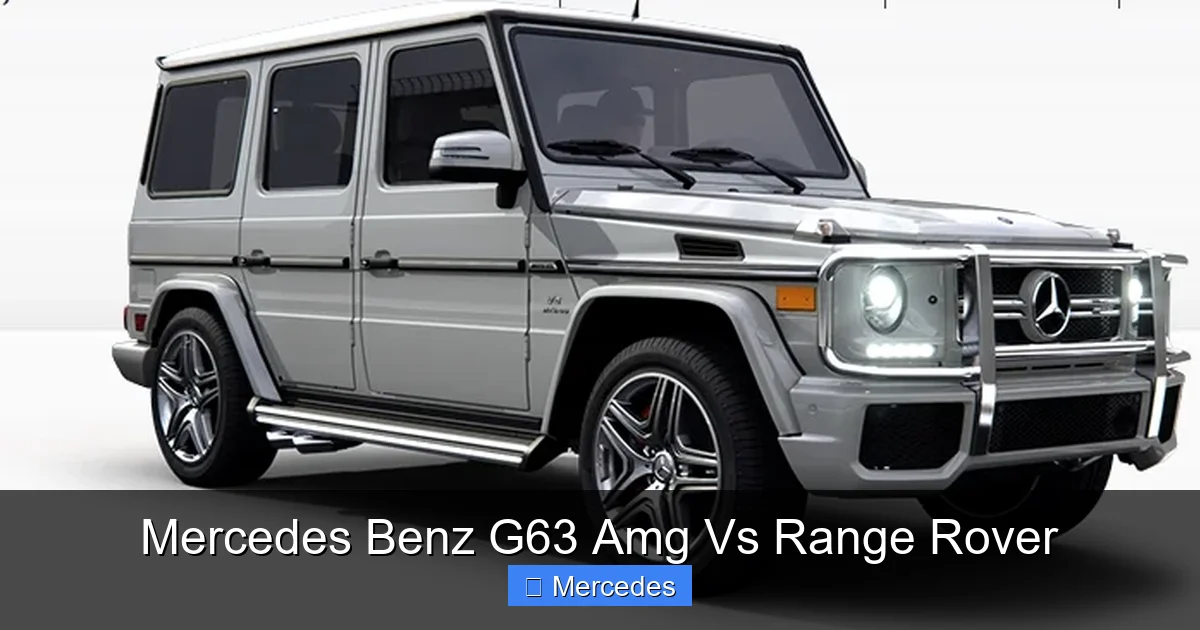
The Mercedes-Benz G63 AMG delivers raw power and iconic boxy design, while the Range Rover blends elegance with refined comfort and advanced all-terrain tech. Choosing between them comes down to whether you prioritize aggressive performance or luxurious refinement—both are elite, but for different reasons.
Key Takeaways
- Power & Performance: The G63 AMG’s twin-turbo V8 cranks out 577 hp and 627 lb-ft of torque, offering blistering acceleration. The Range Rover uses a mild-hybrid 4.4L V8 (523 hp), focusing on smoothness over raw punch.
- Luxury & Interior: Both feature premium materials, but the Range Rover offers more customizable luxury and quieter cabin insulation. The G63 leans into sporty aggression with bold styling and driver-centric controls.
- Off-Road Capability: The G63 is built like a tank—nearly indestructible with three locking differentials. The Range Rover excels in intelligent terrain response systems and adaptive air suspension for mixed environments.
- Technology & Features: The G63 packs AMG-specific tech and a dual-screen setup. The Range Rover leads with cutting-edge infotainment, augmented reality navigation, and advanced driver aids.
- Resale Value & Brand Image: Range Rovers often hold value better long-term. The G63 has stronger enthusiast appeal and a cult following among car collectors.
- Fuel Efficiency: Neither is eco-friendly, but the Range Rover’s mild-hybrid system improves real-world mpg slightly compared to the G63’s thirsty V8.
- Pricing & Exclusivity: The G63 AMG starts around $150K+, while the Range Rover begins near $110K—but options can push both well above $200K.
Quick Answers to Common Questions
Which is faster, the G63 AMG or Range Rover?
The G63 AMG accelerates faster—0–60 mph in 4.5 seconds versus 5.1 seconds for the Range Rover. Its twin-turbo V8 delivers more peak power and instant torque.
Can the Range Rover really go off-road as well as the G63?
Yes! The Range Rover uses intelligent systems like Terrain Response 2 and All-Terrain Progress Control to handle rough terrain smoothly. While it lacks the G63’s mechanical lockers, it’s highly capable and easier to drive on technical trails.
Is the G63 AMG more comfortable than the Range Rover?
Not really. The G63 focuses on sporty dynamics and driver engagement, so long drives can feel stiffer. The Range Rover offers superior ride comfort, especially with its adaptive air suspension and plush rear seats.
Which has better resale value?
The Range Rover generally holds value better long-term, retaining ~55% of its price after three years compared to ~45% for the G63. However, rare G63 editions may appreciate among collectors.
Are the interiors of the G63 and Range Rover similar in quality?
Both use premium materials, but the Range Rover edges ahead in refinement and customization. The G63 leans into AMG’s sporty aesthetic, while the Range Rover emphasizes luxury and serenity.
📑 Table of Contents
- Mercedes-Benz G63 AMG vs Range Rover: A Clash of Titans
- Driving Power: Heartbeats Under the Hood
- Interior Luxury: Craftsmanship Meets Comfort
- Off-Road Dominance: Who Rules the Trails?
- Design & Style: Icons in Their Own Right
- Ownership Experience: Cost, Maintenance, and Practicality
- Final Verdict: Which One Should You Choose?
Mercedes-Benz G63 AMG vs Range Rover: A Clash of Titans
Imagine standing before two of the most recognizable SUVs on the planet—one a German engineering marvel wrapped in military-grade toughness, the other a British icon draped in regal elegance. On one side sits the Mercedes-Benz G63 AMG, a brute-force machine straight from the world of motorsports. On the other, the Range Rover, a symbol of effortless luxury that’s conquered deserts, mountains, and boardrooms alike. These aren’t just vehicles; they’re statements. But when it comes time to choose between them, which one truly fits your lifestyle?
This isn’t about which is “better”—it’s about what you value most. Is it unrelenting power? Timeless design? Or perhaps the quiet confidence of knowing your ride can handle anything from city streets to backcountry trails? We’ll break down every facet of these two legends: engine performance, interior craftsmanship, off-road prowess, tech wizardry, and even ownership experience. By the end, you’ll know exactly where each shines—and where they fall short.
Driving Power: Heartbeats Under the Hood
The G63’s Beast Mode
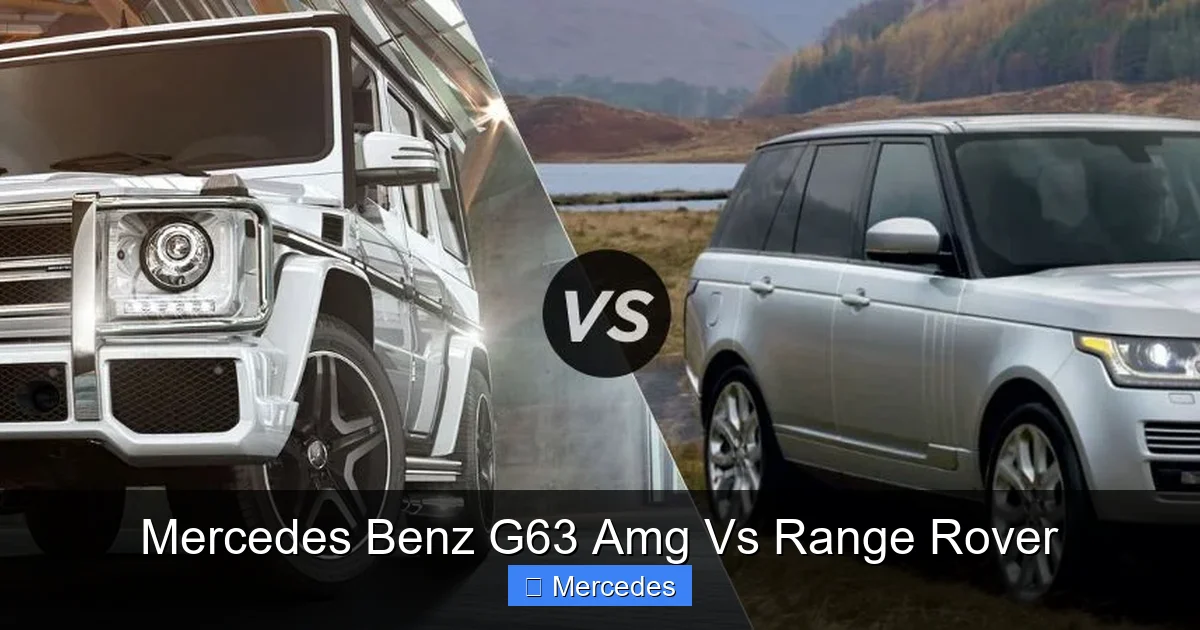
Under the hood of the Mercedes-Benz G63 AMG, you’ll find a hand-built 4.0-liter twin-turbocharged V8 engine. Don’t let the compact size fool you—this motor produces an astonishing 577 horsepower and 627 lb-ft of torque. That’s enough juice to launch this 5,300-pound beast from 0 to 60 mph in just 4.5 seconds. It’s not just fast; it’s violently efficient, thanks to AMG’s signature tuning and a 9-speed automatic transmission that shifts like lightning.
Visual guide about Mercedes Benz G63 Amg Vs Range Rover
Image source: cdn-ds.com
What makes the G63 special isn’t just its numbers—it’s how it feels. The throttle response is immediate, almost telepathic. You stomp on the accelerator, and the car leaps forward with zero hesitation. The exhaust note? Deep, throaty, and gloriously mechanical. Even at idle, there’s a sense of controlled chaos. This isn’t meant to be gentle. It’s meant to remind everyone nearby that you’re driving something extraordinary.
Range Rover’s Refined Might
In contrast, the Range Rover (especially models like the P525 SE or Autobiography) features a 4.4-liter V8 biturbo engine paired with a mild-hybrid system. While it delivers 523 horsepower and 553 lb-ft of torque, it doesn’t shout—it purrs. The hybrid assist helps smooth out low-end grunt and improves fuel economy by up to 15% under light loads. Acceleration is strong (0–60 in ~5.1 seconds), but it’s delivered with surgical precision, not brute force.
The Range Rover’s driving dynamics feel more connected to comfort than competition. The steering is light yet communicative, and the ride quality remains plush no matter how fast you go. There’s a subtlety here that the G63 lacks—a sense that every movement has been engineered for maximum serenity. If you’ve ever felt like your previous SUV was vibrating like a washing machine, you’ll appreciate this level of polish.
Transmission Showdown
The G63 uses Mercedes’ AMG SPEEDSHIFT TCT 9G transmission—a nine-speed dual-clutch unit designed for racing. It pre-selects gears, keeps RPMs high during shifts, and gives drivers paddle shifters that actually mean something. Sport mode turns the entire experience into a visceral thrill ride.
Meanwhile, the Range Rover opts for a Zf 8HP 8-speed automatic, renowned for its silky gear changes and seamless integration with the mild-hybrid system. Upshifts happen without any interruption in power flow. Downshifts? Smooth as butter. It’s the kind of transmission that lets you forget it exists—until you need it.
Interior Luxury: Craftsmanship Meets Comfort
G63 AMG: Aggressive Elegance
Step inside the Mercedes-Benz G63 AMG, and you’re greeted by a cockpit that screams “I belong on a racetrack.” The seats are sporty bolsters wrapped in Nappa leather, the steering wheel is flat-bottomed with carbon-fiber trim, and the dashboard is dominated by two large touchscreens. Everything feels purposeful—even if a little busy.
Visual guide about Mercedes Benz G63 Amg Vs Range Rover
Image source: warmuseums.net
Mercedes hasn’t skimped on materials. Soft-touch surfaces abound, stitching is flawless, and the ambient lighting adds just the right amount of drama. But make no mistake: this is still an AMG. The center console looks like it could survive a tank battle, and the door handles resemble those found on fighter jets. It’s less about relaxation and more about immersion.
Range Rover: Timeless Sophistication
The Range Rover interior tells a different story—one of understated luxury. Picture warm woods, sumptuous hides, and soft-touch armrests shaped for comfort. Every surface feels expensive, from the brushed metal switches to the quilted headliner. Even the cupholders look like jewelry.
Where the G63 prioritizes function, the Range Rover emphasizes indulgence. Rear passengers get massive legroom, heated/cooled/massaging seats, and even a dedicated entertainment screen. The Meridian sound system fills the cabin with crystal-clear audio, and the panoramic roof floods the space with natural light. It’s the difference between wearing a bomber jacket and donning a tailored suit.
Tech & Connectivity
Both cars pack serious tech, but their philosophies differ. The G63 runs on Mercedes’ MBUX infotainment system with dual 12.3-inch displays. Voice control works surprisingly well, and wireless Apple CarPlay/Android Auto are standard. However, the UI can feel cluttered compared to rivals.
The Range Rover goes further with Land Rover’s Pivi Pro system. It features a 10-inch touchscreen, intuitive menus, and even augmented reality navigation that overlays directions onto live camera feeds. Over-the-air updates keep software fresh, and smartphone mirroring is seamless. Plus, the optional ClearSight 3D surround camera makes parking a breeze—something even the G63 struggles with.
Off-Road Dominance: Who Rules the Trails?
G63: The Unstoppable Tank
If you think the G63 is only good on highways, you haven’t taken it off-road. Built on the original G-Class platform (W463), this SUV inherits decades of military heritage. It boasts three locking differentials (front, center, rear), allowing individual wheels to gain traction independently. Combine that with ground clearance of over 11 inches and approach/departure angles exceeding 36 degrees, and you’ve got a machine capable of climbing rocks, wading through rivers, and surviving mud pits like nothing else.
Features like AMG Ride Control+ suspension and 4MATIC all-wheel drive ensure grip in nearly any condition. The G63 also comes standard with low-range gearbox settings and hill descent control. Want to drive across a boulder field blindfolded? Go ahead. It won’t flinch.
Range Rover: Intelligent Terrain Mastery
The Range Rover trades raw strength for smart adaptability. Its Terrain Response 2 system automatically adjusts settings based on detected conditions—sand, mud, rock crawl, etc.—without input from the driver. Adaptive air suspension raises the vehicle for obstacles or lowers it for highway stability. With All-Terrain Progress Control, you can set a target speed (up to 31 mph), and the SUV will maintain it using throttle and brake inputs, freeing you to focus on steering.
While it lacks the G63’s mechanical lockers, the Range Rover compensates with advanced torque vectoring and electronic aids. It’s lighter, more agile, and surprisingly nimble off-road. That said, it’s not quite as durable in extreme scenarios. Drop it in deep water or drag it over jagged ledges, and you might wish for extra armor plating.
Real-World Off-Road Examples
Consider a weekend trip to Moab, Utah. The G63 would dominate technical climbs, thanks to its low-range gearing and locked diffs. Meanwhile, the Range Rover would handle the same trail smoothly, using its AI-driven systems to prevent wheel slip and maintain momentum. In sand dunes, the G63’s torque advantage shines. On icy mountain passes, the Range Rover’s stability control and traction management keep you safe.
For daily drivers who occasionally take dirt roads, the Range Rover is probably the smarter choice. For adventurers planning epic expeditions, the G63 is the ultimate tool.
Design & Style: Icons in Their Own Right
The G63’s Boxy Boldness
Let’s be honest—the Mercedes-Benz G63 AMG looks like it rolled out of a sci-fi movie. Those sharp lines, angular headlights, and unmistakable boxy silhouette scream “I don’t care what you think.” The AMG-specific front grille, flared fenders, and quad exhaust pipes leave no doubt about its identity.
Inside, the aggressive theme continues. Carbon fiber accents, red seat stitching, and AMG badging reinforce its sporty DNA. It’s polarizing—some love it, others hate it. But one thing’s certain: you won’t mistake it for anything else on the road.
Range Rover’s Effortless Class
The Range Rover favors sophistication over shock value. Its flowing curves, elegant proportions, and signature grille exude timeless charm. Whether parked outside a Manhattan penthouse or a safari camp in Botswana, it commands respect without trying too hard.
Customization options are endless—from paint colors to wheel designs—but the base model already looks premium. The interior mirrors this calm confidence: rich wood veneers, minimalist controls, and a sense of space that makes every journey feel expansive.
Ownership Experience: Cost, Maintenance, and Practicality
Pricing & Depreciation
A new Mercedes-Benz G63 AMG starts around $152,000, while the Range Rover begins near $109,000. Add packages like the AMG Performance Studio ($15K+) or the Range Rover Autobiography (£20K+), and both can easily exceed $200,000.
Over time, the Range Rover tends to hold its value better. According to industry reports, a used Range Rover in excellent condition retains ~55% of its original price after three years, versus ~45% for the G63. That said, limited-edition G63s (like the AMG GT Edition) can appreciate rapidly among collectors.
Maintenance & Reliability
Both brands demand premium service. Expect annual maintenance costs of $2,500–$3,500 for either vehicle. The G63’s complex suspension and turbocharged engine require specialized attention. The Range Rover’s air suspension and infotainment systems add unique quirks.
Reliability ratings are mixed. Consumer Reports rates the G63 below average due to electrical issues, while the Range Rover scores slightly higher but still lags behind mainstream luxury SUVs like the BMW X7 or Audi Q7. Warranty coverage is identical (4 years/unlimited miles).
Fuel Economy Reality Check
Neither is fuel-efficient, but here’s the truth: you won’t buy a G63 or Range Rover for MPG. Still, for comparison:
- G63 AMG: 11/15 mpg city/hwy (~12 combined)
- Range Rover (P525): 15/21 mpg city/hwy (~17 combined)
The mild-hybrid system in newer Range Rovers shaves about 2–3 mpg off the G63’s consumption—not huge, but noticeable over long trips.
Final Verdict: Which One Should You Choose?
After dissecting every angle, the answer depends entirely on your priorities. If you crave raw power, iconic design, and unmatched off-road toughness, the Mercedes-Benz G63 AMG is your king. It’s a rolling monument to German engineering, built for adrenaline junkies and car enthusiasts who want their SUV to double as a supercar.
But if you value refined luxury, intelligent tech, and everyday usability, the Range Rover stands taller. It’s the ultimate expression of British elegance fused with modern innovation—perfect for executives, families, or anyone who wants to arrive in style, no matter the destination.
There’s no wrong choice here. Both are masterpieces in their own right. Just ask yourself: Do you want to command attention with thunderous power… or inspire envy with quiet sophistication?
Frequently Asked Questions
Which SUV is more fuel-efficient?
The Range Rover is slightly more efficient thanks to its mild-hybrid system, achieving ~17 mpg combined versus the G63’s ~12 mpg. However, both are gas-guzzling luxury SUVs.
Does the G63 AMG have better off-road capabilities than the Range Rover?
Absolutely. The G63 features three locking differentials, higher ground clearance, and a low-range gearbox, making it more rugged and capable in extreme off-road conditions.
Can I customize the interior of both vehicles?
Yes, both offer extensive personalization. The G63 includes AMG-specific options like carbon fiber trim and sport seats, while the Range Rover provides exotic wood veneers, designer upholstery, and bespoke detailing packages.
How much do these SUVs cost?
A new G63 AMG starts around $152,000, while the Range Rover begins near $109,000. High-end trims can push both well above $200,000.
Which one is better for daily commuting?
The Range Rover is the clear winner for daily use. Its smoother ride, quieter cabin, and advanced driver aids make it ideal for urban and highway driving.
Do both come with all-wheel drive?
Yes, both the G63 AMG and Range Rover feature permanent all-wheel drive systems tailored to their respective performance and terrain goals.