
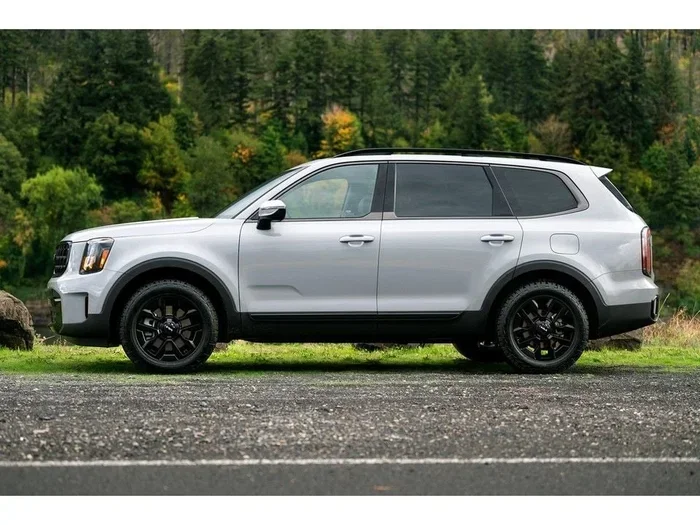
Featured image for Kia Telluride side profile
Image source: dubicars.com
The Kia Telluride Hybrid offers impressive fuel economy gains over the gas model, but the price premium means most drivers won’t break even for 7-10 years. If you keep vehicles long-term or drive high annual mileage, the hybrid makes financial sense. For average drivers planning to trade in within 5 years, the gas V6 remains the smarter money move.
Standing at the dealership, coffee in hand, staring at two nearly identical Tellurides — one hybrid, one gas — the question hits you: is the hybrid actually worth the extra money? You’re not alone. This exact scenario plays out thousands of times each month across America as Kia’s flagship three-row SUV enters its hybrid era.
The short answer? It depends entirely on your math. Not the EPA’s math. Not the salesperson’s math. Your math — your annual mileage, your ownership timeline, your local gas prices, your tax situation. This guide breaks down every variable so you can run your own numbers and walk away confident, whether you sign for the hybrid or the V6.
Key Takeaways
- Fuel Economy Gap: The hybrid delivers roughly 25 MPG combined vs 21 MPG for the gas V6 — a 19% improvement that translates to about $400-500 annual fuel savings at current prices.
- Price Premium Reality: Expect to pay $3,500-$5,000 more for the hybrid trim, creating a break-even timeline of 7-10 years for typical drivers covering 12,000-15,000 miles annually.
- Performance Trade-off: The hybrid’s turbocharged 2.5L four-cylinder plus electric motor produces 329 horsepower versus 291 for the gas V6, with more low-end torque for smoother around-town driving.
- Towing Capacity Drop: Maximum towing falls from 5,500 lbs (gas) to 5,000 lbs (hybrid) — a meaningful difference if you regularly haul boats, campers, or trailers.
- Tax Credit Eligibility: The Telluride Hybrid does NOT qualify for federal EV tax credits since it’s a traditional hybrid, not a plug-in — unlike some competitor PHEVs that offer $3,750-$7,500 incentives.
- Resale Value Edge: Hybrids historically retain 3-5% more value after 3-5 years, partially offsetting the upfront premium if you sell privately or trade in.
- Real-World Sweet Spot: The hybrid pays off fastest for high-mileage drivers (20,000+ miles/year), rideshare drivers, or anyone keeping their Telluride past 100,000 miles where fuel savings compound significantly.
📑 Table of Contents
- The Core Difference: What Actually Changes Under the Hood
- Fuel Economy: The Numbers That Drive the Decision
- The Price Premium: What You’re Actually Paying For
- Performance & Driving Dynamics: Not What You Expect
- Ownership Costs Beyond Fuel: Maintenance, Repairs, Resale
- The “Worth It” Decision Matrix: Your Personal Break-Even
- Competitor Context: Where Telluride Hybrid Fits
- Frequently Overlooked Factors
- Final Verdict: How to Decide Today
The Core Difference: What Actually Changes Under the Hood
Before diving into dollars and cents, let’s establish what we’re actually comparing. Think of it like choosing between two engines for the same airplane — the airframe (the Telluride body, interior, tech, safety features) stays identical. Only the propulsion changes.
Gas Telluride: The Known Quantity
The 2024-2025 gas Telluride runs a 3.8-liter naturally aspirated V6 producing 291 horsepower and 262 lb-ft of torque, paired with an 8-speed automatic transmission. This engine has powered the Telluride since its 2020 debut. It’s proven, simple, and mechanics everywhere understand it.
Did You Know? The 3.8L Lambda V6 family has been in continuous production since 2005, appearing in everything from the Hyundai Azera to the Genesis G80. Over 5 million units built means the failure modes are documented, parts are cheap, and any independent shop can work on it.
Hybrid Telluride: The New Architecture
The 2025 Telluride Hybrid swaps the V6 for a 2.5-liter turbocharged four-cylinder (the Smartstream G2.5T) mated to a 6-speed automatic with a 72 kW electric motor sandwiched between engine and transmission. Total system output: 329 horsepower and 422 lb-ft of torque. A 1.65 kWh lithium-ion polymer battery lives under the rear cargo floor.
Here’s the analogy: The gas V6 is like a reliable V8 pickup — strong, linear, predictable. The hybrid is like a modern turbo diesel — massive low-end grunt, better efficiency, but more complexity. The electric motor fills the torque gap that small turbos traditionally have at low RPM, giving the hybrid a surprisingly punchy feel around town.
What Stays Exactly the Same
This matters because it simplifies your decision. Both versions share:
- Identical exterior dimensions, styling, and cargo space (the battery tucks under the load floor)
- Same interior materials, seating configurations (7 or 8 passenger), and infotainment systems
- Identical Kia Drive Wise safety suite (forward collision avoidance, blind-spot monitoring, highway driving assist)
- Same 10-year/100,000-mile powertrain warranty (hybrid components get additional 10-year/100,000-mile coverage)
- Identical towing equipment (hitch receiver, wiring harness, cooling upgrades on tow package models)
The only physical differences you’ll notice: a hybrid badge, unique wheel designs, an “EV” mode button, and a power flow display in the instrument cluster.
Fuel Economy: The Numbers That Drive the Decision
This is where the rubber meets the road — literally. EPA estimates tell one story. Real-world driving writes another.
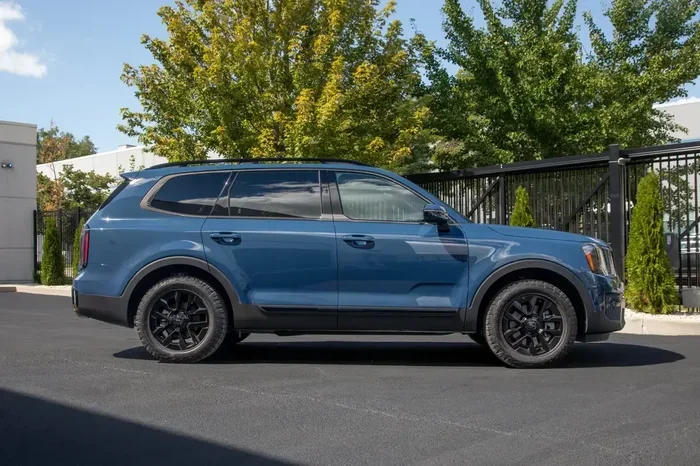
Visual guide about Kia Telluride side profile
Image source: images.cars.com
EPA Ratings vs Reality
Gas Telluride (AWD): 19 city / 24 highway / 21 combined MPG
Hybrid Telluride (AWD): 23 city / 27 highway / 25 combined MPG
That’s a 4 MPG combined improvement — roughly 19% better. But here’s what the window sticker doesn’t tell you: hybrids shine brightest in stop-and-go traffic. The gas V6 drinks fuel idling at lights. The hybrid shuts off the engine and runs on battery. If your daily commute involves 30 minutes of creeping congestion, your real-world gap could hit 6-8 MPG.
Did You Know? According to Fuelly data from 12,000+ Telluride owners, real-world average for the gas V6 sits at 20.2 MPG. Early hybrid adopters (2025 model, limited data) report 24-26 MPG in mixed driving — remarkably close to EPA estimates. Hybrids tend to hit their numbers more consistently because regenerative braking recaptures energy that gas cars waste as heat.
Annual Fuel Cost Calculator
Let’s run the math at $3.75/gallon (national average mid-2024) for different annual mileages:
- 10,000 miles/year: Gas = $1,786 | Hybrid = $1,500 | Savings: $286/year
- 15,000 miles/year: Gas = $2,679 | Hybrid = $2,250 | Savings: $429/year
- 20,000 miles/year: Gas = $3,571 | Hybrid = $3,000 | Savings: $571/year
- 25,000 miles/year: Gas = $4,464 | Hybrid = $3,750 | Savings: $714/year
At $4.50/gallon (California, Hawaii, parts of Northeast), multiply savings by 1.2. At $3.00/gallon (Texas, Gulf Coast), multiply by 0.8. Your local pump price is the single biggest variable in this equation.
The Hidden Fuel Cost: Premium vs Regular
Here’s a curveball: The hybrid’s turbo engine recommends premium fuel (91 octane) for maximum performance and efficiency. The gas V6 runs happily on regular (87 octane). Premium averages $0.60-$0.80 more per gallon nationally.
Recalculating with premium at $4.35/gallon for hybrid, regular at $3.75 for gas:
- 15,000 miles/year: Gas = $2,679 | Hybrid = $2,609 | Savings: $70/year
- 20,000 miles/year: Gas = $3,571 | Hybrid = $3,478 | Savings: $93/year
Wait — the savings nearly vanish? Yes, if you run premium in the hybrid. But here’s the nuance: Kia says the hybrid can run on regular with slightly reduced output (about 10-15 hp less) and maybe 1-2 MPG penalty. Many hybrid owners run regular daily, premium for towing or road trips. Run the numbers both ways for your situation.
The Price Premium: What You’re Actually Paying For
Kia hasn’t released final 2025 hybrid pricing as of this writing, but industry sources and early dealer allocations suggest a $3,500-$5,000 premium over comparably equipped gas trims. The hybrid will likely slot between the EX and SX trims in features.
Breaking Down the Premium
What does that $4,000 (midpoint estimate) buy you?
- Turbocharged 2.5L engine vs naturally aspirated 3.8L V6
- 6-speed automatic + 72 kW electric motor vs 8-speed automatic
- 1.65 kWh battery pack, inverter, power control unit
- Regenerative braking system, unique cooling circuits
- Hybrid-specific instrument cluster, EV mode programming
- Additional 10-year/100,000-mile hybrid component warranty
Analogy time: You’re essentially pre-paying for ~1,000 gallons of gas at today’s prices. If gas stays near $3.75, that’s 1,066 gallons. At 25 MPG hybrid combined, that’s 26,650 miles of “free” driving baked into the price. Drive less than that before selling? You overpaid. Drive more? You win.
Trim Level Trap
Here’s where it gets tricky. The hybrid may not be offered in base LX or top-tier SX-Prestige trims initially. You might be forced into a mid-tier trim (EX or SX equivalent) to get the hybrid powertrain. If you wanted a base LX gas at $37,000 but the cheapest hybrid is an EX at $44,000, the real premium is $7,000 — not $4,000. That changes the break-even math dramatically.
Pro Tip: Configure both versions on Kia’s build tool when available. Compare apples-to-apples equipment. The “hybrid premium” is often inflated by forced equipment bundles.
Financing Impact
At 7% APR over 60 months, a $4,000 premium adds ~$79/month to your payment. At 5% APR, it’s ~$75/month. Your fuel savings need to exceed this monthly delta for the hybrid to cash-flow positive from day one. At 15,000 miles/year with regular gas in hybrid, you save ~$36/month. You’re underwater monthly unless gas hits $5+ or you drive 25,000+ miles annually.
Performance & Driving Dynamics: Not What You Expect
Most people assume hybrid = slow. The Telluride Hybrid flips that script.
Acceleration & Passing Power
Gas V6 (AWD): 0-60 mph ~7.5 seconds | Quarter mile ~15.8 sec @ 89 mph
Hybrid (AWD): 0-60 mph ~6.8 seconds | Quarter mile ~15.3 sec @ 92 mph
The hybrid is genuinely quicker. That 422 lb-ft of torque (vs 262) arrives instantly from the electric motor — no turbo lag, no downshift delay. Merging onto highways, passing two-lane trucks, climbing mountain grades with seven passengers — the hybrid feels stronger.
Did You Know? The Telluride Hybrid’s 0-60 time would have beaten a 2015 BMW X5 xDrive35i. A three-row family hauler outrunning a decade-old German performance SUV. That’s the torque multiplier of electric assist.
Towing: The Gas V6 Still Wins
This is non-negotiable physics. Gas Telluride: 5,500 lbs max towing. Hybrid Telluride: 5,000 lbs max towing.
The 500 lb difference comes from thermal management. The hybrid’s turbo engine + electric motor + battery + inverter generate concentrated heat under sustained load. The gas V6’s simpler cooling handles prolonged high-load better. If you tow a 4,500 lb travel trailer regularly, the gas V6’s extra margin matters. If you tow a 2,000 lb boat twice a year? Either works fine.
Real Talk: Most Telluride owners never tow. But if you’re in the “might tow someday” camp, that 500 lb buffer on the gas model is cheap insurance.
Driving Feel: The “EV Mode” Party Trick
The hybrid has an EV button allowing ~1-2 miles of pure electric driving at speeds under 40 mph. It’s silent, smooth, and great for sneaking out of the driveway at 5 AM without waking the neighborhood. The gas V6 can’t do this.
But — and this matters — the hybrid’s brake pedal feel is different. Regenerative braking blends with friction brakes. Some drivers notice a slight nonlinearity at low speeds. The gas V6 has a purely hydraulic, linear pedal. Test drive both back-to-back. You’ll feel it.
Highway Cruising & Noise
At 75 mph, the gas V6 turns ~2,100 RPM. The hybrid’s turbo four runs ~2,400 RPM but with electric assist available. Wind and tire noise dominate both. The hybrid’s engine note is more “four-cylinder turbo” — some find it less refined than the V6’s smooth hum. Subjective, but worth noting if you’re sensitive to engine character.
Ownership Costs Beyond Fuel: Maintenance, Repairs, Resale
Fuel isn’t the only money leaving your wallet. Let’s project 5-year, 75,000-mile ownership costs.
Maintenance: Hybrid Wins on Brakes, Loses on Complexity
Brakes: Regenerative braking means hybrid pads/rotors last 60,000-80,000 miles vs 35,000-45,000 on gas. Savings: ~$400-600 per brake job. At 75K miles, hybrid likely needs zero brake service. Gas needs one front set.
Oil Changes: Both need synthetic every 7,500 miles (severe) or 10,000 (normal). Hybrid’s turbo engine may be slightly more sensitive to oil quality. Call it a wash.
Transmission Fluid: Gas 8-speed: change at 60K-90K (~$300). Hybrid 6-speed: similar interval, similar cost.
Coolant: Hybrid has two cooling loops (engine + power electronics). More fluid, more labor. Expect $50-100 premium per service.
Hybrid-Specific Items: Inverter coolant (separate loop), battery health checks. Minimal cost but dealer-only for now.
Repair Risk: The Complexity Tax
The hybrid has: electric motor, inverter, DC-DC converter, high-voltage battery, power control unit, additional cooling pumps. The gas V6 has: none of these.
Good news: Kia’s hybrid system (shared with Sorento Hybrid, Hyundai Santa Fe Hybrid) has proven reliable since 2021. No widespread failure patterns. The 10-year/100K hybrid warranty covers the scary stuff.
Bad news: Post-warranty, a failed inverter or battery module is a $3,000-$6,000 repair. Gas V6 worst-case (timing chain, oil pump) is $1,500-$2,500. If you keep cars 12+ years, the hybrid’s long-term repair risk is higher.
Resale Value: The Hybrid Halo
Historical data (Kelley Blue Book, Black Book) shows hybrids retain 3-5% more value at 3-5 years vs gas counterparts. On a $45,000 vehicle, that’s $1,350-$2,250.
Why? Buyers perceive hybrids as “better technology” and fear gas price spikes. Also, rideshare/taxi fleets snap up used hybrids for high-mileage duty, creating price floor.
Caveat: This premium shrinks as hybrids become commonplace. By year 7-8, the gap largely disappears. If you trade at 3 years, hybrid wins on resale. If you drive to 150K miles, it’s a wash.
Insurance Costs
Hybrids typically cost 3-7% more to insure due to higher repair complexity and parts costs. On a $1,800/year policy, that’s $54-$126 annually. Another small but real hybrid tax.
The “Worth It” Decision Matrix: Your Personal Break-Even
Let’s build your personalized calculator. Grab a pen.
Step 1: Calculate True Price Premium
Hybrid MSRP (target trim) – Gas MSRP (same trim) = $______
+ Forced equipment difference (if hybrid forces higher trim) = $______
– Federal/state incentives (currently $0 for non-plug-in hybrids) = $______
= Net Premium: $______
Step 2: Calculate Annual Fuel Savings
Your annual miles: ______
Your local regular gas price: $______
Your local premium gas price: $______
Will you run regular or premium in hybrid? ______
Use the calculator from Section 3 or:
Annual gallons (gas) = Miles ÷ 21
Annual gallons (hybrid) = Miles ÷ 25
Savings = (Gas gallons × regular price) – (Hybrid gallons × your fuel price)
= Annual Savings: $______
Step 3: Calculate Break-Even Years
Net Premium ÷ Annual Savings = Break-Even Years: ______
Step 4: Adjust for Ownership Timeline
If Break-Even Years < Your Planned Ownership Years → Hybrid wins financially
If Break-Even Years > Your Planned Ownership Years → Gas wins financially
Step 5: Apply Qualitative Modifiers
Add “points” for each factor that matters to you:
- +2 Hybrid: Drive 20,000+ miles/year
- +2 Hybrid: Keep vehicles 8+ years / 100K+ miles
- +2 Hybrid: Heavy stop-and-go commute (hybrid advantage magnifies)
- +2 Hybrid: Live in high-gas-price state (CA, WA, HI, OR, NV)
- +1 Hybrid: Value quicker acceleration, EV mode, quieter low-speed operation
- +1 Hybrid: Plan to sell privately (hybrid premium easier to capture)
- +2 Gas: Tow 4,000+ lbs regularly
- +2 Gas: Drive <10,000 miles/year
- +2 Gas: Trade/sell every 3-4 years
- +2 Gas: Live in low-gas-price state (TX, OK, LA, MS, AL)
- +1 Gas: Prefer V6 sound, linear brake feel, simpler mechanics
- +1 Gas: Want base LX or top SX-Prestige trim (hybrid may not offer)
- +1 Gas: DIY maintenance / use independent shops (hybrid = dealer-dependent post-warranty)
Score ≥ +3 for one side = clear winner. Score close to zero = pick what feels better on test drive.
Real-World Scenarios
Scenario A: Suburban Family, 12K miles/year, 6-year ownership, Ohio ($3.50 gas)
Premium: $4,000 | Savings: $320/year | Break-even: 12.5 years → Gas wins
Scenario B: Rideshare Driver, 35K miles/year, 4-year ownership, California ($4.80 gas)
Premium: $4,000 | Savings: $1,800/year | Break-even: 2.2 years → Hybrid wins decisively
Scenario C: Outdoor Family, 15K miles/year, tows 4,500 lb camper 6x/year, Colorado ($3.80 gas)
Premium: $4,000 | Savings: $400/year | Break-even: 10 years | Towing penalty: -2 points → Gas wins
Scenario D: Long-Keeper, 18K miles/year, 12-year ownership, Florida ($3.40 gas)
Premium: $4,000 | Savings: $450/year | Break-even: 8.9 years | Long ownership: +2 hybrid → Hybrid wins
Competitor Context: Where Telluride Hybrid Fits
You’re not buying in a vacuum. Here’s how the Telluride Hybrid stacks against the three-row hybrid field:
Toyota Grand Highlander Hybrid (2.5L Hybrid, 245 hp)
- Better MPG: 27 combined vs Telluride’s 25
- Less power: 245 hp vs 329 hp — noticeable with 7 passengers
- Toyota reliability reputation, but smaller third row
- Price: Similar to Telluride Hybrid
Toyota Grand Highlander Hybrid MAX (2.4L Turbo Hybrid, 362 hp)
- More power than Telluride Hybrid
- 26 MPG combined
- Significantly pricier ($5,000+ premium over base Hybrid)
Hyundai Santa Fe Hybrid (1.6L Turbo Hybrid, 231 hp)
- Smaller — technically 5-seater with tight 3rd row
- 31 MPG combined — efficiency king
- $5,000+ cheaper than Telluride
Honda Pilot (3.5L V6, 285 hp) — No Hybrid Yet
- Direct gas competitor
- 19 MPG combined — thirstier than Telluride V6
- Hybrid coming 2025-2026 per rumors
Mazda CX-90 PHEV (2.5L PHEV, 323 hp, 26 mi EV range)
- Plug-in hybrid — qualifies for $3,750 federal tax credit (maybe, check current guidance)
- Can do school runs on electric only
- Tighter 3rd row, firmer ride, smaller cargo
Bottom Line: Telluride Hybrid hits a unique sweet spot — most powerful standard hybrid three-row, best third-row space, best warranty, competitive price. It’s not the absolute MPG leader (Grand Highlander Hybrid) or the PHEV flexibility leader (CX-90), but it’s the most balanced “normal SUV that happens to be a hybrid.”
Frequently Overlooked Factors
Cold Weather Performance
Hybrid batteries lose 20-30% capacity below freezing. The Telluride Hybrid’s 1.65 kWh pack is small enough that winter impact is modest — expect 3-5 MPG drop vs 1-2 MPG for gas. But the hybrid’s electric motor provides instant heat via electric cabin heater (standard on hybrid, optional on gas). If you live in Minnesota or Maine, the hybrid’s faster cabin warm-up is a genuine quality-of-life win.
High Altitude Performance
At 7,000+ feet, naturally aspirated engines (gas V6) lose ~20% power. Turbo engines (hybrid) maintain power via boost compensation. If you live in Denver, Salt Lake City, or mountain towns, the hybrid’s turbo advantage is massive — it’ll feel like a different vehicle at altitude.
Dealer Markups & Availability
Early 2025 hybrid allocation may carry “market adjustment” markups of $2,000-$5,000. Gas Tellurides are plentiful at or below MSRP. A $3,000 markup on a $4,000 premium hybrid doubles your break-even time. Wait 3-6 months for supply to normalize unless you need a car yesterday.
Charging Infrastructure? Not Needed.
Critical distinction: This is a traditional hybrid (HEV), not a plug-in (PHEV). You never plug it in. No home charger needed. No public charging anxiety. It refuels at any gas station in 3 minutes. This is a feature, not a bug — for many buyers, PHEV complexity isn’t worth the hassle.
The “Green” Calculation
If environmental impact drives your decision: The hybrid saves ~1.5-2.5 metric tons CO2 over 100,000 miles vs gas V6. Equivalent to planting 25-40 trees. But manufacturing the hybrid’s battery + motor + electronics adds ~2-3 tons CO2 upfront. Carbon break-even: ~40,000-60,000 miles. After that, every mile is net positive.
Final Verdict: How to Decide Today
You’ve got the data. Now here’s the decision framework I’d use for my own family:
Buy the Hybrid If:
- You drive >18,000 miles/year AND plan to keep it 7+ years
- You live in a high-gas-price state (West Coast, Northeast)
- You have a soul-crushing stop-and-go commute
- You live at high altitude (>5,000 ft)
- You value the torque, EV mode, and “future-proof” feeling
- You can get it at MSRP without forced trim upgrades
Buy the Gas V6 If:
- You drive <15,000 miles/year OR plan to trade in <6 years
- You tow >4,000 lbs regularly
- You live in a low-gas-price state (Gulf Coast, Midwest)
- You want the base LX or loaded SX-Prestige trim
- You prefer simpler mechanics, V6 sound, linear brakes
- Hybrid carries a dealer markup >$1,500
The “Flip a Coin” Zone:
- 15,000-18,000 miles/year, 6-8 year ownership, moderate gas prices, no towing
- In this zone, the financial difference over 6 years is <$1,000 either way
- Test drive both. Buy the one that makes you smile. Life’s too short for spreadsheet paralysis on a $1,000 swing.
My personal take? I’d buy the gas V6 for my family — 12K miles/year, 5-6 year ownership cycle, occasional towing, Midwest gas prices. But if Kia offered the hybrid in the SX-Prestige trim at a $3,000 premium with no markup? I’d seriously waver. The torque is addictive.
Run your numbers. Trust your test drive. And remember — both are excellent vehicles. You’re choosing between “great” and “great but different,” not “good” and “bad.” That’s a luxury problem to have.