
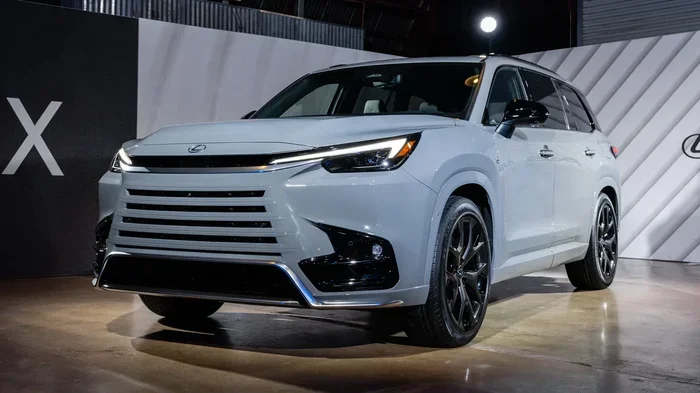
Featured image for Lexus TX SUV
Image source: motortrend.com
The Lexus TX is too new for definitive long-term reliability data, but platform-sharing with the Toyota Grand Highlander and Lexus RX offers strong clues. Early reports highlight potential hybrid inverter issues, transmission software quirks, and advanced safety sensor calibrations as the primary expensive repair risks. Proactive maintenance and extended warranties are highly recommended for first-model-year buyers.
Buying a brand-new luxury three-row SUV like the Lexus TX feels like stepping onto a tightrope. You get the latest tech, the freshest design, and that unbeatable new-car smell. But you also become the test pilot. The 2025 Lexus TX is the first of its name, slotting in above the RX and below the LX. It shares its bones—Toyota’s GA-K platform—with the Toyota Grand Highlander and the current Lexus RX. That family tree is your best crystal ball for predicting Lexus TX common expensive problems before they show up in your driveway.
We need to be honest with each other right now: because the TX just launched, there are no 10-year reliability studies from Consumer Reports or J.D. Power specifically for this model. Anyone claiming a definitive list of “common” failures is guessing. What we can do is look at the siblings, the Technical Service Bulletins (TSBs) for the platform, and the inherent risks of the specific powertrains Lexus chose. Think of this guide as a “pre-flight checklist” based on the family medical history.
Key Takeaways
- First-Year Risk: As a 2025 debut model, the Lexus TX lacks long-term reliability history; buying early means accepting unknown variables.
- Platform Sharing: The TX rides on the GA-K platform shared with the Toyota Grand Highlander and Lexus RX, meaning their recall history is your best preview.
- Hybrid Inverter Costs: The TX 500h F Sport Performance uses a complex hybrid inverter; failure out of warranty can exceed $6,000.
- Transmission Software: The 8-speed automatic (gas) and e-CVT (hybrid) have shown rough shifting on sibling models, often fixed by updates but sometimes requiring hardware replacement.
- Sensor Calibration: Lexus Safety System+ 3.0 relies on radar and cameras; windshield replacement or minor fender benders require expensive recalibration.
- Turbo Engine Stress: The 2.4L turbo (TX 350/500h) runs high boost; strict oil change intervals (5,000 miles) are critical to prevent sludge and turbo failure.
- Extended Warranty Value: Given the tech density and first-year status, a Lexus Extra Care Platinum warranty often pays for itself with a single major repair.
📑 Table of Contents
- Understanding the Lexus TX Platform and Powertrains
- The Big Ticket Items: Hybrid and Electrical System Risks
- Drivetrain and Transmission Concerns
- Engine Specifics: The 2.4L Turbo (T24A-FTS)
- Technology, Sensors, and the “Glass House” Problem
- Suspension, Brakes, and Chassis Wear Points
- Ownership Strategy: Protecting Your Investment
- Comparing the TX to the Competition
- Real World “Did You Know” Facts for the TX Owner
- Conclusion: Should You Buy a Lexus TX?
Understanding the Lexus TX Platform and Powertrains
Before we dive into specific repair nightmares, you need to know what you are actually buying. The TX comes in three distinct flavors, and the potential repair bill changes drastically depending on which badge sits on the liftgate.
The Three Variants: TX 350, TX 500h, and TX 550h+
The entry-level TX 350 uses a 2.4-liter turbocharged four-cylinder making 275 horsepower, paired with an 8-speed automatic transmission. It is the mechanical simpleton of the lineup—relatively speaking. The TX 500h F Sport Performance is the complex one. It pairs that same 2.4L turbo with a rear electric motor and a unique “Direct Shift” 6-speed automatic (not a CVT) for a combined 366 horsepower. The TX 550h+ is the plug-in hybrid (PHEV). It uses a 2.5L naturally aspirated four-cylinder with front and rear motors, a CVT, and a massive 18.1 kWh battery pack good for ~33 electric miles.
Did You Know? The TX 500h’s “Direct Shift” transmission uses actual gears for the first few ratios and a planetary gearset for the rest. It gives the feel of a traditional automatic but the efficiency of a hybrid. It is unique to this platform and unproven long-term.
Why Platform Sharing Matters for Your Wallet
Automakers do not build unique chassis for every model anymore; it costs billions. The TX sits on the GA-K platform. Its corporate cousins are the Toyota Grand Highlander and the Lexus RX (350, 500h, 450h+). If the Grand Highlander Hybrid has a inverter coolant pump recall—and it did in 2024—the TX 500h likely uses the exact same part. If the RX 500h had a software glitch causing the hybrid system to shut down, the TX 500h has the same code. Tracking NHTSA recalls for the Grand Highlander and RX 2023-2024 models is currently the single best way to predict TX issues.
The Big Ticket Items: Hybrid and Electrical System Risks
This is where the “expensive” part of Lexus TX common expensive problems really lives. The TX 500h and 550h+ are rolling computer networks. When they break, you aren’t replacing a $50 sensor; you are replacing a $4,000 inverter or a $15,000 battery pack.

Visual guide about Lexus TX SUV
Image source: motortrend.com
Inverter and Power Control Unit Failures
The inverter converts DC battery power to AC motor power (and back during regen). It generates massive heat. On the Toyota/Lexus Hybrid Synergy Drive systems used in the RX and Grand Highlander, the inverter coolant pump is a known wear item. If that pump fails, the inverter overheats. The car goes into “limp mode” or shuts down completely. On the TX 500h, the inverter is integrated into the Power Control Unit (PCU) mounted right on the transaxle.
Analogy: Think of the inverter like a laptop power brick, but handling 300+ volts and sitting next to a hot exhaust pipe. If its tiny cooling fan or pump dies, the brick cooks itself in minutes.
Repair cost for a PCU/Inverter assembly on a Lexus RX 500h currently runs $4,500–$6,500 parts and labor. The TX 500h uses a similar but unique unit for its 6-speed setup, so parts availability might be tighter early on, driving labor hours up.
High Voltage Battery Degradation vs. Failure
There is a difference between degradation (losing range) and failure (bricking the car). Lexus warranties the HV battery for 10 years / 150,000 miles (depending on state emissions laws). However, the TX 550h+ PHEV battery is larger and cycles deeper (draining to near empty daily) than a standard hybrid. Deep cycling generates heat. Heat kills lithium-ion cells.
Early data from the RAV4 Prime and NX 450h+ (same 18.1 kWh pack architecture) shows robust thermal management, but a single cell failure requires replacing the entire stack. Out of warranty? You are looking at $12,000–$18,000. Tip: If you buy a TX 550h+, keep the battery between 20% and 80% charge whenever possible. Don’t treat it like a phone you drain to 0% every night.
The 12-Volt “Vampire” Drain
This is the most annoying, least expensive, but most common issue on modern Lexus hybrids. The TX has over 30 electronic control units (ECUs) that “sleep” but never fully turn off. They monitor the key fob, the app connection, the security system, and the battery management system. If the 12V auxiliary battery (the small one under the hood or in the cargo area) is weak—usually after 3–4 years—the voltage sag confuses the main ECU. You get “Check Hybrid System” warnings, the car won’t “Ready” on, and the dealer might quote you $3,000 for an inverter when you needed a $200 12V battery.
Pro Tip: Test your 12V battery conductance every oil change after year three. Replace it proactively at the 4-year mark. It is the cheapest insurance you can buy.
Drivetrain and Transmission Concerns
The TX 350 and TX 500h use transmissions that are new to this platform application. New transmissions often mean new software bugs, and sometimes new hardware weaknesses.
TX 350: The 8-Speed Automatic (Aisin AWF8F35)
This transmission is shared with the RX 350 and Grand Highlander 2.4T. Generally, Aisin 8-speeds are bulletproof. However, the 2.4L turbo produces peak torque (317 lb-ft) very low in the RPM range (1,700–3,000 RPM). This puts immense stress on the torque converter lock-up clutch and the valve body solenoids during daily driving.
On the Grand Highlander, some owners have reported a “shudder” or “flare” during the 2-3 or 3-4 upshift when cold. This is often the torque converter lock-up clutch chattering. Lexus usually fixes this with a Transmission Control Module (TCM) software update (reflash). But if the clutch material is glazed or the valve body bore is worn, a software update is a band-aid. A valve body replacement is $1,800–$2,500; a full transmission is $7,000+.
TX 500h: The Direct Shift-6 Transmission
This is the wildcard. Most hybrids use an e-CVT (planetary gearset, no shifting). The TX 500h uses a 6-speed automatic with a clutch pack instead of a torque converter. It is designed for “sporty” feel. Clutch packs wear out. Torque converters generally don’t.
We have seen similar “Direct Shift” units in the Lexus IS 500 and LC 500 (though those are V8 RWD). In a FWD/AWD transverse layout with hybrid torque fill, the thermal load on those clutch packs during aggressive launches or towing is unknown territory. If you buy a TX 500h, change the transmission fluid every 30,000 miles. Do not follow the “lifetime fluid” myth. Use only Lexus ATF WS or equivalent. This single act could save you a $6,000 transmission rebuild at 80,000 miles.
Rear E-Axle (TX 500h & 550h+)
Both upper trims use a rear electric motor (e-Axle) for AWD. This unit contains the motor, a reduction gearset, and an inverter. It is sealed for life. But seals leak. On the RX 500h and NX 350h, there have been isolated cases of rear axle seal leaks allowing gear oil to contaminate the motor windings or the inverter. If the rear inverter fails due to contamination, you are replacing the whole e-Axle assembly. Cost: ~$5,000.
Engine Specifics: The 2.4L Turbo (T24A-FTS)
The heart of the TX 350 and TX 500h is the T24A-FTS engine. It replaces the old V6. It makes more power and torque with better fuel economy, but it works much harder.
LSPI (Low-Speed Pre-Ignition) and Oil Dilution
Small displacement, high-boost turbo engines are prone to LSPI—uncontrolled combustion that can shatter pistons or bend rods. Modern oils (API SP / ILSAC GF-6A) are formulated to prevent this. You must use 0W-16 or 0W-20 meeting API SP spec. Do not put cheap conventional oil in this engine.
Another turbo trait: fuel dilution. On short trips in cold weather, the rich fuel mixture doesn’t fully burn; it washes past the rings into the oil. The oil level rises, viscosity drops, and you lose film strength. The TX 350/500h has an oil level sensor, but it won’t tell you the oil is 15% gasoline. Change oil every 5,000 miles or 6 months, whichever comes first. Ignoring this is the fastest way to a $10,000 engine replacement.
Turbocharger Wastegate and Actuator Issues
The electronic wastegate actuator on the T24A can seize due to carbon buildup or heat cycling. Symptoms: Check Engine Light (P0299 underboost or P0234 overboost), loss of power, “limp mode.” The actuator is often sold only as part of the turbo assembly (~$1,800 part). Labor is 6–8 hours because the turbo is nestled against the firewall. Total bill: ~$3,000.
Did You Know? The T24A engine uses a “ported” cylinder head design where the exhaust manifold is integrated into the head. The turbo bolts directly to the head. This saves weight and spools faster, but it means the turbo glows cherry red during hard use. Heat soak into the head is intense. This is why the cooling system capacity is critical—never ignore a “Low Coolant” warning.
Technology, Sensors, and the “Glass House” Problem
Modern luxury cars are totaled by fender benders not because of bent metal, but because of broken sensors. The TX is a prime candidate for this.
Lexus Safety System+ 3.0 Calibration Costs
The TX uses a front-millimeter-wave radar (behind the grille badge), a front mono-camera (behind the windshield), and corner radars in the bumpers. If you crack the windshield, you aren’t paying $400 for glass. You are paying $400 for glass + $400–$600 for camera calibration (static + dynamic). If you tap a parking pole and crack the front bumper cover, the corner radar behind it needs calibration. That is another $300–$500.
On the RX, windshield replacement with calibration averages $1,100–$1,400 at a dealer. The TX will be similar. Buy the glass coverage rider on your insurance policy. It usually costs $30/year and saves you a $1,000 deductible hit.
Head-Up Display (HUD) and Panoramic View Monitor Failures
The TX 500h and 550h+ get a large Head-Up Display. The projector unit sits deep in the dash. If the laser diode fails or the combiner glass mechanism jams, the dash pad often has to come out. Labor: 8+ hours. The 360-degree camera system uses four wide-angle lenses (front grille, mirror bottoms, tailgate). The mirror cameras are exposed to road spray, salt, and car washes. Water intrusion kills the CMOS sensors. Replacement mirror assemblies with cameras are $800–$1,200 each.
Digital Key and Connectivity Gremlins
Lexus Digital Key (phone-as-key) relies on Bluetooth Low Energy (BLE) and Ultra-Wideband (UWB). Early adoption on the RX and NX saw issues where the car wouldn’t detect the phone, or the “Start” button stayed grayed out. Usually fixed by deleting/re-pairing or an OTA update. But if the UWB antenna module in the door handle fails, that is a $400 part plus door panel removal. Not catastrophic, but annoying for a $70k SUV.
Suspension, Brakes, and Chassis Wear Points
The TX weighs 4,600–5,100 lbs depending on trim. That is heavy. Physics dictates faster wear on consumables.
Adaptive Variable Suspension (AVS) Actuators
The TX 500h F Sport Performance comes standard with AVS. The TX 350 and 550h+ can get it on higher trims. These are electronically controlled dampers with internal solenoid valves. They adjust stiffness in milliseconds. They are robust, but they are wearable items. On the previous gen RX F Sport and LS, rear AVS actuators tended to leak around the 60k–80k mile mark. A single rear actuator is ~$650. Labor for both rears + alignment: ~$500. If the front struts go, double it.
Brake Wear: The Hybrid Paradox
Hybrids use regenerative braking, so pads last forever—right? Mostly. But the TX 500h/550h+ are heavy and performance-oriented. The rear pads often wear faster than the front because the stability control uses the rear brakes aggressively to manage torque vectoring and trailer sway. Also, because regen handles light stops, the friction brakes sit idle and rust. The rotors develop surface corrosion that turns into pitting. You may need rotors at 30k miles even with 80% pad life. Budget $800–$1,200 for a quality brake job at a dealer.
Wheel Bearings and CV Axles
Heavy car + instant electric torque (TX 500h/550h+) = stressed wheel bearings. The rear e-axle on the hybrids sends torque through the half-shafts constantly. Inspect CV boots at every oil change. A torn boot flings grease in 50 miles. A dry CV joint clicks and vibrates. Replacing a half-shaft on the e-axle side requires specific torque procedures for the hybrid high-voltage disconnect. Dealer labor is high.
Ownership Strategy: Protecting Your Investment
Knowing the risks is half the battle. The other half is a strategy to mitigate them. Here is how you sleep well at night owning a Lexus TX.
The Extended Warranty Decision
I rarely recommend extended warranties on a Lexus RX 350. They are too reliable. The TX 500h and 550h+ are different animals. The density of expensive, proprietary components (Direct Shift trans, Rear e-Axle, PHEV battery, PCU) makes the math work for Lexus Extra Care Platinum.
Run the numbers: A 7-year / 100,000-mile Platinum plan (zero deductible) might cost $2,800–$3,500 financed. One inverter failure ($5,500) or e-Axle replacement ($5,000) pays for the policy twice over. For the TX 350 (gas only), the math is tighter. The 8-speed and 2.4T are proven enough that you might skip it, but keep a $3,000 repair fund liquid.
Maintenance Schedule: Severe vs. Normal
Open your glove box. Read the “Scheduled Maintenance” booklet. Look at the “Severe Conditions” column. Follow that one. Lexus defines “Severe” as: short trips under 5 miles, idling in traffic, extreme heat/cold, towing, dusty roads. That describes 90% of TX drivers (school runs, commuting, Costco trips).
- Oil & Filter: 5,000 miles / 6 months (Synthetic 0W-16/0W-20 API SP).
- Transmission Fluid (TX 350/500h): Inspect every 15k, Replace every 30k–45k miles.
- Rear Differential / e-Axle Fluid: Inspect 15k, Replace 30k–60k (use Lexus GL-5 or specific EV grease).
- Brake Fluid: Every 2 years / 20k miles (DOT 3 or 4). Hybrids need this more due to regen heat cycling.
- Coolant (Inverter & Engine): Pink Super Long Life Coolant. 100k miles / 10 years first change, then 50k/5 years. Do not mix colors.
- Cabin/Engine Air Filters: Every 20k miles (more often if wildfire smoke/dust).
Finding a “TX-Ready” Technician
Not every Lexus dealer has a Master Hybrid Technician on staff yet for the TX 500h specific systems. Call the service manager before you buy. Ask: “Do you have a tech certified on the Direct Shift-6 transmission and the T24A turbo engine?” If they hesitate, keep looking. A misdiagnosis on a hybrid system costs hours of labor you will pay for if out of warranty.
Comparing the TX to the Competition
Context helps. Is the TX riskier than a Volvo XC90 or BMW X7?
vs. Volvo XC90 (T6/T8)
The Volvo uses a 2.0L supercharged+turbocharged engine (T6) or PHEV (T8). It has a similar complexity profile. Volvo 8-speed (Aisin) is shared. Volvo electronics are notoriously sensitive to battery voltage. The XC90 has a longer track record (since 2016), so “common problems” are documented: coolant leaks from the supercharger bracket, transmission valve body wear, suspension bushing wear. The TX is a mystery box; the Volvo is a known quantity with known expensive fixes.
vs. BMW X7 (xDrive40i / M60i)
The X7 uses the B58 3.0L inline-6 (bulletproof) or S68 4.4L V8. ZF 8-speed transmission (gold standard). However, BMW charges a premium for everything. Air suspension bags, electronic dampers, valve cover gaskets, oil filter housing gaskets. The TX 500h will likely be cheaper to maintain over 100k miles than an X7, simply because Toyota/Lexus hybrid hardware has higher volume and better parts supply chains than low-volume German V8 bits.
vs. Acura MDX Type S
The MDX Type S uses a 3.0L Turbo V6 + 10-speed auto + SH-AWD. No hybrid complexity. Mechanical simplicity wins here for reliability. But the MDX gets worse MPG and lacks the TX’s third-row space. If you want the lowest risk of a $5k repair, the MDX Type S (gas only) is statistically safer than a first-year TX 500h.
Real World “Did You Know” Facts for the TX Owner
- Fact: The TX 550h+ PHEV qualifies for the federal $7,500 tax credit only if leased (commercial vehicle loophole) or if final assembly/battery sourcing rules change. Buying outright likely gets $0 federal credit as of 2025. Check current IRS guidance.
- Fact: The TX 500h F Sport Performance has a specific “Sport+” mode that disables ESC (Electronic Stability Control) partially. Using this on track days voids warranty coverage for drivetrain damage if the ECU logs excessive G-forces or wheel slip.
- Fact: The TX uses a 12.3-inch digital gauge cluster and 14-inch touchscreen. If the touchscreen delaminates (common on 2022+ Lexus/Toyota units in hot climates), the whole unit is replaced. Cost: ~$2,500. Park in shade; use a windshield sunshade religiously.
- Fact: Towing capacity is 5,000 lbs for all trims. But the TX 500h hybrid system derates power significantly if the inverter coolant hits 176°F (80°C). Towing up a long grade in summer (Davis Dam test conditions) will trigger “Reduced Power” mode. The TX 350 gas model handles sustained load better thermally.
Conclusion: Should You Buy a Lexus TX?
The Lexus TX is a magnificent vehicle. It solves the “three rows in a Lexus” problem beautifully. The TX 500h F Sport Performance is genuinely quick and handles like a sport sedan. The TX 550h+ lets you do the school run on electrons. The TX 350 is the value play.
But you are buying the first chapter of a book that hasn’t been finished. The Lexus TX common expensive problems list will be written by the early adopters over the next 36 months. If you have a low tolerance for “Check Hybrid System” lights, dealer loaner life, or the possibility of a $6,000 inverter bill at 60,001 miles, lease the TX 500h/550h+ for 36 months. Let Lexus carry the depreciation and warranty risk.
If you plan to keep it 10+ years, buy the TX 350. It has the fewest unique failure points. Whichever you choose, change your oil early, test your 12V battery often, and buy the glass coverage. Treat it like a high-performance machine—because underneath the leather and wood, that is exactly what it is.
Frequently Asked Questions
What is the most expensive potential repair on a Lexus TX 500h?
The most expensive potential repair is a failure of the Power Control Unit (PCU) / Hybrid Inverter assembly, which can cost $5,000–$7,000 out of warranty. The rear e-Axle assembly is a close second at roughly $5,000. Both are unique to the hybrid all-wheel-drive system.
Does the Lexus TX 350 have the same transmission problems as the Grand Highlander?
The TX 350 shares the Aisin 8-speed automatic with the Grand Highlander 2.4T. Some Grand Highlander owners have reported cold-shift shudder or hesitation, typically resolved by a TCM software update. Hardware failure is rare but possible if fluid maintenance is neglected.
How often should I change the oil in a Lexus TX 350 or 500h?
You should change the oil every 5,000 miles or 6 months, whichever comes first. The 2.4L turbo engine (T24A-FTS) runs high boost and is susceptible to fuel dilution and LSPI (Low-Speed Pre-Ignition); frequent changes with API SP 0W-16 oil are critical for longevity.
Is the Lexus TX 550h+ plug-in hybrid eligible for the $7,500 federal tax credit?
As of the 2025 model year, the TX 550h+ generally does not qualify for the federal clean vehicle credit when purchased outright due to battery sourcing and final assembly requirements. However, it typically qualifies for the $7,500 commercial lease credit, which dealers often pass on as a lease incentive.
What maintenance items are unique to the Lexus TX hybrids (500h/550h+)?
Unique items include: Inverter coolant system inspection/flush (separate from engine coolant), rear e-Axle gear oil inspection, high-voltage battery cooling intake filter cleaning (cabin area), and 12V auxiliary battery health testing. The 12V battery is the #1 cause of false “Check Hybrid System” warnings.
Should I buy an extended warranty for a new Lexus TX?
For the TX 500h and TX 550h+, yes—strongly consider Lexus Extra Care Platinum (zero deductible). The complexity of the Direct Shift transmission, dual inverters, and large battery pack creates high financial exposure. For the gas-only TX 350, it is optional; a dedicated repair savings fund is a viable alternative.