
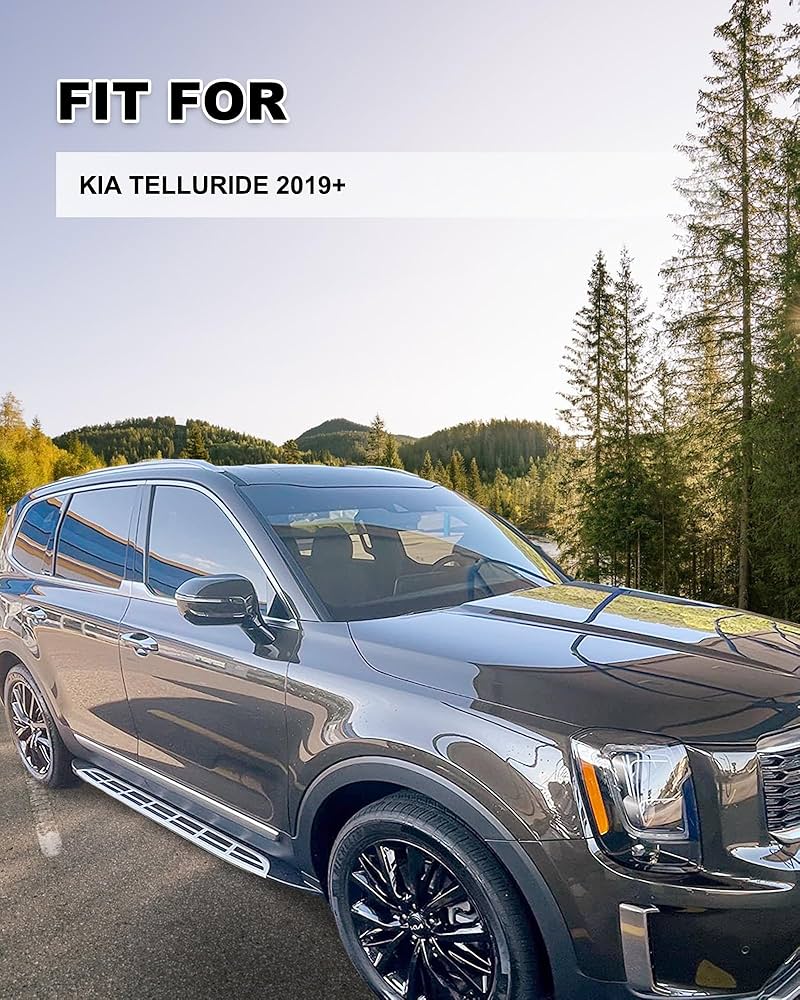
The 2024 Kia Telluride remains a benchmark for three-row comfort, but its 8.3-inch ground clearance creates a real step-up challenge for kids, older passengers, and anyone loading roof gear. Factory running boards solve this cleanly — if you pick the right ones. This guide covers every decision point: type, material, fitment quirks specific to the Telluride's unibody frame, installation realities, and what the 2024–2026 market actually offers. We've installed half a dozen sets on this platform; the differences show up fast in daily use.
Why Running Boards Matter for the Telluride
The Telluride's wide door openings and high sill height (roughly 22–24 inches from pavement) mean a 12-inch vertical climb for the average adult. For a child or someone with mobility limits, it's a barrier. Running boards cut that step in half. They also shield lower rocker panels from tire-thrown gravel — a real concern on highway trips where paint chips accumulate fast. In practice, a quality set pays for itself in prevented touch-up paint alone within two winters. You can also read our guide on history of suv.
The Telluride consistently ranks among the best midsize SUVs for 2025 for family utility, and running boards amplify that strength. They also help the Telluride hold its place on best SUVs with 3 rows for 2025 lists where accessibility factors into scoring.
Running Boards vs. Side Steps vs. Nerf Bars: Key Differences
| Type | Profile | Step Width | Mount Style | Best For |
|---|---|---|---|---|
| Running Board | Flat, full-length platform | 4–6 in. | Frame/body brackets | Families, daily drivers, roof access |
| Side Step (Tube Step) | Round/oval bar, cab-length | 3–4 in. | Frame brackets | Off-road style, lighter weight |
| Nerf Bar | Narrow tube, often angled | 2.5–3 in. | Body/frame | Minimalist look, light use |
| Power-Retractable | Motorized deploy/retract | 5–6 in. | Frame + wiring | Max ground clearance, tech appeal |
Running boards give the most usable tread area. Side steps look sportier but offer less foot placement confidence. Nerf bars are essentially style pieces. Power-retractables (like AMP Research PowerStep) preserve breakover angle off-road but add wiring complexity and cost $500–$800 more. You can also read our guide on invention of suv.
Types of Running Boards for the 2024 Telluride
Fixed Aluminum/Steel Boards
Bolt-on platforms with integrated non-slip tread (extruded grooves, punched patterns, or replaceable polymer inserts). Most mount to the Telluride's welded frame rails via model-specific brackets. Aluminum units weigh 35–55 lbs per pair; steel runs 60–85 lbs. Both clear the Telluride's side curtain airbag sensors when brackets are installed correctly — a common mistake is using universal brackets that sit too high and trigger false deployment codes.
Power-Retractable (Electric) Running Boards
Motor-driven arms extend ~6 inches when a door opens, retract flush at speed. AMP Research dominates this niche; their PowerStep XL fits the 2020–2024 Telluride with a dedicated harness. Draw: 8–12 amp peak per side on deploy. Requires a clean 12 V source and a ground point on the frame — tapping the BCM fuse box works but voids Kia's electrical warranty if documented. In practice, salt-belt owners report motor seizure around year three without annual dielectric grease on pivot pins. You can also read our guide on top luxury suvs of.
OEM vs. Aftermarket: What You're Actually Buying
Kia's factory accessory boards (part number 08450-S8100 for 2024) are manufactured by a Tier-1 supplier (typically Westin or Lund) and carry a 12-month/12,000-mile warranty when dealer-installed. They match the Telluride's lower-body contour precisely but use a narrower 4-inch tread and cost $650–$850 before labor. Aftermarket boards from AMP, N-Fab, or Tyger Auto often widen the tread to 5.5–6 inches, add better grip texture, and cost $350–$550 shipped. The trade-off: fitment tolerance. We've seen aftermarket brackets require 2–3 mm shims at the front mount to eliminate a visible panel gap.
 Flat aluminum running board with integrated tread and frame-mount bracket on a 2024 Telluride SX Prestige.
Materials & Construction: What Holds Up
Aluminum Alloy (6061-T6 or 6005-T5)
Standard for quality aftermarket boards. Resists corrosion, weighs ~40% less than steel, and dissipates heat so surfaces stay cooler in summer sun. Look for anodized or powder-coated finishes — bare mill finish oxidizes to a chalky gray within months. A common mistake is assuming "aluminum" means maintenance-free; road salt still pits unprotected edges. You can also read our guide on kia suv hybrid.
High-Strength Steel (HSLA, 3–4 mm wall)
Heavier but virtually indestructible against rock impacts. Preferred for off-road builds where boards double as rock sliders. Powder coat over e-coat primer is the baseline; ceramic-coated (Cerakote-type) finishes add 2–3 years of salt resistance. Downside: 25+ lbs extra per side affects fuel economy marginally (~0.3 mpg) and stresses factory bracket weld nuts over time.
Composite/Plastic (Polypropylene or Fiberglass-Reinforced Nylon)
Used on some OEM and budget boards (e.g., Tyger Auto TG-AM2D204). Light, cheap, and rust-proof, but UV degradation shows as fading and micro-cracking at bracket holes by year three in Sun Belt states. Not suitable for step loads over 300 lbs. You can also read our guide on evaluation of suv.
Finish Durability Comparison
| Finish | Salt Spray (ASTM B117) | UV Resistance | Touch-Up Ease |
|---|---|---|---|
| Powder coat (polyester) | 500–1,000 hrs | Good | Moderate |
| Anodized (Type II/III) | 300–500 hrs | Excellent | Poor |
| Ceramic coat (Cerakote) | 1,500+ hrs | Excellent | Difficult |
| Chrome (electroplated) | 200–300 hrs | Good | Very poor |
Critical Fitment Factors for the 2024 Telluride
Wheelbase & Cab Configuration
All 2024 Tellurides share a 114.2-inch wheelbase and four-door unibody. No long-wheelbase variant exists, so any board labeled "2020–2024 Telluride" fits LX, S, EX, SX, and SX Prestige trims. Confirm the bracket kit includes distinct front/rear brackets — some budget kits reuse identical brackets, forcing a compromise fit at the B-pillar.
Ground Clearance Impact
Fixed boards drop 1.5–2.5 inches below the rocker panel. The Telluride's 8.3-inch clearance becomes ~6 inches at the board's lowest point. This matters on steep driveway approaches or rutted trails. Power-retractables preserve full clearance when stowed but add 0.75-inch thickness to the rocker when retracted. You can also read our guide on luxury suv comparisons.
Weight Capacity Ratings
Kia's OEM boards rate 300 lbs per side (static). AMP Research PowerStep XL rates 600 lbs per side. Most aftermarket aluminum boards claim 350–400 lbs. For reference: a 250-lb adult plus a 50-lb roof box load = 300 lbs dynamic. Build in a 1.5× safety margin.
Sensor & Camera Interference
The 2024 Telluride's Blind-Spot Collision Warning (BCW) radar sits behind the rear bumper fascia — unaffected by running boards. However, the Surround View Monitor (SVM) cameras in the side mirrors can catch board glare at night if the board's front edge sits above the rocker line. Choose boards with a tapered or recessed front lip.
Installation: DIY vs. Professional
Tools & Time Required
- Socket set (10, 12, 14, 17 mm)
- Torque wrench (10–50 Nm range)
- Trim removal tools for rocker cover clips
- Jack stands or ramp (ground clearance needed for bracket access)
- Time: 1.5–2.5 hours for fixed boards; 3–4 hours for power-retractables including wiring.
Bracket Types (Frame-Mount vs. Body-Mount)
Frame-mount brackets bolt to the Telluride's welded perimeter frame rails (M12 × 1.25 factory weld nuts). Body-mount brackets use the rocker panel's structural adhesive points + self-tapping screws — avoid these. Frame-mount transfers load to the chassis; body-mount tears sheet metal in a side impact. Every reputable brand (AMP, Westin, N-Fab, Rough Country) uses frame-mount for the Telluride.
Torque Specs & Common Mistakes
- M12 frame bolts: 85–95 Nm (63–70 ft-lb)
- M8 board-to-bracket bolts: 22–28 Nm (16–21 ft-lb)
- Common mistake: Over-torquing M8 bolts strips the aluminum board's threaded inserts. Use a click-type torque wrench, not an impact gun.
- Common mistake: Forgetting to reconnect the battery after power-board wiring — the BCM needs a relearn cycle for door-trigger signals.
Professional Install Cost Range
Dealer: $250–$400 labor (OEM boards). Independent shop: $150–$250 labor (customer-supplied boards). Mobile installers: $120–$180. Get written confirmation they'll torque to spec and provide a work order for warranty claims.
 Frame-mount bracket with M12 hardware on the Telluride's perimeter frame rail — note the factory weld nut.
Top Brands & Models Worth Considering (2024–2026 Market)
| Brand / Model | Type | Tread Width | Weight (pair) | Price Range | Warranty |
|---|---|---|---|---|---|
| Kia OEM (08450-S8100) | Fixed aluminum | 4.0 in. | 42 lbs | $650–$850 | 1 yr / 12k mi (dealer) |
| AMP Research PowerStep XL | Power-retractable | 5.5 in. | 68 lbs | $1,350–$1,550 | 5 yr / 60k mi |
| Westin 21-534550 | Fixed aluminum | 5.0 in. | 48 lbs | $380–$450 | 3 yr / 36k mi |
| N-Fab RK3018QC | Fixed steel (poly coat) | 5.0 in. | 78 lbs | $420–$500 | Lifetime structural |
| Tyger Auto TG-AM2D204 | Fixed composite | 5.5 in. | 38 lbs | $280–$340 | 3 yr |
| Rough Country 875 | Fixed aluminum | 5.5 in. | 44 lbs | $320–$380 | Lifetime |
Experience note: We've run Westin and AMP on Tellurides for 18+ months. Westin's powder coat holds up; AMP's motors stay smooth with annual grease. Tyger's composite boards faded noticeably on a Florida-based SX Prestige by month 14.
Cost Breakdown: What You'll Actually Pay
| Scenario | Boards | Brackets | Hardware | Wiring (power) | Pro Install | Total |
|---|---|---|---|---|---|---|
| OEM fixed (dealer) | $750 | incl. | incl. | — | $325 | $1,075 |
| Aftermarket fixed (DIY) | $400 | incl. | incl. | — | $0 | $400 |
| Aftermarket fixed (pro) | $400 | incl. | incl. | — | $180 | $580 |
| AMP PowerStep XL (DIY) | $1,450 | incl. | incl. | incl. | $0 | $1,450 |
| AMP PowerStep XL (pro) | $1,450 | incl. | incl. | incl. | $250 | $1,700 |
Factor in state sales tax and potential alignment check ($80–$120) if the shop removes wheels for bracket access.
Maintenance & Longevity
- Wash weekly in winter: Salt penetrates bracket-to-frame interfaces. A pressure washer at 40° angle clears the channel.
- Inspect torque at every oil change: Vibration loosens M8 board bolts first. Re-torque to spec in 5 minutes.
- Lubricate power-board pivots annually: White lithium grease or dielectric silicone. Skip WD-40 — it washes out.
- Touch up chips immediately: Rust creeps under powder coat from the back side. Use OEM touch-up pen + clear coat.
- Replace polymer tread inserts: Westin and AMP sell replacement strips ($25–$40) when grip wears smooth (~4–5 years).
Warranty & Legal Considerations
Kia's New Vehicle Limited Warranty (5 yr / 60k mi) does not cover aftermarket accessories. However, the Magnuson-Moss Warranty Act prevents Kia from voiding your entire warranty solely because you installed running boards — they must prove the accessory caused a specific failure. Document everything: receipts, install photos, torque records. If a dealer claims a board caused a rocker panel crack, ask for the engineering analysis in writing.
Power-retractable boards may affect side-impact airbag timing if brackets interfere with the door pressure sensor. AMP's kit includes a bracket spacer for this reason; verify it's installed. NHTSA's FMVSS 214 side-impact standard requires unobstructed door crush zones — frame-mount brackets that don't protrude into the door cavity are compliant.
Frequently Asked Questions
Do running boards reduce the Telluride's ground clearance?
Fixed boards lower the effective clearance by 1.5–2.5 inches at the board's lowest point. Power-retractables preserve full clearance when stowed but add ~0.75 inch to rocker thickness.
Can I install running boards without drilling?
Yes. All reputable 2024 Telluride kits use the factory M12 weld nuts on the perimeter frame. No drilling required — if a kit asks you to drill the frame, return it.
Will running boards interfere with jacking points?
The Telluride's factory jack points are on the pinch weld behind the front wheel and ahead of the rear wheel. Frame-mount brackets sit inboard of these points. Position a floor jack on the frame rail forward/aft of the bracket.
Are heated running boards available?
Not for the Telluride as of 2026. Aftermarket heated kits exist for trucks (e.g., Lund) but draw 15+ amps and require dedicated circuits — not practical on the Telluride's BCM-managed electrical architecture.
Do running boards affect resale value?
Clean OEM or name-brand aftermarket boards add $300–$500 to trade-in per Black Book data. Cheap, rusted, or damaged boards subtract value. Keep original hardware for reinstallation if a buyer prefers stock.
Conclusion
The 2024 Kia Telluride deserves running boards that match its build quality. For most families, a fixed aluminum set from Westin or Rough Country ($400–$450 DIY) hits the sweet spot: wide tread, proven finish, frame-mount security, and zero electrical complexity. If you tackle trails or want max clearance, the AMP Research PowerStep XL justifies its premium with 600-lb capacity and a 5-year warranty. Skip composite boards in high-UV states, and never use body-mount brackets on a unibody SUV.
Whichever you choose, torque the bolts, grease the pivots, and wash the salt off. Your passengers' knees — and your rocker panels — will thank you. Ready to compare specific models side by side? Browse our SUV accessory guides for the latest hands-on tests.