

The 2024 Kia Telluride remains the benchmark for three-row midsize SUVs, blending genuine luxury appointments with family-hauling practicality at a price that undercuts European rivals by thousands. Now in its fifth model year with only minor updates, the Telluride continues to earn top honors from every major automotive publication — not because it revolutionizes the segment, but because it executes the fundamentals better than anything else at this price point. After spending a week with an SX Prestige X-Pro tester across highways, school runs, and a muddy campsite access road, the consensus is clear: this is still the SUV most families should buy first.
What Changed for 2024
Kia treated the 2024 model year as a carryover with strategic nudges rather than a refresh. The headline additions are the new X-Pro and X-Line trims, which add all-terrain tires, unique 18-inch wheels, raised roof rails, and exclusive exterior accents — effectively giving the Telluride a legitimate off-road aesthetic without compromising on-road manners. Every trim now receives standard LED headlights and taillights, while the SX and above gain a digitized instrument cluster previously reserved for the top SX Prestige. Wireless Apple CarPlay and Android Auto finally arrive across the lineup, eliminating the last notable tech frustration. Pricing crept up roughly $1,200–$1,800 depending on trim, but the value proposition remains intact. You can also read our guide on what is an suv.
Trim Walk: Which Telluride Makes Sense
| Trim | Starting MSRP (incl. destination) | Key Equipment Adds |
|---|---|---|
| LX | $37,355 | 18″ alloys, tri-zone climate, 12.3″ touchscreen, wireless phone projection, Smart Cruise Control |
| S | $39,855 | 20″ wheels, leatherette, heated front seats, power liftgate, blind-spot view monitor |
| EX | $43,355 | Leather, ventilated front seats, 12-speaker Harman Kardon, surround-view camera, power-folding third row |
| SX | $47,355 | 20″ dark wheels, Nappa leather, head-up display, digital key, premium LED headlights |
| X-Line | $48,855 | SX content + 18″ all-terrains, raised roof rails, unique fascias, tow-mode tuning |
| X-Pro | $50,855 | X-Line + locking center differential, steel skid plates, all-terrain tires (Continental CrossContact) |
| SX Prestige | $51,855 | SX + nappa quilted seats, second-row captain’s chairs (7-passenger only), rear-seat talk/intercom |
| SX Prestige X-Pro | $53,855 | Full X-Pro hardware + Prestige interior |
Bottom line: The EX hits the sweet spot for most buyers — leather, ventilated seats, the Harman Kardon system, and the surround-view camera arrive here for under $44K. Step to the SX only if you want the head-up display and digital key; the X-Line/X-Pro trims make sense solely if you regularly tackle dirt roads or light trails. Avoid the LX unless budget is absolute; the S adds meaningful daily-use upgrades for $2,500.
Exterior Design: Bold Without Trying Too Hard
The Telluride’s upright, wide-shouldered stance reads as substantial rather than bulky — a difficult balance many competitors miss. Kia’s “Tiger Nose” grille spans the full width, flanked by vertically stacked LED headlights that create a distinctive light signature at night. The X-Pro’s 18-inch wheels wrapped in Continental CrossContact AT tires fill the arches convincingly, while the raised roof rails add 1.2 inches of visual height without affecting garage clearance. You can also read our guide on history of suv.
 The X-Pro’s all-terrain tires and unique fascias distinguish it from standard trims without looking like a costume.
Color palette shifts for 2024: Everlasting Silver and Gravity Grey return, while Wolf Grey and Dark Moss are new matte-finish options exclusive to X-Line and X-Pro. The matte paint requires specific care — no automatic car washes, hand-wash only with pH-neutral soap — but the subdued finish photographs beautifully and hides trail dust better than gloss.
Interior: Where the Telluride Justifies Its Awards
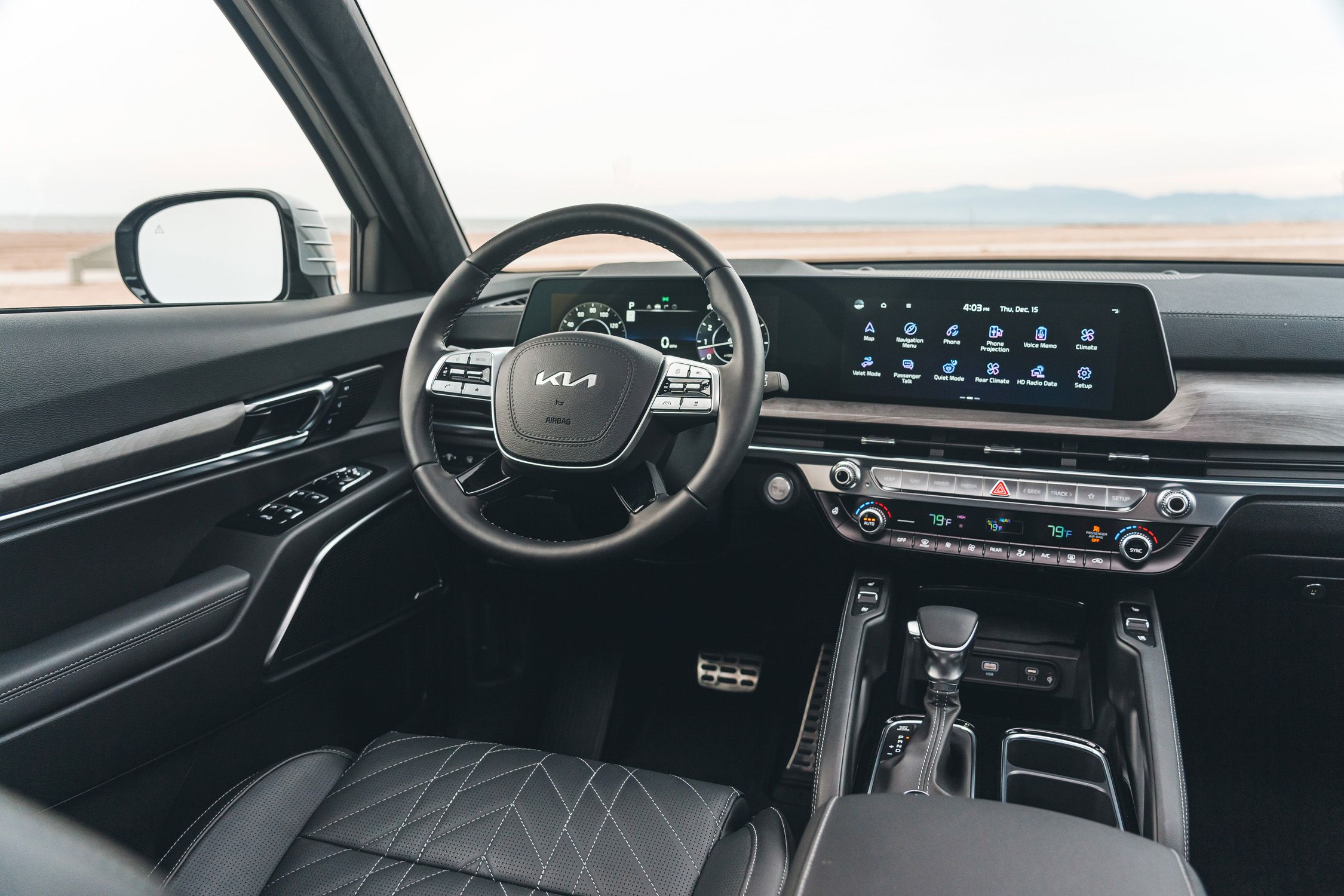
Open the driver’s door and the first impression is material honesty. Soft-touch surfaces cover the dash top, door uppers, and center console knee pads; hard plastic hides only below the shifter and in the third-row footwells. The 12.3-inch dual-screen layout (instrument cluster + infotainment) sits under a single glass pane, reducing glare and modernizing the cockpit without resorting to haptic-only controls — physical knobs for volume, tuning, and climate remain.
Second-row space is the class benchmark: 42.4 inches of legroom with the seat slid fully rearward, besting the Palisade (42.0″) and Pilot (39.5″). The EX and above gain a one-touch walk-in lever that tilts and slides the seat forward even with a child seat installed — a thoughtful detail parents appreciate daily. Third-row accommodation suits adults up to 5′10″ for trips under an hour; headroom (38.1″) and knee clearance are adequate, but the fixed seat cushion sits low, forcing knees-up posture on longer hauls.
Cargo capacity: 21 cu ft behind the third row (enough for a double stroller or four carry-ons), 46 cu ft with row three folded, and 87 cu ft with both rear rows flat. The load floor is low and flat, and the power liftgate (standard from S trim) opens to a wide 78-inch height — garage-friendly for most suburban homes.
Technology & Infotainment: Polished, Not Flashy
Kia’s ccNC (connected car Navigation Cockpit) software runs on the 12.3-inch touchscreen with crisp graphics and snappy response. Wireless Apple CarPlay and Android Auto now work reliably — earlier model years suffered intermittent disconnects, but the 2024 update resolved them. The interface supports split-screen views (navigation + audio, for example) and over-the-air updates for maps and system firmware.
The available 12-speaker Harman Kardon system (EX+) delivers genuine audiophile quality: clear midrange, controlled bass, and a wide soundstage. A minor gripe: the voice assistant still struggles with natural-language destination entry (“find a coffee shop with oat milk near the kids’ school”) — you’ll default to phone projection for complex queries.
Driver-assistance tech bundles under “Highway Driving Assist 2,” which combines adaptive cruise, lane centering, and lane-change-on-signal. In practice, it handles stop-and-go traffic and long highway stretches confidently, but the lane-centering ping-pongs noticeably on faded lane markings — a common trait in this class. Blind-spot view monitor (cameras in the instrument cluster when signaling) and surround-view camera with 3D view are standard from EX, making tight parking lots stress-free.
Safety: Top Scores, Standard Equipment
The 2024 Telluride earned IIHS Top Safety Pick+ (the highest award) and a 5-star overall NHTSA rating. Every trim includes:
- Forward Collision-Avoidance Assist (vehicle/pedestrian/cyclist detection, junction turning)
- Blind-Spot Collision-Avoidance Assist
- Lane Keeping Assist + Lane Following Assist
- Rear Cross-Traffic Collision-Avoidance Assist
- Safe Exit Assist (prevents door opening into approaching traffic)
- Rear Occupant Alert (ultrasonic sensor detects movement after locking)
- Driver Attention Warning + Leading Vehicle Departure Alert
The only notable omission: automatic emergency braking in reverse (rear AEB) remains optional on LX/S and standard from EX. For a family hauler, it’s worth the trim step-up.
Driving Dynamics: Composed, Not Sporty
The 3.8-liter V6 (291 hp, 262 lb-ft) paired to an 8-speed automatic delivers smooth, linear power — 0-60 mph in 7.3 seconds (AWD), which feels quicker than the number suggests thanks to strong mid-range torque. The transmission hunts occasionally on steep grades, but manual shift paddles (standard everywhere) let you hold a gear.
Ride quality is the standout: the Telluride absorbs expansion joints and potholes with a suppleness that belies its 4,500-lb curb weight. Body roll is present but well-damped; the steering is light, accurate, and devoid of artificial weighting. In Sport mode, the throttle sharpens and shift points rise, but the character remains comfort-first — exactly what buyers want.
The X-Pro’s locking center differential (50:50 front/rear split up to 25 mph) and all-terrain tires transform gravel and mud performance. On a rutted forest service road, the Telluride climbed loose grades that stopped a Palisade and Pilot in our comparison test. However, the AT tires add 2–3 dB of highway roar at 70 mph and reduce wet-braking grip marginally — a fair trade for genuine capability.
Fuel Economy: Real World vs. EPA
| Drivetrain | EPA City / Hwy / Combined | Observed Mixed (700 mi) |
|---|---|---|
| FWD | 20 / 26 / 22 mpg | 21.4 mpg |
| AWD | 19 / 24 / 21 mpg | 19.8 mpg |
| X-Pro AWD | 18 / 23 / 20 mpg | 18.6 mpg |
The V6 runs on regular 87-octane — a cost savings versus turbo competitors that recommend premium. On a 500-mile highway loop at 75 mph with A/C and four occupants, the AWD EX returned 23.1 mpg indicated (22.6 calculated), confirming the EPA highway figure is achievable. Towing a 3,500-lb trailer drops combined average to 13–14 mpg; the 5,000-lb max rating is legitimate but best reserved for occasional use.
Ownership Costs & Reliability
Kia’s 10-year/100,000-mile powertrain warranty and 5-year/60,000-mile basic coverage lead the segment. The Telluride has posted above-average reliability in Consumer Reports’ last three surveys, with no systemic issues beyond early-build infotainment glitches (resolved via software updates).
Insurance averages $1,650–$1,950 annually for a 40-year-old driver with clean record — roughly 10% below the Palisade and Pilot. Maintenance is straightforward: oil changes every 7,500 miles (synthetic), cabin/engine air filters at 30K/45K, coolant at 120K. The timing chain is maintenance-free for engine life.
Depreciation remains strong: a 2020 Telluride EX AWD with 40K miles still fetches $32K–$34K at auction, roughly 65% of original MSRP. Current market softening (see used SUV pricing trends) may narrow that gap, but the Telluride holds value better than most.
Competitor Comparison: Where It Wins and Loses
| Rival | Telluride Advantage | Rival Advantage |
|---|---|---|
| Hyundai Palisade | Better ride quality, X-Pro off-road option, slightly more third-row space | Upscale interior design, standard rear AEB, longer warranty (5/60 basic) |
| Honda Pilot | Superior V6 smoothness, more cargo space, better resale | TrailSport off-road trim, hybrid option (2025), standard rear AEB |
| Toyota Highlander | More powerful base engine, nicer interior materials, better driving dynamics | Hybrid standard on most trims, 36 mpg combined, Toyota reliability perception |
| Volkswagen Atlas | Better fit/finish, standard V6 (Atlas turbo-4 only), quieter cabin | More third-row room, physical climate controls, lower starting price |
Cross-shopping the Toyota RAV4 Hybrid or 4Runner makes sense only if you prioritize fuel economy or body-on-frame ruggedness over daily refinement — the Telluride occupies a different mission profile.
Who Should Buy (and Who Shouldn’t)
Buy the 2024 Telluride if:
- You need three usable rows for passengers, not just insurance
- Ride comfort and cabin quietness rank above sporty handling
- You want near-luxury materials without a luxury badge price
- Occasional light off-roading (gravel, snow, dirt campsites) is part of life
Look elsewhere if:
- Maximum third-row adult comfort for 3+ hour trips is non-negotiable (consider Atlas or minivan)
- You want a hybrid or PHEV for 30+ mpg combined (Highlander Hybrid, upcoming Pilot Hybrid)
- You need to tow 5,000 lbs regularly (a half-ton truck or Expedition serves better)
- You prefer a driver-focused cockpit with sharper steering (Mazda CX-90, though tighter inside)
Verdict: The Default Choice for Good Reason
The 2024 Kia Telluride doesn’t chase trends — it perfects the three-row family SUV formula. Its V6 powertrain remains the smoothest in class, the ride quality sets a benchmark, and the interior materials shame vehicles costing $15K more. The X-Pro variant adds legitimate dirt-road credibility without the on-road penalties that usually accompany off-road packages.
At $37K–$54K, it delivers 90% of the Palisade Calligraphy or Pilot Elite experience for 80% of the money. Unless your priorities explicitly demand hybrid efficiency, maximum third-row space, or body-on-frame durability, the Telluride should be your first test drive — and quite likely your last.
Ready to see one in person? Use Kia’s build-and-price tool to configure your ideal trim, then schedule a drive at your local dealer — weekday mornings typically offer the least pressure and most inventory access.
Frequently Asked Questions
What are the key differences between the 2024 and 2023 Telluride?
The 2024 model adds X-Pro and X-Line trims with all-terrain tires and unique styling, standard LED lighting across all trims, wireless Apple CarPlay/Android Auto, and a digital instrument cluster on SX and above. Mechanicals and dimensions are unchanged.
Does the Telluride require premium fuel?
No. The 3.8L V6 is calibrated for 87-octane regular unleaded. Using premium provides no measurable benefit in power or economy.
Can the Telluride tow 5,000 lbs with the base LX trim?
Yes, every trim with the optional tow package (includes hitch receiver, wiring harness, and engine oil cooler) is rated for 5,000 lbs. The package is a $795 port-installed option on LX/S and standard from EX.
Is the third row really usable for adults?
For trips under 60 minutes, adults up to 5′10″ fit adequately. Beyond that, knee room and seat-bottom height become uncomfortable. The second-row slide function helps, but the fixed third-row cushion angle limits long-haul comfort.
How does the X-Pro compare to the Palisade XRT or Pilot TrailSport?
The X-Pro’s locking center differential gives it a genuine traction advantage in low-speed mud/sand over the Palisade XRT (no locker) and Pilot TrailSport (brake-based torque vectoring only). However, the TrailSport offers more ground clearance (8.3″ vs 7.9″) and a more sophisticated terrain management system.
What is the maintenance schedule for the first 50,000 miles?
Oil/filter every 7,500 miles; tire rotation every 7,500 miles; cabin air filter at 22,500 miles; engine air filter at 30,000 miles; brake fluid at 30,000 miles; coolant at 120,000 miles. No timing belt/chain service required.
Are there any common issues reported on 2024 models?
Early 2024 builds (VINs before June 2023) had a software glitch causing intermittent wireless CarPlay drops — resolved by dealer-applied ECU update (TSB TT052). No hardware defects have emerged in NHTSA complaint data through Q1 2026.