
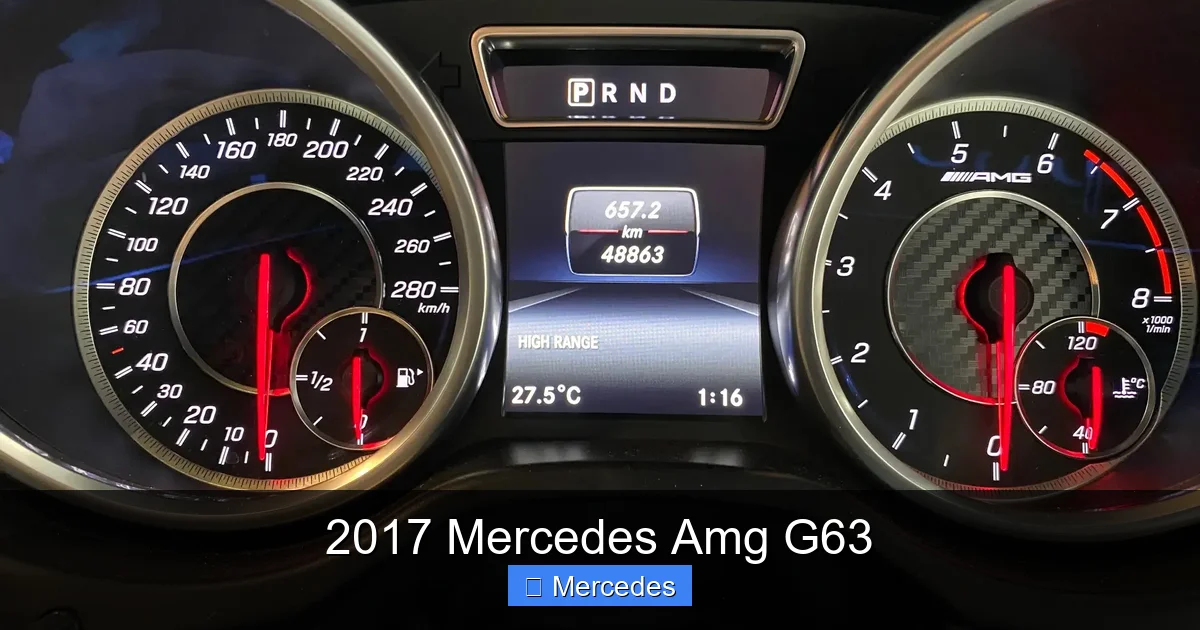
The 2017 Mercedes-AMG G63 remains a singular presence in the luxury SUV landscape — a boxy, ladder-frame icon that pairs a handcrafted twin-turbo V8 with genuine off-road hardware. Unlike its unibody rivals, the G63 traces its DNA to a 1970s military vehicle, yet the 2017 refresh brought a lighter platform, updated aerodynamics, and the 4.0‑liter M177 V8 that still feels contemporary in 2026. Whether you’re cross‑shopping a used example or researching the model’s collectibility, this guide covers every angle: powertrain, dynamics, interior tech, ownership costs, and what to inspect before buying.
Quick Specs at a Glance
| Specification | Detail |
|---|---|
| Engine | 4.0 L twin‑turbo V8 (M177) |
| Output | 549 hp @ 5,500 rpm / 561 lb‑ft @ 1,750‑5,250 rpm |
| Transmission | 7‑speed AMG Speedshift 7G‑Tronic |
| Drivetrain | Permanent 4MATIC with three locking differentials |
| 0‑60 mph | 4.4 seconds (manufacturer) |
| Top Speed | 130 mph (electronically limited) |
| Fuel Economy (EPA) | 13 mpg city / 16 mpg highway / 14 mpg combined |
| Towing Capacity | 7,000 lb (properly equipped) |
| Ground Clearance | 10.7 in (adjustable via suspension) |
| Seating | 5 or 7 (optional third row) |
| Cargo Volume | 35.5 cu ft behind 2nd row / 64.2 cu ft with rows folded |
Source: Mercedes-Benz G-Class official site and EPA fuel economy ratings.
Evolution of the G‑Class: From Military Roots to Modern Icon
The G‑Wagen began life as a joint Mercedes‑Steyr project for NATO forces. Its boxy silhouette, portal axles (on early military versions), and body‑on‑frame construction were engineered for battlefield durability. Civilian sales started in 1979, but the model stayed niche until the 1990s when AMG began offering tuned versions. The 2017 model year introduced the W463A chassis — aluminum‑intensive, 170 lb lighter, with a wider track and revised suspension geometry — while preserving the ladder frame that enables the G63’s articulation.
This refresh also marked the switch from the 5.5 L V8 to the 4.0 L twin‑turbo unit, part of Mercedes’ modular engine family. The move improved throttle response, reduced turbo lag via variable turbine geometry, and met stricter emissions standards without sacrificing the visceral soundtrack enthusiasts expect. Understanding this SUV heritage helps explain why the G63 drives unlike any modern SUV definition.
Powertrain and Performance: Twin‑Turbo V8 Brilliance
 The 2017 G63's imposing stance and signature AMG styling cues.
The M177 engine is a masterclass in packaging: hot‑V turbo layout, dry‑sump lubrication, and cylinder deactivation (on later updates) — though the 2017 spec runs all eight cylinders full time. Peak torque arrives at just 1,750 rpm, giving the 5,600‑lb SUV effortless low‑end shove. The 7‑speed automatic, while not a dual‑clutch, is tuned for quick shifts and holds gears aggressively in Sport/Sport+ modes.
Real‑world observations
- Cold starts produce a pronounced V8 bark that settles into a deep idle within 30 seconds.
- In Comfort mode, the transmission upshifts early (around 2,000 rpm) to keep the cabin serene.
- Manual paddle shifts are crisp, but the torque converter still slips slightly under full‑throttle downshifts — a characteristic of traditional automatics.
Fuel Requirements and Economy
The G63 demands 91 octane (or higher) to protect the high‑pressure direct‑injection system and turbochargers. Running regular can cause knock retard, reducing power and risking long‑term damage. For a deeper dive, see the premium fuel requirements, which models need premium, and pros and cons of regular fuel. Expect 12‑14 mpg in mixed driving; highway cruising at 75 mph with the aerodynamics of a brick yields ~15 mpg.
Driving Dynamics: On‑Road Manners and Off‑Road Prowess
On‑Road Behavior
The G63’s recirculating‑ball steering (updated with variable ratio in 2017) requires more lock‑to‑lock turns than a rack‑and‑pinion setup, but it transmits clear feedback from the front tires. Body roll is noticeable in quick transitions, yet the adaptive damping (AMG Ride Control) does a commendable job of flattening the SUV in Sport+. The optional carbon‑ceramic brakes (standard on later Edition 1 models) provide fade‑free stops, though the standard steel rotors are adequate for street use.
Off‑Road Capability
Three locking differentials — center (automatic), front and rear (driver‑selectable) — are the G63’s trump card. Engage low range via the console switch, lock all three diffs, and the G63 will crawl up a 100 % grade (45°) or traverse a 35° side slope. The Terrain Response system (Comfort, Eco, Sport, Sand, Rock) adjusts throttle maps, shift points, and ABS/ESP intervention. In practice, Rock mode with rear locker engaged lets the G63 climb loose, rocky inclines that would strand a Range Rover Sport SVR.
Approach / Departure / Breakover Angles
- Approach: 30.9°
- Departure: 30.7°
- Breakover: 24.3°
Ground clearance is adjustable from 8.5 in (Aero mode) to 11.8 in (Off‑road+). Water fording depth is 27.5 in — impressive for a vehicle that also does 130 mph on the autobahn.
Interior: Craftsmanship Meets Technology
 Inside the G63, dual widescreen displays dominate a cabin trimmed in Nappa leather and carbon fiber.
The 2017 cabin introduced the widescreen cockpit — two 12.3‑inch displays under a single glass pane — running the COMAND Online system with Apple CarPlay/Android Auto. Materials are top‑tier: standard designo Nappa leather, optional carbon‑fiber or open‑pore wood trim, and hand‑stitched dashboard accents. The front seats (heated, ventilated, 14‑way power) offer excellent bolstering for spirited driving yet remain comfortable on 10‑hour trips.
Rear passengers benefit from individual climate zones, USB‑C ports, and optional heated seats. The optional third row is tight — suitable only for children or short hops — and reduces cargo space to a minimal 12 cu ft. With the second row up, the load floor is high due to the ladder frame, but the 40/20/40 split folding creates a flat surface when folded.
Tech Highlights
- Burmester® 3D surround sound (15 speakers, 590 W)
- Wireless charging (Qi) in the center console
- Panoramic sunroof with electrochromic shading
- Adaptive Highbeam Assist Plus LED headlights
- Active Distance Assist Distronic (adaptive cruise with stop‑&‑go)
- Active Lane Keeping Assist, Blind Spot Assist, and Pre‑Safe® Plus
The infotainment learning curve is moderate; the touchpad controller on the console takes a few days to master. Voice control (“Hey Mercedes”) handles navigation and climate well but struggles with complex media requests.
Exterior Design: Timeless Aggression
The 2017 facelift sharpened the G63’s visage: AMG‑specific Panamericana grille (vertical slats), flared wheel arches covering 19‑, 20‑, or 21‑inch forged wheels, and quad‑exit exhaust tips integrated into the rear bumper. Designo matte finishes (graphite magno, olivine magno) add exclusivity but require specialized care — bird droppings can etch the clearcoat within hours.
Key heritage cues remain: the hood‑mounted three‑pointed star, exposed door hinges, spare tire on the tailgate (with a cover that doubles as a step), and the characteristic “G” badge on the front fenders. LED lighting front and rear became standard in 2017, replacing the previous bi‑xenon units.
Ownership Experience: Costs, Reliability, and Practicality
Maintenance Schedule and Typical Costs (2026 estimates)
| Service | Interval | Estimated Cost (Independent / Dealer) |
|---|---|---|
| Synthetic oil change (10 qt) | 10,000 mi / 1 yr | $250 / $450 |
| Brake fluid flush | 2 yr | $180 / $300 |
| Transmission fluid & filter | 40,000 mi | $450 / $750 |
| Differential fluids (3x) | 40,000 mi | $300 / $500 |
| Spark plugs (8x) | 60,000 mi | $400 / $650 |
| Air filters (engine + cabin) | 30,000 mi | $150 / $250 |
| Coolant flush | 10 yr / 150,000 mi | $350 / $550 |
Costs vary by region; dealer labor rates often exceed $200/hr.
Common Issues to Monitor
- Turbocharger wastegate rattle — often audible at cold idle; updated actuators were issued under TSB.
- Air suspension compressor failure — more common on high‑mileage examples; listen for excessive run time.
- Center console cup‑holder mechanism — brittle plastic tabs break; inexpensive DIY fix.
- Pixel loss on instrument cluster — early 2017 builds; covered under extended warranty in some regions.
- Rear differential seal weep — not catastrophic but messy; inspect at each oil change.
Reliability is above average for a high‑performance SUV if maintenance is rigorous. The M177 engine has proven robust; most major expenses center on suspension, electronics, and brake wear.
Insurance and Depreciation
Insurance premiums run $2,500‑$4,000/yr for a clean record (varies by state). Depreciation has slowed; well‑kept, low‑mileage (<30k) examples now trade above original MSRP ($156,450 in 2017) due to enthusiast demand. High‑mileage (>80k) units settle in the $90k‑$110k range.
Buying a Used 2017 G63: What to Check
- Service records — demand a complete history; gaps are red flags.
- Carfax / AutoCheck — verify no accident damage to the ladder frame.
- Cold‑start video — listen for wastegate rattle, rough idle, or smoke.
- Undercarriage inspection — look for off‑road damage: bent skid plates, scraped differentials, torn CV boots.
- Tire matching — all four must be same brand/model/size; staggered setups require rotation discipline.
- Electronics sweep — test every screen, camera, sensor, and seat function.
- Fluid analysis — send oil and differential fluid samples to a lab (Blackstone, etc.) for wear metals.
A pre‑purchase inspection by an AMG‑certified technician is non‑negotiable. Budget $500‑$800 for a thorough evaluation.
Market Outlook and Collectibility
The 2017 G63 sits at a sweet spot: last of the “analog” V8 G‑Classes before the 2019 W463B introduced mild‑hybrid assist and a 9‑speed transmission. Limited editions (Edition 1, Night Edition, 4×4²) command significant premiums. As emission regulations tighten globally, pre‑GPF (gasoline particulate filter) V8s like the 2017 are increasingly viewed as modern classics. Values for pristine, documented examples have risen 15‑20 % since 2023. If you’re considering an alternative, the Mercedes premium package landscape offers insight into how option codes affect resale across the lineup.
Frequently Asked Questions
What distinguishes the 2017 G63 from the standard G‑Class?
The G63 is the AMG flagship: hand‑built M177 V8, sport‑tuned suspension, three locking diffs, unique bodywork (flared arches, Panamericana grille), and exclusive interior trim. The base G550 uses a 4.0 L V8 with 416 hp and lacks the lockable front/rear differentials.
Is the G63 practical for daily driving?
Yes, if you accept 13‑14 mpg, a wide turning circle (44.3 ft), and firm ride quality. Visibility is excellent, parking sensors/cameras are standard, and the cabin isolates wind noise well at highway speeds.
Can the G63 tow a travel trailer?
Up to 7,000 lb with the factory hitch and wiring. Tongue weight limit is 700 lb. For frequent towing, add a transmission cooler (dealer accessory) and monitor oil temps.
Does the 2017 G63 have a particulate filter?
No. The gasoline particulate filter (GPF) arrived with the 2019 model year update. This makes the 2017’s exhaust note louder and less restricted.
Are parts and service available outside major metros?
Mercedes dealers can order any part, but lead times for AMG‑specific items (turbo actuators, air‑strut modules) can be 2‑3 weeks. Independent specialists with STAR diagnostic access are a viable alternative for out‑of‑warranty work.
How does the G63 compare to a 2017 Range Rover Sport SVR?
The SVR is quicker 0‑60 (4.3 s), rides better on pavement, and has a more modern interior. The G63 wins off‑road, towing, resale, and emotional appeal. Choose based on your primary use case.
Conclusion
The 2017 Mercedes‑AMG G63 is a rare vehicle that transcends categories — part super‑SUV, part expedition rig, part rolling sculpture. Its twin‑turbo V8 delivers instantaneous thrust, the three locking differentials provide genuine off‑road credibility, and the cabin remains a benchmark for tactile luxury. Ownership demands a realistic budget for fuel, maintenance, and insurance, but the reward is a driving experience no crossover can replicate. As the last pre‑hybrid, pre‑GPF G63, the 2017 model year is increasingly sought after by collectors and enthusiasts alike. If you find a well‑documented example with a clean undercarriage, it’s a compelling blend of performance, heritage, and investment potential — provided you respect the maintenance schedule and feed it the premium fuel it deserves.