
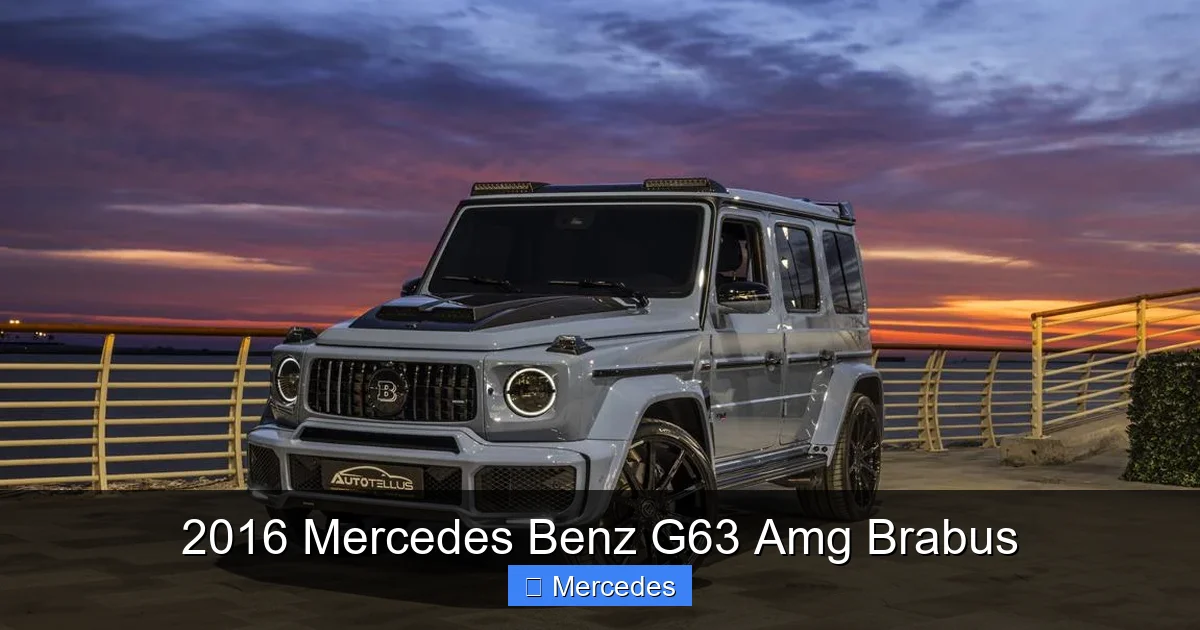
The 2016 Mercedes-Benz G63 AMG Brabus sits at a rare intersection: a factory-backed off-road icon infused with aftermarket engineering that pushes output to 730 hp. In 2026, this collaboration remains a benchmark for low-volume, high-performance SUVs — valued by collectors for its numbered build plates, hand-finished cabins, and the unmistakable presence of a Brabus-tuned V8. Whether you’re researching a purchase, comparing alternatives, or studying the evolution of the G-Class, this guide covers every angle with current market context.
The AMG–Brabus Partnership: Engineering Meets Artistry
Why This Collaboration Matters
Mercedes-AMG supplied the 5.5 L twin-turbo V8, 4MATIC+ all-wheel drive, and the G-Class’s ladder-frame chassis. Brabus then layered its own intake, exhaust, ECU calibration, suspension tuning, and aerodynamic bodywork. The result is not a mere appearance package — it’s a holistic re-engineering that preserves the G’s three locking differentials and low-range transfer case while adding supercar acceleration. In practice, the Brabus touch transforms throttle response and exhaust note without compromising the durability AMG built in.
Production Numbers and Rarity
Global production for the 2016 model year is estimated below 500 units, each receiving a numbered plaque on the center console. That scarcity, combined with Brabus’s practice of documenting every build, creates a verifiable provenance chain that today’s collectors demand. For broader perspective on how the G-Class became a platform for such limited editions, see the SUV heritage timeline.
Powertrain & Performance: 730 HP from a 5.5 L V8
Engine Specs and Brabus Upgrades
| Specification | Standard G63 AMG | Brabus 700 (2016) |
|---|---|---|
| Displacement | 5.5 L V8 twin-turbo | 5.5 L V8 twin-turbo |
| Horsepower | 563 hp @ 5,500 rpm | 730 hp @ 5,800 rpm |
| Torque | 560 lb-ft @ 1,750 rpm | 738 lb-ft @ 2,500 rpm (electronically limited) |
| 0–60 mph | 5.3 s | 4.8 s |
| Top Speed | 130 mph (limited) | 149 mph (limited) |
Brabus achieves the gains through a high-flow intake, larger turbocharger compressors, a stainless-steel sport exhaust with active flaps, and a revised ECU map that raises boost pressure by ~0.4 bar. Cooling capacity is upgraded with a larger intercooler and auxiliary radiators — critical for sustained output in hot climates.
 Widened carbon-fiber fenders and 22″ Monoblock forged wheels distinguish the Brabus body.
Image source: cdn.dealeraccelerate.com
Acceleration, Top Speed, and Driving Dynamics
The 0–60 mph sprint in 4.8 seconds is remarkable for a 2,700 kg vehicle. Power delivery is linear: torque peaks early and holds flat to redline, making highway overtakes effortless. The 7-speed AMG Speedshift MCT transmission (wet multi-plate clutch, not a torque converter) snaps through gears in Sport+ mode, while the 4MATIC+ system splits torque 40/60 front/rear under normal conditions and can send up to 100 % to either axle.
Transmission and 4MATIC+ AWD System
The transmission’s “Controlled Efficiency” mode starts in second gear for smoother urban pulls, while “Manual” mode holds gears to redline. Brabus recalibrates shift points and firmness, reducing slip during hard acceleration. The three mechanical locking differentials (front, center, rear) remain fully functional — a key advantage over rivals that rely solely on brake-based torque vectoring.
Exterior Design: Aggressive Aerodynamics and Bespoke Styling
Widened Body, Forged Wheels, and Carbon Accents
The Brabus Widestar kit adds 60 mm of track width per axle via carbon-fiber fender flares, allowing 22×10″ front and 22×11″ rear Monoblock F “Platinum Edition” forged wheels wrapped in 295/40 R22 and 325/35 R22 tires. A front splitter, side skirts, and rear diffuser — all carbon fiber — generate measurable downforce above 120 mph without increasing drag coefficient beyond 0.54.
Exclusive Paint Options and Badging
Brabus offered 12 exclusive metallic and matte finishes (e.g., “Brabus Blue,” “Graphite Grey Matte”) plus custom wrap matching. Each car wears Brabus script on the C-pillars, a chrome trunk lid badge, and illuminated door-sill plates with the build number.
Lighting and Functional Aerodynamics
LED headlamps with adaptive high-beam assist and a unique daytime-running-light signature improve night visibility. The enlarged front grille intakes feed the upgraded cooling stack; hood vents extract engine-bay heat at low speeds.
Interior: Handcrafted Luxury Meets Modern Tech
Materials, Craftsmanship, and Customization
Every cabin is built to order in Bottrop. Options include:
- Leather: Nappa, Designo, or Brabus “Fine Grain” in 30+ colors
- Stitching: Contrast, diamond-quilted, or “BRABUS” embroidery on headrests
- Trim: Open-pore wood, forged carbon, or anodized aluminum
- Headliner: Alcantara or leather with custom perforation patterns
 Carbon-fiber trim, quilted Nappa leather, and Brabus-badged steering wheel define the cabin.
Image source: veh-markets.com
Infotainment, Audio, and Comfort Features
The COMAND Online system (8.4″ screen) supports Apple CarPlay/Android Auto via firmware update — verify the dealer applied the 2021 retrofit. Burmester 3D surround sound (15 speakers, 590 W) remains reference-grade. Heated/ventilated front seats, heated rear seats, and a panoramic sunroof are standard; an Executive Rear Seat package adds recline, massage, and a center console with tablet integration.
Space, Practicality, and Rear-Seat Experience
Front passengers enjoy ample headroom despite the sunroof. Rear legroom is 37.2″ — adequate for adults on trips under three hours. Cargo volume behind the second row is 38.1 cu ft; folded, it expands to 68.6 cu ft. The split tailgate (side-hinged door + drop-down glass) simplifies loading in tight garages.
Off-Road Capability: The G-Class DNA Remains Intact
Ground Clearance, Suspension, and Approach Angles
Ride height: 10.7″ (standard) → 12.2″ (Off-Road+ mode via air suspension). Approach/departure/breakover angles: 36° / 31° / 26°. The Brabus sport suspension lowers the body 15 mm in Sport mode for highway stability, but the air springs retain full travel for off-road use.
Three Locking Differentials and Terrain Modes
Dashboard-mounted buttons engage front, center, and rear lockers independently. Terrain modes (Sand, Rock, Snow, Individual) adjust throttle mapping, shift logic, ESP thresholds, and steering weight. In practice, the G63 Brabus climbs 100 % grades and fords 27.5″ of water — unchanged from the standard G63.
Real-World Off-Road Performance
Owners report successful expeditions in Moab, the Icelandic highlands, and the Moroccan dunes. The combination of low-range gearing (2.46:1), locker engagement under load, and the V8’s low-end torque makes technical crawling surprisingly smooth. However, the 22″ wheels and low-profile tires demand careful line selection on sharp rock.
On-Road Manners: Daily Driving and Long-Distance Comfort
City Visibility, Parking Aids, and Ride Quality
The upright greenhouse and thin A-pillars provide excellent sightlines. A 360° camera, front/rear parking sensors, and active park assist mitigate the 75.5″ width. In Comfort mode, the adaptive dampers absorb potholes well, though the 22″ tires transmit sharp impacts more than the standard 20″ setup.
Highway Stability, Noise Isolation, and Cruise Control
At 75 mph, cabin noise measures ~68 dB — impressive for a body-on-frame SUV. Acoustic laminated glass and active engine mounts suppress V8 vibration. Adaptive cruise control with stop-and-go and lane-centering (Distronic Plus) reduces fatigue on interstates. Crosswind assist is calibrated for the G’s high center of gravity.
Fuel Economy Realities
EPA combined: 12 mpg (11 city / 13 highway). Real-world mixed driving averages 10–11 mpg. The 26.4-gallon tank yields ~280 miles range. Premium 91-octane minimum is mandatory; using regular risks detonation under boost. For a detailed breakdown of Mercedes fuel requirements across models, consult the premium fuel guide.
Ownership Experience: Maintenance, Costs, and Brabus Support
Service Intervals, Specialist Requirements, and Parts Availability
- Oil & filter: Every 10,000 miles or 12 months (10 L of 0W-40 meeting MB 229.5)
- Spark plugs: Every 30,000 miles (Brabus-spec heat range)
- Brake fluid: Every 2 years
- Differential/transfer case oils: Every 40,000 miles
Service must be performed by a Brabus-authorized center or a Mercedes dealer with Brabus training to maintain the build certification. Parts unique to Brabus (exhaust flaps, carbon body panels, ECU) are ordered through Bottrop; lead times can reach 6–8 weeks. Standard G63 mechanical parts remain widely stocked.
Warranty Status in 2026 and Extended Coverage Options
The original 4-year/50,000-mile Mercedes warranty expired by 2020. Brabus provided a 2-year/unlimited-mile warranty on its modifications — also expired. Third-party extended warranties (e.g., CARCHEX, Endurance) cover the powertrain but often exclude Brabus-specific components. Verify exclusion lists before purchasing.
Common Issues and Buyer Tips
- Exhaust flap actuators seize in salty climates — lubricate annually.
- Air suspension compressors may fail after 80k miles; upgraded units are available.
- Carbon-ceramic brakes (optional) last 60k+ miles but cost ~$12k/axle to replace; steel rotors are cheaper and adequate for street use.
- ECU tuning verification: Request the Brabus flash certificate; some used cars have been reverted to stock.
Market Value & Investment Potential in 2026
Current Price Ranges and Auction Trends
| Condition / Mileage | Private Party | Dealer Retail | Recent Auction (BaT/RM) |
|---|---|---|---|
| <10k miles, pristine | $220k–$260k | $240k–$290k | $250k–$310k |
| 10k–30k miles, excellent | $190k–$230k | $210k–$250k | $200k–$240k |
| 30k–50k miles, good | $160k–$190k | $180k–$210k | $170k–$200k |
Values have appreciated ~8 % annually since 2021, outpacing the broader collector SUV segment. The 2024 market analysis notes limited-supply German performance SUVs as a resilient category.
Factors That Influence Value
- Documentation: Complete Brabus build folder, window sticker, service records.
- Originality: Unmodified exhaust, ECU, and bodywork command premiums.
- Color combination: Rare matte paints with contrasting interiors add $15k–$25k.
- Provenance: Single-owner, celebrity history, or show awards increase desirability.
Comparison to Rivals
| Model | Power | 0–60 | Production | 2026 Median Value |
|---|---|---|---|---|
| 2016 G63 AMG Brabus 700 | 730 hp | 4.8 s | <500 | $210k |
| 2016 Range Rover SVAutobiography | 550 hp | 5.2 s | ~1,200 | $130k |
| 2016 Lamborghini Urus (2018 launch) | 641 hp | 3.6 s | >5,000/yr | $180k |
The Brabus G63 offers the only blend of genuine off-road hardware, hand-built cabin, and sub-5-second acceleration in a platform with four decades of heritage.
Buying Guide: What to Inspect Before Purchase
Verifying Brabus Authenticity and Build Records
- Match the numbered plaque (center console) to the Brabus certificate of authenticity.
- Confirm the VIN corresponds to a G63 AMG (WDCYC7DFxGX…) and that Brabus’s secondary VIN plate (driver’s door jamb) is present.
- Request the original Brabus invoice listing every option code.
Pre-Purchase Inspection Checklist
- Cold-start video: Listen for exhaust flap rattle, timing chain noise.
- Compression/leak-down test on all eight cylinders.
- Scan all control units for stored codes, especially ECU, TCU, and suspension modules.
- Inspect carbon bodywork for hairline cracks at mounting points.
- Check differential oil for metallic glitter (locker clutch wear).
- Verify tire date codes; 22″ Brabus-spec Pirelli P Zero tires age out at 6 years.
Red Flags and Modification Concerns
- Aftermarket tunes stacked on top of Brabus ECU — can cause lean conditions.
- Non-Brabus wheels (offset changes scrub radius, stress wheel bearings).
- Missing build paperwork — suggests the car may be a replica kit.
- Accident history on Carfax/AutoCheck with structural damage — run from these.
Conclusion: Why the 2016 G63 AMG Brabus Stands Out
Ten years after its debut, the 2016 Mercedes-Benz G63 AMG Brabus remains a singular proposition: a vehicle that can embarrass supercars at a stoplight, traverse the Rubicon Trail, and coddle four adults in bespoke luxury — all while wearing a numbered build plate that guarantees exclusivity. Its value trajectory reflects that uniqueness. If you’re serious about acquiring one, prioritize provenance over price, budget for specialist maintenance, and join the Brabus owner network for parts intelligence. For more deep dives into low-volume performance SUVs, explore our editorial hub.
Frequently Asked Questions
Is the 2016 G63 AMG Brabus fuel-efficient?
No. Expect 10–11 mpg combined. The adaptive suspension and cylinder deactivation (not fitted to this V8) do not materially improve economy.
Are replacement parts easy to find?
Standard G63 parts: yes. Brabus-specific items (carbon panels, ECU, exhaust flaps) require ordering through Bottrop or an authorized partner — plan for 4–8 week lead times.
Does it come with a warranty today?
Original warranties are expired. Third-party extended contracts exist but often exclude Brabus modifications. Read the fine print.
Can I modify it further after purchase?
Proceed cautiously. Additional tuning risks drivetrain reliability and voids any remaining extended coverage. Unauthorized changes also diminish collector value.
How does it compare to other luxury SUVs?
Few rivals match its triad of off-road hardware, supercar acceleration, and handcrafted individuality. The Urus is faster on pavement; the SVAutobiography is plusher; neither offers three lockers and a ladder frame.
What should I check before buying used?
Verify the Brabus build number, obtain a cold-start video, commission a Brabus-familiar PPI, and confirm all service intervals were met with correct fluids. Walk away if documentation is incomplete.