
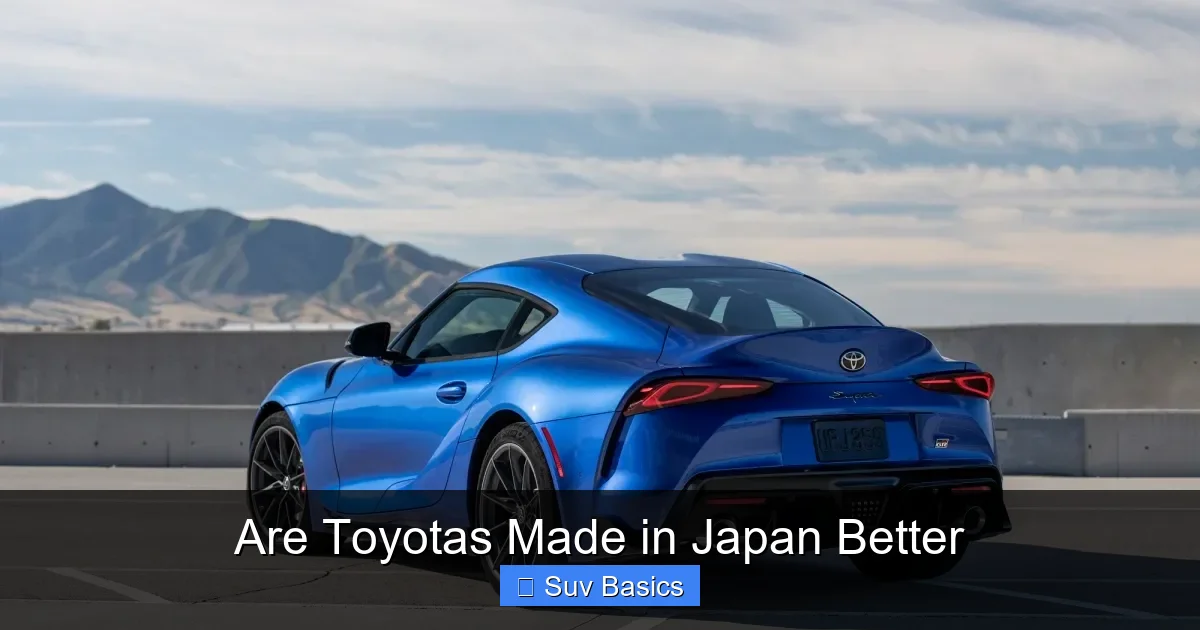
Many car buyers believe Toyotas made in Japan are superior due to stricter quality control and craftsmanship. While Japanese-built models often feature premium materials and precision engineering, the difference may not be as dramatic as some think—especially with Toyota’s global manufacturing standards improving.
Key Takeaways
- Japanese-built Toyotas often have tighter quality control: Factories in Japan follow rigorous production standards, leading to fewer defects and higher attention to detail.
- Perceived craftsmanship and materials matter: Some models made in Japan use higher-grade interior materials and offer smoother finishes, especially in luxury trims.
- Not all “Japan-made” Toyotas are equal: Assembly location doesn’t always determine quality—trim level, model year, and production line play bigger roles.
- Global Toyota plants now match Japanese standards: Facilities in the U.S., Thailand, and Canada have adopted similar processes, narrowing the quality gap.
- Resale value can be slightly higher for Japan-built models: Enthusiasts and collectors often prefer vehicles assembled in Japan, boosting demand and resale prices.
- Warranty and reliability are consistent worldwide: Toyota’s reputation for durability holds across regions, regardless of where the vehicle was built.
- Check the VIN to verify origin: The first character in your Vehicle Identification Number reveals where your Toyota was manufactured.
📑 Table of Contents
- Are Toyotas Made in Japan Better? The Truth Behind the Hype
- The Legacy of Japanese Manufacturing Excellence
- How Global Production Has Changed the Game
- Real-World Differences: What Drivers Actually Notice
- Resale Value and Collector Appeal
- How to Tell Where Your Toyota Was Made
- Should You Prioritize a Japan-Made Toyota?
- Final Thoughts: Quality Over Origin
Are Toyotas Made in Japan Better? The Truth Behind the Hype
When shopping for a Toyota SUV—whether it’s a RAV4, Highlander, or 4Runner—you might come across the phrase “Made in Japan” and wonder: does that really make a difference? For decades, Japanese engineering has been synonymous with reliability, precision, and longevity. And Toyota, as Japan’s largest automaker, has built a global reputation on those values. But does building a car in Japan automatically make it better than one assembled in the U.S., Mexico, or Thailand?
It’s a question that sparks debate among car enthusiasts, mechanics, and everyday drivers alike. Some swear by the superior build quality of Japan-made Toyotas, while others argue that modern manufacturing has leveled the playing field. The truth lies somewhere in between—and it’s worth exploring what “Made in Japan” really means in today’s global automotive landscape.
The Legacy of Japanese Manufacturing Excellence

Visual guide about Are Toyotas Made in Japan Better
Image source: garagedreams.net
Japan has long been a leader in automotive innovation, thanks in large part to the Toyota Production System (TPS). This revolutionary approach to manufacturing emphasizes efficiency, waste reduction, and continuous improvement—principles that have been adopted worldwide. Japanese factories are known for their meticulous attention to detail, worker training, and strict quality control measures.
In Japan, assembly line workers often have more autonomy to stop production if they spot a defect. This “andon cord” system ensures problems are addressed immediately, rather than passed down the line. Additionally, Japanese plants tend to use more hand-finishing and manual inspections, especially on higher-end models. This human touch can result in tighter panel gaps, quieter cabins, and a more refined overall feel.
For example, the Toyota Land Cruiser and Lexus LX—luxury SUVs with global appeal—are primarily built in Japan. Owners often praise their solid construction, smooth ride, and premium interior materials. These vehicles are seen as benchmarks for durability and refinement, reinforcing the idea that Japan-made equals higher quality.
How Global Production Has Changed the Game
While Japanese factories set the gold standard, Toyota has invested heavily in replicating those processes around the world. Plants in the United States—like the one in Georgetown, Kentucky, which builds the Camry and RAV4—now operate with similar efficiency and quality control. In fact, many of these facilities have received awards for productivity and defect reduction.
Toyota’s global strategy focuses on “local production for local markets,” which reduces shipping costs and supports regional economies. But it also means that a RAV4 sold in California might be built in Texas, while the same model sold in Australia could come from Japan. So, does the origin really affect performance or longevity?
According to Toyota’s own data, the difference in defect rates between Japanese and overseas plants has narrowed significantly over the past decade. Modern robotics, standardized parts, and rigorous training programs have helped overseas factories match—or even exceed—Japanese output in some metrics. For instance, the Indiana plant that builds the Highlander has consistently ranked among Toyota’s top-performing facilities for quality.
Real-World Differences: What Drivers Actually Notice
So, if the factories are so similar, why do some drivers still prefer Japan-made Toyotas? The answer often comes down to perception and subtle differences in materials and assembly.
Interior Quality and Fit-and-Finish
One area where Japan-built models sometimes stand out is interior craftsmanship. Owners of Japan-made Priuses or C-HRs often report softer-touch plastics, better-aligned trim pieces, and quieter cabins. These small details can make a big difference in daily driving comfort, especially on long trips.
For example, a 2022 Toyota RAV4 assembled in Japan might have slightly tighter door seals and less wind noise at highway speeds compared to its U.S.-built counterpart. While the difference isn’t drastic, it’s noticeable to those who prioritize a premium driving experience.
Paint and Exterior Detailing
Another common observation is the quality of paint and exterior finishes. Japanese factories often use more layers of paint and perform additional hand-buffing, resulting in a deeper, more durable shine. This can be especially important in regions with harsh weather or frequent sun exposure.
Additionally, some buyers report fewer paint chips or scratches on Japan-made models, possibly due to more careful handling during assembly and shipping.
Mechanical Consistency
Mechanically, both Japanese and overseas-built Toyotas use the same engines, transmissions, and suspension components. However, some mechanics note that Japan-assembled engines may have slightly tighter tolerances or more consistent calibration. This could contribute to smoother idle quality or more responsive throttle input—though these differences are often minor and hard to quantify.
Resale Value and Collector Appeal
One tangible benefit of Japan-made Toyotas is their stronger resale value, particularly among enthusiasts. Vehicles like the Toyota 4Runner, Supra, or GR Yaris—especially limited editions—often command higher prices when they’re confirmed to be built in Japan.
Car forums and resale platforms frequently highlight “Japan Domestic Market” (JDM) models as more desirable. This isn’t just about quality—it’s also about heritage and exclusivity. For collectors, a Japan-built vehicle carries a certain cachet that can translate into better long-term value.
Even mainstream SUVs like the RAV4 see a slight premium when sold as Japan-made, especially in markets like Australia, New Zealand, and parts of Southeast Asia where Japanese manufacturing is highly respected.
How to Tell Where Your Toyota Was Made
Curious whether your Toyota was built in Japan? The easiest way to find out is by checking your Vehicle Identification Number (VIN). The first character of the VIN indicates the country of manufacture:
- J: Japan
- 1, 4, or 5: United States
- 2: Canada
- 3: Mexico
- K: South Korea
- L: China
- T: Thailand
For example, a VIN starting with “JTE” means your Toyota was made in Japan. You can decode your full VIN using free online tools or by contacting Toyota customer service.
Keep in mind that even if your SUV was assembled in the U.S., many of its components—like the engine or transmission—may still be sourced from Japan. Toyota maintains a global supply chain, so “Made in Japan” doesn’t always mean 100% Japanese parts.
Should You Prioritize a Japan-Made Toyota?
Ultimately, the decision comes down to your priorities. If you’re buying a Toyota for its legendary reliability, fuel efficiency, or family-friendly features, the assembly location may not matter much. Toyota’s global reputation for durability holds strong, regardless of where the vehicle was built.
However, if you’re a detail-oriented buyer who values craftsmanship, resale value, or the prestige of owning a Japan-made vehicle, it’s worth seeking out models assembled in Japan. This is especially true for older or enthusiast-focused models like the 4Runner, Land Cruiser, or GR Corolla.
That said, don’t overlook excellent vehicles built elsewhere. A U.S.-built Highlander or a Thai-made Fortuner can offer the same reliability, safety, and performance as their Japanese counterparts—often at a lower price due to reduced import costs.
Final Thoughts: Quality Over Origin
The idea that “Made in Japan” automatically means better is a myth that’s slowly fading. While Japanese factories still set a high bar for quality and precision, Toyota’s global operations have caught up in meaningful ways. Today’s Toyotas—no matter where they’re built—are engineered to last, perform well, and deliver value.
Instead of focusing solely on origin, consider factors like model year, trim level, maintenance history, and your personal driving needs. A well-maintained U.S.-built RAV4 can outlast a neglected Japan-made one. And with Toyota’s strong warranty and widespread service network, you’re covered no matter where your SUV calls home.
In the end, the best Toyota is the one that fits your lifestyle, budget, and expectations—not necessarily the one with a “J” in the VIN.
Frequently Asked Questions
Are all Toyotas made in Japan more reliable?
Not necessarily. While Japanese-built Toyotas often have tighter quality control, modern global plants now meet similar standards. Reliability depends more on maintenance and model design than assembly location.
How can I tell if my Toyota SUV was made in Japan?
Check the first character of your VIN. If it starts with “J,” your vehicle was manufactured in Japan. You can use free online VIN decoders to confirm the full details.
Do Japan-made Toyotas have better resale value?
Generally, yes—especially for enthusiast models like the 4Runner or GR Yaris. Buyers often pay a premium for Japan-built vehicles due to perceived quality and heritage.
Are parts different in Japan-made vs. U.S.-made Toyotas?
Most parts are the same, but some interior materials or trim details may vary slightly. Mechanical components like engines and transmissions are typically identical across regions.
Is it worth paying extra for a Japan-made Toyota?
It depends on your priorities. If craftsmanship and resale value matter to you, it may be worth it. For most buyers, however, the difference isn’t significant enough to justify a higher price.
Do Japan-made Toyotas have fewer recalls?
Not consistently. Recall rates are influenced by design flaws and supplier issues, not just assembly location. Both Japanese and overseas-built Toyotas are subject to the same safety standards and recall processes.