
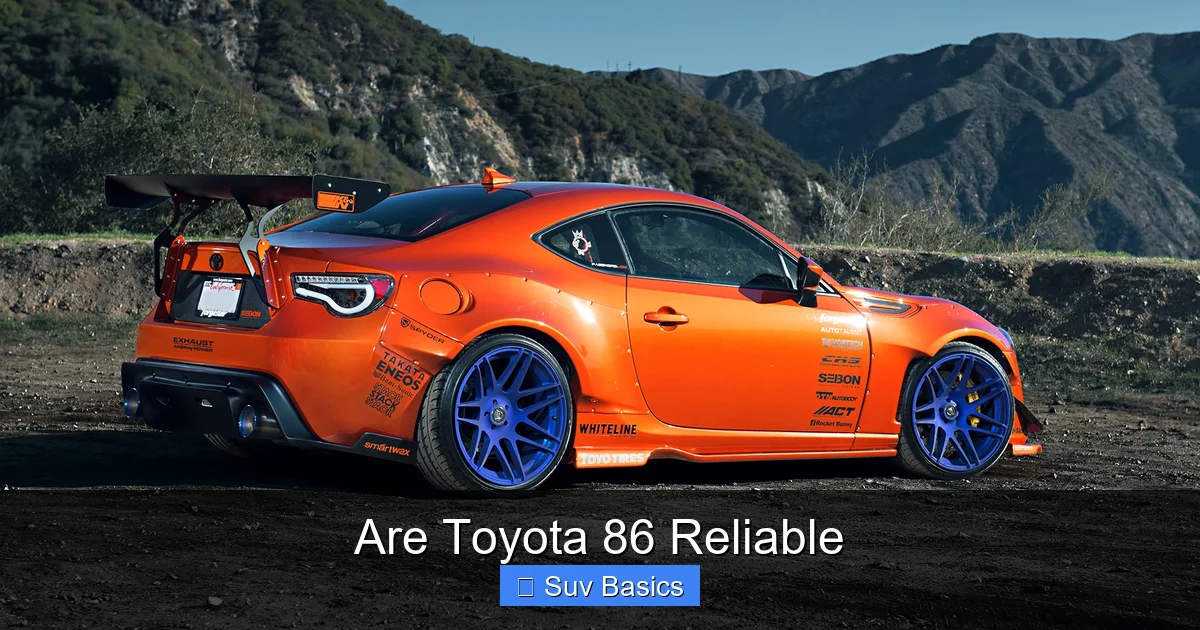
The Toyota 86 is widely regarded as a reliable sports car, especially when properly maintained. With a simple mechanical design, strong owner satisfaction, and low repair frequency, it delivers dependable performance for daily driving and weekend fun alike.
If you’re also curious about how SUVs differ from sports cars, you can explore our guide on what defines an SUV.
Key Takeaways
- Solid Build Quality: The Toyota 86 features a lightweight chassis and durable components designed for performance and longevity.
- Low Maintenance Costs: Routine upkeep is affordable, and major repairs are rare when following the recommended service schedule.
- Proven Powertrain: The 2.0L flat-four boxer engine is simple, reliable, and well-tested in both Toyota and Subaru models.
- Strong Owner Satisfaction: Enthusiasts praise its driving dynamics and reliability, with many reporting trouble-free ownership over 100,000 miles.
- Common Issues Are Minor: Known problems like exhaust leaks or clutch wear are typically easy and inexpensive to fix.
- Great for Modding: Its reliability makes it a favorite among tuners who upgrade engines and suspensions without sacrificing dependability.
- Resale Value Holds Well: High demand and strong reputation help the Toyota 86 retain value better than many rivals.
📑 Table of Contents
- Are Toyota 86 Reliable? A Deep Dive into Long-Term Dependability
- Engine and Drivetrain: Built for Simplicity and Strength
- Common Issues and How to Avoid Them
- Maintenance and Ownership Costs
- Owner Experiences and Long-Term Reliability
- Resale Value and Market Demand
- Conclusion: Is the Toyota 86 Right for You?
To see how SUVs have evolved over the decades, check out our detailed history of SUVs.
Are Toyota 86 Reliable? A Deep Dive into Long-Term Dependability
If you’re in the market for a fun, affordable sports car that won’t leave you stranded, the Toyota 86 deserves serious consideration. Launched in 2012 as a joint project between Toyota and Subaru (where it’s sold as the BRZ), the 86 was built to deliver an engaging driving experience without the complexity or high maintenance costs of exotic machinery. But beyond the smiles per gallon and rear-wheel-drive thrills, one question keeps coming up: Are Toyota 86 reliable?
The short answer? Yes—especially if you treat it right. Over a decade on the market, the Toyota 86 has earned a solid reputation for reliability among drivers, mechanics, and automotive reviewers. It’s not perfect, but its strengths far outweigh its flaws. With proper care, many owners report driving their 86s well past 150,000 miles with only routine maintenance. Whether you’re commuting to work, hitting mountain roads on weekends, or even tracking it at the local circuit, the 86 proves that performance and dependability can go hand in hand.
Engine and Drivetrain: Built for Simplicity and Strength
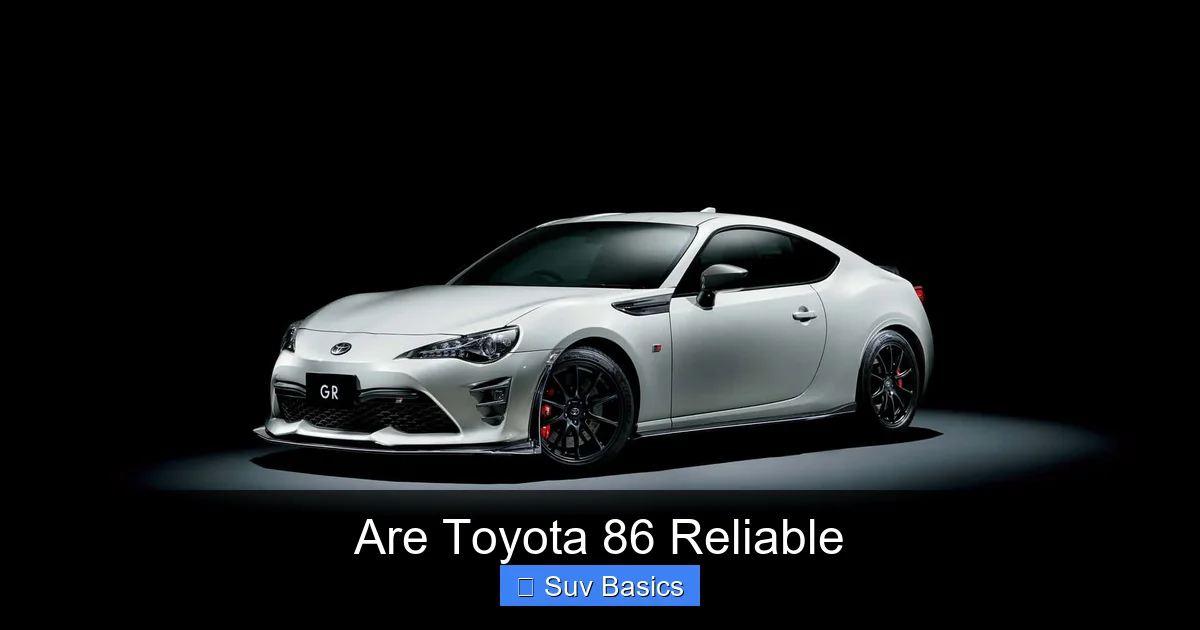
Visual guide about Are Toyota 86 Reliable
Image source: wallpapers.com
At the heart of the Toyota 86 is a 2.0-liter naturally aspirated flat-four boxer engine, co-developed with Subaru. This engine, known internally as the FA20, is a gem of mechanical simplicity. Unlike turbocharged or high-strung performance engines, the FA20 runs cool, has fewer components, and doesn’t rely on forced induction—factors that contribute significantly to its long-term reliability.
Why the Boxer Engine Shines
The horizontally opposed layout of the boxer engine lowers the car’s center of gravity, improving handling. But it also means balanced operation with less vibration, reducing stress on internal parts. The FA20 produces around 200 horsepower—not mind-blowing by modern standards, but more than enough for spirited driving. What it lacks in brute force, it makes up for in responsiveness and smoothness.
Owners consistently report that the engine runs strong even after years of use. Regular oil changes every 5,000 to 7,500 miles, using the recommended 0W-20 synthetic oil, keep things running smoothly. There are no major recalls or widespread engine failures tied to the FA20, which is a strong indicator of its durability.
Transmission and Drivetrain Reliability
The Toyota 86 comes with either a 6-speed manual or a 6-speed automatic transmission. The manual is a favorite among driving purists—and it’s also the more reliable option. With fewer electronic components and no torque converter, the manual gearbox is less prone to failure. That said, the automatic (with paddle shifters) is also solid, though some owners note minor issues with shift solenoids over very high mileage.
The rear-wheel-drive layout and limited-slip differential (on most trims) add to the car’s dynamic appeal without introducing complex systems that could fail. The drivetrain is straightforward: engine → transmission → driveshaft → rear differential → wheels. Fewer parts mean fewer things to go wrong.
Common Issues and How to Avoid Them
No car is completely problem-free, and the Toyota 86 is no exception. However, the issues it does have are generally minor, inexpensive to fix, and easy to prevent with regular maintenance.
Exhaust Manifold Leaks
One of the most commonly reported issues is a leaking exhaust manifold, especially on earlier models (2013–2016). The symptoms include a ticking or tapping noise at idle that disappears as the engine warms up. This is caused by warping of the manifold due to heat cycling. The fix involves replacing the manifold gaskets or, in some cases, upgrading to a reinforced manifold.
The good news? This issue is well-documented, and many owners have resolved it under warranty or with a straightforward repair costing $300–$600. Regular coolant checks and avoiding overheating can help prevent it.
Clutch Wear (Manual Models)
Because the Toyota 86 is often driven enthusiastically—especially by new owners learning to heel-and-toe or launch control—the clutch can wear out faster than in a typical commuter car. Slipping under hard acceleration or a burning smell are signs it’s time for a replacement.
Replacing the clutch typically costs $800–$1,200, depending on labor rates. To extend clutch life, avoid riding the clutch, minimize aggressive launches, and service it every 30,000–50,000 miles if you drive hard.
Suspension and Bushings
The 86’s sport-tuned suspension delivers sharp handling, but the stiffer components can wear out faster than those on softer cars. Rear trailing arm bushings and front control arm bushings may need replacement around 80,000–100,000 miles, especially if you drive on rough roads or track the car.
Inspecting suspension components during oil changes and replacing worn bushings early can prevent noise, poor alignment, and uneven tire wear.
Maintenance and Ownership Costs
One of the biggest advantages of the Toyota 86 is its low cost of ownership. It’s not just reliable—it’s also cheap to maintain compared to other sports cars.
Routine Maintenance Is Simple
The maintenance schedule is straightforward: oil changes, tire rotations, brake inspections, and fluid top-offs. There’s no turbo to worry about, no complex all-wheel-drive system, and no hybrid battery to replace. Toyota recommends oil changes every 7,500 miles under normal driving conditions, but many owners (and mechanics) suggest every 5,000 miles if you drive aggressively or in hot climates.
Affordable Parts and Labor
Because the 86 shares many components with the Subaru BRZ and other Toyota models, parts are widely available and reasonably priced. A full set of brake pads might cost $150, and a new set of tires (like Michelin Pilot Sport 4s) runs about $600–$800. Even performance upgrades—like coilovers or cold air intakes—are budget-friendly and don’t typically compromise reliability if installed correctly.
Insurance and Fuel Economy
Insurance costs are moderate for a sports car, especially if you have a clean driving record. The 86 isn’t classified as a high-risk vehicle, so premiums are lower than for cars like the Ford Mustang or Nissan 370Z. Fuel economy is also a plus: expect 22–28 mpg combined, depending on driving style. That’s excellent for a rear-wheel-drive coupe with a manual transmission.
If you’re interested in family-friendly options, our list of the top 5 luxury SUVs of 2024 might be worth a look.
Owner Experiences and Long-Term Reliability
Real-world feedback from Toyota 86 owners paints a positive picture of long-term reliability. Online forums like Reddit’s r/Toyota86, BRZForum, and Toyota Nation are filled with stories of high-mileage, trouble-free ownership.
High-Mileage Success Stories
Many owners report driving their 86s past 100,000 miles with only routine maintenance. One owner on a popular forum shared that his 2014 86 hit 140,000 miles with no major repairs—just oil changes, tires, and brakes. Another mentioned using his 86 as a daily driver for five years, including winter commutes in snowy climates, with zero engine or transmission issues.
Track Use and Reliability
The 86 is a favorite among amateur track day enthusiasts. Its lightweight design, balanced chassis, and predictable handling make it ideal for learning performance driving. And because it’s mechanically simple, it holds up well under repeated hard use—provided you monitor fluids, brakes, and tires.
That said, track use does increase wear. Owners who track their 86s regularly often upgrade cooling systems, use high-performance brake fluid, and change oil more frequently. But even with these precautions, the core reliability of the car remains intact.
Resale Value and Market Demand
Reliability directly impacts resale value, and the Toyota 86 scores well here too. Despite being out of production since 2020 (replaced by the GR86), used 86s hold their value remarkably well. According to Kelley Blue Book and Edmunds, a well-maintained 2017 Toyota 86 with 60,000 miles can still fetch $18,000–$22,000, depending on trim and condition.
Why It Holds Value
Several factors contribute to strong resale value:
– Limited production numbers compared to mainstream sedans
– High demand from driving enthusiasts
– Strong reputation for reliability and fun-to-drive dynamics
– Compatibility with aftermarket parts and mods
This makes the 86 a smart buy not just for enjoyment, but also as a relatively stable investment in the used car market.
Conclusion: Is the Toyota 86 Right for You?
So, are Toyota 86 reliable? The evidence says yes. With a proven engine, simple drivetrain, and low maintenance needs, the 86 delivers dependable performance year after year. It’s not a luxury cruiser or a family hauler—it’s a driver’s car built for engagement, and it excels at that role without sacrificing reliability.
If you’re looking for a sporty, affordable coupe that won’t break the bank to own or repair, the Toyota 86 is one of the best choices in its class. Just remember: like any performance car, it rewards responsible ownership. Follow the maintenance schedule, drive it with care (or enthusiasm, within reason), and it will reward you with years of smiles behind the wheel.
Whether you’re a first-time sports car buyer or a seasoned enthusiast, the Toyota 86 proves that reliability and driving fun don’t have to be mutually exclusive.
Frequently Asked Questions
Is the Toyota 86 expensive to maintain?
No, the Toyota 86 is relatively affordable to maintain. Routine services like oil changes, brake pads, and tires are reasonably priced, and major repairs are uncommon when the car is properly cared for.
How long does the Toyota 86 engine last?
With proper maintenance, the FA20 boxer engine can easily last 150,000 to 200,000 miles. Many owners report trouble-free operation well beyond 100,000 miles.
Are there any major recalls on the Toyota 86?
There have been a few minor recalls related to airbags and fuel pumps, but no widespread mechanical failures. Most issues are minor and easily addressed.
Can I daily drive a Toyota 86?
Yes, many owners use the 86 as a daily driver. It’s reliable, fuel-efficient, and comfortable enough for commuting, though rear seat space is limited.
Is the Toyota 86 reliable for track use?
Yes, but track use increases wear. Regular fluid changes, brake inspections, and cooling system checks are recommended to maintain reliability under hard driving.
Does the Toyota 86 have good resale value?
Yes, the 86 holds its value well due to high demand, limited production, and strong owner satisfaction. It depreciates slower than many other sports cars.