
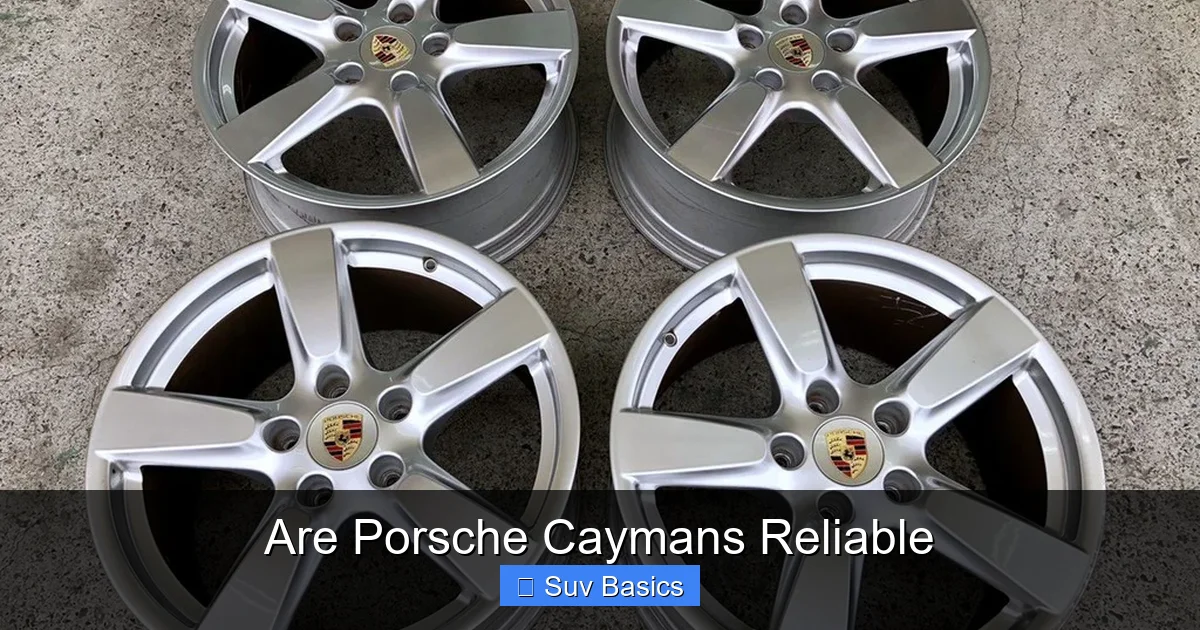
The Porsche Cayman is generally considered a reliable sports car, especially when properly maintained. While it outperforms many rivals in build quality and driving dynamics, certain model years and components require attention to ensure long-term dependability.
Key Takeaways
- Overall Reliability: The Porsche Cayman ranks above average for sports cars, with strong engineering and durable construction when maintained correctly.
- Engine Performance: Mid-engine flat-six and flat-four engines are robust, but early 987 and 718 models may face IMS bearing or turbocharger concerns.
- Maintenance Matters: Regular servicing at authorized centers or trusted specialists significantly boosts longevity and resale value.
- Common Issues: Watch for intermediate shaft (IMS) bearing wear in older models, clutch wear in manual transmissions, and minor electrical glitches.
- Model Year Differences: 987 (2006–2012) and 981 (2013–2016) generations are more proven; 718 (2016–present) offers modern tech but newer turbo engines need monitoring.
- Owner Satisfaction: Enthusiasts praise the Cayman’s balance, handling, and daily usability—making it a rewarding long-term ownership choice.
- Cost of Ownership: Higher than average maintenance and repair costs, but justified by performance and driving experience when budgeted for.
📑 Table of Contents
- Are Porsche Caymans Reliable? A Deep Dive into Performance and Longevity
- Understanding the Porsche Cayman Lineup
- Engine Reliability: The Heart of the Matter
- Transmission and Drivetrain: Smooth Shifts and Solid Grip
- Common Issues and How to Avoid Them
- Ownership Costs and Long-Term Value
- Owner Experiences: Real Stories from the Road
- Conclusion: Is the Porsche Cayman Right for You?
If you’re also exploring other vehicle types, check out our comprehensive SUVs Explained: Your Guide to Sport Utility Vehicles.
Are Porsche Caymans Reliable? A Deep Dive into Performance and Longevity
When you think of a Porsche, images of precision engineering, sleek design, and heart-pounding acceleration likely come to mind. Among the brand’s lineup, the Porsche Cayman stands out as a driver-focused sports car that blends everyday usability with track-ready performance. But beyond the adrenaline and prestige, one practical question looms for potential buyers: Are Porsche Caymans reliable?
Unlike SUVs or family sedans, sports cars often face skepticism about long-term dependability. High-performance engines, tight tolerances, and aggressive driving can take a toll. Yet, the Cayman has earned a reputation—not just for thrills, but for resilience. With proper care, many Caymans log well over 100,000 miles without major failures. Of course, like any complex machine, they’re not immune to issues. Understanding what to expect can help you enjoy the ride without constant worry.
Understanding the Porsche Cayman Lineup

Visual guide about Are Porsche Caymans Reliable
Image source: supercars.net
For readers interested in utility vehicles, see our article on From Rugged All-Terrain to Family Favorite: A History of SUVs.
Before diving into reliability, it helps to know which Cayman we’re talking about. The Cayman has evolved through three main generations, each with distinct characteristics.
The 987 Generation (2006–2012)
The original Cayman, based on the Boxster, introduced the mid-engine layout that defines the model. Powered by naturally aspirated flat-six engines (2.7L and 3.4L), the 987 is beloved for its analog feel and balanced handling. These early models are now affordable on the used market, making them popular among enthusiasts.
The 981 Generation (2013–2016)
The second generation brought a complete redesign—sharper styling, improved interiors, and more powerful engines. The 981 retained the flat-six but introduced a 2.7L and 3.4L option, with the Cayman S and Cayman GTS offering even more punch. This era also saw the debut of the Cayman GT4, a track-focused variant praised for its purity.
The 718 Generation (2016–Present)
In 2016, Porsche controversially switched to turbocharged flat-four engines (2.0L and 2.5L) to meet emissions standards. While purists missed the flat-six’s sound, the 718 delivered impressive power and efficiency. The 718 also introduced advanced tech, including Porsche Communication Management (PCM) and optional adaptive suspension.
Each generation has its strengths and potential weak points—so reliability can vary by model year and engine type.
Engine Reliability: The Heart of the Matter
The engine is where many reliability concerns begin. Let’s break down the key powertrains.
Flat-Six Engines (987 and 981)
The naturally aspirated flat-six engines in the 987 and 981 are generally reliable, especially when maintained. However, one notorious issue looms: the intermediate shaft (IMS) bearing. In early 987 models (2006–2008), the IMS bearing could fail prematurely, leading to catastrophic engine damage. Porsche addressed this in later models with improved bearings, but it remains a concern for pre-2009 cars.
That said, many owners report trouble-free operation past 100,000 miles. Regular oil changes, using high-quality synthetic oil, and avoiding prolonged high-RPM driving can extend engine life.
Turbocharged Flat-Four Engines (718)
The 718’s turbocharged engines are newer and more efficient, but they come with their own considerations. While turbochargers add power, they also introduce heat and complexity. Some early 718 owners reported turbocharger wastegate rattle or boost pressure issues, though these are often resolved under warranty.
Additionally, the direct-injection system can lead to carbon buildup on intake valves over time—a common issue in turbo engines. Regular maintenance, including fuel system cleanings and using top-tier fuel, can mitigate this.
Real-World Examples
Take John, a 981 Cayman S owner from Texas. He’s driven his car over 85,000 miles with only routine maintenance—oil changes every 7,500 miles, brake fluid flushes, and tire rotations. “It’s been flawless,” he says. “I treat it like a daily driver, and it’s never left me stranded.”
On the other hand, Sarah, who owned a 2007 Cayman S, faced an IMS bearing failure at 68,000 miles. “It was expensive,” she admits, “but I should’ve done the IMS upgrade sooner.” Her story highlights the importance of proactive maintenance.
Transmission and Drivetrain: Smooth Shifts and Solid Grip
The Cayman offers both manual and automatic (PDK) transmissions, each with its own reliability profile.
Manual Transmission
The six-speed manual is a joy to use—precise, engaging, and durable. However, clutch wear can be an issue, especially if the car is driven aggressively or in heavy traffic. Expect to replace the clutch every 60,000 to 80,000 miles, depending on driving style. Upgrading to a lightweight flywheel or performance clutch can improve feel and longevity.
PDK Dual-Clutch Transmission
Porsche’s PDK is one of the best automatics on the market. It’s fast, smooth, and built to handle high torque. Reliability is excellent, with many PDK units lasting over 150,000 miles with proper fluid changes. The key is adhering to Porsche’s service schedule—typically every 40,000 miles for fluid and filter replacement.
One tip: Avoid “riding the clutch” in stop-and-go traffic. Let the PDK do its job—it’s designed for it.
Drivetrain and AWD (Cayman 4)
Most Caymans are rear-wheel drive, but the Cayman 4 and 4S models offer all-wheel drive. The AWD system is robust and rarely problematic, though it adds weight and complexity. Regular inspection of driveshafts, differentials, and CV joints is recommended, especially in colder climates where road salt can accelerate wear.
Common Issues and How to Avoid Them
No car is perfect, and the Cayman has a few known quirks.
Electrical Glitches
Some owners report minor electrical issues—faulty window switches, infotainment system freezes, or sensor errors. These are usually software-related and can often be fixed with a software update at a Porsche center. Keeping the PCM system updated is a simple preventive step.
Suspension and Steering
The Cayman’s suspension is tuned for performance, which means stiffer components that can wear faster. Worn control arm bushings, strut mounts, or ball joints may cause clunking or uneven tire wear. Regular inspections during oil changes can catch these early.
Brake Wear
Performance brakes are great—until they wear out. The Cayman’s brakes are strong but can wear quickly if driven hard. Expect to replace pads every 20,000 to 30,000 miles and rotors every 40,000 to 60,000. Using high-quality brake fluid and bleeding the system every two years helps maintain performance.
Tips for Preventing Problems
- Use only Porsche-approved parts and fluids.
- Keep up with scheduled maintenance—don’t skip services.
- Warm up the engine gently before hard driving.
- Avoid short trips that don’t allow the engine to reach optimal temperature.
- Store the car in a garage to protect from extreme weather.
Ownership Costs and Long-Term Value
Reliability isn’t just about breakdowns—it’s also about cost. The Cayman is more expensive to maintain than a Toyota or Honda, but it’s competitive among luxury sports cars.
Maintenance and Repairs
Annual maintenance can range from $800 to $1,500, depending on mileage and model. Major services (every 30,000 or 40,000 miles) may cost $1,000–$2,000. Repairs can be pricey—IMS bearing replacement, for example, can run $5,000–$8,000 if not covered by warranty.
Depreciation and Resale
The Cayman holds its value well, especially well-maintained examples. The 981 and 718 generations have seen strong resale demand, with GT4 and Spyder models appreciating in some cases. A documented service history significantly boosts resale value.
Insurance and Fuel
Insurance is higher than average due to the car’s performance nature. Fuel economy is decent for a sports car—expect 20–25 mpg combined, depending on driving style.
Owner Experiences: Real Stories from the Road
Many owners also appreciate the versatility of SUVs for family trips; learn more in our Top Luxury SUVs Compared: Find Your Perfect Match.
Enthusiast Communities
Forums like Rennlist and Pelican Parts are filled with Cayman owners sharing tips and experiences. Many report 100,000+ mile journeys with only routine maintenance. Common themes include the importance of oil changes, avoiding cheap parts, and driving the car regularly to keep systems healthy.
Professional Mechanics’ Views
Independent Porsche specialists often say the Cayman is one of the more reliable Porsches, especially compared to the 911 of the same era. “It’s simpler, less complex, and built to last,” says Mark, a technician with 15 years of experience. “Just don’t neglect it.”
Conclusion: Is the Porsche Cayman Right for You?
So, are Porsche Caymans reliable? The answer is a qualified yes. With proper maintenance, attention to known issues, and realistic expectations, the Cayman can be a dependable and thrilling long-term companion. It’s not a Toyota Camry—it demands care and respect—but for those who love driving, it’s one of the most rewarding sports cars you can own.
Whether you’re eyeing a used 987 for weekend fun or a newer 718 for daily driving, the Cayman delivers a unique blend of performance, precision, and pride. Just remember: reliability starts with you. Stay on top of maintenance, listen to your car, and enjoy every mile.
Frequently Asked Questions
Are Porsche Caymans expensive to maintain?
Yes, maintenance costs are higher than average due to specialized parts and labor. However, they’re in line with other luxury sports cars. Budget $1,000–$1,500 annually for routine care.
Which Cayman model year is the most reliable?
The 981 generation (2013–2016) is often considered the sweet spot—proven reliability, strong engines, and modern features without the turbo complexities of the 718.
Do all Caymans have IMS bearing issues?
No. Only early 987 models (2006–2008) are at higher risk. Later 987s and all 981/718 models have improved IMS designs or different engine layouts.
Can a Porsche Cayman be a daily driver?
Absolutely. Many owners use their Caymans daily. The ride is firm but manageable, and fuel economy is reasonable for a sports car.
How long do Porsche Cayman engines last?
With proper maintenance, Cayman engines can easily exceed 100,000 miles. Some well-cared-for examples reach 150,000+ miles without major issues.
Is the 718 Cayman less reliable than older models?
Not necessarily. The 718’s turbo engines are newer and have fewer known issues than early 987 IMS concerns. However, long-term data is still limited compared to older generations.