
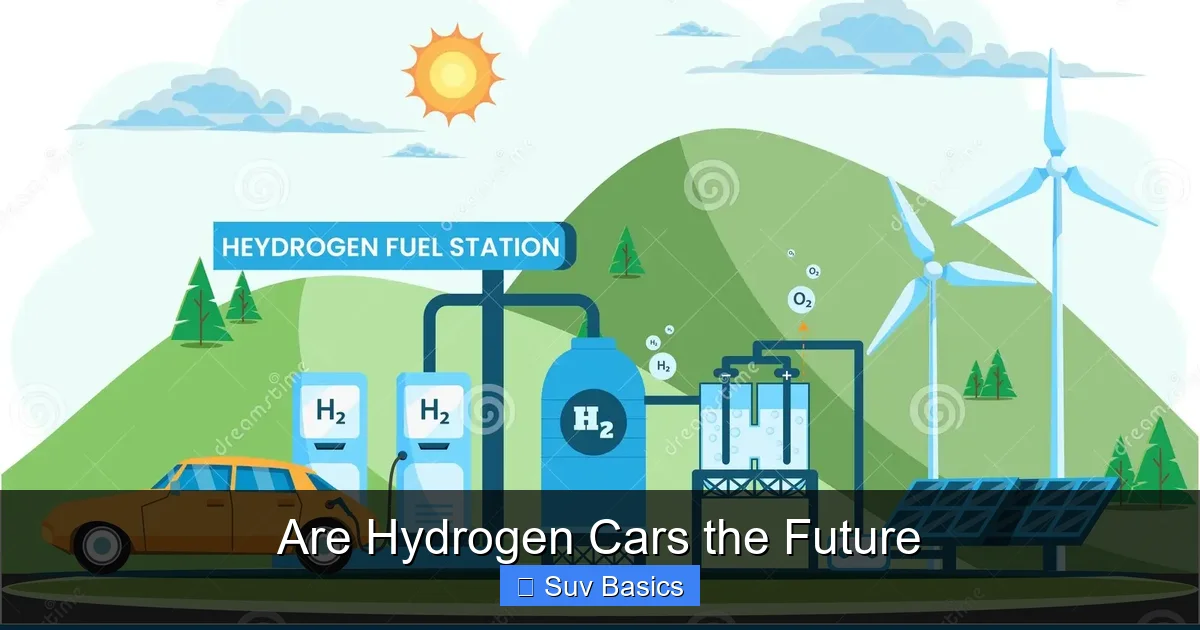
Hydrogen cars offer zero emissions and fast refueling, but face challenges like limited infrastructure and high costs. While promising, they’re not yet ready to replace electric or gas-powered SUVs for most drivers.
Key Takeaways
- Zero tailpipe emissions: Hydrogen cars only emit water vapor, making them environmentally friendly during operation.
- Fast refueling: Unlike battery EVs, hydrogen vehicles can be refueled in under 10 minutes, similar to gasoline cars.
- Limited infrastructure: There are fewer than 100 hydrogen refueling stations in the U.S., mostly in California.
- High production and vehicle costs: Green hydrogen is expensive to produce, and hydrogen SUVs cost significantly more than comparable EVs.
- Efficiency concerns: Hydrogen production and conversion lose more energy than direct battery charging.
- Best for specific use cases: Ideal for long-haul transport or fleet vehicles where quick refueling is essential.
- Still in early adoption phase: Consumer hydrogen SUVs like the Toyota Mirai and Hyundai NEXO remain niche due to practical limitations.
📑 Table of Contents
- Are Hydrogen Cars the Future? A Realistic Look at the Technology
- How Hydrogen Cars Work: The Science Made Simple
- The Environmental Promise of Hydrogen Cars
- Challenges Holding Hydrogen Cars Back
- Where Hydrogen Cars Shine: Niche Applications
- The Future Outlook: Will Hydrogen Cars Take Off?
- Should You Buy a Hydrogen SUV?
- Final Thoughts: A Piece of the Puzzle
Are Hydrogen Cars the Future? A Realistic Look at the Technology
Imagine pulling up to a fuel station, filling your SUV in under five minutes, and driving 300 miles—all while emitting nothing but clean water vapor. Sounds like a dream, right? That’s the promise of hydrogen fuel cell vehicles (FCVs). But despite the hype, hydrogen cars haven’t taken off like electric vehicles (EVs). So, are hydrogen cars the future? Or are they just a futuristic idea stuck in neutral.
Hydrogen cars run on fuel cells that combine hydrogen gas with oxygen from the air to produce electricity, which powers an electric motor. The only byproduct? Water. No carbon dioxide, no smog-forming pollutants. On paper, it’s a clean, efficient solution for reducing transportation emissions. But the real world is more complicated. While hydrogen technology holds promise, several hurdles—infrastructure, cost, efficiency, and scalability—stand in the way of mass adoption.
How Hydrogen Cars Work: The Science Made Simple
Let’s break it down without the jargon. A hydrogen car is essentially an electric vehicle, but instead of relying solely on a large battery, it generates its own electricity on the go.
The Fuel Cell: The Heart of the System
Inside the car is a fuel cell stack—a series of thin plates that look like high-tech sandwiches. Hydrogen gas is pumped into one side, and air (containing oxygen) flows into the other. A catalyst, usually platinum, triggers a chemical reaction that splits hydrogen atoms into protons and electrons. The protons pass through a membrane, while the electrons are forced to travel through an external circuit, creating an electric current. This electricity powers the motor and charges a small buffer battery.
Visual guide about Are Hydrogen Cars the Future
Image source: thumbs.dreamstime.com
Refueling: Quick and Clean
Refueling a hydrogen car is similar to filling up a gas tank. You drive up to a hydrogen pump, connect a nozzle, and in about 3 to 5 minutes, your tank is full. Compare that to the 30 minutes or more it can take to fast-charge an EV to 80%, and it’s easy to see the appeal—especially for long trips or commercial fleets.
Real-World Examples
Today’s hydrogen SUVs include the Toyota Mirai and the Hyundai NEXO. Both offer smooth, quiet rides, impressive range (over 300 miles), and zero emissions. The Mirai, for example, can travel up to 402 miles on a full tank and refuels in under 10 minutes. These vehicles prove that the technology works—but they’re still rare on the road.
The Environmental Promise of Hydrogen Cars
One of the biggest selling points of hydrogen cars is their environmental impact—or lack thereof.
Zero Tailpipe Emissions
When you drive a hydrogen car, the only thing coming out of the exhaust is water vapor. No CO₂, no nitrogen oxides, no particulate matter. For cities struggling with air quality, this is a game-changer. If hydrogen cars replaced gas-powered SUVs, urban smog could drop dramatically.
The Catch: How Is the Hydrogen Made?
Here’s the catch: not all hydrogen is created equal. Currently, over 95% of hydrogen is produced using natural gas in a process called steam methane reforming. This method releases carbon dioxide, undermining the environmental benefits. However, “green hydrogen”—produced using renewable energy to split water molecules via electrolysis—is carbon-free. The challenge? It’s expensive and energy-intensive.
The Bigger Picture
For hydrogen cars to be truly green, the entire supply chain must be clean. That means renewable-powered electrolysis, sustainable hydrogen transport, and widespread adoption of green hydrogen production. Some countries, like Germany and Japan, are investing heavily in this vision. But in the U.S., progress has been slow.
Challenges Holding Hydrogen Cars Back
Despite their potential, hydrogen cars face serious roadblocks.
Limited Refueling Infrastructure
As of 2024, there are fewer than 100 hydrogen refueling stations in the United States—and over 80% are in California. If you live outside the Golden State, finding a place to fill up is nearly impossible. Compare that to over 160,000 gas stations or 60,000 public EV chargers, and the gap is staggering.
High Costs for Vehicles and Fuel
Hydrogen SUVs are expensive. The Toyota Mirai starts around $50,000, and the Hyundai NEXO is even pricier. That’s significantly more than comparable EVs like the Tesla Model Y or Ford Mustang Mach-E. On top of that, hydrogen fuel costs about $16 per kilogram—enough for roughly 60–70 miles of driving. That’s about $0.23 per mile, compared to $0.04–$0.06 per mile for a typical EV.
Energy Efficiency: A Major Drawback
Hydrogen is less efficient than battery EVs. Here’s why: producing hydrogen via electrolysis loses about 30% of the original energy. Compressing, transporting, and storing it loses another 10–15%. Then, converting it back to electricity in the fuel cell loses another 40–50%. In total, only about 25–35% of the original energy makes it to the wheels. In contrast, battery EVs use about 77% of grid energy to power the car.
Storage and Safety Concerns
Hydrogen is the lightest element and highly flammable. It must be stored under high pressure (up to 10,000 psi) in reinforced tanks. While modern hydrogen tanks are rigorously tested and extremely safe, public perception remains a hurdle. Accidents involving hydrogen are rare, but when they happen, they make headlines.
Where Hydrogen Cars Shine: Niche Applications
While hydrogen may not replace EVs for everyday drivers, it excels in specific roles.
Long-Haul Trucking and Fleets
For semi-trucks that drive hundreds of miles a day, quick refueling is critical. A hydrogen-powered truck can refuel in 15–20 minutes and travel 400–600 miles—something battery-electric trucks can’t yet match due to battery weight and charging times. Companies like Nikola and Toyota are testing hydrogen trucks for freight and delivery services.
Public Transit and Buses
Hydrogen buses are already in use in cities like London, Tokyo, and Aberdeen. They offer zero emissions, quiet operation, and fast refueling—perfect for fixed routes. Since buses return to a central depot, building a single hydrogen station is more feasible than installing dozens of chargers. Cities interested in sustainable fleets often look at luxury SUV options for administrative vehicles. luxury SUV options
Remote or High-Use Areas
In regions with limited electricity infrastructure or extreme cold (where EV batteries lose efficiency), hydrogen could be a better fit. For example, mining operations in remote areas are exploring hydrogen-powered equipment to reduce diesel dependence.
The Future Outlook: Will Hydrogen Cars Take Off?
So, are hydrogen cars the future? The answer isn’t a simple yes or no.
Government and Industry Support
Governments are starting to invest. The U.S. Department of Energy has launched the “Hydrogen Shot” initiative, aiming to cut the cost of clean hydrogen to $1 per kilogram within a decade. The European Union and Japan have similar plans. Automakers like Toyota, Hyundai, and BMW continue to develop hydrogen models, signaling long-term commitment.
Technological Advances on the Horizon
Researchers are working on cheaper catalysts (to replace expensive platinum), more efficient fuel cells, and better storage methods. Solid-state hydrogen storage and ammonia-based delivery systems could make hydrogen safer and easier to transport.
A Complementary, Not Replacement, Technology
Most experts believe hydrogen won’t replace battery EVs for passenger cars. Instead, it will complement them. EVs are ideal for city driving, short commutes, and home charging. Hydrogen shines in heavy transport, long-distance travel, and industrial use. Think of it like renewable energy: solar and wind don’t compete—they work together.
Consumer Adoption: Still a Long Road
For now, hydrogen cars remain a niche choice. Limited stations, high costs, and lack of model variety keep them off most buyers’ radars. But as infrastructure grows and green hydrogen becomes cheaper, that could change—especially in regions with strong policy support.
Should You Buy a Hydrogen SUV?
If you’re shopping for a new SUV, should you consider hydrogen? Probably not—yet.
Who Might Benefit?
Hydrogen SUVs make sense if you:
- Live in California (where most stations are)
- Need long range and fast refueling
- Want zero emissions and can afford the premium
- Have access to employer or government fueling programs
Who Should Wait?
Most drivers will be better served by a battery EV or hybrid. For instance, many owners look for crossover SUV hybrids because they offer a balance of efficiency and range. EVs are cheaper to run, have rapidly expanding charging networks, and benefit from falling battery prices. Plus, home charging means you rarely need public stations.
A Practical Tip
If you’re curious, try a hydrogen car through a rental or demo program. Toyota and Hyundai often offer test drives or lease deals in California. Experience the quiet ride and quick fill-up firsthand—but also note how hard it is to find a station outside major cities.
Final Thoughts: A Piece of the Puzzle
Hydrogen cars aren’t the future—at least not the *only* future. But they could be an important part of it. For certain applications—like trucks, buses, and industrial equipment—hydrogen offers a clean, efficient solution that batteries can’t yet match. For everyday SUV drivers, however, battery EVs remain the more practical, affordable, and accessible choice.
The real key is diversification. We don’t need one perfect solution—we need a mix of technologies tailored to different needs. Solar, wind, batteries, and yes, hydrogen—all have roles to play in building a cleaner transportation system.
So, are hydrogen cars the future? Maybe not for your next family SUV. But in the broader picture of sustainable mobility, they’re definitely part of the conversation.
Frequently Asked Questions
Are hydrogen cars really zero emission?
Hydrogen cars emit only water vapor from the tailpipe, so they are zero emission during operation. However, if the hydrogen is produced using fossil fuels, the overall process still generates carbon emissions.
How long does it take to refuel a hydrogen car?
Refueling a hydrogen car takes about 3 to 10 minutes, similar to filling a gas tank. This is much faster than charging most electric vehicles, even with fast chargers.
Where can I refuel a hydrogen car in the U.S.?
Most hydrogen refueling stations are in California, with a few in Hawaii and the Northeast. As of 2024, there are fewer than 100 stations nationwide, making long-distance travel difficult.
Are hydrogen cars safe?
Yes, hydrogen cars are designed with multiple safety features, including reinforced tanks and leak detection systems. They undergo rigorous testing and are considered as safe as gasoline or electric vehicles.
Why are hydrogen cars so expensive?
Hydrogen cars use advanced fuel cell technology and expensive materials like platinum. Low production volumes and limited demand also keep prices high compared to EVs and gas vehicles.
Will hydrogen cars replace electric cars?
Unlikely. Hydrogen and battery electric vehicles serve different needs. EVs are better for daily driving and short trips, while hydrogen may excel in heavy transport and long-haul applications.