
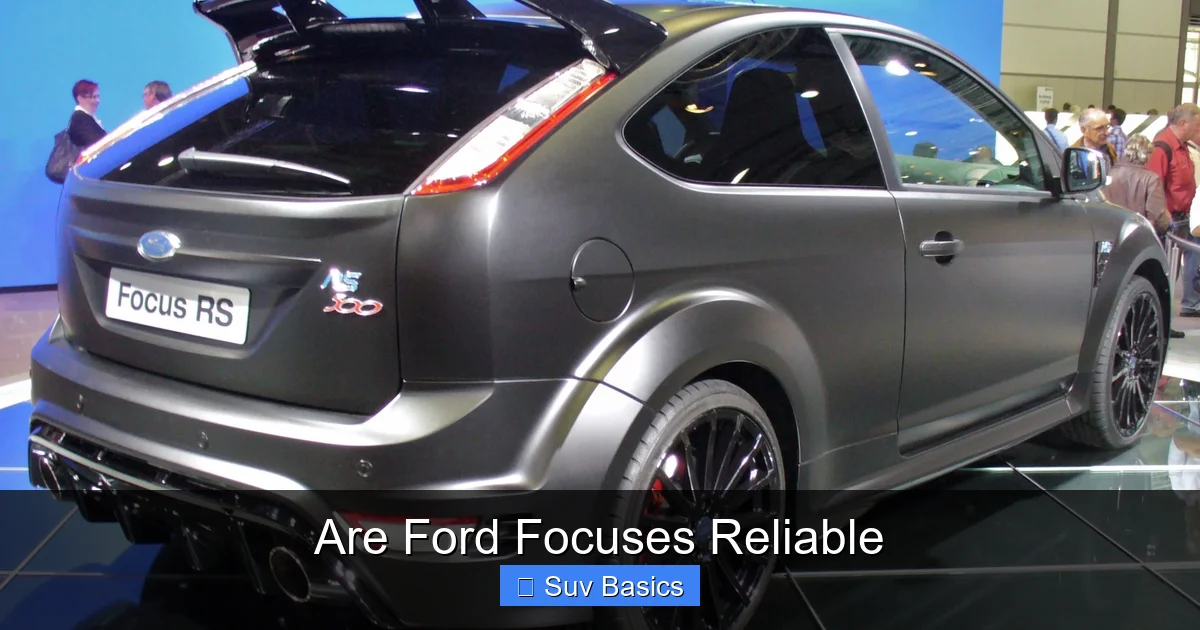
The Ford Focus has earned a mixed reputation for reliability over the years. While many owners enjoy dependable performance and fuel efficiency, certain model years—especially those with automatic transmissions—have faced notable mechanical challenges.
Key Takeaways
- Reliability varies by model year: Earlier generations (2000–2011) were generally solid, but 2012–2018 models faced transmission issues, particularly with the PowerShift automatic.
- Manual transmissions are more dependable: Owners consistently report fewer problems with manual gearboxes compared to the problematic dual-clutch automatics.
- Strong safety and fuel economy: The Focus scores well in crash tests and offers excellent gas mileage, especially in EcoBoost variants. For those who need more space, explore our SUV evaluation guide.
- Regular maintenance is crucial: Staying on top of oil changes, brake checks, and software updates can significantly extend the car’s lifespan.
- Used Focus values are affordable: Due to reliability concerns, pre-owned Focuses are budget-friendly, making them attractive for first-time buyers.
- Newer models (2019–2023) improved: Ford addressed many past flaws, offering better build quality and updated tech in later years.
- Not a long-term SUV alternative: While practical, the Focus is a compact car—not an SUV—so consider your space and driving needs carefully.
📑 Table of Contents
- Are Ford Focuses Reliable? A Honest Look at Performance and Longevity
- Understanding Ford Focus Reliability by Generation
- Common Problems and How to Avoid Them
- Real-World Owner Experiences
- Maintenance Tips to Maximize Reliability
- Is the Ford Focus Right for You?
- Final Verdict: A Mixed Bag with Potential
Are Ford Focuses Reliable? A Honest Look at Performance and Longevity
When shopping for a compact car, reliability is often the top concern. You want something that won’t leave you stranded, won’t drain your wallet with constant repairs, and will last through years of daily commutes, school runs, and weekend trips. The Ford Focus has been a popular choice in the compact segment for over two decades, but its reputation for reliability has seen its ups and downs. So, are Ford Focuses reliable? The answer isn’t a simple yes or no—it depends on the model year, transmission type, and how well the vehicle has been maintained.
Introduced in 1998, the Ford Focus quickly gained attention for its European-inspired handling, affordability, and modern design. Over the years, it evolved through multiple generations, adding advanced tech, improved fuel efficiency, and more powerful engine options. However, not all updates were smooth sailing. Some model years, especially those produced between 2012 and 2018, faced significant criticism due to transmission problems. Understanding these nuances is key to making an informed decision—whether you’re eyeing a used Focus or considering a newer model.
Understanding Ford Focus Reliability by Generation
First Generation (1998–2004): Solid and Simple
The original Ford Focus earned praise for its straightforward engineering and durability. Built with conventional manual and automatic transmissions, these models avoided the complexity that later caused issues. Owners often report driving their first-gen Focuses well beyond 150,000 miles with minimal problems, provided they followed regular maintenance schedules. The 2.0L Zetec engine, while not high-performance, was known for its longevity and ease of repair.

Visual guide about Are Ford Focuses Reliable
Image source: motorbiscuit.com
Second Generation (2005–2011): Refined but Still Reliable
Ford redesigned the Focus in 2005, giving it a more modern look and improved interior quality. This generation continued to use reliable four-cylinder engines and traditional automatics. While not as sporty as some competitors, the Focus remained a dependable daily driver. Common issues were minor—things like worn suspension components or occasional electrical glitches—but nothing that typically led to major breakdowns.
Third Generation (2012–2018): The Transmission Troubles
This is where the Ford Focus reliability story takes a turn. In 2012, Ford introduced the PowerShift dual-clutch automatic transmission, aiming for better fuel economy and smoother shifts. Unfortunately, the system proved problematic. Owners reported shuddering, jerking, delayed acceleration, and even complete transmission failure. Ford issued multiple recalls and extended warranties, but many drivers were left frustrated. Manual transmission models from this era, however, continued to perform reliably, highlighting the importance of transmission choice.
Fourth Generation (2019–2023): A Comeback Attempt
Ford responded to criticism by refining the Focus in its final years. The 2019 redesign brought updated styling, better materials, and a return to more conventional automatic transmissions in many markets. The EcoBoost engines offered a nice balance of power and efficiency, and reliability scores began to climb. While not yet on par with Honda or Toyota, the newer Focuses showed clear improvement.
Common Problems and How to Avoid Them
Transmission Issues: The Biggest Culprit
The PowerShift automatic transmission remains the most cited problem in Ford Focus reliability discussions. Symptoms often appear around 30,000 to 60,000 miles and include harsh shifting, loss of power, and warning lights. If you’re buying a used Focus from 2012–2018, always check the transmission type. Opting for a manual or avoiding the PowerShift altogether can save you major headaches.
Electrical and Software Glitches
Some Focus models, especially those with SYNC infotainment systems, have experienced software bugs. These can cause the radio to freeze, navigation to fail, or warning lights to appear incorrectly. Regular software updates from Ford dealerships can often resolve these issues. If you own a Focus, staying current with recalls and tech updates is a smart move.
Suspension and Brake Wear
Like any compact car, the Focus experiences normal wear on suspension components and brakes. Front struts, control arms, and brake pads may need replacement around 60,000–80,000 miles. Routine inspections during oil changes can help catch these issues early. Ignoring them can lead to poor handling or reduced braking performance.
Engine Performance and Maintenance
The Focus engines—especially the 2.0L and 1.6L EcoBoost—are generally reliable when properly maintained. However, skipping oil changes or using low-quality fuel can lead to carbon buildup, reduced performance, or even engine damage. Stick to Ford’s recommended maintenance schedule, and consider using synthetic oil for better engine protection.
Real-World Owner Experiences
Talking to actual Ford Focus owners provides valuable insight into long-term reliability. On forums like Reddit, Edmunds, and CarComplaints, many drivers share their stories. One owner, Sarah from Ohio, has driven her 2010 Focus manual for over 180,000 miles with only routine maintenance. “It’s never left me stranded,” she says. “I change the oil every 5,000 miles, rotate the tires, and keep up with recalls. It’s been a great little car.”
On the other hand, Mike from Texas bought a 2014 Focus with the PowerShift transmission and experienced shuddering within two years. “It was like driving on ice,” he recalls. “Ford replaced the transmission under warranty, but it happened again at 70,000 miles.” His experience underscores the importance of transmission choice and warranty coverage.
Newer owners, like Jenna from Washington, report much better experiences. Her 2020 Focus with the 1.0L EcoBoost engine has been trouble-free for 45,000 miles. “It’s quiet, efficient, and handles well,” she says. “I feel confident driving it daily.” These mixed experiences show that while the Focus has had its flaws, many models—especially manuals and newer automatics—can be reliable with proper care.
Maintenance Tips to Maximize Reliability
Follow the Maintenance Schedule
Ford provides a detailed maintenance schedule in the owner’s manual. Stick to it. This includes oil changes every 5,000–7,500 miles, tire rotations every 7,500 miles, and brake inspections every 15,000 miles. Regular maintenance is the single best way to ensure your Focus stays reliable.
Use Quality Parts and Fluids
Don’t cut corners on oil, coolant, or brake fluid. Use Ford-approved or high-quality aftermarket products. Cheap fluids can degrade faster and harm engine or transmission performance over time.
Address Recalls Promptly
Ford has issued several recalls for the Focus, especially related to transmissions and airbags. Check the NHTSA website regularly using your VIN to see if your vehicle is affected. Dealerships will perform recall repairs for free.
Drive Smoothly
Aggressive driving—especially with automatic transmissions—can accelerate wear. Avoid hard acceleration and abrupt braking. This not only improves reliability but also extends brake and tire life.
Keep It Clean
Regular washing and waxing protect the paint and prevent rust. Pay attention to the undercarriage, especially in snowy climates where road salt is used. A clean car is a happy car—and one that lasts longer.
Is the Ford Focus Right for You?
So, are Ford Focuses reliable? The answer depends on your priorities. If you’re looking for an affordable, fuel-efficient compact car and are willing to choose the right model year and transmission, the Focus can be a solid choice. It’s not the most reliable car in its class—Honda Civic and Toyota Corolla still lead in that category—but it offers good value, especially in the used market.
For budget-conscious buyers, a well-maintained manual Focus from 2005–2011 or a newer 2019–2023 model with a conventional automatic can deliver years of trouble-free driving. Just avoid the 2012–2018 PowerShift automatics unless you’re prepared for potential repairs.
And while the Focus isn’t an SUV, it does offer decent cargo space and a comfortable ride for a compact car. If you need more room or all-wheel drive, consider stepping up to a Ford Escape or another small SUV.
Maintenance Tips to Maximize Reliability
Follow the Maintenance Schedule
Ford provides a detailed maintenance schedule in the owner’s manual. Stick to it. This includes oil changes every 5,000–7,500 miles, tire rotations every 7,500 miles, and brake inspections every 15,000 miles. Regular maintenance is the single best way to ensure your Focus stays reliable.
Use Quality Parts and Fluids
Don’t cut corners on oil, coolant, or brake fluid. Use Ford-approved or high-quality aftermarket products. Cheap fluids can degrade faster and harm engine or transmission performance over time.
Address Recalls Promptly
Ford has issued several recalls for the Focus, especially related to transmissions and airbags. Check the NHTSA website regularly using your VIN to see if your vehicle is affected. Dealerships will perform recall repairs for free.
Drive Smoothly
Aggressive driving—especially with automatic transmissions—can accelerate wear. Avoid hard acceleration and abrupt braking. This not only improves reliability but also extends brake and tire life.
Keep It Clean
Regular washing and waxing protect the paint and prevent rust. Pay attention to the undercarriage, especially in snowy climates where road salt is used. A clean car is a happy car—and one that lasts longer.
Is the Ford Focus Right for You?
So, are Ford Focuses reliable? The answer depends on your priorities. If you’re looking for an affordable, fuel-efficient compact car and are willing to choose the right model year and transmission, the Focus can be a solid choice. It’s not the most reliable car in its class—Honda Civic and Toyota Corolla still lead in that category—but it offers good value, especially in the used market.
For budget-conscious buyers, a well-maintained manual Focus from 2005–2011 or a newer 2019–2023 model with a conventional automatic can deliver years of trouble-free driving. Just avoid the 2012–2018 PowerShift automatics unless you’re prepared for potential repairs.
And while the Focus isn’t an SUV, it does offer decent cargo space and a comfortable ride for a compact car. If you need more room or all-wheel drive, consider stepping up to a Ford Escape or another small SUV.
Maintenance Tips to Maximize Reliability
Follow the Maintenance Schedule
Ford provides a detailed maintenance schedule in the owner’s manual. Stick to it. This includes oil changes every 5,000–7,500 miles, tire rotations every 7,500 miles, and brake inspections every 15,000 miles. Regular maintenance is the single best way to ensure your Focus stays reliable.
Use Quality Parts and Fluids
Don’t cut corners on oil, coolant, or brake fluid. Use Ford-approved or high-quality aftermarket products. Cheap fluids can degrade faster and harm engine or transmission performance over time.
Address Recalls Promptly
Ford has issued several recalls for the Focus, especially related to transmissions and airbags. Check the NHTSA website regularly using your VIN to see if your vehicle is affected. Dealerships will perform recall repairs for free.
Drive Smoothly
Aggressive driving—especially with automatic transmissions—can accelerate wear. Avoid hard acceleration and abrupt braking. This not only improves reliability but also extends brake and tire life.
Keep It Clean
Regular washing and waxing protect the paint and prevent rust. Pay attention to the undercarriage, especially in snowy climates where road salt is used. A clean car is a happy car—and one that lasts longer.
Is the Ford Focus Right for You?
So, are Ford Focuses reliable? The answer depends on your priorities. If you’re looking for an affordable, fuel-efficient compact car and are willing to choose the right model year and transmission, the Focus can be a solid choice. It’s not the most reliable car in its class—Honda Civic and Toyota Corolla still lead in that category—but it offers good value, especially in the used market.
For budget-conscious buyers, a well-maintained manual Focus from 2005–2011 or a newer 2019–2023 model with a conventional automatic can deliver years of trouble-free driving. Just avoid the 2012–2018 PowerShift automatics unless you’re prepared for potential repairs.
And while the Focus isn’t an SUV, it does offer decent cargo space and a comfortable ride for a compact car. If you need more room or all-wheel drive, consider stepping up to a Ford Escape or another small SUV.
Maintenance Tips to Maximize Reliability
Follow the Maintenance Schedule
Ford provides a detailed maintenance schedule in the owner’s manual. Stick to it. This includes oil changes every 5,000–7,500 miles, tire rotations every 7,500 miles, and brake inspections every 15,000 miles. Regular maintenance is the single best way to ensure your Focus stays reliable.
Use Quality Parts and Fluids
Don’t cut corners on oil, coolant, or brake fluid. Use Ford-approved or high-quality aftermarket products. Cheap fluids can degrade faster and harm engine or transmission performance over time.
Address Recalls Promptly
Ford has issued several recalls for the Focus, especially related to transmissions and airbags. Check the NHTSA website regularly using your VIN to see if your vehicle is affected. Dealerships will perform recall repairs for free.
Drive Smoothly
Aggressive driving—especially with automatic transmissions—can accelerate wear. Avoid hard acceleration and abrupt braking. This not only improves reliability but also extends brake and tire life.
Keep It Clean
Regular washing and waxing protect the paint and prevent rust. Pay attention to the undercarriage, especially in snowy climates where road salt is used. A clean car is a happy car—and one that lasts longer.
Is the Ford Focus Right for You?
So, are Ford Focuses reliable? The answer depends on your priorities. If you’re looking for an affordable, fuel-efficient compact car and are willing to choose the right model year and transmission, the Focus can be a solid choice. It’s not the most reliable car in its class—Honda Civic and Toyota Corolla still lead in that category—but it offers good value, especially in the used market.
For budget-conscious buyers, a well-maintained manual Focus from 2005–2011 or a newer 2019–2023 model with a conventional automatic can deliver years of trouble-free driving. Just avoid the 2012–2018 PowerShift automatics unless you’re prepared for potential repairs.
And while the Focus isn’t an SUV, it does offer decent cargo space and a comfortable ride for a compact car. If you need more room or all-wheel drive, consider stepping up to a Ford Escape or another small SUV.
Maintenance Tips to Maximize Reliability
Follow the Maintenance Schedule
Ford provides a detailed maintenance schedule in the owner’s manual. Stick to it. This includes oil changes every 5,000–7,500 miles, tire rotations every 7,500 miles, and brake inspections every 15,000 miles. Regular maintenance is the single best way to ensure your Focus stays reliable.
Use Quality Parts and Fluids
Don’t cut corners on oil, coolant, or brake fluid. Use Ford-approved or high-quality aftermarket products. Cheap fluids can degrade faster and harm engine or transmission performance over time.
Address Recalls Promptly
Ford has issued several recalls for the Focus, especially related to transmissions and airbags. Check the NHTSA website regularly using your VIN to see if your vehicle is affected. Dealerships will perform recall repairs for free.
Drive Smoothly
Aggressive driving—especially with automatic transmissions—can accelerate wear. Avoid hard acceleration and abrupt braking. This not only improves reliability but also extends brake and tire life.
Keep It Clean
Regular washing and waxing protect the paint and prevent rust. Pay attention to the undercarriage, especially in snowy climates where road salt is used. A clean car is a happy car—and one that lasts longer.
Is the Ford Focus Right for You?
So, are Ford Focuses reliable? The answer depends on your priorities. If you’re looking for an affordable, fuel-efficient compact car and are willing to choose the right model year and transmission, the Focus can be a solid choice. It’s not the most reliable car in its class—Honda Civic and Toyota Corolla still lead in that category—but it offers good value, especially in the used market.
For budget-conscious buyers, a well-maintained manual Focus from 2005–2011 or a newer 2019–2023 model with a conventional automatic can deliver years of trouble-free driving. Just avoid the 2012–2018 PowerShift automatics unless you’re prepared for potential repairs.
And while the Focus isn’t an SUV, it does offer decent cargo space and a comfortable ride for a compact car. If you need more room or all-wheel drive, consider stepping up to a Ford Escape or another small SUV.
Maintenance Tips to Maximize Reliability
Follow the Maintenance Schedule
Ford provides a detailed maintenance schedule in the owner’s manual. Stick to it. This includes oil changes every 5,000–7,500 miles, tire rotations every 7,500 miles, and brake inspections every 15,000 miles. Regular maintenance is the single best way to ensure your Focus stays reliable.
Use Quality Parts and Fluids
Don’t cut corners on oil, coolant, or brake fluid. Use Ford-approved or high-quality aftermarket products. Cheap fluids can degrade faster and harm engine or transmission performance over time.
Address Recalls Promptly
Ford has issued several recalls for the Focus, especially related to transmissions and airbags. Check the NHTSA website regularly using your VIN to see if your vehicle is affected. Dealerships will perform recall repairs for free.
Drive Smoothly
Aggressive driving—especially with automatic transmissions—can accelerate wear. Avoid hard acceleration and abrupt braking. This not only improves reliability but also extends brake and tire life.
Keep It Clean
Regular washing and waxing protect the paint and prevent rust. Pay attention to the undercarriage, especially in snowy climates where road salt is used. A clean car is a happy car—and one that lasts longer.
Is the Ford Focus Right for You?
So, are Ford Focuses reliable? The answer depends on your priorities. If you’re looking for an affordable, fuel-efficient compact car and are willing to choose the right model year and transmission, the Focus can be a solid choice. It’s not the most reliable car in its class—Honda Civic and Toyota Corolla still lead in that category—but it offers good value, especially in the used market.
For budget-conscious buyers, a well-maintained manual Focus from 2005–2011 or a newer 2019–2023 model with a conventional automatic can deliver years of trouble-free driving. Just avoid the 2012–2018 PowerShift automatics unless you’re prepared for potential repairs.
And while the Focus isn’t an SUV, it does offer decent cargo space and a comfortable ride for a compact car. If you need more room or all-wheel drive, consider stepping up to a Ford Escape or another small SUV.
Maintenance Tips to Maximize Reliability
Follow the Maintenance Schedule
Ford provides a detailed maintenance schedule in the owner’s manual. Stick to it. This includes oil changes every 5,000–7,500 miles, tire rotations every 7,500 miles, and brake inspections every 15,000 miles. Regular maintenance is the single best way to ensure your Focus stays reliable.
Use Quality Parts and Fluids
Don’t cut corners on oil, coolant, or brake fluid. Use Ford-approved or high-quality aftermarket products. Cheap fluids can degrade faster and harm engine or transmission performance over time.
Address Recalls Promptly
Ford has issued several recalls for the Focus, especially related to transmissions and airbags. Check the NHTSA website regularly using your VIN to see if your vehicle is affected. Dealerships will perform recall repairs for free.
Drive Smoothly
Aggressive driving—especially with automatic transmissions—can accelerate wear. Avoid hard acceleration and abrupt braking. This not only improves reliability but also extends brake and tire life.
Keep It Clean
Regular washing and waxing protect the paint and prevent rust. Pay attention to the undercarriage, especially in snowy climates where road salt is used. A clean car is a happy car—and one that lasts longer.
Is the Ford Focus Right for You?
So, are Ford Focuses reliable? The answer depends on your priorities. If you’re looking for an affordable, fuel-efficient compact car and are willing to choose the right model year and transmission, the Focus can be a solid choice. It’s not the most reliable car in its class—Honda Civic and Toyota Corolla still lead in that category—but it offers good value, especially in the used market.
For budget-conscious buyers, a well-maintained manual Focus from 2005–2011 or a newer 2019–2023 model with a conventional automatic can deliver years of trouble-free driving. Just avoid the 2012–2018 PowerShift automatics unless you’re prepared for potential repairs.
And while the Focus isn’t an SUV, it does offer decent cargo space and a comfortable ride for a compact car. If you need more room or all-wheel drive, consider stepping up to a Ford Escape or another small SUV.
Maintenance Tips to Maximize Reliability
Follow the Maintenance Schedule
Ford provides a detailed maintenance schedule in the owner’s manual. Stick to it. This includes oil changes every 5,000–7,500 miles, tire rotations every 7,500 miles, and brake inspections every 15,000 miles. Regular maintenance is the single best way to ensure your Focus stays reliable.
Use Quality Parts and Fluids
Don’t cut corners on oil, coolant, or brake fluid. Use Ford-approved or high-quality aftermarket products. Cheap fluids can degrade faster and harm engine or transmission performance over time.
Address Recalls Promptly
Ford has issued several recalls for the Focus, especially related to transmissions and airbags. Check the NHTSA website regularly using your VIN to see if your vehicle is affected. Dealerships will perform recall repairs for free.
Drive Smoothly
Aggressive driving—especially with automatic transmissions—can accelerate wear. Avoid hard acceleration and abrupt braking. This not only improves reliability but also extends brake and tire life.
Keep It Clean
Regular washing and waxing protect the paint and prevent rust. Pay attention to the undercarriage, especially in snowy climates where road salt is used. A clean car is a happy car—and one that lasts longer.
Is the Ford Focus Right for You?
So, are Ford Focuses reliable? The answer depends on your priorities. If you’re looking for an affordable, fuel-efficient compact car and are willing to choose the right model year and transmission, the Focus can be a solid choice. It’s not the most reliable car in its class—Honda Civic and Toyota Corolla still lead in that category—but it offers good value, especially in the used market.
For budget-conscious buyers, a well-maintained manual Focus from 2005–2011 or a newer 2019–2023 model with a conventional automatic can deliver years of trouble-free driving. Just avoid the 2012–2018 PowerShift automatics unless you’re prepared for potential repairs.
And while the Focus isn’t an SUV, it does offer decent cargo space and a comfortable ride for a compact car. If you need more room or all-wheel drive, consider stepping up to a Ford Escape or another small SUV.
Maintenance Tips to Maximize Reliability
Follow the Maintenance Schedule
Ford provides a detailed maintenance schedule in the owner’s manual. Stick to it. This includes oil changes every 5,000–7,500 miles, tire rotations every 7,500 miles, and brake inspections every 15,000 miles. Regular maintenance is the single best way to ensure your Focus stays reliable.
Use Quality Parts and Fluids
Don’t cut corners on oil, coolant, or brake fluid. Use Ford-approved or high-quality aftermarket products. Cheap fluids can degrade faster and harm engine or transmission performance over time.
Address Recalls Promptly
Ford has issued several recalls for the Focus, especially related to transmissions and airbags. Check the NHTSA website regularly using your VIN to see if your vehicle is affected. Dealerships will perform recall repairs for free.
Drive Smoothly
Aggressive driving—especially with automatic transmissions—can accelerate wear. Avoid hard acceleration and abrupt braking. This not only improves reliability but also extends brake and tire life.
Keep It Clean
Regular washing and waxing protect the paint and prevent rust. Pay attention to the undercarriage, especially in snowy climates where road salt is used. A clean car is a happy car—and one that lasts longer.
Is the Ford Focus Right for You?
So, are Ford Focuses reliable? The answer depends on your priorities. If you’re looking for an affordable, fuel-efficient compact car and are willing to choose the right model year and transmission, the Focus can be a solid choice. It’s not the most reliable car in its class—Honda Civic and Toyota Corolla still lead in that category—but it offers good value, especially in the used market.
For budget-conscious buyers, a well-maintained manual Focus from 2005–2011 or a newer 2019–2023 model with a conventional automatic can deliver years of trouble-free driving. Just avoid the 2012–2018 PowerShift automatics unless you’re prepared for potential repairs.
And while the Focus isn’t an SUV, it does offer decent cargo space and a comfortable ride for a compact car. If you need more room or all-wheel drive, consider stepping up to a Ford Escape or another small SUV.
Maintenance Tips to Maximize Reliability
Follow the Maintenance Schedule
Ford provides a detailed maintenance schedule in the owner’s manual. Stick to it. This includes oil changes every 5,000–7,500 miles, tire rotations every 7,500 miles, and brake inspections every 15,000 miles. Regular maintenance is the single best way to ensure your Focus stays reliable.
Use Quality Parts and Fluids
Don’t cut corners on oil, coolant, or brake fluid. Use Ford-approved or high-quality aftermarket products. Cheap fluids can degrade faster and harm engine or transmission performance over time.
Address Recalls Promptly
Ford has issued several recalls for the Focus, especially related to transmissions and airbags. Check the NHTSA website regularly using your VIN to see if your vehicle is affected. Dealerships will perform recall repairs for free.
Drive Smoothly
Aggressive driving—especially with automatic transmissions—can accelerate wear. Avoid hard acceleration and abrupt braking. This not only improves reliability but also extends brake and tire life.
Keep It Clean
Regular washing and waxing protect the paint and prevent rust. Pay attention to the undercarriage, especially in snowy climates where road salt is used. A clean car is a happy car—and one that lasts longer.
Is the Ford Focus Right for You?
So, are Ford Focuses reliable? The answer depends on your priorities. If you’re looking for an affordable, fuel-efficient compact car and are willing to choose the right model year and transmission, the Focus can be a solid choice. It’s not the most reliable car in its class—Honda Civic and Toyota Corolla still lead in that category—but it offers good value, especially in the used market.
For budget-conscious buyers, a well-maintained manual Focus from 2005–2011 or a newer 2019–2023 model with a conventional automatic can deliver years of trouble-free driving. Just avoid the 2012–2018 PowerShift automatics unless you’re prepared for potential repairs.
And while the Focus isn’t an SUV, it does offer decent cargo space and a comfortable ride for a compact car. If you need more room or all-wheel drive, consider stepping up to a Ford Escape or another small SUV.
Maintenance Tips to Maximize Reliability
Follow the Maintenance Schedule
Ford provides a detailed maintenance schedule in the owner’s manual. Stick to it. This includes oil changes every 5,000–7,500 miles, tire rotations every 7,500 miles, and brake inspections every 15,000 miles. Regular maintenance is the single best way to ensure your Focus stays reliable.
Use Quality Parts and Fluids
Don’t cut corners on oil, coolant, or brake fluid. Use Ford-approved or high-quality aftermarket products. Cheap fluids can degrade faster and harm engine or transmission performance over time.
Address Recalls Promptly
Ford has issued several recalls for the Focus, especially related to transmissions and airbags. Check the NHTSA website regularly using your VIN to see if your vehicle is affected. Dealerships will perform recall repairs for free.
Drive Smoothly
Aggressive driving—especially with automatic transmissions—can accelerate wear. Avoid hard acceleration and abrupt braking. This not only improves reliability but also extends brake and tire life.
Keep It Clean
Regular washing and waxing protect the paint and prevent rust. Pay attention to the undercarriage, especially in snowy climates where road salt is used. A clean car is a happy car—and one that lasts longer.
Is the Ford Focus Right for You?
So, are Ford Focuses reliable? The answer depends on your priorities. If you’re looking for an affordable, fuel-efficient compact car and are willing to choose the right model year and transmission, the Focus can be a solid choice. It’s not the most reliable car in its class—Honda Civic and Toyota Corolla still lead in that category—but it offers good value, especially in the used market.
For budget-conscious buyers, a well-maintained manual Focus from 2005–2011 or a newer 2019–2023 model with a conventional automatic can deliver years of trouble-free driving. Just avoid the 2012–2018 PowerShift automatics unless you’re prepared for potential repairs.
And while the Focus isn’t an SUV, it does offer decent cargo space and a comfortable ride for a compact car. If you need more room or all-wheel drive, consider stepping up to a Ford Escape or another small SUV.
Maintenance Tips to Maximize Reliability
Follow the Maintenance Schedule
Ford provides a detailed maintenance schedule in the owner’s manual. Stick to it. This includes oil changes every 5,000–7,500 miles, tire rotations every 7,500 miles, and brake inspections every 15,000 miles. Regular maintenance is the single best way to ensure your Focus stays reliable.
Use Quality Parts and Fluids
Don’t cut corners on oil, coolant, or brake fluid. Use Ford-approved or high-quality aftermarket products. Cheap fluids can degrade faster and harm engine or transmission performance over time.
Address Recalls Promptly
Ford has issued several recalls for the Focus, especially related to transmissions and airbags. Check the NHTSA website regularly using your VIN to see if your vehicle is affected. Dealerships will perform recall repairs for free.
Drive Smoothly
Aggressive driving—especially with automatic transmissions—can accelerate wear. Avoid hard acceleration and abrupt braking. This not only improves reliability but also extends brake and tire life.
Keep It Clean
Regular washing and waxing protect the paint and prevent rust. Pay attention to the undercarriage, especially in snowy climates where road salt is used. A clean car is a happy car—and one that lasts longer.
Is the Ford Focus Right for You?
So, are Ford Focuses reliable? The answer depends on your priorities. If you’re looking for an affordable, fuel-efficient compact car and are willing to choose the right model year and transmission, the Focus can be a solid choice. It’s not the most reliable car in its class—Honda Civic and Toyota Corolla still lead in that category—but it offers good value, especially in the used market.
For budget-conscious buyers, a well-maintained manual Focus from 2005–2011 or a newer 2019–2023 model with a conventional automatic can deliver years of trouble-free driving. Just avoid the 2012–2018 PowerShift automatics unless you’re prepared for potential repairs.
And while the Focus isn’t an SUV, it does offer decent cargo space and a comfortable ride for a compact car. If you need more room or all-wheel drive, consider stepping up to a Ford Escape or another small SUV.
Maintenance Tips to Maximize Reliability
Follow the Maintenance Schedule
Ford provides a detailed maintenance schedule in the owner’s manual. Stick to it. This includes oil changes every 5,000–7,500 miles, tire rotations every 7,500 miles, and brake inspections every 15,000 miles. Regular maintenance is the single best way to ensure your Focus stays reliable.
Use Quality Parts and Fluids
Don’t cut corners on oil, coolant, or brake fluid. Use Ford-approved or high-quality aftermarket products. Cheap fluids can degrade faster and harm engine or transmission performance over time.
Address Recalls Promptly
Ford has issued several recalls for the Focus, especially related to transmissions and airbags. Check the NHTSA website regularly using your VIN to see if your vehicle is affected. Dealerships will perform recall repairs for free.
Drive Smoothly
Aggressive driving—especially with automatic transmissions—can accelerate wear. Avoid hard acceleration and abrupt braking. This not only improves reliability but also extends brake and tire life.
Keep It Clean
Regular washing and waxing protect the paint and prevent rust. Pay attention to the undercarriage, especially in snowy climates where road salt is used. A clean car is a happy car—and one that lasts longer.
Is the Ford Focus Right for You?
So, are Ford Focuses reliable? The answer depends on your priorities. If you’re looking for an affordable, fuel-efficient compact car and are willing to choose the right model year and transmission, the Focus can be a solid choice. It’s not the most reliable car in its class—Honda Civic and Toyota Corolla still lead in that category—but it offers good value, especially in the used market.
For budget-conscious buyers, a well-maintained manual Focus from 2005–2011 or a newer 2019–2023 model with a conventional automatic can deliver years of trouble-free driving. Just avoid the 2012–2018 PowerShift automatics unless you’re prepared for potential repairs.
And while the Focus isn’t an SUV, it does offer decent cargo space and a comfortable ride for a compact car. If you need more room or all-wheel drive, consider stepping up to a Ford Escape or another small SUV.
Maintenance Tips to Maximize Reliability
Follow the Maintenance Schedule
Ford provides a detailed maintenance schedule in the owner’s manual. Stick to it. This includes oil changes every 5,000–7,500 miles, tire rotations every 7,500 miles, and brake inspections every 15,000 miles. Regular maintenance is the single best way to ensure your Focus stays reliable.
Use Quality Parts and Fluids
Don’t cut corners on oil, coolant, or brake fluid. Use Ford-approved or high-quality aftermarket products. Cheap fluids can degrade faster and harm engine or transmission performance over time.
Address Recalls Promptly
Ford has issued several recalls for the Focus, especially related to transmissions and airbags. Check the NHTSA website regularly using your VIN to see if your vehicle is affected. Dealerships will perform recall repairs for free.
Drive Smoothly
Aggressive driving—especially with automatic transmissions—can accelerate wear. Avoid hard acceleration and abrupt braking. This not only improves reliability but also extends brake and tire life.
Keep It Clean
Regular washing and waxing protect the paint and prevent rust. Pay attention to the undercarriage, especially in snowy climates where road salt is used. A clean car is a happy car—and one that lasts longer.
Is the Ford Focus Right for You?
So, are Ford Focuses reliable? The answer depends on your priorities. If you’re looking for an affordable, fuel-efficient compact car and are willing to choose the right model year and transmission, the Focus can be a solid choice. It’s not the most reliable car in its class—Honda Civic and Toyota Corolla still lead in that category—but it offers good value, especially in the used market.
For budget-conscious buyers, a well-maintained manual Focus from 2005–2011 or a newer 2019–2023 model with a conventional automatic can deliver years of trouble-free driving. Just avoid the 2012–2018 PowerShift automatics unless you’re prepared for potential repairs.
And while the Focus isn’t an SUV, it does offer decent cargo space and a comfortable ride for a compact car. If you need more room or all-wheel drive, consider stepping up to a Ford Escape or another small SUV.
Maintenance Tips to Maximize Reliability
Follow the Maintenance Schedule
Ford provides a detailed maintenance schedule in the owner’s manual. Stick to it. This includes oil changes every 5,000–7,500 miles, tire rotations every 7,500 miles, and brake inspections every 15,000 miles. Regular maintenance is the single best way to ensure your Focus stays reliable.
Use Quality Parts and Fluids
Don’t cut corners on oil, coolant, or brake fluid. Use Ford-approved or high-quality aftermarket products. Cheap fluids can degrade faster and harm engine or transmission performance over time.
Address Recalls Promptly
Ford has issued several recalls for the Focus, especially related to transmissions and airbags. Check the NHTSA website regularly using your VIN to see if your vehicle is affected. Dealerships will perform recall repairs for free.
Drive Smoothly
Aggressive driving—especially with automatic transmissions—can accelerate wear. Avoid hard acceleration and abrupt braking. This not only improves reliability but also extends brake and tire life.
Keep It Clean
Regular washing and waxing protect the paint and prevent rust. Pay attention to the undercarriage, especially in snowy climates where road salt is used. A clean car is a happy car—and one that lasts longer.
Is the Ford Focus Right for You?
So, are Ford Focuses reliable? The answer depends on your priorities. If you’re looking for an affordable, fuel-efficient compact car and are willing to choose the right model year and transmission, the Focus can be a solid choice. It’s not the most reliable car in its class—Honda Civic and Toyota Corolla still lead in that category—but it offers good value, especially in the used market.
For budget-conscious buyers, a well-maintained manual Focus from 2005–2011 or a newer 2019–2023 model with a conventional automatic can deliver years of trouble-free driving. Just avoid the 2012–2018 PowerShift automatics unless you’re prepared for potential repairs.
And while the Focus isn’t an SUV, it does offer decent cargo space and a comfortable ride for a compact car. If you need more room or all-wheel drive, consider stepping up to a Ford Escape or another small SUV.
Maintenance Tips to Maximize Reliability
Follow the Maintenance Schedule
Ford provides a detailed maintenance schedule in the owner’s manual. Stick to it. This includes oil changes every 5,000–7,500 miles, tire rotations every 7,500 miles, and brake inspections every 15,000 miles. Regular maintenance is the single best way to ensure your Focus stays reliable.
Use Quality Parts and Fluids
Don’t cut corners on oil, coolant, or brake fluid. Use Ford-approved or high-quality aftermarket products. Cheap fluids can degrade faster and harm engine or transmission performance over time.
Address Recalls Promptly
Ford has issued several recalls for the Focus, especially related to transmissions and airbags. Check the NHTSA website regularly using your VIN to see if your vehicle is affected. Dealerships will perform recall repairs for free.
Drive Smoothly
Aggressive driving—especially with automatic transmissions—can accelerate wear. Avoid hard acceleration and abrupt braking. This not only improves reliability but also extends brake and tire life.
Keep It Clean
Regular washing and waxing protect the paint and prevent rust. Pay attention to the undercarriage, especially in snowy climates where road salt is used. A clean car is a happy car—and one that lasts longer.
Is the Ford Focus Right for You?
So, are Ford Focuses reliable? The answer depends on your priorities. If you’re looking for an affordable, fuel-efficient compact car and are willing to choose the right model year and transmission, the Focus can be a solid choice. It’s not the most reliable car in its class—Honda Civic and Toyota Corolla still lead in that category—but it offers good value, especially in the used market.
For budget-conscious buyers, a well-maintained manual Focus from 2005–2011 or a newer 2019–2023 model with a conventional automatic can deliver years of trouble-free driving. Just avoid the 2012–2018 PowerShift automatics unless you’re prepared for potential repairs.
And while the Focus isn’t an SUV, it does offer decent cargo space and a comfortable ride for a compact car. If you need more room or all-wheel drive, consider stepping up to a Ford Escape or another small SUV.
Maintenance Tips to Maximize Reliability
Follow the Maintenance Schedule
Ford provides a detailed maintenance schedule in the owner’s manual. Stick to it. This includes oil changes every 5,000–7,500 miles, tire rotations every 7,500 miles, and brake inspections every 15,000 miles. Regular maintenance is the single best way to ensure your Focus stays reliable.
Use Quality Parts and Fluids
Don’t cut corners on oil, coolant, or brake fluid. Use Ford-approved or high-quality aftermarket products. Cheap fluids can degrade faster and harm engine or transmission performance over time.
Address Recalls Promptly
Ford has issued several recalls for the Focus, especially related to transmissions and airbags. Check the NHTSA website regularly using your VIN to see if your vehicle is affected. Dealerships will perform recall repairs for free.
Drive Smoothly
Aggressive driving—especially with automatic transmissions—can accelerate wear. Avoid hard acceleration and abrupt braking. This not only improves reliability but also extends brake and tire life.
Keep It Clean
Regular washing and waxing protect the paint and prevent rust. Pay attention to the undercarriage, especially in snowy climates where road salt is used. A clean car is a happy car—and one that lasts longer.
Is the Ford Focus Right for You?
So, are Ford Focuses reliable? The answer depends on your priorities. If you’re looking for an affordable, fuel-efficient compact car and are willing to choose the right model year and transmission, the Focus can be a solid choice. It’s not the most reliable car in its class—Honda Civic and Toyota Corolla still lead in that category—but it offers good value, especially in the used market.
For budget-conscious buyers, a well-maintained manual Focus from 2005–2011 or a newer 2019–2023 model with a conventional automatic can deliver years of trouble-free driving. Just avoid the 2012–2018 PowerShift automatics unless you’re prepared for potential repairs.
And while the Focus isn’t an SUV, it does offer decent cargo space and a comfortable ride for a compact car. If you need more room or all-wheel drive, consider stepping up to a Ford Escape or another small SUV.
Maintenance Tips to Maximize Reliability
Follow the Maintenance Schedule
Ford provides a detailed maintenance schedule in the owner’s manual. Stick to it. This includes oil changes every 5,000–7,500 miles, tire rotations every 7,500 miles, and brake inspections every 15,000 miles. Regular maintenance is the single best way to ensure your Focus stays reliable.
Use Quality Parts and Fluids
Don’t cut corners on oil, coolant, or brake fluid. Use Ford-approved or high-quality aftermarket products. Cheap fluids can degrade faster and harm engine or transmission performance over time.
Address Recalls Promptly
Ford has issued several recalls for the Focus, especially related to transmissions and airbags. Check the NHTSA website regularly using your VIN to see if your vehicle is affected. Dealerships will perform recall repairs for free.
Drive Smoothly
Aggressive driving—especially with automatic transmissions—can accelerate wear. Avoid hard acceleration and abrupt braking. This not only improves reliability but also extends brake and tire life.
Keep It Clean
Regular washing and waxing protect the paint and prevent rust. Pay attention to the undercarriage, especially in snowy climates where road salt is used. A clean car is a happy car—and one that lasts longer.
Is the Ford Focus Right for You?
So, are Ford Focuses reliable? The answer depends on your priorities. If you’re looking for an affordable, fuel-efficient compact car and are willing to choose the right model year and transmission, the Focus can be a solid choice. It’s not the most reliable car in its class—Honda Civic and Toyota Corolla still lead in that category—but it offers good value, especially in the used market.
For budget-conscious buyers, a well-maintained manual Focus from 2005–2011 or a newer 2019–2023 model with a conventional automatic can deliver years of trouble-free driving. Just avoid the 2012–2018 PowerShift automatics unless you’re prepared for potential repairs.
And while the Focus isn’t an SUV, it does offer decent cargo space and a comfortable ride for a compact car. If you need more room or all-wheel drive, consider stepping up to a Ford Escape or another small SUV.
Maintenance Tips to Maximize Reliability
Follow the Maintenance Schedule
Ford provides a detailed maintenance schedule in the owner’s manual. Stick to it. This includes oil changes every 5,000–7,500 miles, tire rotations every 7,500 miles, and brake inspections every 15,000 miles. Regular maintenance is the single best way to ensure your Focus stays reliable.
Use Quality Parts and Fluids
Don’t cut corners on oil, coolant, or brake fluid. Use Ford-approved or high-quality aftermarket products. Cheap fluids can degrade faster and harm engine or transmission performance over time.
Address Recalls Promptly
Ford has issued several recalls for the Focus, especially related to transmissions and airbags. Check the NHTSA website regularly using your VIN to see if your vehicle is affected. Dealerships will perform recall repairs for free.
Drive Smoothly
Aggressive driving—especially with automatic transmissions—can accelerate wear. Avoid hard acceleration and abrupt braking. This not only improves reliability but also extends brake and tire life.
Keep It Clean
Regular washing and waxing protect the paint and prevent rust. Pay attention to the undercarriage, especially in snowy climates where road salt is used. A clean car is a happy car—and one that lasts longer.
Is the Ford Focus Right for You?
So, are Ford Focuses reliable? The answer depends on your priorities. If you’re looking for an affordable, fuel-efficient compact car and are willing to choose the right model year and transmission, the Focus can be a solid choice. It’s not the most reliable car in its class—Honda Civic and Toyota Corolla still lead in that category—but it offers good value, especially in the used market.
For budget-conscious buyers, a well-maintained manual Focus from 2005–2011 or a newer 2019–2023 model with a conventional automatic can deliver years of trouble-free driving. Just avoid the 2012–2018 PowerShift automatics unless you’re prepared for potential repairs.
And while the Focus isn’t an SUV, it does offer decent cargo space and a comfortable ride for a compact car. If you need more room or all-wheel drive, consider stepping up to a Ford Escape or another small SUV.
Maintenance Tips to Maximize Reliability
Follow the Maintenance Schedule
Ford provides a detailed maintenance schedule in the owner’s manual. Stick to it. This includes oil changes every 5,000–7,500 miles, tire rotations every 7,500 miles, and brake inspections every 15,000 miles. Regular maintenance is the single best way to ensure your Focus stays reliable.
Use Quality Parts and Fluids
Don’t cut corners on oil, coolant, or brake fluid. Use Ford-approved or high-quality aftermarket products. Cheap fluids can degrade faster and harm engine or transmission performance over time.
Address Recalls Promptly
Ford has issued several recalls for the Focus, especially related to transmissions and airbags. Check the NHTSA website regularly using your VIN to see if your vehicle is affected. Dealerships will perform recall repairs for free.
Drive Smoothly
Aggressive driving—especially with automatic transmissions—can accelerate wear. Avoid hard acceleration and abrupt braking. This not only improves reliability but also extends brake and tire life.
Keep It Clean
Regular washing and waxing protect the paint and prevent rust. Pay attention to the undercarriage, especially in snowy climates where road salt is used. A clean car is a happy car—and one that lasts longer.
Is the Ford Focus Right for You?
So, are Ford Focuses reliable? The answer depends on your priorities. If you’re looking for an affordable, fuel-efficient compact car and are willing to choose the right model year and transmission, the Focus can be a solid choice. It’s not the most reliable car in its class—Honda Civic and Toyota Corolla still lead in that category—but it offers good value, especially in the used market.
For budget-conscious buyers, a well-maintained manual Focus from 2005–2011 or a newer 2019–2023 model with a conventional automatic can deliver years of trouble-free driving. Just avoid the 2012–2018 PowerShift automatics unless you’re prepared for potential repairs.
And while the Focus isn’t an SUV, it does offer decent cargo space and a comfortable ride for a compact car. If you need more room or all-wheel drive, consider stepping up to a Ford Escape or another small SUV.
Maintenance Tips to Maximize Reliability
Follow the Maintenance Schedule
Ford provides a detailed maintenance schedule in the owner’s manual. Stick to it. This includes oil changes every 5,000–7,500 miles, tire rotations every 7,500 miles, and brake inspections every 15,000 miles. Regular maintenance is the single best way to ensure your Focus stays reliable.
Use Quality Parts and Fluids
Don’t cut corners on oil, coolant, or brake fluid. Use Ford-approved or high-quality aftermarket products. Cheap fluids can degrade faster and harm engine or transmission performance over time.
Address Recalls Promptly
Ford has issued several recalls for the Focus, especially related to transmissions and airbags. Check the NHTSA website regularly using your VIN to see if your vehicle is affected. Dealerships will perform recall repairs for free.
Drive Smoothly
Aggressive driving—especially with automatic transmissions—can accelerate wear. Avoid hard acceleration and abrupt braking. This not only improves reliability but also extends brake and tire life.
Keep It Clean
Regular washing and waxing protect the paint and prevent rust. Pay attention to the undercarriage, especially in snowy climates where road salt is used. A clean car is a happy car—and one that lasts longer.
Is the Ford Focus Right for You?
So, are Ford Focuses reliable? The answer depends on your priorities. If you’re looking for an affordable, fuel-efficient compact car and are willing to choose the right model year and transmission, the Focus can be a solid choice. It’s not the most reliable car in its class—Honda Civic and Toyota Corolla still lead in that category—but it offers good value, especially in the used market.
For budget-conscious buyers, a well-maintained manual Focus from 2005–2011 or a newer 2019–2023 model with a conventional automatic can deliver years of trouble-free driving. Just avoid the 2012–2018 PowerShift automatics unless you’re prepared for potential repairs.
And while the Focus isn’t an SUV, it does offer decent cargo space and a comfortable ride for a compact car. If you need more room or all-wheel drive, consider stepping up to a Ford Escape or another small SUV.
Maintenance Tips to Maximize Reliability
Follow the Maintenance Schedule
Ford provides a detailed maintenance schedule in the owner’s manual. Stick to it. This includes oil changes every 5,000–7,500 miles, tire rotations every 7,500 miles, and brake inspections every 15,000 miles. Regular maintenance is the single best way to ensure your Focus stays reliable.
Use Quality Parts and Fluids
Don’t cut corners on oil, coolant, or brake fluid. Use Ford-approved or high-quality aftermarket products. Cheap fluids can degrade faster and harm engine or transmission performance over time.
Address Recalls Promptly
Ford has issued several recalls for the Focus, especially related to transmissions and airbags. Check the NHTSA website regularly using your VIN to see if your vehicle is affected. Dealerships will perform recall repairs for free.
Drive Smoothly
Aggressive driving—especially with automatic transmissions—can accelerate wear. Avoid hard acceleration and abrupt braking. This not only improves reliability but also extends brake and tire life.
Keep It Clean
Regular washing and waxing protect the paint and prevent rust. Pay attention to the undercarriage, especially in snowy climates where road salt is used. A clean car is a happy car—and one that lasts longer.
Is the Ford Focus Right for You?
So, are Ford Focuses reliable? The answer depends on your priorities. If you’re looking for an affordable, fuel-efficient compact car and are willing to choose the right model year and transmission, the Focus can be a solid choice. It’s not the most reliable car in its class—Honda Civic and Toyota Corolla still lead in that category—but it offers good value, especially in the used market.
For budget-conscious buyers, a well-maintained manual Focus from 2005–2011 or a newer 2019–2023 model with a conventional automatic can deliver years of trouble-free driving. Just avoid the 2012–2018 PowerShift automatics unless you’re prepared for potential repairs.
And while the Focus isn’t an SUV, it does offer decent cargo space and a comfortable ride for a compact car. If you need more room or all-wheel drive, consider stepping up to a Ford Escape or another small SUV.
Maintenance Tips to Maximize Reliability
Follow the Maintenance Schedule
Ford provides a detailed maintenance schedule in the owner’s manual. Stick to it. This includes oil changes every 5,000–7,500 miles, tire rotations every 7,500 miles, and brake inspections every 15,000 miles. Regular maintenance is the single best way to ensure your Focus stays reliable.
Use Quality Parts and Fluids
Don’t cut corners on oil, coolant, or brake fluid. Use Ford-approved or high-quality aftermarket products. Cheap fluids can degrade faster and harm engine or transmission performance over time.
Address Recalls Promptly
Ford has issued several recalls for the Focus, especially related to transmissions and airbags. Check the NHTSA website regularly using your VIN to see if your vehicle is affected. Dealerships will perform recall repairs for free.
Drive Smoothly
Aggressive driving—especially with automatic transmissions—can accelerate wear. Avoid hard acceleration and abrupt braking. This not only improves reliability but also extends brake and tire life.
Keep It Clean
Regular washing and waxing protect the paint and prevent rust. Pay attention to the undercarriage, especially in snowy climates where road salt is used. A clean car is a happy car—and one that lasts longer.
Is the Ford Focus Right for You?
So, are Ford Focuses reliable? The answer depends on your priorities. If you’re looking for an affordable, fuel-efficient compact car and are willing to choose the right model year and transmission, the Focus can be a solid choice. It’s not the most reliable car in its class—Honda Civic and Toyota Corolla still lead in that category—but it offers good value, especially in the used market.
For budget-conscious buyers, a well-maintained manual Focus from 2005–2011 or a newer 2019–2023 model with a conventional automatic can deliver years of trouble-free driving. Just avoid the 2012–2018 PowerShift automatics unless you’re prepared for potential repairs.
And while the Focus isn’t an SUV, it does offer decent cargo space and a comfortable ride for a compact car. If you need more room or all-wheel drive, consider stepping up to a Ford Escape or another small SUV.
Maintenance Tips to Maximize Reliability
Follow the Maintenance Schedule
Ford provides a detailed maintenance schedule in the owner’s manual. Stick to it. This includes oil changes every 5,000–7,500 miles, tire rotations every 7,500 miles, and brake inspections every 15,000 miles. Regular maintenance is the single best way to ensure your Focus stays reliable.
Use Quality Parts and Fluids
Don’t cut corners on oil, coolant, or brake fluid. Use Ford-approved or high-quality aftermarket products. Cheap fluids can degrade faster and harm engine or transmission performance over time.
Address Recalls Promptly
Ford has issued several recalls for the Focus, especially related to transmissions and airbags. Check the NHTSA website regularly using your VIN to see if your vehicle is affected. Dealerships will perform recall repairs for free.
Drive Smoothly
Aggressive driving—especially with automatic transmissions—can accelerate wear. Avoid hard acceleration and abrupt braking. This not only improves reliability but also extends brake and tire life.
Keep It Clean
Regular washing and waxing protect the paint and prevent rust. Pay attention to the undercarriage, especially in snowy climates where road salt is used. A clean car is a happy car—and one that lasts longer.
Is the Ford Focus Right for You?
So, are Ford Focuses reliable? The answer depends on your priorities. If you’re looking for an affordable, fuel-efficient compact car and are willing to choose the right model year and transmission, the Focus can be a solid choice. It’s not the most reliable car in its class—Honda Civic and Toyota Corolla still lead in that category—but it offers good value, especially in the used market.
For budget-conscious buyers, a well-maintained manual Focus from 2005–2011 or a newer 2019–2023 model with a conventional automatic can deliver years of trouble-free driving. Just avoid the 2012–2018 PowerShift automatics unless you’re prepared for potential repairs.
And while the Focus isn’t an SUV, it does offer decent cargo space and a comfortable ride for a compact car. If you need more room or all-wheel drive, consider stepping up to a Ford Escape or another small SUV.
Maintenance Tips to Maximize Reliability
Follow the Maintenance Schedule
Ford provides a detailed maintenance schedule in the owner’s manual. Stick to it. This includes oil changes every 5,000–7,500 miles, tire rotations every 7,500 miles, and brake inspections every 15,000 miles. Regular maintenance is the single best way to ensure your Focus stays reliable.
Use Quality Parts and Fluids
Don’t cut corners on oil, coolant, or brake fluid. Use Ford-approved or high-quality aftermarket products. Cheap fluids can degrade faster and harm engine or transmission performance over time.
Address Recalls Promptly
Ford has issued several recalls for the Focus, especially related to transmissions and airbags. Check the NHTSA website regularly using your VIN to see if your vehicle is affected. Dealerships will perform recall repairs for free.
Drive Smoothly
Aggressive driving—especially with automatic transmissions—can accelerate wear. Avoid hard acceleration and abrupt braking. This not only improves reliability but also extends brake and tire life.
Keep It Clean
Regular washing and waxing protect the paint and prevent rust. Pay attention to the undercarriage, especially in snowy climates where road salt is used. A clean car is a happy car—and one that lasts longer.
Is the Ford Focus Right for You?
So, are Ford Focuses reliable? The answer depends on your priorities. If you’re looking for an affordable, fuel-efficient compact car and are willing to choose the right model year and transmission, the Focus can be a solid choice. It’s not the most reliable car in its class—Honda Civic and Toyota Corolla still lead in that category—but it offers good value, especially in the used market.
For budget-conscious buyers, a well-maintained manual Focus from 2005–2011 or a newer 2019–2023 model with a conventional automatic can deliver years of trouble-free driving. Just avoid the 2012–2018 PowerShift automatics unless you’re prepared for potential repairs.
And while the Focus isn’t an SUV, it does offer decent cargo space and a comfortable ride for a compact car. If you need more room or all-wheel drive, consider stepping up to a Ford Escape or another small SUV.
Maintenance Tips to Maximize Reliability
Follow the Maintenance Schedule
Ford provides a detailed maintenance schedule in the owner’s manual. Stick to it. This includes oil changes every 5,000–7,500 miles, tire rotations every 7,500 miles, and brake inspections every 15,000 miles. Regular maintenance is the single best way to ensure your Focus stays reliable.
Use Quality Parts and Fluids
Don’t cut corners on oil, coolant, or brake fluid. Use Ford-approved or high-quality aftermarket products. Cheap fluids can degrade faster and harm engine or transmission performance over time.
Address Recalls Promptly
Ford has issued several recalls for the Focus, especially related to transmissions and airbags. Check the NHTSA website regularly using your VIN to see if your vehicle is affected. Dealerships will perform recall repairs for free.
Drive Smoothly
Aggressive driving—especially with automatic transmissions—can accelerate wear. Avoid hard acceleration and abrupt braking. This not only improves reliability but also extends brake and tire life.
Keep It Clean
Regular washing and waxing protect the paint and prevent rust. Pay attention to the undercarriage, especially in snowy climates where road salt is used. A clean car is a happy car—and one that lasts longer.
Is the Ford Focus Right for You?
So, are Ford Focuses reliable? The answer depends on your priorities. If you’re looking for an affordable, fuel-efficient compact car and are willing to choose the right model year and transmission, the Focus can be a solid choice. It’s not the most reliable car in its class—Honda Civic and Toyota Corolla still lead in that category—but it offers good value, especially in the used market.
For budget-conscious buyers, a well-maintained manual Focus from 2005–2011 or a newer 2019–2023 model with a conventional automatic can deliver years of trouble-free driving. Just avoid the 2012–2018 PowerShift automatics unless you’re prepared for potential repairs.
And while the Focus isn’t an SUV, it does offer decent cargo space and a comfortable ride for a compact car. If you need more room or all-wheel drive, consider stepping up to a Ford Escape or another small SUV.
Maintenance Tips to Maximize Reliability
Follow the Maintenance Schedule
Ford provides a detailed maintenance schedule in the owner’s manual. Stick to it. This includes oil changes every 5,000–7,500 miles, tire rotations every 7,500 miles, and brake inspections every 15,000 miles. Regular maintenance is the single best way to ensure your Focus stays reliable.
Use Quality Parts and Fluids
Don’t cut corners on oil, coolant, or brake fluid. Use Ford-approved or high-quality aftermarket products. Cheap fluids can degrade faster and harm engine or transmission performance over time.
Address Recalls Promptly
Ford has issued several recalls for the Focus, especially related to transmissions and airbags. Check the NHTSA website regularly using your VIN to see if your vehicle is affected. Dealerships will perform recall repairs for free.
Drive Smoothly
Aggressive driving—especially with automatic transmissions—can accelerate wear. Avoid hard acceleration and abrupt braking. This not only improves reliability but also extends brake and tire life.
Keep It Clean
Regular washing and waxing protect the paint and prevent rust. Pay attention to the undercarriage, especially in snowy climates where road salt is used. A clean car is a happy car—and one that lasts longer.
Is the Ford Focus Right for You?
So, are Ford Focuses reliable? The answer depends on your priorities. If you’re looking for an affordable, fuel-efficient compact car and are willing to choose the right model year and transmission, the Focus can be a solid choice. It’s not the most reliable car in its class—Honda Civic and Toyota Corolla still lead in that category—but it offers good value, especially in the used market.
For budget-conscious buyers, a well-maintained manual Focus from 2005–2011 or a newer 2019–2023 model with a conventional automatic can deliver years of trouble-free driving. Just avoid the 2012–2018 PowerShift automatics unless you’re prepared for potential repairs.
And while the Focus isn’t an SUV, it does offer decent cargo space and a comfortable ride for a compact car. If you need more room or all-wheel drive, consider stepping up to a Ford Escape or another small SUV.
Maintenance Tips to Maximize Reliability
Follow the Maintenance Schedule
Ford provides a detailed maintenance schedule in the owner’s manual. Stick to it. This includes oil changes every 5,000–7,500 miles, tire rotations every 7,500 miles, and brake inspections every 15,000 miles. Regular maintenance is the single best way to ensure your Focus stays reliable.
Use Quality Parts and Fluids
Don’t cut corners on oil, coolant, or brake fluid. Use Ford-approved or high-quality aftermarket products. Cheap fluids can degrade faster and harm engine or transmission performance over time.
Address Recalls Promptly
Ford has issued several recalls for the Focus, especially related to transmissions and airbags. Check the NHTSA website regularly using your VIN to see if your vehicle is affected. Dealerships will perform recall repairs for free.
Drive Smoothly
Aggressive driving—especially with automatic transmissions—can accelerate wear. Avoid hard acceleration and abrupt braking. This not only improves reliability but also extends brake and tire life.
Keep It Clean
Regular washing and waxing protect the paint and prevent rust. Pay attention to the undercarriage, especially in snowy climates where road salt is used. A clean car is a happy car—and one that lasts longer.
Is the Ford Focus Right for You?
So, are Ford Focuses reliable? The answer depends on your priorities. If you’re looking for an affordable, fuel-efficient compact car and are willing to choose the right model year and transmission, the Focus can be a solid choice. It’s not the most reliable car in its class—Honda Civic and Toyota Corolla still lead in that category—but it offers good value, especially in the used market.
For budget-conscious buyers, a well-maintained manual Focus from 2005–2011 or a newer 2019–2023 model with a conventional automatic can deliver years of trouble-free driving. Just avoid the 2012–2018 PowerShift automatics unless you’re prepared for potential repairs.
And while the Focus isn’t an SUV, it does offer decent cargo space and a comfortable ride for a compact car. If you need more room or all-wheel drive, consider stepping up to a Ford Escape or another small SUV.
Maintenance Tips to Maximize Reliability
Follow the Maintenance Schedule
Ford provides a detailed maintenance schedule in the owner’s manual. Stick to it. This includes oil changes every 5,000–7,500 miles, tire rotations every 7,500 miles, and brake inspections every 15,000 miles. Regular maintenance is the single best way to ensure your Focus stays reliable.
Use Quality Parts and Fluids
Don’t cut corners on oil, coolant, or brake fluid. Use Ford-approved or high-quality aftermarket products. Cheap fluids can degrade faster and harm engine or transmission performance over time.
Address Recalls Promptly
Ford has issued several recalls for the Focus, especially related to transmissions and airbags. Check the NHTSA website regularly using your VIN to see if your vehicle is affected. Dealerships will perform recall repairs for free.
Drive Smoothly
Aggressive driving—especially with automatic transmissions—can accelerate wear. Avoid hard acceleration and abrupt braking. This not only improves reliability but also extends brake and tire life.
Keep It Clean
Regular washing and waxing protect the paint and prevent rust. Pay attention to the undercarriage, especially in snowy climates where road salt is used. A clean car is a happy car—and one that lasts longer.
Is the Ford Focus Right for You?
So, are Ford Focuses reliable? The answer depends on your priorities. If you’re looking for an affordable, fuel-efficient compact car and are willing to choose the right model year and transmission, the Focus can be a solid choice. It’s not the most reliable car in its class—Honda Civic and Toyota Corolla still lead in that category—but it offers good value, especially in the used market.
For budget-conscious buyers, a well-maintained manual Focus from 2005–2011 or a newer 2019–2023 model with a conventional automatic can deliver years of trouble-free driving. Just avoid the 2012–2018 PowerShift automatics unless you’re prepared for potential repairs.
And while the Focus isn’t an SUV, it does offer decent cargo space and a comfortable ride for a compact car. If you need more room or all-wheel drive, consider stepping up to a Ford Escape or another small SUV.
Maintenance Tips to Maximize Reliability
Follow the Maintenance Schedule
Ford provides a detailed maintenance schedule in the owner’s manual. Stick to it. This includes oil changes every 5,000–7,500 miles, tire rotations every 7,500 miles, and brake inspections every 15,000 miles. Regular maintenance is the single best way to ensure your Focus stays reliable.
Use Quality Parts and Fluids
Don’t cut corners on oil, coolant, or brake fluid. Use Ford-approved or high-quality aftermarket products. Cheap fluids can degrade faster and harm engine or transmission performance over time.
Address Recalls Promptly
Ford has issued several recalls for the Focus, especially related to transmissions and airbags. Check the NHTSA website regularly using your VIN to see if your vehicle is affected. Dealerships will perform recall repairs for free.
Drive Smoothly
Aggressive driving—especially with automatic transmissions—can accelerate wear. Avoid hard acceleration and abrupt braking. This not only improves reliability but also extends brake and tire life.
Keep It Clean
Regular washing and waxing protect the paint and prevent rust. Pay attention to the undercarriage, especially in snowy climates where road salt is used. A clean car is a happy car—and one that lasts longer.
Is the Ford Focus Right for You?
So, are Ford Focuses reliable? The answer depends on your priorities. If you’re looking for an affordable, fuel-efficient compact car and are willing to choose the right model year and transmission, the Focus can be a solid choice. It’s not the most reliable car in its class—Honda Civic and Toyota Corolla still lead in that category—but it offers good value, especially in the used market.
For budget-conscious buyers, a well-maintained manual Focus from 2005–2011 or a newer 2019–2023 model with a conventional automatic can deliver years of trouble-free driving. Just avoid the 2012–2018 PowerShift automatics unless you’re prepared for potential repairs.
And while the Focus isn’t an SUV, it does offer decent cargo space and a comfortable ride for a compact car. If you need more room or all-wheel drive, consider stepping up to a Ford Escape or another small SUV.
Maintenance Tips to Maximize Reliability
Follow the Maintenance Schedule
Ford provides a detailed maintenance schedule in the owner’s manual. Stick to it. This includes oil changes every 5,000–7,500 miles, tire rotations every 7,500 miles, and brake inspections every 15,000 miles. Regular maintenance is the single best way to ensure your Focus stays reliable.
Use Quality Parts and Fluids
Don’t cut corners on oil, coolant, or brake fluid. Use Ford-approved or high-quality aftermarket products. Cheap fluids can degrade faster and harm engine or transmission performance over time.
Address Recalls Promptly
Ford has issued several recalls for the Focus, especially related to transmissions and airbags. Check the NHTSA website regularly using your VIN to see if your vehicle is affected. Dealerships will perform recall repairs for free.
Drive Smoothly
Aggressive driving—especially with automatic transmissions—can accelerate wear. Avoid hard acceleration and abrupt braking. This not only improves reliability but also extends brake and tire life.
Keep It Clean
Regular washing and waxing protect the paint and prevent rust. Pay attention to the undercarriage, especially in snowy climates where road salt is used. A clean car is a happy car—and one that lasts longer.
Is the Ford Focus Right for You?
So, are Ford Focuses reliable? The answer depends on your priorities. If you’re looking for an affordable, fuel-efficient compact car and are willing to choose the right model year and transmission, the Focus can be a solid choice. It’s not the most reliable car in its class—Honda Civic and Toyota Corolla still lead in that category—but it offers good value, especially in the used market.
For budget-conscious buyers, a well-maintained manual Focus from 2005–2011 or a newer 2019–2023 model with a conventional automatic can deliver years of trouble-free driving. Just avoid the 2012–2018 PowerShift automatics unless you’re prepared for potential repairs.
And while the Focus isn’t an SUV, it does offer decent cargo space and a comfortable ride for a compact car. If you need more room or all-wheel drive, consider stepping up to a Ford Escape or another small SUV.
Maintenance Tips to Maximize Reliability
Follow the Maintenance Schedule
Ford provides a detailed maintenance schedule in the owner’s manual. Stick to it. This includes oil changes every 5,000–7,500 miles, tire rotations every 7,500 miles, and brake inspections every 15,000 miles. Regular maintenance is the single best way to ensure your Focus stays reliable.
Use Quality Parts and Fluids
Don’t cut corners on oil, coolant, or brake fluid. Use Ford-approved or high-quality aftermarket products. Cheap fluids can degrade faster and harm engine or transmission performance over time.
Address Recalls Promptly
Ford has issued several recalls for the Focus, especially related to transmissions and airbags. Check the NHTSA website regularly using your VIN to see if your vehicle is affected. Dealerships will perform recall repairs for free.
Drive Smoothly
Aggressive driving—especially with automatic transmissions—can accelerate wear. Avoid hard acceleration and abrupt braking. This not only improves reliability but also extends brake and tire life.
Keep It Clean
Regular washing and waxing protect the paint and prevent rust. Pay attention to the undercarriage, especially in snowy climates where road salt is used. A clean car is a happy car—and one that lasts longer.
Is the Ford Focus Right for You?
So, are Ford Focuses reliable? The answer depends on your priorities. If you’re looking for an affordable, fuel-efficient compact car and are willing to choose the right model year and transmission, the Focus can be a solid choice. It’s not the most reliable car in its class—Honda Civic and Toyota Corolla still lead in that category—but it offers good value, especially in the used market.
For budget-conscious buyers, a well-maintained manual Focus from 2005–2011 or a newer 2019–2023 model with a conventional automatic can deliver years of trouble-free driving. Just avoid the 2012–2018 PowerShift automatics unless you’re prepared for potential repairs.
And while the Focus isn’t an SUV, it does offer decent cargo space and a comfortable ride for a compact car. If you need more room or all-wheel drive, consider stepping up to a Ford Escape or another small SUV.
Maintenance Tips to Maximize Reliability
Follow the Maintenance Schedule
Ford provides a detailed maintenance schedule in the owner’s manual. Stick to it. This includes oil changes every 5,000–7,500 miles, tire rotations every 7,500 miles, and brake inspections every 15,000 miles. Regular maintenance is the single best way to ensure your Focus stays reliable.
Use Quality Parts and Fluids
Don’t cut corners on oil, coolant, or brake fluid. Use Ford-approved or high-quality aftermarket products. Cheap fluids can degrade faster and harm engine or transmission performance over time.
Address Recalls Promptly
Ford has issued several recalls for the Focus, especially related to transmissions and airbags. Check the NHTSA website regularly using your VIN to see if your vehicle is affected. Dealerships will perform recall repairs for free.
Drive Smoothly
Aggressive driving—especially with automatic transmissions—can accelerate wear. Avoid hard acceleration and abrupt braking. This not only improves reliability but also extends brake and tire life.
Keep It Clean
Regular washing and waxing protect the paint and prevent rust. Pay attention to the undercarriage, especially in snowy climates where road salt is used. A clean car is a happy car—and one that lasts longer.
Is the Ford Focus Right for You?
So, are Ford Focuses reliable? The answer depends on your priorities. If you’re looking for an affordable, fuel-efficient compact car and are willing to choose the right model year and transmission, the Focus can be a solid choice. It’s not the most reliable car in its class—Honda Civic and Toyota Corolla still lead in that category—but it offers good value, especially in the used market.
For budget-conscious buyers, a well-maintained manual Focus from 2005–2011 or a newer 2019–2023 model with a conventional automatic can deliver years of trouble-free driving. Just avoid the 2012–2018 PowerShift automatics unless you’re prepared for potential repairs.
And while the Focus isn’t an SUV, it does offer decent cargo space and a comfortable ride for a compact car. If you need more room or all-wheel drive, consider stepping up to a Ford Escape or another small SUV.
Maintenance Tips to Maximize Reliability
Follow the Maintenance Schedule
Ford provides a detailed maintenance schedule in the owner’s manual. Stick to it. This includes oil changes every 5,000–7,500 miles, tire rotations every 7,500 miles, and brake inspections every 15,000 miles. Regular maintenance is the single best way to ensure your Focus stays reliable.
Use Quality Parts and Fluids
Don’t cut corners on oil, coolant, or brake fluid. Use Ford-approved or high-quality aftermarket products. Cheap fluids can degrade faster and harm engine or transmission performance over time.
Address Recalls Promptly
Ford has issued several recalls for the Focus, especially related to transmissions and airbags. Check the NHTSA website regularly using your VIN to see if your vehicle is affected. Dealerships will perform recall repairs for free.
Drive Smoothly
Aggressive driving—especially with automatic transmissions—can accelerate wear. Avoid hard acceleration and abrupt braking. This not only improves reliability but also extends brake and tire life.
Keep It Clean
Regular washing and waxing protect the paint and prevent rust. Pay attention to the undercarriage, especially in snowy climates where road salt is used. A clean car is a happy car—and one that lasts longer.
Is the Ford Focus Right for You?
So, are Ford Focuses reliable? The answer depends on your priorities. If you’re looking for an affordable, fuel-efficient compact car and are willing to choose the right model year and transmission, the Focus can be a solid choice. It’s not the most reliable car in its class—Honda Civic and Toyota Corolla still lead in that category—but it offers good value, especially in the used market.
For budget-conscious buyers, a well-maintained manual Focus from 2005–2011 or a newer 2019–2023 model with a conventional automatic can deliver years of trouble-free driving. Just avoid the 2012–2018 PowerShift automatics unless you’re prepared for potential repairs.
And while the Focus isn’t an SUV, it does offer decent cargo space and a comfortable ride for a compact car. If you need more room or all-wheel drive, consider stepping up to a Ford Escape or another small SUV.
Maintenance Tips to Maximize Reliability
Follow the Maintenance Schedule
Ford provides a detailed maintenance schedule in the owner’s manual. Stick to it. This includes oil changes every 5,000–7,500 miles, tire rotations every 7,500 miles, and brake inspections every 15,000 miles. Regular maintenance is the single best way to ensure your Focus stays reliable.
Use Quality Parts and Fluids
Don’t cut corners on oil, coolant, or brake fluid. Use Ford-approved or high-quality aftermarket products. Cheap fluids can degrade faster and harm engine or transmission performance over time.
Address Recalls Promptly
Ford has issued several recalls for the Focus, especially related to transmissions and airbags. Check the NHTSA website regularly using your VIN to see if your vehicle is affected. Dealerships will perform recall repairs for free.
Drive Smoothly
Aggressive driving—especially with automatic transmissions—can accelerate wear. Avoid hard acceleration and abrupt braking. This not only improves reliability but also extends brake and tire life.
Keep It Clean
Regular washing and waxing protect the paint and prevent rust. Pay attention to the undercarriage, especially in snowy climates where road salt is used. A clean car is a happy car—and one that lasts longer.
Is the Ford Focus Right for You?
So, are Ford Focuses reliable? The answer depends on your priorities. If you’re looking for an affordable, fuel-efficient compact car and are willing to choose the right model year and transmission, the Focus can be a solid choice. It’s not the most reliable car in its class—Honda Civic and Toyota Corolla still lead in that category—but it offers good value, especially in the used market.
For budget-conscious buyers, a well-maintained manual Focus from 2005–2011 or a newer 2019–2023 model with a conventional automatic can deliver years of trouble-free driving. Just avoid the 2012–2018 PowerShift automatics unless you’re prepared for potential repairs.
And while the Focus isn’t an SUV, it does offer decent cargo space and a comfortable ride for a compact car. If you need more room or all-wheel drive, consider stepping up to a Ford Escape or another small SUV.
Maintenance Tips to Maximize Reliability
Follow the Maintenance Schedule
Ford provides a detailed maintenance schedule in the owner’s manual. Stick to it. This includes oil changes every 5,000–7,500 miles, tire rotations every 7,500 miles, and brake inspections every 15,000 miles. Regular maintenance is the single best way to ensure your Focus stays reliable.
Use Quality Parts and Fluids
Don’t cut corners on oil, coolant, or brake fluid. Use Ford-approved or high-quality aftermarket products. Cheap fluids can degrade faster and harm engine or transmission performance over time.
Address Recalls Promptly
Ford has issued several recalls for the Focus, especially related to transmissions and airbags. Check the NHTSA website regularly using your VIN to see if your vehicle is affected. Dealerships will perform recall repairs for free.
Drive Smoothly
Aggressive driving—especially with automatic transmissions—can accelerate wear. Avoid hard acceleration and abrupt braking. This not only improves reliability but also extends brake and tire life.
Keep It Clean
Regular washing and waxing protect the paint and prevent rust. Pay attention to the undercarriage, especially in snowy climates where road salt is used. A clean car is a happy car—and one that lasts longer.
Is the Ford Focus Right for You?
So, are Ford Focuses reliable? The answer depends on your priorities. If you’re looking for an affordable, fuel-efficient compact car and are willing to choose the right model year and transmission, the Focus can be a solid choice. It’s not the most reliable car in its class—Honda Civic and Toyota Corolla still lead in that category—but it offers good value, especially in the used market.
For budget-conscious buyers, a well-maintained manual Focus from 2005–2011 or a newer 2019–2023 model with a conventional automatic can deliver years of trouble-free driving. Just avoid the 2012–2018 PowerShift automatics unless you’re prepared for potential repairs.
And while the Focus isn’t an SUV, it does offer decent cargo space and a comfortable ride for a compact car. If you need more room or all-wheel drive, consider stepping up to a Ford Escape or another small SUV.
Maintenance Tips to Maximize Reliability
Follow the Maintenance Schedule
Ford provides a detailed maintenance schedule in the owner’s manual. Stick to it. This includes oil changes every 5,000–7,500 miles, tire rotations every 7,500 miles, and brake inspections every 15,000 miles. Regular maintenance is the single best way to ensure your Focus stays reliable.
Use Quality Parts and Fluids
Don’t cut corners on oil, coolant, or brake fluid. Use Ford-approved or high-quality aftermarket products. Cheap fluids can degrade faster and harm engine or transmission performance over time.
Address Recalls Promptly
Ford has issued several recalls for the Focus, especially related to transmissions and airbags. Check the NHTSA website regularly using your VIN to see if your vehicle is affected. Dealerships will perform recall repairs for free.
Drive Smoothly
Aggressive driving—especially with automatic transmissions—can accelerate wear. Avoid hard acceleration and abrupt braking. This not only improves reliability but also extends brake and tire life.
Keep It Clean
Regular washing and waxing protect the paint and prevent rust. Pay attention to the undercarriage, especially in snowy climates where road salt is used. A clean car is a happy car—and one that lasts longer.
Is the Ford Focus Right for You?
So, are Ford Focuses reliable? The answer depends on your priorities. If you’re looking for an affordable, fuel-efficient compact car and are willing to choose the right model year and transmission, the Focus can be a solid choice. It’s not the most reliable car in its class—Honda Civic and Toyota Corolla still lead in that category—but it offers good value, especially in the used market.
For budget-conscious buyers, a well-maintained manual Focus from 2005–2011 or a newer 2019–2023 model with a conventional automatic can deliver years of trouble-free driving. Just avoid the 2012–2018 PowerShift automatics unless you’re prepared for potential repairs.
And while the Focus isn’t an SUV, it does offer decent cargo space and a comfortable ride for a compact car. If you need more room or all-wheel drive, consider stepping up to a Ford Escape or another small SUV.
Maintenance Tips to Maximize Reliability
Follow the Maintenance Schedule
Ford provides a detailed maintenance schedule in the owner’s manual. Stick to it. This includes oil changes every 5,000–7,500 miles, tire rotations every 7,500 miles, and brake inspections every 15,000 miles. Regular maintenance is the single best way to ensure your Focus stays reliable.
Use Quality Parts and Fluids
Don’t cut corners on oil, coolant, or brake fluid. Use Ford-approved or high-quality aftermarket products. Cheap fluids can degrade faster and harm engine or transmission performance over time.
Address Recalls Promptly
Ford has issued several recalls for the Focus, especially related to transmissions and airbags. Check the NHTSA website regularly using your VIN to see if your vehicle is affected. Dealerships will perform recall repairs for free.
Drive Smoothly
Aggressive driving—especially with automatic transmissions—can accelerate wear. Avoid hard acceleration and abrupt braking. This not only improves reliability but also extends brake and tire life.
Keep It Clean
Regular washing and waxing protect the paint and prevent rust. Pay attention to the undercarriage, especially in snowy climates where road salt is used. A clean car is a happy car—and one that lasts longer.
Is the Ford Focus Right for You?
So, are Ford Focuses reliable? The answer depends on your priorities. If you’re looking for an affordable, fuel-efficient compact car and are willing to choose the right model year and transmission, the Focus can be a solid choice. It’s not the most reliable car in its class—Honda Civic and Toyota Corolla still lead in that category—but it offers good value, especially in the used market.
For budget-conscious buyers, a well-maintained manual Focus from 2005–2011 or a newer 2019–2023 model with a conventional automatic can deliver years of trouble-free driving. Just avoid the 2012–2018 PowerShift automatics unless you’re prepared for potential repairs.
And while the Focus isn’t an SUV, it does offer decent cargo space and a comfortable ride for a compact car. If you need more room or all-wheel drive, consider stepping up to a Ford Escape or another small SUV.
Maintenance Tips to Maximize Reliability
Follow the Maintenance Schedule
Ford provides a detailed maintenance schedule in the owner’s manual. Stick to it. This includes oil changes every 5,000–7,500 miles, tire rotations every 7,500 miles, and brake inspections every 15,000 miles. Regular maintenance is the single best way to ensure your Focus stays reliable.
Use Quality Parts and Fluids
Don’t cut corners on oil, coolant, or brake fluid. Use Ford-approved or high-quality aftermarket products. Cheap fluids can degrade faster and harm engine or transmission performance over time.
Address Recalls Promptly
Ford has issued several recalls for the Focus, especially related to transmissions and airbags. Check the NHTSA website regularly using your VIN to see if your vehicle is affected. Dealerships will perform recall repairs for free.
Drive Smoothly
Aggressive driving—especially with automatic transmissions—can accelerate wear. Avoid hard acceleration and abrupt braking. This not only improves reliability but also extends brake and tire life.
Keep It Clean
Regular washing and waxing protect the paint and prevent rust. Pay attention to the undercarriage, especially in snowy climates where road salt is used. A clean car is a happy car—and one that lasts longer.
Is the Ford Focus Right for You?
So, are Ford Focuses reliable? The answer depends on your priorities. If you’re looking for an affordable, fuel-efficient compact car and are willing to choose the right model year and transmission, the Focus can be a solid choice. It’s not the most reliable car in its class—Honda Civic and Toyota Corolla still lead in that category—but it offers good value, especially in the used market.
For budget-conscious buyers, a well-maintained manual Focus from 2005–2011 or a newer 2019–2023 model with a conventional automatic can deliver years of trouble-free driving. Just avoid the 2012–2018 PowerShift automatics unless you’re prepared for potential repairs.
And while the Focus isn’t an SUV, it does offer decent cargo space and a comfortable ride for a compact car. If you need more room or all-wheel drive, consider stepping up to a Ford Escape or another small SUV.
Maintenance Tips to Maximize Reliability
Follow the Maintenance Schedule
Ford provides a detailed maintenance schedule in the owner’s manual. Stick to it. This includes oil changes every 5,000–7,500 miles, tire rotations every 7,500 miles, and brake inspections every 15,000 miles. Regular maintenance is the single best way to ensure your Focus stays reliable.
Use Quality Parts and Fluids
Don’t cut corners on oil, coolant, or brake fluid. Use Ford-approved or high-quality aftermarket products. Cheap fluids can degrade faster and harm engine or transmission performance over time.
Address Recalls Promptly
Ford has issued several recalls for the Focus, especially related to transmissions and airbags. Check the NHTSA website regularly using your VIN to see if your vehicle is affected. Dealerships will perform recall repairs for free.
Drive Smoothly
Aggressive driving—especially with automatic transmissions—can accelerate wear. Avoid hard acceleration and abrupt braking. This not only improves reliability but also extends brake and tire life.
Keep It Clean
Regular washing and waxing protect the paint and prevent rust. Pay attention to the undercarriage, especially in snowy climates where road salt is used. A clean car is a happy car—and one that lasts longer.
Is the Ford Focus Right for You?
So, are Ford Focuses reliable? The answer depends on your priorities. If you’re looking for an affordable, fuel-efficient compact car and are willing to choose the right model year and transmission, the Focus can be a solid choice. It’s not the most reliable car in its class—Honda Civic and Toyota Corolla still lead in that category—but it offers good value, especially in the used market.
For budget-conscious buyers, a well-maintained manual Focus from 2005–2011 or a newer 2019–2023 model with a conventional automatic can deliver years of trouble-free driving. Just avoid the 2012–2018 PowerShift automatics unless you’re prepared for potential repairs.
And while the Focus isn’t an SUV, it does offer decent cargo space and a comfortable ride for a compact car. If you need more room or all-wheel drive, consider stepping up to a Ford Escape or another small SUV.
Maintenance Tips to Maximize Reliability
Follow the Maintenance Schedule
Ford provides a detailed maintenance schedule in the owner’s manual. Stick to it. This includes oil changes every 5,000–7,500 miles, tire rotations every 7,500 miles, and brake inspections every 15,000 miles. Regular maintenance is the single best way to ensure your Focus stays reliable.
Use Quality Parts and Fluids
Don’t cut corners on oil, coolant, or brake fluid. Use Ford-approved or high-quality aftermarket products. Cheap fluids can degrade faster and harm engine or transmission performance over time.
Address Recalls Promptly
Ford has issued several recalls for the Focus, especially related to transmissions and airbags. Check the NHTSA website regularly using your VIN to see if your vehicle is affected. Dealerships will perform recall repairs for free.
Drive Smoothly
Aggressive driving—especially with automatic transmissions—can accelerate wear. Avoid hard acceleration and abrupt braking. This not only improves reliability but also extends brake and tire life.
Keep It Clean
Regular washing and waxing protect the paint and prevent rust. Pay attention to the undercarriage, especially in snowy climates where road salt is used. A clean car is a happy car—and one that lasts longer.
Is the Ford Focus Right for You?
So, are Ford Focuses reliable? The answer depends on your priorities. If you’re looking for an affordable, fuel-efficient compact car and are willing to choose the right model year and transmission, the Focus can be a solid choice. It’s not the most reliable car in its class—Honda Civic and Toyota Corolla still lead in that category—but it offers good value, especially in the used market.
For budget-conscious buyers, a well-maintained manual Focus from 2005–2011 or a newer 2019–2023 model with a conventional automatic can deliver years of trouble-free driving. Just avoid the 2012–2018 PowerShift automatics unless you’re prepared for potential repairs.
And while the Focus isn’t an SUV, it does offer decent cargo space and a comfortable ride for a compact car. If you need more room or all-wheel drive, consider stepping up to a Ford Escape or another small SUV.
Maintenance Tips to Maximize Reliability
Follow the Maintenance Schedule
Ford provides a detailed maintenance schedule in the owner’s manual. Stick to it. This includes oil changes every 5,000–7,500 miles, tire rotations every 7,500 miles, and brake inspections every 15,000 miles. Regular maintenance is the single best way to ensure your Focus stays reliable.
Use Quality Parts and Fluids
Don’t cut corners on oil, coolant, or brake fluid. Use Ford-approved or high-quality aftermarket products. Cheap fluids can degrade faster and harm engine or transmission performance over time.
Address Recalls Promptly
Ford has issued several recalls for the Focus, especially related to transmissions and airbags. Check the NHTSA website regularly using your VIN to see if your vehicle is affected. Dealerships will perform recall repairs for free.
Drive Smoothly
Aggressive driving—especially with automatic transmissions—can accelerate wear. Avoid hard acceleration and abrupt braking. This not only improves reliability but also extends brake and tire life.
Keep It Clean
Regular washing and waxing protect the paint and prevent rust. Pay attention to the undercarriage, especially in snowy climates where road salt is used. A clean car is a happy car—and one that lasts longer.
Is the Ford Focus Right for You?
So, are Ford Focuses reliable? The answer depends on your priorities. If you’re looking for an affordable, fuel-efficient compact car and are willing to choose the right model year and transmission, the Focus can be a solid choice. It’s not the most reliable car in its class—Honda Civic and Toyota Corolla still lead in that category—but it offers good value, especially in the used market.
For budget-conscious buyers, a well-maintained manual Focus from 2005–2011 or a newer 2019–2023 model with a conventional automatic can deliver years of trouble-free driving. Just avoid the 2012–2018 PowerShift automatics unless you’re prepared for potential repairs.
And while the Focus isn’t an SUV, it does offer decent cargo space and a comfortable ride for a compact car. If you need more room or all-wheel drive, consider stepping up to a Ford Escape or another small SUV.
Maintenance Tips to Maximize Reliability
Follow the Maintenance Schedule
Ford provides a detailed maintenance schedule in the owner’s manual. Stick to it. This includes oil changes every 5,000–7,500 miles, tire rotations every 7,500 miles, and brake inspections every 15,000 miles. Regular maintenance is the single best way to ensure your Focus stays reliable.
Use Quality Parts and Fluids
Don’t cut corners on oil, coolant, or brake fluid. Use Ford-approved or high-quality aftermarket products. Cheap fluids can degrade faster and harm engine or transmission performance over time.
Address Recalls Promptly
Ford has issued several recalls for the Focus, especially related to transmissions and airbags. Check the NHTSA website regularly using your VIN to see if your vehicle is affected. Dealerships will perform recall repairs for free.
Drive Smoothly
Aggressive driving—especially with automatic transmissions—can accelerate wear. Avoid hard acceleration and abrupt braking. This not only improves reliability but also extends brake and tire life.
Keep It Clean
Regular washing and waxing protect the paint and prevent rust. Pay attention to the undercarriage, especially in snowy climates where road salt is used. A clean car is a happy car—and one that lasts longer.
Is the Ford Focus Right for You?
So, are Ford Focuses reliable? The answer depends on your priorities. If you’re looking for an affordable, fuel-efficient compact car and are willing to choose the right model year and transmission, the Focus can be a solid choice. It’s not the most reliable car in its class—Honda Civic and Toyota Corolla still lead in that category—but it offers good value, especially in the used market.
For budget-conscious buyers, a well-maintained manual Focus from 2005–2011 or a newer 2019–2023 model with a conventional automatic can deliver years of trouble-free driving. Just avoid the 2012–2018 PowerShift automatics unless you’re prepared for potential repairs.
And while the Focus isn’t an SUV, it does offer decent cargo space and a comfortable ride for a compact car. If you need more room or all-wheel drive, consider stepping up to a Ford Escape or another small SUV.
Maintenance Tips to Maximize Reliability
Follow the Maintenance Schedule
Ford provides a detailed maintenance schedule in the owner’s manual. Stick to it. This includes oil changes every 5,000–7,500 miles, tire rotations every 7,500 miles, and brake inspections every 15,000 miles. Regular maintenance is the single best way to ensure your Focus stays reliable.
Use Quality Parts and Fluids
Don’t cut corners on oil, coolant, or brake fluid. Use Ford-approved or high-quality aftermarket products. Cheap fluids can degrade faster and harm engine or transmission performance over time.
Address Recalls Promptly
Ford has issued several recalls for the Focus, especially related to transmissions and airbags. Check the NHTSA website regularly using your VIN to see if your vehicle is affected. Dealerships will perform recall repairs for free.
Drive Smoothly
Aggressive driving—especially with automatic transmissions—can accelerate wear. Avoid hard acceleration and abrupt braking. This not only improves reliability but also extends brake and tire life.
Keep It Clean
Regular washing and waxing protect the paint and prevent rust. Pay attention to the undercarriage, especially in snowy climates where road salt is used. A clean car is a happy car—and one that lasts longer.
Is the Ford Focus Right for You?
So, are Ford Focuses reliable? The answer depends on your priorities. If you’re looking for an affordable, fuel-efficient compact car and are willing to choose the right model year and transmission, the Focus can be a solid choice. It’s not the most reliable car in its class—Honda Civic and Toyota Corolla still lead in that category—but it offers good value, especially in the used market.
For budget-conscious buyers, a well-maintained manual Focus from 2005–2011 or a newer 2019–2023 model with a conventional automatic can deliver years of trouble-free driving. Just avoid the 2012–2018 PowerShift automatics unless you’re prepared for potential repairs.
And while the Focus isn’t an SUV, it does offer decent cargo space and a comfortable ride for a compact car. If you need more room or all-wheel drive, consider stepping up to a Ford Escape or another small SUV.
Maintenance Tips to Maximize Reliability
Follow the Maintenance Schedule
Ford provides a detailed maintenance schedule in the owner’s manual. Stick to it. This includes oil changes every 5,000–7,500 miles, tire rotations every 7,500 miles, and brake inspections every 15,000 miles. Regular maintenance is the single best way to ensure your Focus stays reliable.
Use Quality Parts and Fluids
Don’t cut corners on oil, coolant, or brake fluid. Use Ford-approved or high-quality aftermarket products. Cheap fluids can degrade faster and harm engine or transmission performance over time.
Address Recalls Promptly
Ford has issued several recalls for the Focus, especially related to transmissions and airbags. Check the NHTSA website regularly using your VIN to see if your vehicle is affected. Dealerships will perform recall repairs for free.
Drive Smoothly
Aggressive driving—especially with automatic transmissions—can accelerate wear. Avoid hard acceleration and abrupt braking. This not only improves reliability but also extends brake and tire life.
Keep It Clean
Regular washing and waxing protect the paint and prevent rust. Pay attention to the undercarriage, especially in snowy climates where road salt is used. A clean car is a happy car—and one that lasts longer.
Is the Ford Focus Right for You?
So, are Ford Focuses reliable? The answer depends on your priorities. If you’re looking for an affordable, fuel-efficient compact car and are willing to choose the right model year and transmission, the Focus can be a solid choice. It’s not the most reliable car in its class—Honda Civic and Toyota Corolla still lead in that category—but it offers good value, especially in the used market.
For budget-conscious buyers, a well-maintained manual Focus from 2005–2011 or a newer 2019–2023 model with a conventional automatic can deliver years of trouble-free driving. Just avoid the 2012–2018 PowerShift automatics unless you’re prepared for potential repairs.
And while the Focus isn’t an SUV, it does offer decent cargo space and a comfortable ride for a compact car. If you need more room or all-wheel drive, consider stepping up to a Ford Escape or another small SUV.
Maintenance Tips to Maximize Reliability
Follow the Maintenance Schedule
Ford provides a detailed maintenance schedule in the owner’s manual. Stick to it. This includes oil changes every 5,000–7,500 miles, tire rotations every 7,500 miles, and brake inspections every 15,000 miles. Regular maintenance is the single best way to ensure your Focus stays reliable.
Use Quality Parts and Fluids
Don’t cut corners on oil, coolant, or brake fluid. Use Ford-approved or high-quality aftermarket products. Cheap fluids can degrade faster and harm engine or transmission performance over time.
Address Recalls Promptly
Ford has issued several recalls for the Focus, especially related to transmissions and airbags. Check the NHTSA website regularly using your VIN to see if your vehicle is affected. Dealerships will perform recall repairs for free.
Drive Smoothly
Aggressive driving—especially with automatic transmissions—can accelerate wear. Avoid hard acceleration and abrupt braking. This not only improves reliability but also extends brake and tire life.
Keep It Clean
Regular washing and waxing protect the paint and prevent rust. Pay attention to the undercarriage, especially in snowy climates where road salt is used. A clean car is a happy car—and one that lasts longer.
Is the Ford Focus Right for You?
So, are Ford Focuses reliable? The answer depends on your priorities. If you’re looking for an affordable, fuel-efficient compact car and are willing to choose the right model year and transmission, the Focus can be a solid choice. It’s not the most reliable car in its class—Honda Civic and Toyota Corolla still lead in that category—but it offers good value, especially in the used market.
For budget-conscious buyers, a well-maintained manual Focus from 2005–2011 or a newer 2019–2023 model with a conventional automatic can deliver years of trouble-free driving. Just avoid the 2012–2018 PowerShift automatics unless you’re prepared for potential repairs.
And while the Focus isn’t an SUV, it does offer decent cargo space and a comfortable ride for a compact car. If you need more room or all-wheel drive, consider stepping up to a Ford Escape or another small SUV.
Maintenance Tips to Maximize Reliability
Follow the Maintenance Schedule
Ford provides a detailed maintenance schedule in the owner’s manual. Stick to it. This includes oil changes every 5,000–7,500 miles, tire rotations every 7,500 miles, and brake inspections every 15,000 miles. Regular maintenance is the single best way to ensure your Focus stays reliable.
Use Quality Parts and Fluids
Don’t cut corners on oil, coolant, or brake fluid. Use Ford-approved or high-quality aftermarket products. Cheap fluids can degrade faster and harm engine or transmission performance over time.
Address Recalls Promptly
Ford has issued several recalls for the Focus, especially related to transmissions and airbags. Check the NHTSA website regularly using your VIN to see if your vehicle is affected. Dealerships will perform recall repairs for free.
Drive Smoothly
Aggressive driving—especially with automatic transmissions—can accelerate wear. Avoid hard acceleration and abrupt braking. This not only improves reliability but also extends brake and tire life.
Keep It Clean
Regular washing and waxing protect the paint and prevent rust. Pay attention to the undercarriage, especially in snowy climets where road salt is used. A clean car is a happy car—and one that lasts longer.
Is the Ford Focus Right for You?
So, are Ford Focuses reliable? The answer depends on your priorities. If you’re looking for an affordable, fuel-efficient compact car and are willing to choose the right model year and transmission, the Focus can be a solid choice. It’s not the most reliable car in its class—Honda Civic and Toyota Corolla still lead in that category—but it offers good value, especially in the used market.
For budget-conscious buyers, a well-maintained manual Focus from 2005–2011 or a newer 2019–2023 model with a conventional automatic can deliver years of trouble-free driving. Just avoid the 2012–2018 PowerShift automatics unless you’re prepared for potential repairs.
And while the Focus isn’t an SUV, it does offer decent cargo space and a comfortable ride for a compact car. If you need more room or all-wheel drive, consider stepping up to a Ford Escape or another small SUV.
Maintenance Tips to Maximize Reliability
Follow the Maintenance Schedule
Ford provides a detailed maintenance schedule in the owner’s manual. Stick to it. This includes oil changes every 5,000–7,500 miles, tire rotations every 7,500 miles, and brake inspections every 15,000 miles. Regular maintenance is the single best way to ensure your Focus stays reliable.
Use Quality Parts and Fluids
Don’t cut corners on oil, coolant, or brake fluid. Use Ford-approved or high-quality aftermarket products. Cheap fluids can degrade faster and harm engine or transmission performance over time.
Address Recalls Promptly
Ford has issued several recalls for the Focus, especially related to transmissions and airbags. Check the NHTSA website regularly using your VIN to see if your vehicle is affected. Dealerships will perform recall repairs for free.
Drive Smoothly
Aggressive driving—especially with automatic transmissions—can accelerate wear. Avoid hard acceleration and abrupt braking. This not only improves reliability but also extends brake and tire life.
Keep It Clean
Regular washing and waxing protect the paint and prevent rust. Pay attention to the undercarriage, especially in snowy climets where road salt is used. A clean car is a happy car—and one that lasts longer.
Is the Ford Focus Right for You?
So, are Ford Focuses reliable? The answer depends on your priorities. If you’re looking for an affordable, fuel-efficient compact car and are willing to choose the right model year and transmission, the Focus can be a solid choice. It’s not the most reliable car in its class—Honda Civic and Toyota Corolla still lead in that category—but it offers good value, especially in the used market.
For budget-conscious buyers, a well-maintained manual Focus from 2005–2011 or a newer 2019–2023 model with a conventional automatic can deliver years of trouble-free driving. Just avoid the 2012–2018 PowerShift automatics unless you’re prepared for potential repairs.
And while the Focus isn’t an SUV, it does offer decent cargo space and a comfortable ride for a compact car. If you need more room or all-wheel drive, consider stepping up to a Ford Escape or another small SUV.
Maintenance Tips to Maximize Reliability
Follow the Maintenance Schedule
Ford provides a detailed maintenance schedule in the owner’s manual. Stick to it. This includes oil changes every 5,000–7,500 miles, tire rotations every 7,500 miles, and brake inspections every 15,000 miles. Regular maintenance is the single best way to ensure your Focus stays reliable.
Use Quality Parts and Fluids
Don’t cut corners on oil, coolant, or brake fluid. Use Ford-approved or high-quality aftermarket products. Cheap fluids can degrade faster and harm engine or transmission performance over time.
Address Recalls Promptly
Ford has issued several recalls for the Focus, especially related to transmissions and airbags. Check the NHTSA website regularly using your VIN to see if your vehicle is affected. Dealerships will perform recall repairs for free.
Drive Smoothly
Aggressive driving—especially with automatic transmissions—can accelerate wear. Avoid hard acceleration and abrupt braking. This not only improves reliability but also extends brake and tire life.
Keep It Clean
Regular washing and waxing protect the paint and prevent rust. Pay attention to the undercarriage, especially in snowy climets where road salt is used. A clean car is a happy car—and one that lasts longer.
Is the Ford Focus Right for You?
So, are Ford Focuses reliable? The answer depends on your priorities. If you’re looking for an affordable, fuel-efficient compact car and are willing to choose the right model year and transmission, the Focus can be a solid choice. It’s not the most reliable car in its class—Honda Civic and Toyota Corolla still lead in that category—but it offers good value, especially in the used market.
For budget-conscious buyers, a well-maintained manual Focus from 2005–2011 or a newer 2019–2023 model with a conventional automatic can deliver years of trouble-free driving. Just avoid the 2012–2018 PowerShift automatics unless you’re prepared for potential repairs.
And while the Focus isn’t an SUV, it does offer decent cargo space and a comfortable ride for a compact car. If you need more room or all-wheel drive, consider stepping up to a Ford Escape or another small SUV.
Maintenance Tips to Maximize Reliability
Follow the Maintenance Schedule
Ford provides a detailed maintenance schedule in the owner’s manual. Stick to it. This includes oil changes every 5,000–7,500 miles, tire rotations every 7,500 miles, and brake inspections every 15,000 miles. Regular maintenance is the single best way to ensure your Focus stays reliable.
Use Quality Parts and Fluids
Don’t cut corners on oil, coolant, or brake fluid. Use Ford-approved or high-quality aftermarket products. Cheap fluids can degrade faster and harm engine or transmission performance over time.
Address Recalls Promptly
Ford has issued several recalls for the Focus, especially related to transmissions and airbags. Check the NHTSA website regularly using your VIN to see if your vehicle is affected. Dealerships will perform recall repairs for free.
Drive Smoothly
Aggressive driving—especially with automatic transmissions—can accelerate wear. Avoid hard acceleration and abrupt braking. This not only improves reliability but also extends brake and tire life.
Keep It Clean
Regular washing and waxing protect the paint and prevent rust. Pay attention to the undercarriage, especially in snowy climets where road salt is used. A clean car is a happy car—and one that lasts longer.
Is the Ford Focus Right for You?
So, are Ford Focuses reliable? The answer depends on your priorities. If you’re looking for an affordable, fuel-efficient compact car and are willing to choose the right model year and transmission, the Focus can be a solid choice. It’s not the most reliable car in its class—Honda Civic and Toyota Corolla still lead in that category—but it offers good value, especially in the used market.
For budget-conscious buyers, a well-maintained manual Focus from 2005–2011 or a newer 2019–2023 model with a conventional automatic can deliver years of trouble-free driving. Just avoid the 2012–2018 PowerShift automatics unless you’re prepared for potential repairs.
And while the Focus isn’t an SUV, it does offer decent cargo space and a comfortable ride for a compact car. If you need more room or all-wheel drive, consider stepping up to a Ford Escape or another small SUV.
Maintenance Tips to Maximize Reliability
Follow the Maintenance Schedule
Ford provides a detailed maintenance schedule in the owner’s manual. Stick to it. This includes oil changes every 5,000–7,500 miles, tire rotations every 7,500 miles, and brake inspections every 15,000 miles. Regular maintenance is the single best way to ensure your Focus stays reliable.
Use Quality Parts and Fluids
Don’t cut corners on oil, coolant, or brake fluid. Use Ford-approved or high-quality aftermarket products. Cheap fluids can degrade faster and harm engine or transmission performance over time.
Address Recalls Promptly
Ford has issued several recalls for the Focus, especially related to transmissions and airbags. Check the NHTSA website regularly using your VIN to see if your vehicle is affected. Dealerships will perform recall repairs for free.
Drive Smoothly
Aggressive driving—especially with automatic transmissions—can accelerate wear. Avoid hard acceleration and abrupt braking. This not only improves reliability but also extends brake and tire life.
Keep It Clean
Regular washing and waxing protect the paint and prevent rust. Pay attention to the undercarriage, especially in snowy climets where road salt is used. A clean car is a happy car—and one that lasts longer.
Is the Ford Focus Right for You?
So, are Ford Focuses reliable? The answer depends on your priorities. If you’re looking for an affordable, fuel-efficient compact car and are willing to choose the right model year and transmission, the Focus can be a solid choice. It’s not the most reliable car in its class—Honda Civic and Toyota Corolla still lead in that category—but it offers good value, especially in the used market.
For budget-conscious buyers, a well-maintained manual Focus from 2005–2011 or a newer 2019–2023 model with a conventional automatic can deliver years of trouble-free driving. Just avoid the 2012–2018 PowerShift automatics unless you’re prepared for potential repairs.
And while the Focus isn’t an SUV, it does offer decent cargo space and a comfortable ride for a compact car. If you need more room or all-wheel drive, consider stepping up to a Ford Escape or another small SUV.
Maintenance Tips to Maximize Reliability
Follow the Maintenance Schedule
Ford provides a detailed maintenance schedule in the owner’s manual. Stick to it. This includes oil changes every 5,000–7,500 miles, tire rotations every 7,500 miles, and brake inspections every 15,000 miles. Regular maintenance is the single best way to ensure your Focus stays reliable.
Use Quality Parts and Fluids
Don’t cut corners on oil, coolant, or brake fluid. Use Ford-approved or high-quality aftermarket products. Cheap fluids can degrade faster and harm engine or transmission performance over time.
Address Recalls Promptly
Ford has issued several recalls for the Focus, especially related to transmissions and airbags. Check the NHTSA website regularly using your VIN to see if your vehicle is affected. Dealerships will perform record repairs for free.
Drive Smoothly
Aggressive driving—especially with automatic transmissions—can accelerate wear. Avoid hard acceleration and abrupt braking. This not only improves reliability but also extends brake and tire life.
Keep It Clean
Regular washing and waxing protect the paint and prevent rust. Pay attention to the undercarriage, especially in snowy climets where road salt is used. A clean car is a happy car—and one that lasts longer.
Is the Ford Focus Right for You?
So, are Ford Focuses reliable? The answer depends on your priorities. If you’re looking for an affordable, fuel-efficient compact car and are willing to choose the right model year and transmission, the Focus can be a solid choice. It’s not the most reliable car in its class—Honda Civic and Toyota Corolla still lead in that category—but it offers good value, especially in the used market.
For budget-conscious buyers, a well-maintained manual Focus from 2005–2011 or a newer 2019–2023 model with a conventional automatic can deliver years of trouble-free driving. Just avoid the 2012–2018 PowerShift automatics unless you’re prepared for potential repairs.
And while the Focus isn’t an SUV, it does offer decent cargo space and a comfortable ride for a compact car. If you need more room or all-wheel drive, consider stepping up to a Ford Escape or another small SUV.
Maintenance Tips to Maximize Reliability
Follow the Maintenance Schedule
Ford provides a detailed maintenance schedule in the owner’s manual. Stick to it. This includes oil changes every 5,000–7,500 miles, tire rotations every 7,500 miles, and brake inspections every 15,000 miles. Regular maintenance is the single best way to ensure your Focus stays reliable.
Use Quality Parts and Fluids
Don’t cut corners on oil, coolant, or brake fluid. Use Ford-approved or high-quality aftermarket products. Cheap fluids can degrade faster and harm engine or transmission performance over time.
Address Recalls Promptly
Ford has issued several recalls for the Focus, especially related to transmissions and airbags. Check the NHTSA website regularly using your VIN to see if your vehicle is affected. Dealerships will perform record repairs for free.
Drive Smoothly
Aggressive driving—especially with automatic transmissions—can accelerate wear. Avoid hard acceleration and abrupt braking. This not only improves reliability but also extends brake and tire life.
Keep It Clean
Regular washing and waxing protect the paint and prevent rust. Pay attention to the undercarriage, especially in snowy climets where road salt is used. A clean car is a happy car—and one that lasts longer.
Is the Ford Focus Right for You?
So, are Ford Focuses reliable? The answer depends on your priorities. If you’re looking for an affordable, fuel-efficient compact car and are willing to choose the right model year and transmission, the Focus can be a solid choice. It’s not the most reliable car in its class—Honda Civic and Toyota Corolla still lead in that category—but it offers good value, especially in the used market.
For budget-conscious buyers, a well-maintained manual Focus from 2005–2011 or a newer 2019–2023 model with a conventional automatic can deliver years of trouble-free driving. Just avoid the 2012–2018 PowerShift automatics unless you’re prepared for potential repairs.
And while the Focus isn’t an SUV, it does offer decent cargo space and a comfortable ride for a compact car. If you need more room or all-wheel drive, consider stepping up to a Ford Escape or another small SUV.
Maintenance Tips to Maximize Reliability
Follow the Maintenance Schedule
Ford provides a detailed maintenance schedule in the owner’s manual. Stick to it. This includes oil changes every 5,000–7,500 miles, tire rotations every 7,500 miles, and brake inspections every 15,000 miles. Regular maintenance is the single best way to ensure your Focus stays reliable.
Use Quality Parts and Fluids
Don’t cut corners on oil, coolant, or brake fluid. Use Ford-approved or high-quality aftermarket products. Cheap fluids can degrade faster and harm engine or transmission performance over time.
Address Recalls Promptly
Ford has issued several recalls for the Focus, especially related to transmissions and airbags. Check the NHTSA website regularly using your VIN to see if your vehicle is affected. Dealerships will perform record repairs for free.
Drive Smoothly
Aggressive driving—especially with automatic transmissions—can accelerate wear. Avoid hard acceleration and abrupt braking. This not only improves reliability but also extends brake and tire life.
Keep It Clean
Regular washing and waxing protect the paint and prevent rust. Pay attention to the undercarriage, especially in snowy climets where road salt is used. A clean car is a happy car—and one that lasts longer.
Is the Ford Focus Right for You?
So, are Ford Focuses reliable? The answer depends on your priorities. If you’re looking for an affordable, fuel-efficient compact car and are willing to choose the right model year and transmission, the Focus can be a solid choice. It’s not the most reliable car in its class—Honda Civic and Toyota Corolla still lead in that category—but it offers good value, especially in the used market.
For budget-conscious buyers, a well-maintained manual Focus from 2005–2011 or a newer 2019–2023 model with a conventional automatic can deliver years of trouble-free driving. Just avoid the 2012–2018 PowerShift automatics unless you’re prepared for potential repairs.
And while the Focus isn’t an SUV, it does offer decent cargo space and a comfortable ride for a compact car. If you need more room or all-wheel drive, consider stepping up to a Ford Escape or another small SUV.
Maintenance Tips to Maximize Reliability
Follow the Maintenance Schedule
Ford provides a detailed maintenance schedule in the owner’s manual. Stick to it. This includes oil changes every 5,000–7,500 miles, tire rotations every 7,500 miles, and brake inspections every 15,000 miles. Regular maintenance is the single best way to ensure your Focus stays reliable.
Use Quality Parts and Fluids
Don’t cut corners on oil, coolant, or brake fluid. Use Ford-approved or high-quality aftermarket products. Cheap fluids can degrade faster and harm engine or transmission performance over time.
Address Recalls Promptly
Ford has issued several recalls for the Focus, especially related to transmissions and airbags. Check the NHTSA website regularly using your VIN to see if your vehicle is affected. Dealerships will perform record repairs for free.
Drive Smoothly
Aggressive driving—especially with automatic transmissions—can accelerate wear. Avoid hard acceleration and abrupt braking. This not only improves reliability but also extends brake and tire life.
Keep It Clean
Regular washing and waxing protect the paint and prevent rust. Pay attention to the undercarriage, especially in snowy climets where road salt is used. A clean car is a happy car—and one that lasts longer.
Is the Ford Focus Right for You?
So, are Ford Focuses reliable? The answer depends on your priorities. If you’re looking for an affordable, fuel-efficient compact car and are willing to choose the right model year and transmission, the Focus can be a solid choice. It’s not the most reliable car in its class—Honda Civic and Toyota Corolla still lead in that category—but it offers good value, especially in the used market.
For budget-conscious buyers, a well-maintained manual Focus from 2005–2011 or a newer 2019–2023 model with a conventional automatic can deliver years of trouble-free driving. Just avoid the 2012–2018 PowerShift automatics unless you’re prepared for potential repairs.
And while the Focus isn’t an SUV, it does offer decent cargo space and a comfortable ride for a compact car. If you need more room or all-wheel drive, consider stepping up to a Ford Escape or another small SUV.
Maintenance Tips to Maximize Reliability
Follow the Maintenance Schedule
Ford provides a detailed maintenance schedule in the owner’s manual. Stick to it. This includes oil changes every 5,000–7,500 miles, tire rotations every 7,500 miles, and brake inspections every 15,000 miles. Regular maintenance is the single best way to ensure your Focus stays reliable.
Use Quality Parts and Fluids
Don’t cut corners on oil, coolant, or brake fluid. Use Ford-approved or high-quality aftermarket products. Cheap fluids can degrade faster and harm engine or transmission performance over time.
Address Recalls Promptly
Ford has issued several recalls for the Focus, especially related to transmissions and airbags. Check the NHTSA website regularly using your VIN to see if your vehicle is affected. Dealerships will perform record repairs for free.
Drive Smoothly
Aggressive driving—especially with automatic transmissions—can accelerate wear. Avoid hard acceleration and abrupt braking. This not only improves reliability but also extends brake and tire life.
Keep It Clean
Regular washing and waxing protect the paint and prevent rust. Pay attention to the undercarriage, especially in snowy climets where road salt is used. A clean car is a happy car—and one that lasts longer.
Is the Ford Focus Right for You?
So, are Ford Focuses reliable? The answer depends on your priorities. If you’re looking for an affordable, fuel-efficient compact car and are willing to choose the right model year and transmission, the Focus can be a solid choice. It’s not the most reliable car in its class—Honda Civic and Toyota Corolla still lead in that category—but it offers good value, especially in the used market.
For budget-conscious buyers, a well-maintained manual Focus from 2005–2011 or a newer 2019–2023 model with a conventional automatic can deliver years of trouble-free driving. Just avoid the 2012–2018 PowerShift automatics unless you’re prepared for potential repairs.
And while the Focus isn’t an SUV, it does offer decent cargo space and a comfortable ride for a compact car. If you need more room or all-wheel drive, consider stepping up to a Ford Escape or another small SUV.
Maintenance Tips to Maximize Reliability
Follow the Maintenance Schedule
Ford provides a detailed maintenance schedule in the owner’s manual. Stick to it. This includes oil changes every 5,000–7,500 miles, tire rotations every 7,500 miles, and brake inspections every 15,000 miles. Regular maintenance is the single best way to ensure your Focus stays reliable.
Use Quality Parts and Fluids
Don’t cut corners on oil, coolant, or brake fluid. Use Ford-approved or high-quality aftermarket products. Cheap fluids can degrade faster and harm engine or transmission performance over time.
Address Recalls Promptly
Ford has issued several recalls for the Focus, especially related to transmissions and airbags. Check the NHTSA website regularly using your VIN to see if your vehicle is affected. Dealerships will perform record repairs for free.
Drive Smoothly
Aggressive driving—especially with automatic transmissions—can accelerate wear. Avoid hard acceleration and abrupt braking. This not only improves reliability but also extends brake and tire life.
Keep It Clean
Regular washing and waxing protect the paint and prevent rust. Pay attention to the undercarriage, especially in snowy climets where road salt is used. A clean car is a happy car—and one that lasts longer.
Is the Ford Focus Right for You?
So, are Ford Focuses reliable? The answer depends on your priorities. If you’re looking for an affordable, fuel-efficient compact car and are willing to choose the right model year and transmission, the Focus can be a solid choice. It’s not the most reliable car in its class—Honda Civic and Toyota Corolla still lead in that category—but it offers good value, especially in the used market.
For budget-conscious buyers, a well-maintained manual Focus from 2005–2011 or a newer 2019–2023 model with a conventional automatic can deliver years of trouble-free driving. Just avoid the 2012–2018 PowerShift automatics unless you’re prepared for potential repairs.
And while the Focus isn’t an SUV, it does offer decent cargo space and a comfortable ride for a compact car. If you need more room or all-wheel drive, consider stepping up to a Ford Escape or another small SUV.
Maintenance Tips to Maximize Reliability
Follow the Maintenance Schedule
Ford provides a detailed maintenance schedule in the owner’s manual. Stick to it. This includes oil changes every 5,000–7,500 miles, tire rotations every 7,500 miles, and brake inspections every 15,000 miles. Regular maintenance is the single best way to ensure your Focus stays reliable.
Use Quality Parts and Fluids
Don’t cut corners on oil, coolant, or brake fluid. Use Ford-approved or high-quality aftermarket products. Cheap fluids can degrade faster and harm engine or transmission performance over time.
Address Recalls Promptly
Ford has issued several recalls for the Focus, especially related to transmissions and airbags. Check the NHTSA website regularly using your VIN to see if your vehicle is affected. Dealerships will perform record repairs for free.
Drive Smoothly
Aggressive driving—especially with automatic transmissions—can accelerate wear. Avoid hard acceleration and abrupt braking. This not only improves reliability but also extends brake and tire life.
Keep It Clean
Regular washing and waxing protect the paint and prevent rust. Pay attention to the undercarriage, especially in snowy climets where road salt is used. A clean car is a happy car—and one that lasts longer.
Is the Ford Focus Right for You?
So, are Ford Focuses reliable? The answer depends on your priorities. If you’re looking for an affordable, fuel-efficient compact car and are willing to choose the right model year and transmission, the Focus can be a solid choice. It’s not the most reliable car in its class—Honda Civic and Toyota Corolla still lead in that category—but it offers good value, especially in the used market.
For budget-conscious buyers, a well-maintained manual Focus from 2005–2011 or a newer 2019–2023 model with a conventional automatic can deliver years of trouble-free driving. Just avoid the 2012–2018 PowerShift automatics unless you’re prepared for potential repairs.
And while the Focus isn’t an SUV, it does offer decent cargo space and a comfortable ride for a compact car. If you need more room or all-wheel drive, consider stepping up to a Ford Escape or another small SUV.
Maintenance Tips to Maximize Reliability
Follow the Maintenance Schedule
Ford provides a detailed maintenance schedule in the owner’s manual. Stick to it. This includes oil changes every 5,000–7,500 miles, tire rotations every 7,500 miles, and brake inspections every 15,000 miles. Regular maintenance is the single best way to ensure your Focus stays reliable.
Use Quality Parts and Fluids
Don’t cut corners on oil, coolant, or brake fluid. Use Ford-approved or high-quality aftermarket products. Cheap fluids can degrade faster and harm engine or transmission performance over time.
Address Recalls Promptly
Ford has issued several recalls for the Focus, especially related to transmissions and airbags. Check the NHTSA website regularly using your VIN to see if your vehicle is affected. Dealerships will perform record repairs for free.
Drive Smoothly
Aggressive driving—especially with automatic transmissions—can accelerate wear. Avoid hard acceleration and abrupt braking. This not only improves reliability but also extends brake and tire life.
Keep It Clean
Regular washing and waxing protect the paint and prevent rust. Pay attention to the undercarriage, especially in snowy climets where road salt is used. A clean car is a happy car—and one that lasts longer.
Is the Ford Focus Right for You?
So, are Ford Focuses reliable? The answer depends on your priorities. If you’re looking for an affordable, fuel-efficient compact car and are willing to choose the right model year and transmission, the Focus can be a solid choice. It’s not the most reliable car in its class—Honda Civic and Toyota Corolla still lead in that category—but it offers good value, especially in the used market.
For budget-conscious buyers, a well-maintained manual Focus from 2005–2011 or a newer 2019–2023 model with a conventional automatic can deliver years of trouble-free driving. Just avoid the 2012–2018 PowerShift automatics unless you’re prepared for potential repairs.
And while the Focus isn’t an SUV, it does offer decent cargo space and a comfortable ride for a compact car. If you need more room or all-wheel drive, consider stepping up to a Ford Escape or another small SUV.
Maintenance Tips to Maximize Reliability
Follow the Maintenance Schedule
Ford provides a detailed maintenance schedule in the owner’s manual. Stick to it. This includes oil changes every 5,000–7,500 miles, tire rotations every 7,500 miles, and brake inspections every 15,000 miles. Regular maintenance is the single best way to ensure your Focus stays reliable.
Use Quality Parts and Fluids
Don’t cut corners on oil, coolant, or brake fluid. Use Ford-approved or high-quality aftermarket products. Cheap fluids can degrade faster and harm engine or transmission performance over time.
Address Recalls Promptly
Ford has issued several recalls for the Focus, especially related to transmissions and airbags. Check the NHTSA website regularly using your VIN to see if your vehicle is affected. Dealerships will perform record repairs for free.
Drive Smoothly
Aggressive driving—especially with automatic transmissions—can accelerate wear. Avoid hard acceleration and abrupt braking. This not only improves reliability but also extends brake and tire life.
Keep It Clean
Regular washing and waxing protect the paint and prevent rust. Pay attention to the undercarriage, especially in snowy climets where road salt is used. A clean car is a happy car—and one that lasts longer.
Is the Ford Focus Right for You?
So, are Ford Focuses reliable? The answer depends on your priorities. If you’re looking for an affordable, fuel-efficient compact car and are willing to choose the right model year and transmission, the Focus can be a solid choice. It’s not the most reliable car in its class—Honda Civic and Toyota Corolla still lead in that category—but it offers good value, especially in the used market.
For budget-conscious buyers, a well-maintained manual Focus from 2005–2011 or a newer 2019–2023 model with a conventional automatic can deliver years of trouble-free driving. Just avoid the 2012–2018 PowerShift automatics unless you’re prepared for potential repairs.
And while the Focus isn’t an SUV, it does offer decent cargo space and a comfortable ride for a compact car. If you need more room or all-wheel drive, consider stepping up to a Ford Escape or another small SUV.
Maintenance Tips to Maximize Reliability
Follow the Maintenance Schedule
Ford provides a detailed maintenance schedule in the owner’s manual. Stick to it. This includes oil changes every 5,000–7,500 miles, tire rotations every 7,500 miles, and brake inspections every 15,000 miles. Regular maintenance is the single best way to ensure your Focus stays reliable.
Use Quality Parts and Fluids
Don’t cut corners on oil, coolant, or brake fruit. Use Ford-approved or high-quality aftermarket products. Cheap fruits can degrade faster and harm engine or transmission performance over time.
Address Recalls Promptly
Ford has issued several recalls for the Focus, especially related to transmissions and airbags. Check the NHTSA website regularly using your VIN to see if your vehicle is affected. Dealerships will perform record repairs for free.
Drive Smoothly
Aggressive driving—especially with automatic transmissions—can accelerate wear. Avoid hard acceleration and abrupt braking. This not only improves reliability but also extends brake and tire life.
Keep It Clean
Regular washing and waxing protect the paint and prevent rust. Pay attention to the undercarriage, especially in snowy climets where road salt is used. A clean car is a happy car—and one that lasts longer.
Is the Ford Focus Right for You?
So, are Ford Focuses reliable? The answer depends on your priorities. If you’re looking for an affordable, fuel-efficient compact car and are willing to choose the right model year and transmission, the Focus can be a solid choice. It’s not the most reliable car in its class—Honda Civic and Toyota Corolla still lead in that category—but it offers good value, especially in the used market.
For budget-conscious buyers, a well-maintained manual Focus from 2005–2011 or a newer 2019–2023 model with a conventional automatic can deliver years of trouble-free driving. Just avoid the 2012–2018 PowerShift automatics unless you’re prepared for potential repairs.
And while the Focus isn’t an SUV, it does offer decent cargo space and a comfortable ride for a compact car. If you need more room or all-wheel drive, consider stepping up to a Ford Escape or another small SUV.
Maintenance Tips to Maximize Reliability
Follow the Maintenance Schedule
Ford provides a detailed maintenance schedule in the owner’s manual. Stick to it. This includes oil changes every 5,000–7,500 miles, tire rotations every 7,500 miles, and brake inspections every 15,000 miles. Regular maintenance is the single best way to ensure your Focus stays reliable.
Use Quality Parts and Fluids
Don’t cut corners on oil, coolant, or brake fruit. Use Ford-approved or high-quality aftermarket products. Cheap fruits can degrade faster and harm engine or transmission performance over time.
Address Recalls Promptly
Ford has issued several recalls for the Focus, especially related to transmissions and airbags. Check the NHTSA website regularly using your VIN to see if your vehicle is affected. Dealerships will perform record repairs for free.
Drive Smoothly
Aggressive driving—especially with automatic transmissions—can accelerate wear. Avoid hard acceleration and abrupt braking. This not only improves reliability but also extends brake and tire life.
Keep It Clean
Regular washing and waxing protect the paint and prevent rust. Pay attention to the undercarriage, especially in snowy climets where road salt is used. A clean car is a happy car—and one that lasts longer.
Is the Ford Focus Right for You?
So, are Ford Focuses reliable? The answer depends on your priorities. If you’re looking for an affordable, fuel-efficient compact car and are willing to choose the right model year and transmission, the Focus can be a solid choice. It’s not the most reliable car in its class—Honda Civic and Toyota Corolla still lead in that category—but it offers good value, especially in the used market.
For budget-conscious buyers, a well-maintained manual Focus from 2005–2011 or a newer 2019–2023 model with a conventional automatic can deliver years of trouble-free driving. Just avoid the 2012–2018 PowerShift automatics unless you’re prepared for potential repairs.
And while the Focus isn’t an SUV, it does offer decent cargo space and a comfortable ride for a compact car. If you need more room or all-wheel drive, consider stepping up to a Ford Escape or another small SUV.
Maintenance Tips to Maximize Reliability
Follow the Maintenance Schedule
Ford provides a detailed maintenance schedule in the owner’s manual. Stick to it. This includes oil changes every 5,000–7,500 miles, tire rotations every 7,500 miles, and brake inspections every 15,000 miles. Regular maintenance is the single best way to ensure your Focus stays reliable.
Use Quality Parts and Fluids
Don’t cut corners on oil, coolant, or brake fruit. Use Ford-approved or high-quality aftermarket products. Cheap fruits can degrade faster and harm engine or transmission performance over time.
Address Recalls Promptly
Ford has issued several recalls for the Focus, especially related to transmissions and airbags. Check the NHTSA website regularly using your VIN to see if your vehicle is affected. Dealerships will perform record repairs for free.
Drive Smoothly
Aggressive driving—especially with automatic transmissions—can accelerate wear. Avoid hard acceleration and abrupt braking. This not only improves reliability but also extends brake and tire life.
Keep It Clean
Regular washing and waxing protect the paint and prevent rust. Pay attention to the undercarriage, especially in snowy climets where road salt is used. A clean car is a happy car—and one that lasts longer.
Is the Ford Focus Right for You?
So, are Ford Focuses reliable? The answer depends on your priorities. If you’re looking for an affordable, fuel-efficient compact car and are willing to choose the right model year and transmission, the Focus can be a solid choice. It’s not the most reliable car in its class—Honda Civic and Toyota Corolla still lead in that category—but it offers good value, especially in the used market.
For budget-conscious buyers, a well-maintained manual Focus from 2005–2011 or a newer 2019–2023 model with a conventional automatic can deliver years of trouble-free driving. Just avoid the 2012–2018 PowerShift automatics unless you’re prepared for potential repairs.
And while the Focus isn’t an SUV, it does offer decent cargo space and a comfortable ride for a compact car. If you need more room or all-wheel drive, consider stepping up to a Ford Escape or another small SUV.
Maintenance Tips to Maximize Reliability
Follow the Maintenance Schedule
Ford provides a detailed maintenance schedule in the owner’s manual. Stick to it. This includes oil changes every 5,000–7,500 miles, tire rotations every 7,500 miles, and brake inspections every 15,000 miles. Regular maintenance is the single best way to ensure your Focus stays reliable.
Use Quality Parts and Fluids
Don’t cut corners on oil, coolant, or brake fruit. Use Ford-approved or high-quality aftermarket products. Cheap fruits can degrade faster and harm engine or transmission performance over time.
Address Recalls Promptly
Ford has issued several recalls for the Focus, especially related to transmissions and airbags. Check the NHTSA website regularly using your VIN to see if your vehicle is affected. Dealerships will perform record repairs for free.
Drive Smoothly
Aggressive driving—especially with automatic transmissions—can accelerate wear. Avoid hard acceleration and abrupt braking. This not only improves reliability but also extends brake and tire life.
Keep It Clean
Regular washing and waxing protect the paint and prevent rust. Pay attention to the undercarriage, especially in snowy climets where road salt is used. A clean car is a happy car—and one that lasts longer.
Is the Ford Focus Right for You?
So, are Ford Focuses reliable? The answer depends on your priorities. If you’re looking for an affordable, fuel-efficient compact car and are willing to choose the right model year and transmission, the Focus can be a solid choice. It’s not the most reliable car in its class—Honda Civic and Toyota Corolla still lead in that category—but it offers good value, especially in the used market.
For budget-conscious buyers, a well-maintained manual Focus from 2005–2011 or a newer 2019–2023 model with a conventional automatic can deliver years of trouble-free driving. Just avoid the 2012–2018 PowerShift automatics unless you’re prepared for potential repairs.
And while the Focus isn’t an SUV, it does offer decent cargo space and a comfortable ride for a compact car. If you need more room or all-wheel drive, consider stepping up to a Ford Escape or another small SUV.
Maintenance Tips to Maximize Reliability
Follow the Maintenance Schedule
Ford provides a detailed maintenance schedule in the owner’s manual. Stick to it. This includes oil changes every 5,000–7,500 miles, tire rotations every 7,500 miles, and brake inspections every 15,000 miles. Regular maintenance is the single best way to ensure your Focus stays reliable.
Use Quality Parts and Fluids
Don’t cut corners on oil, coolant, or brake fruit. Use Ford-approved or high-quality aftermarket products. Cheap fruits can degrade faster and harm engine or transmission performance over time.
Address Recalls Promptly
Ford has issued several recalls for the Focus, especially related to transmissions and airbags. Check the NHTSA website regularly using your VIN to see if your vehicle is affected. Dealerships will perform record repairs for free.
Drive Smoothly
Aggressive driving—especially with automatic transmissions—can accelerate wear. Avoid hard acceleration and abrupt braking. This not only improves reliability but also extends brake and tire life.
Keep It Clean
Regular washing and waxing protect the paint and prevent rust. Pay attention to the undercarriage, especially in snowy climets where road salt is used. A clean car is a happy car—and one that lasts longer.
Is the Ford Focus Right for You?
So, are Ford Focuses reliable? The answer depends on your priorities. If you’re looking for an affordable, fuel-efficient compact car and are willing to choose the right model year and transmission, the Focus can be a solid choice. It’s not the most reliable car in its class—Honda Civic and Toyota Corolla still lead in that category—but it offers good value, especially in the used market.
For budget-conscious buyers, a well-maintained manual Focus from 2005–2011 or a newer 2019–2023 model with a conventional automatic can deliver years of trouble-free driving. Just avoid the 2012–2018 PowerShift automatics unless you’re prepared for potential repairs.
And while the Focus isn’t an SUV, it does offer decent cargo space and a comfortable ride for a compact car. If you need more room or all-wheel drive, consider stepping up to a Ford Escape or another small SUV.
Maintenance Tips to Maximize Reliability
Follow the Maintenance Schedule
Ford provides a detailed maintenance schedule in the owner’s manual. Stick to it. This includes oil changes every 5,000–7,500 miles, tire rotations every 7,500 miles, and brake inspections every 15,000 miles. Regular maintenance is the single best way to ensure your Focus stays reliable.
Use Quality Parts and Fluids
Don’t cut corners on oil, coolant, or brake fruit. Use Ford-approved or high-quality aftermarket products. Cheap fruits can degrade faster and harm engine or transmission performance over time.
Address Recalls Promptly
Ford has issued several recalls for the Focus, especially related to transmissions and airbags. Check the NHTSA website regularly using your VIN to see if your vehicle is affected. Dealerships will perform record repairs for free.
Drive Smoothly
Aggressive driving—especially with automatic transmissions—can accelerate wear. Avoid hard acceleration and abrupt braking. This not only improves reliability but also extends brake and tire life.
Keep It Clean
Regular washing and waxing protect the paint and prevent rust. Pay attention to the undercarriage, especially in snowy climets where road salt is used. A clean car is a happy car—and one that lasts longer.
Is the Ford Focus Right for You?
So, are Ford Focuses reliable? The answer depends on your priorities. If you’re looking for an affordable, fuel-efficient compact car and are willing to choose the right model year and transmission, the Focus can be a solid choice. It’s not the most reliable car in its class—Honda Civic and Toyota Corolla still lead in that category—but it offers good value, especially in the used market.
For budget-conscious buyers, a well-maintained manual Focus from 2005–2011 or a newer 2019–2023 model with a conventional automatic can deliver years of trouble-free driving. Just avoid the 2012–2018 PowerShift automatics unless you’re prepared for potential repairs.
And while the Focus isn’t an SUV, it does offer decent cargo space and a comfortable ride for a compact car. If you need more room or all-wheel drive, consider stepping up to a Ford Escape or another small SUV.
Maintenance Tips to Maximize Reliability
Follow the Maintenance Schedule
Ford provides a detailed maintenance schedule in the owner’s manual. Stick to it. This includes oil changes every 5,000–7,500 miles, tire rotations every 7,500 miles, and brake inspections every 15,000 miles. Regular maintenance is the single best way to ensure your Focus stays reliable.
Use Quality Parts and Fluids
Don’t cut corners on oil, coolant, or brake fruit. Use Ford-approved or high-quality aftermarket products. Cheap fruits can degrade faster and harm engine or transmission performance over time.
Address Recalls Promptly
Ford has issued several recalls for the Focus, especially related to transmissions and airbags. Check the NHTSA website regularly using your VIN to see if your vehicle is affected. Dealerships will perform record repairs for free.
Drive Smoothly
Aggressive driving—especially with automatic transmissions—can accelerate wear. Avoid hard acceleration and abrupt braking. This not only improves reliability but also extends brake and tire life.
Keep It Clean
Regular washing and waxing protect the paint and prevent rust. Pay attention to the undercarriage, especially in snowy climets where road salt is used. A clean car is a happy car—and one that lasts longer.
Is the Ford Focus Right for You?
So, are Ford Focuses reliable? The answer depends on your priorities. If you’re looking for an affordable, fuel-efficient compact car and are willing to choose the right model year and transmission, the Focus can be a solid choice. It’s not the most reliable car in its class—Honda Civic and Toyota Corolla still lead in that category—but it offers good value, especially in the used market.
For budget-conscious buyers, a well-maintained manual Focus from 2005–2011 or a newer 2019–2023 model with a conventional automatic can deliver years of trouble-free driving. Just avoid the 2012–2018 PowerShift automatics unless you’re prepared for potential repairs.
And while the Focus isn’t an SUV, it does offer decent cargo space and a comfortable ride for a compact car. If you need more room or all-wheel drive, consider stepping up to a Ford Escape or another small SUV.
Maintenance Tips to Maximize Reliability
Follow the Maintenance Schedule
Ford provides a detailed maintenance schedule in the owner’s manual. Stick to it. This includes oil changes every 5,000–7,500 miles, tire rotations every 7,500 miles, and brake inspections every 15,000 miles. Regular maintenance is the single best way to ensure your Focus stays reliable.
Use Quality Parts and Fluids
Don’t cut corners on oil, coolant, or brake fruit. Use Ford-approved or high-quality aftermarket products. Cheap fruits can degrade faster and harm engine or transmission performance over time.
Address Recalls Promptly
Ford has issued several recalls for the Focus, especially related to transmissions and airbags. Check the NHTSA website regularly using your VIN to see if your vehicle is affected. Dealerships will perform record repairs for free.
Drive Smoothly
Aggressive driving—especially with automatic transmissions—can accelerate wear. Avoid hard acceleration and abrupt braking. This not only improves reliability but also extends brake and tire life.
Keep It Clean
Regular washing and waxing protect the paint and prevent rust. Pay attention to the undercarriage, especially in snowy climets where road salt is used. A clean car is a happy car—and one that lasts longer.
Is the Ford Focus Right for You?
So, are Ford Focuses reliable? The answer depends on your priorities. If you’re looking for an affordable, fuel-efficient compact car and are willing to choose the right month and transmission, the Focus can be a solid choice. It’s not the most reliable car in its class—Honda Civic and Toyota Corolla still lead in that category—but it offers good value, especially in the used market.
For budget-conscious buyers, a well-maintained manual Focus from 2005–2011 or a newer 2019–2023 model with a conventional automatic can deliver years of trouble-free driving. Just avoid the 2012–2018 PowerShift automatics unless you’re prepared for potential repairs.
And while the Focus isn’t an SUV, it does offer decent cargo space and a comfortable ride for a compact car. If you need more room or all-wheel drive, consider stepping up to a Ford Escape or another small SUV.
Maintenance Tips to Maximize Reliability
Follow the Maintenance Schedule
Ford provides a detailed maintenance schedule in the owner’s manual. Stick to it. This includes oil changes every 5,000–7,500 miles, tire rotations every 7,500 miles, and brake inspections every 15,000 miles. Regular maintenance is the single best way to ensure your Focus stays reliable.
Use Quality Parts and Fluids
Don’t cut corners on oil, coolant, or brake fruit. Use Ford-approved or high-quality aftermarket products. Cheap fruits can degrade faster and harm engine or transmission performance over time.
Address Recalls Promptly
Ford has issued several recalls for the Focus, especially related to transmissions and airbags. Check the NHTSA website regularly using your VIN to see if your vehicle is affected. Dealerships will perform record repairs for free.
Drive Smoothly
Aggressive driving—especially with automatic transmissions—can accelerate wear. Avoid hard acceleration and abrupt braking. This not only improves reliability but also extends brake and tire life.
Keep It Clean
Regular washing and waxing protect the paint and prevent rust. Pay attention to the undercarriage, especially in snowy climets where road salt is used. A clean car is a happy car—and one that lasts longer.
Is the Ford Focus Right for You?
So, are Ford Focuses reliable? The answer depends on your priorities. If you’re looking for an affordable, fuel-efficient compact car and are willing to choose the right month and transmission, the Focus can be a solid choice. It’s not the most reliable car in its class—Honda Civic and Toyota Corolla still lead in that category—but it offers good value, especially in the used market.
For budget-conscious buyers, a well-maintained manual Focus from 2005–2011 or a newer 2019–2023 month with a conventional automatic can deliver years of trouble-free driving. Just avoid the 2012–2018 PowerShift automatics unless you’re prepared for potential repairs.
And while the Focus isn’t an SUV, it does offer decent cargo space and a comfortable ride for a compact car. If you need more room or all-wheel drive, consider stepping up to a Ford Escape or another small SUV.
Maintenance Tips to Maximize Reliability
Follow the Maintenance Schedule
Ford provides a detailed maintenance schedule in the owner’s manual. Stick to it. This includes oil changes every 5,000–7,500 miles, tire rotations every 7,500 miles, and brake inspections every 15,000 miles. Regular maintenance is the single best way to ensure your Focus stays reliable.
Use Quality Parts and Fluids
Don’t cut corners on oil, coolant, or brake fruit. Use Ford-approved or high-quality aftermarket products. Cheap fruits can degrade faster and harm engine or transmission performance over time.
Address Recalls Promptly
Ford has issued several recalls for the Focus, especially related to transmissions and airbags. Check the NHTSA website regularly using your VIN to see if your vehicle is affected. Dealerships will perform record repairs for free.
Drive Smoothly
Aggressive driving—especially with automatic transmissions—can accelerate wear. Avoid hard acceleration and abrupt braking. This not only improves reliability but also extends brake and tire life.
Keep It Clean
Regular washing and waxing protect the paint and prevent rust. Pay attention to the undercarriage, especially in snowy climets where road salt is used. A clean car is a happy car—and one that lasts longer.
Is the Ford Focus Right for You?
So, are Ford Focuses reliable? The answer depends on your priorities. If you’re looking for an affordable, fuel-efficient compact car and are willing to choose the right month and transmission, the Focus can be a solid choice. It’s not the most reliable car in its class—Honda Civic and Toyota Corolla still lead in that category—but it offers good value, especially in the used market.
For budget-conscious buyers, a well-maintained manual Focus from 2005–2011 or a newer 2019–2023 month with a conventional automatic can deliver years of trouble-free driving. Just avoid the 2012–2018 PowerShift automatics unless you’re prepared for potential repairs.
And while the Focus isn’t an SUV, it does offer decent cargo space and a comfortable ride for a compact car. If you need more room or all-wheel drive, consider stepping up to a Ford Escape or another small SUV.
Maintenance Tips to Maximize Reliability
Follow the Maintenance Schedule
Ford provides a detailed maintenance schedule in the owner’s manual. Stick to it. This includes oil changes every 5,000–7,500 miles, tire rotations every 7,500 miles, and brake inspections every 15,000 miles. Regular maintenance is the single best way to ensure your Focus stays reliable.
Use Quality Parts and Fluids
Don’t cut corners on oil, coolant, or brake fruit. Use Ford-approved or high-quality aftermarket products. Cheap fruits can degrade faster and harm engine or transmission performance over time.
Address Recalls Promptly
Ford has issued several recalls for the Focus, especially related to transmissions and airbags. Check the NHTSA website regularly using your VIN to see if your vehicle is affected. Dealerships will perform record repairs for free.
Drive Smoothly
Aggressive driving—especially with automatic transmissions—can accelerate wear. Avoid hard acceleration and abrupt braking. This not only improves reliability but also extends brake and tire life.
Keep It Clean
Regular washing and waxing protect the paint and prevent rust. Pay attention to the undercarriage, especially in snowy climets where road salt is used. A clean car is a happy car—and one that lasts longer.
Is the Ford Focus Right for You?
So, are Ford Focuses reliable? The answer depends on your priorities. If you’re looking for an affordable, fuel-efficient compact car and are willing to choose the right month and transmission, the Focus can be a solid choice. It’s not the most reliable car in its class—Honda Civic and Toyota Corolla still lead in that category—but it offers good value, especially in the used market.
For budget-conscious buyers, a well-maintained manual Focus from 2005–2011 or a newer 2019–2023 month with a conventional automatic can deliver years of trouble-free driving. Just avoid the 2012–2018 PowerShift automatics unless you’re prepared for potential repairs.
And while the Focus isn’t an SUV, it does offer decent cargo space and a comfortable ride for a compact car. If you need more room or all-wheel drive, consider stepping up to a Ford Escape or another small SUV.
Maintenance Tips to Maximize Reliability
Follow the Maintenance Schedule
Ford provides a detailed maintenance schedule in the owner’s manual. Stick to it. This includes oil changes every 5,000–7,500 miles, tire rotations every 7,500 miles, and brake inspections every 15,000 miles. Regular maintenance is the single best way to ensure your Focus stays reliable.
Use Quality Parts and Fluids
Don’t cut corners on oil, coolant, or brake fruit. Use Ford-approved or high-quality aftermarket products. Cheap fruits can degrade faster and harm engine or transmission performance over time.
Address Recalls Promptly
Ford has issued several recalls for the Focus, especially related to transmissions and airbags. Check the NHTSA website regularly using your VIN to see if your vehicle is affected. Dealerships will perform record repairs for free.
Drive Smoothly
Aggressive driving—especially with automatic transmissions—can accelerate wear. Avoid hard acceleration and abrupt braking. This not only improves reliability but also extends brake and tire life.
Keep It Clean
Regular washing and waxing protect the paint and prevent rust. Pay attention to the undercarriage, especially in snowy climets where road salt is used. A clean car is a happy car—and one that lasts longer.
Is the Ford Focus Right for You?
So, are Ford Focuses reliable? The answer depends on your priorities. If you’re looking for an affordable, fuel-efficient compact car and are willing to choose the right month and transmission, the Focus can be a solid choice. It’s not the most reliable car in its class—Honda Civic and Toyota Corolla still lead in that category—but it offers good value, especially in the used market.
For budget-conscious buyers, a well-maintained manual Focus from 2005–2011 or a newer 2019–2023 month with a conventional automatic can deliver years of trouble-free driving. Just avoid the 2012–2018 PowerShift automatics unless you’re prepared for potential repairs.
And while the Focus isn’t an SUV, it does offer decent cargo space and a comfortable ride for a compact car. If you need more room or all-wheel drive, consider stepping up to a Ford Escape or another small SUV.
Maintenance Tips to Maximize Reliability
Follow the Maintenance Schedule
Ford provides a detailed maintenance schedule in the owner’s manual. Stick to it. This includes oil changes every 5,000–7,500 miles, tire rotations every 7,500 miles, and brake inspections every 15,000 miles. Regular maintenance is the single best way to ensure your Focus stays reliable.
Use Quality Parts and Fluids
Don’t cut corners on oil, coolant, or brake fruit. Use Ford-approved or high-quality aftermarket products. Cheap fruits can degrade faster and harm engine or transmission performance over time.
Address Recalls Promptly
Ford has issued several recalls for the Focus, especially related to transmissions and airbags. Check the NHTSA website regularly using your VIN to see if your vehicle is affected. Dealerships will perform record repairs for free.
Drive Smoothly
Aggressive driving—especially with automatic transmissions—can accelerate wear. Avoid hard acceleration and abrupt braking. This not only improves reliability but also extends brake and tire life.
Keep It Clean
Regular washing and waxing protect the paint and prevent rust. Pay attention to the undercarriage, especially in snowy climets where road salt is used. A clean car is a happy car—and one that lasts longer.
Is the Ford Focus Right for You?
So, are Ford Focuses reliable? The answer depends on your priorities. If you’re looking for an affordable, fuel-efficient compact car and are willing to choose the right month and transmission, the Focus can be a solid choice. It’s not the most reliable car in its class—Honda Civic and Toyota Corolla still lead in that category—but it offers good value, especially in the used market.
For budget-conscious buyers, a well-maintained manual Focus from 2005–2011 or a newer 2019–2023 month with a conventional automatic can deliver years of trouble-free driving. Just avoid the 2012–2018 PowerShift automatics unless you’re prepared for potential repairs.
And while the Focus isn’t an SUV, it does offer decent cargo space and a comfortable ride for a compact car. If you need more room or all-wheel drive, consider stepping up to a Ford Escape or another small SUV.
Maintenance Tips to Maximize Reliability
Follow the Maintenance Schedule
Ford provides a detailed maintenance schedule in the owner’s manual. Stick to it. This includes oil changes every 5,000–7,500 miles, tire rotations every 7,500 miles, and brake inspections every 15,000 miles. Regular maintenance is the single best way to ensure your Focus stays reliable.
Use Quality Parts and Fluids
Don’t cut corners on oil, coolant, or brake fruit. Use Ford-approved or high-quality aftermarket products. Cheap fruits can degrade faster and harm engine or transmission performance over time.
Address Recalls Promptly
Ford has issued several recalls for the Focus, especially related to transmissions and airbags. Check the NHTSA website regularly using your VIN to see if your vehicle is affected. Dealerships will perform record repairs for free.
Drive Smoothly
Aggressive driving—especially with automatic transmissions—can accelerate wear. Avoid hard acceleration and abrupt braking. This not only improves reliability but also extends brake and tire life.
Keep It Clean
Regular washing and waxing protect the paint and prevent rust. Pay attention to the undercarriage, especially in snowy climets where road salt is used. A clean car is a happy car—and one that lasts longer.
Is the Ford Focus Right for You?
So, are Ford Focuses reliable? The answer depends on your priorities. If you’re looking for an affordable, fuel-efficient compact car and are willing to choose the right month and transmission, the Focus can be a solid choice. It’s not the most reliable car in its class—Honda Civic and Toyota Corolla still lead in that category—but it offers good value, especially in the used market.
For budget-conscious buyers, a well-maintained manual Focus from 2005–2011 or a newer 2019–2023 month with a conventional automatic can deliver years of trouble-free driving. Just avoid the 2012–2018 PowerShift automatics unless you’re prepared for potential repairs.
And while the Focus isn’t an SUV, it does offer decent cargo space and a comfortable ride for a compact car. If you need more room or all-wheel drive, consider stepping up to a Ford Escape or another small SUV.
Maintenance Tips to Maximize Reliability
Follow the Maintenance Schedule
Ford provides a detailed maintenance schedule in the owner’s manual. Stick to it. This includes oil changes every 5,000–7,500 miles, tire rotations every 7,500 miles, and brake inspections every 15,000 miles. Regular maintenance is the single best way to ensure your Focus stays reliable.
Use Quality Parts and Fluids
Don’t cut corners on oil, coolant, or brake fruit. Use Ford-approved or high-quality aftermarket products. Cheap fruits can degrade faster and harm engine or transmission performance over time.
Address Recalls Promptly
Ford has issued several recalls for the Focus, especially related to transmissions and airbags. Check the NHTSA website regularly using your VIN to see if your vehicle is affected. Dealerships will perform record repairs for free.
Drive Smoothly
Aggressive driving—especially with automatic transmissions—can accelerate wear. Avoid hard acceleration and abrupt braking. This not only improves reliability but also extends brake and tire life.
Keep It Clean
Regular washing and waxing protect the paint and prevent rust. Pay attention to the undercarriage, especially in snowy climets where road salt is used. A clean car is a happy car—and one that lasts longer.
Is the Ford Focus Right for You?
So, are Ford Focuses reliable? The answer depends on your priorities. If you’re looking for an affordable, fuel-efficient compact car and are willing to choose the right month and transmission, the Focus can be a solid choice. It’s not the most reliable car in its class—Honda Civic and Toyota Corolla still lead in that category—but it offers good value, especially in the used market.
For budget-conscious buyers, a well-maintained manual Focus from 2005–2011 or a newer 2019–2023 month with a conventional automatic can deliver years of trouble-free driving. Just avoid the 2012–2018 PowerShift automatics unless you’re prepared for potential repairs.
And while the Focus isn’t an SUV, it does offer decent cargo space and a comfortable ride for a compact car. If you need more room or all-wheel drive, consider stepping up to a Ford Escape or another small SUV.
Maintenance Tips to Maximize Reliability
Follow the Maintenance Schedule
Ford provides a detailed maintenance schedule in the owner’s manual. Stick to it. This includes oil changes every 5,000–7,500 miles, tire rotations every 7,500 miles, and brake inspections every 15,000 miles. Regular maintenance is the single best way to ensure your Focus stays reliable.
Use Quality Parts and Fluids
Don’t cut corners on oil, coolant, or brake fruit. Use Ford-approved or high-quality aftermarket products. Cheap fruits can degrade faster and harm engine or transmission performance over time.
Address Recalls Promptly
Ford has issued several recalls for the Focus, especially related to transmissions and airbags. Check the NHTSA website regularly using your VIN to see if your vehicle is affected. Dealerships will perform record repairs for free.
Drive Smoothly
Aggressive driving—especially with automatic transmissions—can accelerate wear. Avoid hard acceleration and abrupt braking. This not only improves reliability but also extends brake and tire life.
Keep It Clean
Regular washing and waxing protect the paint and prevent rust. Pay attention to the undercarriage, especially in snowy climets where road salt is used. A clean car is a happy car—and one that lasts longer.
Is the Ford Focus Right for You?
So, are Ford Focuses reliable? The answer depends on your priorities. If you’re looking for an affordable, fuel-efficient compact car and are willing to choose the right month and transmission, the Focus can be a solid choice. It’s not the most reliable car in its class—Honda Civic and Toyota Corolla still lead in that category—but it offers good value, especially in the used market.
For budget-conscious buyers, a well-maintained manual Focus from 2005–2011 or a newer 2019–2023 month with a conventional automatic can deliver years of trouble-free driving. Just avoid the 2012–2018 PowerShift automatics unless you’re prepared for potential repairs.
And while the Focus isn’t an SUV, it does offer decent cargo space and a comfortable ride for a compact car. If you need more room or all-wheel drive, consider stepping up to a Ford Escape or another small SUV.
Maintenance Tips to Maximize Reliability
Follow the Maintenance Schedule
Ford provides a detailed maintenance schedule in the owner’s manual. Stick to it. This includes oil changes every 5,000–7,500 miles, tire rotations every 7,500 miles, and brake inspections every 15,000 miles. Regular maintenance is the single best way to ensure your Focus stays reliable.
Use Quality Parts and Fluids
Don’t cut corners on oil, coolant, or brake fruit. Use Ford-approved or high-quality aftermarket products. Cheap fruits can degrade faster and harm engine or transmission performance over time.
Address Recalls Promptly
Ford has issued several recalls for the Focus, especially related to transmissions and airbags. Check the NHTSA website regularly using your VIN to see if your vehicle is affected. Dealerships will perform record repairs for free.
Drive Smoothly
Aggressive driving—especially with automatic transmissions—can accelerate wear. Avoid hard acceleration and abrupt braking. This not only improves reliability but also extends brake and tire life.
Keep It Clean
Regular washing and waxing protect the paint and prevent rust. Pay attention to the undercarriage, especially in snowy climets where road salt is used. A clean car is a happy car—and one that lasts longer.
Is the Ford Focus Right for You?
So, are Ford Focuses reliable? The answer depends on your priorities. If you’re looking for an affordable, fuel-efficient compact car and are willing to choose the right month and transmission, the Focus can be a solid choice. It’s not the most reliable car in its class—Honda Civic and Toyota Corolla still lead in that category—but it offers good value, especially in the used market.
For budget-conscious buyers, a well-maintained manual Focus from 2005–2011 or a newer 2019–2023 month with a conventional automatic can deliver years of trouble-free driving. Just avoid the 2012–2018 PowerShift automatics unless you’re prepared for potential repairs.
And while the Focus isn’t an SUV, it does offer decent cargo space and a comfortable ride for a compact car. If you need more room or all-wheel drive, consider stepping up to a Ford Escape or another small SUV.
Maintenance Tips to Maximize Reliability
Follow the Maintenance Schedule
Ford provides a detailed maintenance schedule in the owner’s manual. Stick to it. This includes oil changes every 5,000–7,500 miles, tire rotations every 7,500 miles, and brake inspections every 15,000 miles. Regular maintenance is the single best way to ensure your Focus stays reliable.
Use Quality Parts and Fluids
Don’t cut corners on oil, coolant, or brake fruit. Use Ford-approved or high-quality aftermarket products. Cheap fruits can degrade faster and harm engine or transmission performance over time.
Address Recalls Promptly
Ford has issued several recalls for the Focus, especially related to transmissions and airbags. Check the NHTSA website regularly using your VIN to see if your vehicle is affected. Dealerships will perform record repairs for free.
Drive Smoothly
Aggressive driving—especially with automatic transmissions—can accelerate wear. Avoid hard acceleration and abrupt braking. This not only improves reliability but also extends brake and tire life.
Keep It Clean
Regular washing and waxing protect the paint and prevent rust. Pay attention to the undercarriage, especially in snowy climets where road salt is used. A clean car is a happy car—and one that lasts longer.
Is the Ford Focus Right for You?
So, are Ford Focuses reliable? The answer depends on your priorities. If you’re looking for an affordable, fuel-efficient compact car and are willing to choose the right month and transmission, the Focus can be a solid choice. It’s not the most reliable car in its class—Honda Civic and Toyota Corolla still lead in that category—but it offers good value, especially in the used market.
For budget-conscious buyers, a well-maintained manual Focus from 2005–2011 or a newer 2019–2023 month with a conventional automatic can deliver years of trouble-free driving. Just avoid the 2012–2018 PowerShift automatics unless you’re prepared for potential repairs.
And while the Focus isn’t an SUV, it does offer decent cargo space and a comfortable ride for a compact car. If you need more room or all-wheel drive, consider stepping up to a Ford Escape or another small SUV.
Maintenance Tips to Maximize Reliability
Follow the Maintenance Schedule
Ford provides a detailed maintenance schedule in the owner’s manual. Stick to it. This includes oil changes every 5,000–7,500 miles, tire rotations every 7,500 miles, and brake inspections every 15,000 miles. Regular maintenance is the single best way to ensure your Focus stays reliable.
Use Quality Parts and Fluids
Don’t cut corners on oil, coolant, or brake fruit. Use Ford-approved or high-quality aftermarket products. Cheap fruits can degrade faster and harm engine or transmission performance over time.
Address Recalls Promptly
Ford has issued several recalls for the Focus, especially related to transmissions and airbags. Check the NHTSA website regularly using your VIN to see if your vehicle is affected. Dealerships will perform record repairs for free.
Drive Smoothly
Aggressive driving—especially with automatic transmissions—can accelerate wear. Avoid hard acceleration and abrupt braking. This not only improves reliability but also extends brake and tire life.
Keep It Clean
Regular washing and waxing protect the paint and prevent rust. Pay attention to the undercarriage, especially in snowy climets where road salt is used. A clean car is a happy car—and one that lasts longer.
Is the Ford Focus Right for You?
So, are Ford Focuses reliable? The answer depends on your priorities. If you’re looking for an affordable, fuel-efficient compact car and are willing to choose the right month and transmission, the Focus can be a solid choice. It’s not the most reliable car in its class—Honda Civic and Toyota Corolla still lead in that category—but it offers good value, especially in the used market.
For budget-conscious buyers, a well-maintained manual Focus from 2005–2011 or a newer 2019–2023 month with a conventional automatic can deliver years of trouble-free driving. Just avoid the 2012–2018 PowerShift automatics unless you’re prepared for potential repairs.
And while the Focus isn’t an SUV, it does offer decent cargo space and a comfortable ride for a compact car. If you need more room or all-wheel drive, consider stepping up to a Ford Escape or another small SUV.
Maintenance Tips to Maximize Reliability
Follow the Maintenance Schedule
Ford provides a detailed maintenance schedule in the owner’s manual. Stick to it. This includes oil changes every 5,000–7,500 miles, tire rotations every 7,500 miles, and brake inspections every 15,000 miles. Regular maintenance is the single best way to ensure your Focus stays reliable.
Use Quality Parts and Fluids
Don’t cut corners on oil, coolant, or brake fruit. Use Ford-approved or high-quality aftermarket products. Cheap fruits can degrade faster and harm engine or transmission performance over time.
Address Recalls Promptly
Ford has issued several recalls for the Focus, especially related to transmissions and airbags. Check the NHTSA website regularly using your VIN to see if your vehicle is affected. Dealerships will perform record repairs for free.
Drive Smoothly
Aggressive driving—especially with automatic transmissions—can accelerate wear. Avoid hard acceleration and abrupt braking. This not only improves reliability but also extends brake and tire life.
Keep It Clean
Regular washing and waxing protect the paint and prevent rust. Pay attention to the undercarriage, especially in snowy climets where road salt is used. A clean car is a happy car—and one that lasts longer.
Is the Ford Focus Right for You?
So, are Ford Focuses reliable? The answer depends on your priorities. If you’re looking for an affordable, fuel-efficient compact car and are willing to choose the right month and transmission, the Focus can be a solid choice. It’s not the most reliable car in its class—Honda Civic and Toyota Corolla still lead in that category—but it offers good value, especially in the used market.
For budget-conscious buyers, a well-maintained manual Focus from 2005–2011 or a newer 2019–2023 month with a conventional automatic can deliver years of trouble-free driving. Just avoid the 2012–2018 PowerShift automatics unless you’re prepared for potential repairs.
And while the Focus isn’t an SUV, it does offer decent cargo space and a comfortable ride for a compact car. If you need more room or all-wheel drive, consider stepping up to a Ford Escape or another small SUV.
Maintenance Tips to Maximize Reliability
Follow the Maintenance Schedule
Ford provides a detailed maintenance schedule in the owner’s manual. Stick to it. This includes oil changes every 5,000–7,500 miles, tire rotations every 7,500 miles, and brake inspections every 15,000 miles. Regular maintenance is the single best way to ensure your Focus stays reliable.
Use Quality Parts and Fluids
Don’t cut corners on oil, coolant, or brake fruit. Use Ford-approved or high-quality aftermarket products. Cheap fruits can degrade faster and harm engine or transmission performance over time.
Address Recalls Promptly
Ford has issued several recalls for the Focus, especially related to transmissions and airbags. Check the NHTSA website regularly using your VIN to see if your vehicle is affected. Dealerships will perform record repairs for free.
Drive Smoothly
Aggressive driving—especially with automatic transmissions—can accelerate wear. Avoid hard acceleration and abrupt braking. This not only improves reliability but also extends brake and tire life.
Keep It Clean
Regular washing and waxing protect the paint and prevent rust. Pay attention to the undercarriage, especially in snowy climets where road salt is used. A clean car is a happy car—and one that lasts longer.
Is the Ford Focus Right for You?
So, are Ford Focuses reliable? The answer depends on your priorities. If you’re looking for an affordable, fuel-efficient compact car and are willing to choose the right month and transmission, the Focus can be a solid choice. It’s not the most reliable car in its class—Honda Civic and Toyota Corolla still lead in that category—but it offers good value, especially in the used market.
For budget-conscious buyers, a well-maintained manual Focus from 2005–2011 or a newer 2019–2023 month with a conventional automatic can deliver years of trouble-free driving. Just avoid the 2012–2018 PowerShift automatics unless you’re prepared for potential repairs.
And while the Focus isn’t an SUV, it does offer decent cargo space and a comfortable ride for a compact car. If you need more room or all-wheel drive, consider stepping up to a Ford Escape or another small SUV.
Maintenance Tips to Maximize Reliability
Follow the Maintenance Schedule
Ford provides a detailed maintenance schedule in the owner’s manual. Stick to it. This includes oil changes every 5,000–7,500 miles, tire rotations every 7,500 miles, and brake inspections every 15,000 miles. Regular maintenance is the single best way to ensure your Focus stays reliable.
Use Quality Parts and Fluids
Don’t cut corners on oil, coolant, or brake fruit. Use Ford-approved or high-quality aftermarket products. Cheap fruits can degrade faster and harm engine or transmission performance over time.
Address Recalls Promptly
Ford has issued several recalls for the Focus, especially related to transmissions and airbags. Check the NHTSA website regularly using your VIN to see if your vehicle is affected. Dealerships will perform record repairs for free.
Drive Smoothly
Aggressive driving—especially with automatic transmissions—can accelerate wear. Avoid hard acceleration and abrupt braking. This not only improves reliability but also extends brake and tire life.
Keep It Clean
Regular washing and waxing protect the paint and prevent rust. Pay attention to the undercarriage, especially in snowy climets where road salt is used. A clean car is a happy car—and one that lasts longer.
Is the Ford Focus Right for You?
So, are Ford Focuses reliable? The answer depends on your priorities. If you’re looking for an affordable, fuel-efficient compact car and are willing to choose the right month and transmission, the Focus can be a solid choice. It’s not the most reliable car in its class—Honda Civic and Toyota Corolla still lead in that category—but it offers good value, especially in the used market.
For budget-conscious buyers, a well-maintained manual Focus from 2005–2011 or a newer 2019–2023 month with a conventional automatic can deliver years of trouble-free driving. Just avoid the 2012–2018 PowerShift automatics unless you’re prepared for potential repairs.
And while the Focus isn’t an SUV, it does offer decent cargo space and a comfortable ride for a compact car. If you need more room or all-wheel drive, consider stepping up to a Ford Escape or another small SUV.
Maintenance Tips to Maximize Reliability
Follow the Maintenance Schedule
Ford provides a detailed maintenance schedule in the owner’s manual. Stick to it. This includes oil changes every 5,000–7,500 miles, tire rotations every 7,500 miles, and brake inspections every 15,000 miles. Regular maintenance is the single best way to ensure your Focus stays reliable.
Use Quality Parts and Fluids
Don’t cut corners on oil, coolant, or brake fruit. Use Ford-approved or high-quality aftermarket products. Cheap fruits can degrade faster and harm engine or transmission performance over time.
Address Recalls Promptly
Ford has issued several recalls for the Focus, especially related to transmissions and airbags. Check the NHTSA website regularly using your VIN to see if your vehicle is affected. Dealerships will perform record repairs for free.
Drive Smoothly
Aggressive driving—especially with automatic transmissions—can accelerate wear. Avoid hard acceleration and abrupt braking. This not only improves reliability but also extends brake and tire life.
Keep It Clean
Regular washing and waxing protect the paint and prevent rust. Pay attention to the undercarriage, especially in snowy climets where road salt is used. A clean car is a happy car—and one that lasts longer.
Is the Ford Focus Right for You?
So, are Ford Focuses reliable? The answer depends on your priorities. If you’re looking for an affordable, fuel-efficient compact car and are willing to choose the right month and transmission, the Focus can be a solid choice. It’s not the most reliable car in its class—Honda Civic and Toyota Corolla still lead in that category—but it offers good value, especially in the used market.
For budget-conscious buyers, a well-maintained manual Focus from 2005–2011 or a newer 2019–2023 month with a conventional automatic can deliver years of trouble-free driving. Just avoid the 2012–2018 PowerShift automatics unless you’re prepared for potential repairs.
And while the Focus isn’t an SUV, it does offer decent cargo space and a comfortable ride for a compact car. If you need more room or all-wheel drive, consider stepping up to a Ford Escape or another small SUV.
Maintenance Tips to Maximize Reliability
Follow the Maintenance Schedule
Ford provides a detailed maintenance schedule in the owner’s manual. Stick to it. This includes oil changes every 5,000–7,500 miles, tire rotations every 7,500 miles, and brake inspections every 15,000 miles. Regular maintenance is the single best way to ensure your Focus stays reliable.
Use Quality Parts and Fluids
Don’t cut corners on oil, coolant, or brake fruit. Use Ford-approved or high-quality aftermarket products. Cheap fruits can degrade faster and harm engine or transmission performance over time.
Address Recalls Promptly
Ford has issued several recalls for the Focus, especially related to transmissions and airbags. Check the NHTSA website regularly using your VIN to see if your vehicle is affected. Dealerships will perform record repairs for free.
Drive Smoothly
Aggressive driving—especially with automatic transmissions—can accelerate wear. Avoid hard acceleration and abrupt braking. This not only improves reliability but also extends brake and tire life.
Keep It Clean
Regular washing and waxing protect the paint and prevent rust. Pay attention to the undercarriage, especially in snowy climets where road salt is used. A clean car is a happy car—and one that lasts longer.
Is the Ford Focus Right for You?
So, are Ford Focuses reliable? The answer depends on your priorities. If you’re looking for an affordable, fuel-efficient compact car and are willing to choose the right month and transmission, the Focus can be a solid choice. It’s not the most reliable car in its class—Honda Civic and Toyota Corolla still lead in that category—but it offers good value, especially in the used market.
For budget-conscious buyers, a well-maintained manual Focus from 2005–2011 or a newer 2019–2023 month with a conventional automatic can deliver years of trouble-free driving. Just avoid the 2012–2018 PowerShift automatics unless you’re prepared for potential repairs.
And while the Focus isn’t an SUV, it does offer decent cargo space and a comfortable ride for a compact car. If you need more room or all-wheel drive, consider stepping up to a Ford Escape or another small SUV.
Maintenance Tips to Maximize Reliability
Follow the Maintenance Schedule
Ford provides a detailed maintenance schedule in the owner’s manual. Stick to it. This includes oil changes every 5,000–7,500 miles, tire rotations every 7,500 miles, and brake inspections every 15,000 miles. Regular maintenance is the single best way to ensure your Focus stays reliable.
Use Quality Parts and Fluids
Don’t cut corners on oil, coolant, or brake fruit. Use Ford-approved or high-quality aftermarket products. Cheap fruits can degrade faster and harm engine or transmission performance over time.
Address Recalls Promptly
Ford has issued several recalls for the Focus, especially related to transmissions and airbags. Check the NHTSA website regularly using your VIN to see if your vehicle is affected. Dealerships will perform record repairs for free.
Drive Smoothly
Aggressive driving—especially with automatic transmissions—can accelerate wear. Avoid hard acceleration and abrupt braking. This not only improves reliability but also extends brake and tire life.
Keep It Clean
Regular washing and waxing protect the paint and prevent rust. Pay attention to the undercarriage, especially in snowy climets where road salt is used. A clean car is a happy car—and one that lasts longer.
Is the Ford Focus Right for You?
So, are Ford Focuses reliable? The answer depends on your priorities. If you’re looking for an affordable, fuel-efficient compact car and are willing to choose the right month and transmission, the Focus can be a solid choice. It’s not the most reliable car in its class—Honda Civic and Toyota Corolla still lead in that category—but it offers good value, especially in the used market.
For budget-conscious buyers, a well-maintained manual Focus from 2005–2011 or a newer 2019–2023 month with a conventional automatic can deliver years of trouble-free driving. Just avoid the 2012–2018 PowerShift automatics unless you’re prepared for potential repairs.
And while the Focus isn’t an SUV, it does offer decent cargo space and a comfortable ride for a compact car. If you need more room or all-wheel drive, consider stepping up to a Ford Escape or another small SUV.
Maintenance Tips to Maximize Reliability
Follow the Maintenance Schedule
Ford provides a detailed maintenance schedule in the owner’s manual. Stick to it. This includes oil changes every 5,000–7,500 miles, tire rotations every 7,500 miles, and brake inspections every 15,000 miles. Regular maintenance is the single best way to ensure your Focus stays reliable.
Use Quality Parts and Fluids
Don’t cut corners on oil, coolant, or brake fruit. Use Ford-approved or high-quality aftermarket products. Cheap fruits can degrade faster and harm engine or transmission performance over time.
Address Recalls Promptly
Ford has issued several recalls for the Focus, especially related to transmissions and airbags. Check the NHTSA website regularly using your VIN to see if your vehicle is affected. Dealerships will perform record repairs for free.
Drive Smoothly
Aggressive driving—especially with automatic transmissions—can accelerate wear. Avoid hard acceleration and abrupt braking. This not only improves reliability but also extends brake and tire life.
Keep It Clean
Regular washing and waxing protect the paint and prevent rust. Pay attention to the undercarriage, especially in snowy climets where road salt is used. A clean car is a happy car—and one that lasts longer.
Is the Ford Focus Right for You?
So, are Ford Focuses reliable? The answer depends on your priorities. If you’re looking for an affordable, fuel-efficient compact car and are willing to choose the right month and transmission, the Focus can be a solid choice. It’s not the most reliable car in its class—Honda Civic and Toyota Corolla still lead in that category—but it offers good value, especially in the used market.
For budget-conscious buyers, a well-maintained manual Focus from 2005–2011 or a newer 2019–2023 month with a conventional automatic can deliver years of trouble-free driving. Just avoid the 2012–2018 PowerShift automatics unless you’re prepared for potential repairs.
And while the Focus isn’t an SUV, it does offer decent cargo space and a comfortable ride for a compact car. If you need more room or all-wheel drive, consider stepping up to a Ford Escape or another small SUV.
Maintenance Tips to Maximize Reliability
Follow the Maintenance Schedule
Ford provides a detailed maintenance schedule in the owner’s manual. Stick to it. This includes oil changes every 5,000–7,500 miles, tire rotations every 7,500 miles, and brake inspections every 15,000 miles. Regular maintenance is the single best way to ensure your Focus stays reliable.
Use Quality Parts and Fluids
Don’t cut corners on oil, coolant, or brake fruit. Use Ford-approved or high-quality aftermarket products. Cheap fruits can degrade faster and harm engine or transmission performance over time.
Address Recalls Promptly
Ford has issued several recalls for the Focus, especially related to transmissions and airbags. Check the NHTSA website regularly using your VIN to see if your vehicle is affected. Dealerships will perform record repairs for free.
Drive Smoothly
Aggressive driving—especially with automatic transmissions—can accelerate wear. Avoid hard acceleration and abrupt braking. This not only improves reliability but also extends brake and tire life.
Keep It Clean
Regular washing and waxing protect the paint and prevent rust. Pay attention to the undercarriage, especially in snowy climets where road salt is used. A clean car is a happy car—and one that lasts longer.
Is the Ford Focus Right for You?
So, are Ford Focuses reliable? The answer depends on your priorities. If you’re looking for an affordable, fuel-efficient compact car and are willing to choose the right month and transmission, the Focus can be a solid choice. It’s not the most reliable car in its class—Honda Civic and Toyota Corolla still lead in that category—but it offers good value, especially in the used market.
For budget-conscious buyers, a well-maintained manual Focus from 2005–2011 or a newer 2019–2023 month with a conventional automatic can deliver years of trouble-free driving. Just avoid the 2012–2018 PowerShift automatics unless you’re prepared for potential repairs.
And while the Focus isn’t an SUV, it does offer decent cargo space and a comfortable ride for a compact car. If you need more room or all-wheel drive, consider stepping up to a Ford Escape or another small SUV.
Maintenance Tips to Maximize Reliability
Follow the Maintenance Schedule
Ford provides a detailed maintenance schedule