
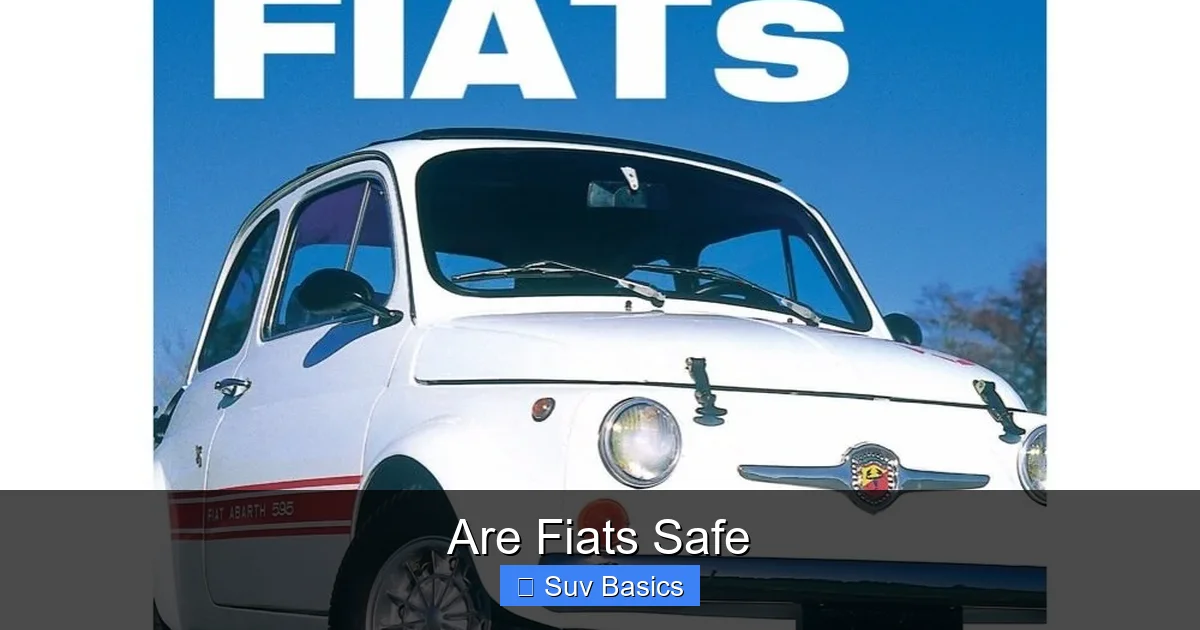
Are Fiats safe? The short answer is yes—many modern Fiat models meet or exceed key safety standards. While older models had mixed reviews, newer Fiats come equipped with advanced driver-assist technologies and solid crash test ratings from trusted organizations like Euro NCAP and the IIHS.
When it comes to choosing a car, safety is usually near the top of the list—right after fuel efficiency and price. But if you’re eyeing a stylish, compact Fiat, you might be wondering: Are Fiats safe? It’s a fair question, especially given the brand’s reputation in past decades for prioritizing style over substance. However, the automotive landscape has changed dramatically, and so has Fiat.
Today’s Fiats are not the same cars your parents may have driven. With stricter global safety regulations and evolving consumer expectations, Fiat has stepped up its game. From reinforced chassis designs to intelligent driver-assist systems, the Italian automaker now builds vehicles that compete with—and often match—the safety credentials of more established brands. Whether you’re considering the city-friendly Fiat 500, the versatile 500X SUV, or the family-oriented Tipo, understanding how these cars perform in real-world safety scenarios is crucial.
Key Takeaways
- Modern Fiats score well in crash tests: Recent models like the Fiat 500X and Tipo have earned high marks from Euro NCAP and IIHS for occupant protection.
- Advanced safety tech is standard: Features like automatic emergency braking, lane departure warning, and blind-spot monitoring are now common across the lineup.
- Small doesn’t mean unsafe: Compact Fiats like the 500 are engineered with high-strength steel frames to absorb impact energy effectively.
- Reliability has improved: Fiat has addressed past concerns about mechanical reliability, leading to fewer safety-related recalls in recent years.
- Driver behavior matters most: Even the safest car can’t prevent accidents caused by distracted or aggressive driving—safe habits are essential.
- Check specific model year ratings: Safety performance can vary between model years, so always review the latest crash test data before buying.
- Consider your driving needs: Urban drivers may benefit more from Fiat’s nimble handling and parking ease, while long-distance travelers should evaluate comfort and fatigue-reducing features.
📑 Table of Contents
- Crash Test Ratings: What the Experts Say
- Safety Features: What’s Standard in Modern Fiats?
- Size Matters—But Not How You Think
- Reliability and Recalls: Are Fiats Prone to Safety Issues?
- Driving Dynamics and Safety
- Who Should Consider a Fiat?
Crash Test Ratings: What the Experts Say
One of the most reliable ways to assess a car’s safety is by looking at independent crash test results. Organizations like the European New Car Assessment Programme (Euro NCAP) and the U.S.-based Insurance Institute for Highway Safety (IIHS) put vehicles through rigorous evaluations that simulate real-life collisions. For a broader perspective on how SUVs compare, see our guide to luxury SUVs luxury SUVs.
The Fiat 500X, for example, earned a five-star overall rating from Euro NCAP in its latest assessment. It scored particularly well in adult occupant protection (97%) and safety assist features (83%). Similarly, the Fiat Tipo received a four-star rating, with strong marks for side-impact protection and seatbelt reminders. Even the iconic Fiat 500, despite its tiny size, achieved a four-star Euro NCAP rating in recent tests—thanks to improvements in structural integrity and airbag deployment systems.
Understanding the Numbers
Crash test ratings break down into categories like frontal impact, side impact, pedestrian protection, and safety technology. A high score in “safety assist” means the car includes features like electronic stability control (ESC), lane-keeping aid, and automatic emergency braking—all of which actively help prevent accidents.
It’s also important to note that while no car is completely immune to damage in a severe crash, the goal of modern safety engineering is to protect occupants by managing crash forces. Fiats now use crumple zones and high-strength steel in key areas to redirect energy away from the passenger cabin.
Safety Features: What’s Standard in Modern Fiats?
Gone are the days when Fiats were criticized for skimping on safety equipment. Today, even entry-level models come with a robust suite of standard safety features. Let’s break down what you can expect.
Active Safety Technologies
Active safety features are designed to help you avoid accidents in the first place. In most 2020 and newer Fiat models, you’ll find:

Visual guide about Are Fiats Safe
Image source: pizzapartiesofamerica.com
- Automatic Emergency Braking (AEB): Detects potential collisions with vehicles or pedestrians and applies the brakes if the driver doesn’t respond in time.
- Lane Departure Warning (LDW): Alerts you if you unintentionally drift out of your lane.
- Blind Spot Monitoring (BSM): Uses sensors to detect vehicles in your blind spots and warns you before you change lanes.
- Adaptive Cruise Control: Maintains a safe following distance by automatically adjusting your speed.
Passive Safety Systems
When a crash is unavoidable, passive safety features kick in to minimize injury. Modern Fiats include:
- Six to seven airbags (front, side, curtain, and knee)
- Reinforced passenger cell with energy-absorbing structures
- Seatbelt pretensioners that tighten during impact
- ISOFIX child seat anchors for secure installation
For example, the Fiat 500L—a compact MPV—comes standard with seven airbags and a rollover sensor that deploys curtain airbags if the vehicle tips. These features make it a solid choice for families seeking a small but safe vehicle.
Size Matters—But Not How You Think
A common misconception is that smaller cars are inherently less safe than larger SUVs or sedans. While it’s true that physics plays a role—bigger vehicles often have more mass to absorb impact—modern engineering has narrowed the gap significantly.
How Fiats Compensate for Size
Fiat addresses the size challenge through smart design. The Fiat 500, for instance, uses a “safety cell” concept where the passenger compartment is built with ultra-high-strength steel, while the front and rear are designed to crumple in a controlled manner. This helps manage crash forces even in a subcompact frame.
Additionally, Fiat vehicles are often used in urban environments where speeds are lower. In city driving, the risk of high-speed, high-impact collisions is reduced, which can offset some of the disadvantages of a smaller footprint. Plus, their agility and compact size make them easier to maneuver and park, reducing the likelihood of low-speed fender benders.
Real-World Accident Data
According to data from the U.S. National Highway Traffic Safety Administration (NHTSA), small cars like the Fiat 500 have comparable fatality rates to midsize sedans in single-vehicle crashes. However, in multi-vehicle collisions involving larger trucks or SUVs, the odds do shift. That said, the presence of advanced safety tech like AEB can significantly reduce the chance of such crashes occurring in the first place.
Reliability and Recalls: Are Fiats Prone to Safety Issues?
Historically, Fiat had a reputation for mechanical issues and frequent recalls, which understandably raised safety concerns. But the brand has made significant strides in improving quality control and reliability.
Recent Recall Trends
In the past five years, Fiat recalls have focused more on software glitches or minor component failures rather than critical safety defects. For example, a 2021 recall involved the 500X’s infotainment system potentially distracting the driver—important, but not life-threatening. Earlier recalls, such as those for faulty airbag sensors or brake assist problems, have been addressed through over-the-air updates or dealership repairs.
Compared to the early 2010s—when Fiat had multiple high-profile recalls—the brand’s reliability has stabilized. J.D. Power and Consumer Reports now rate newer Fiat models closer to industry averages, especially in terms of safety-related dependability.
Tips for Buyers
If you’re considering a used Fiat, always check the vehicle’s recall history on the NHTSA website or through Fiat’s official portal. Many recalls are free to fix, and staying up to date ensures your car maintains its safety integrity.
Driving Dynamics and Safety
Safety isn’t just about what happens during a crash—it’s also about how well a car handles in everyday driving conditions. Fiat vehicles are known for their responsive steering and nimble handling, which can actually enhance safety by helping drivers avoid hazards.
Urban-Friendly Design
The Fiat 500, for example, is a masterclass in urban mobility. Its short wheelbase and tight turning radius make it easy to navigate narrow streets, parallel park in tight spots, and quickly change lanes when needed. These traits reduce driver stress and the likelihood of low-speed accidents—common in city driving.
All-Wheel Drive Options
For drivers in regions with harsh weather, the Fiat 500X offers an available all-wheel-drive (AWD) system. AWD improves traction on wet or snowy roads, reducing the risk of skidding or losing control. While not a substitute for cautious driving, it adds an extra layer of confidence in challenging conditions.
Who Should Consider a Fiat?
Fiats are ideal for certain types of drivers. If you primarily drive in the city, value fuel efficiency, and appreciate Italian design, a Fiat could be a smart, safe choice. They’re also great for younger drivers or those looking for a stylish second car.
However, if you frequently drive on highways, tow heavy loads, or need maximum cargo space, you might want to consider a larger SUV or crossover. That said, models like the 500X and 500L offer a good balance of size, safety, and practicality for small families or commuters.
Final Thoughts on Fiat Safety
So, are Fiats safe? The evidence suggests that modern Fiats are much safer than their predecessors and hold their own against competitors in the compact and subcompact segments. With strong crash test ratings, a growing suite of driver-assist technologies, and improved build quality, they’re a viable option for safety-conscious buyers.
As with any vehicle, the key is to choose the right model for your needs, stay current on maintenance, and practice safe driving habits. A well-maintained Fiat, driven responsibly, can be both stylish and secure.
Frequently Asked Questions
Are Fiats safe in a crash?
Yes, modern Fiats perform well in crash tests. Models like the 500X and Tipo have earned high ratings from Euro NCAP and IIHS, especially in adult occupant protection and safety assist features.
Do Fiats have airbags?
Yes, most new Fiats come with six to seven airbags, including front, side, curtain, and sometimes knee airbags, depending on the model and trim level.
Are small Fiats less safe than bigger cars?
Not necessarily. While larger vehicles have more mass, modern Fiats use advanced engineering like high-strength steel frames and crumple zones to protect occupants effectively.
Do Fiats have automatic emergency braking?
Yes, automatic emergency braking is standard on most 2020 and newer Fiat models, helping prevent or reduce the severity of front-end collisions.
Have Fiats had many safety recalls?
Fiat has had recalls in the past, but recent years show fewer critical safety issues. Most current recalls involve software or minor components, not major safety defects.
Is the Fiat 500 safe for a new driver?
Yes, the Fiat 500 is a good option for new drivers due to its compact size, ease of handling, and available safety features like lane departure warning and blind-spot monitoring.