
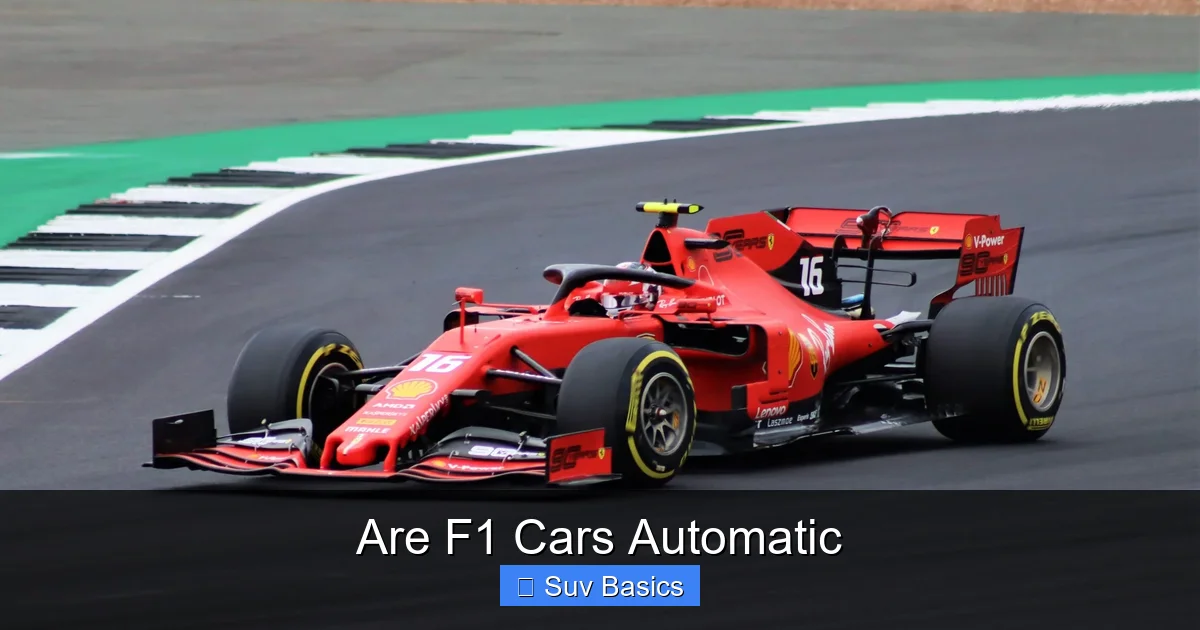
F1 cars are not automatic—they use advanced semi-automatic sequential gearboxes controlled by paddle shifters behind the steering wheel. Despite their complexity, drivers still manually shift gears, blending human skill with cutting-edge technology for maximum performance on the track. Just as SUVs have evolved over the decades, F1 transmissions continue to push technological boundaries.
When you watch a Formula 1 race, it’s easy to be mesmerized by the roar of the engines, the blur of color zipping around the track, and the incredible speed at which these machines operate. For those interested in how automotive technology transfers to consumer vehicles, check out the evolution of SUVs. One question that often comes up among fans—especially those new to the sport—is: Are F1 cars automatic? It’s a fair question. After all, these cars shift gears seamlessly, often without any visible effort from the driver. But the reality is more nuanced than a simple “yes” or “no.”
The short answer? No, F1 cars are not automatic in the traditional sense. They don’t have a conventional automatic transmission like your family SUV or sedan. Instead, they use a highly sophisticated semi-automatic sequential gearbox that blends human control with electronic precision. This system allows drivers to shift gears rapidly using paddle shifters mounted behind the steering wheel—no clutch pedal required during normal driving. The result is a driving experience that’s both intensely manual and incredibly automated, a perfect marriage of man and machine.
Understanding how this works requires a closer look at the technology behind F1 transmissions, the role of the driver, and how these systems have evolved over the decades. From the early days of manual gearboxes to today’s lightning-fast electronic systems, the way F1 cars change gears reflects the sport’s relentless pursuit of speed, efficiency, and innovation.
Key Takeaways
- F1 cars use semi-automatic transmissions: Unlike traditional automatics, they require driver input via paddle shifters to change gears.
- No clutch pedal is used during driving: The clutch is only engaged at startup and pit stops, managed electronically or via a button.
- Gear changes happen in milliseconds: Advanced systems allow shifts as fast as 0.05 seconds, optimizing acceleration and speed.
- Sequential gearboxes are standard: Gears are shifted in order (up or down), not selected individually like in manual cars.
- Drivers rely on steering wheel controls: All critical functions, including gear shifts, are managed through the multifunctional steering wheel.
- Technology enhances, but doesn’t replace, driver skill: While automation aids performance, precise timing and technique remain essential.
- F1 transmissions are highly customized: Each team designs its gearbox to match car dynamics and driver preferences.
📑 Table of Contents
- What Is a Semi-Automatic Transmission?
- How Do F1 Drivers Change Gears?
- Sequential vs. H-Pattern Gearboxes
- The Evolution of F1 Transmissions
- Driver Skill vs. Automation
- Common Misconceptions About F1 Transmissions
- Conclusion
What Is a Semi-Automatic Transmission?
To truly grasp whether F1 cars are automatic, we need to define what “automatic” really means. In everyday vehicles, an automatic transmission shifts gears on its own using hydraulic systems and torque converters. The driver simply selects “Drive” and lets the car handle the rest. In contrast, a manual transmission requires the driver to use a clutch pedal and gear stick to change gears.
F1 cars fall into a third category: the semi-automatic transmission. This system uses electronic actuators to engage and disengage gears, but the driver still initiates each shift. Instead of a gear stick, drivers use paddle shifters—small levers behind the steering wheel—to move up or down through the gears. When the driver pulls the right paddle, the car shifts up; the left paddle shifts down. The entire process is controlled by the car’s onboard computer, which ensures smooth, rapid gear changes without the need for a clutch during normal operation.
This setup offers the best of both worlds: the control and responsiveness of a manual system with the speed and precision of automation. It’s not fully automatic because the driver must still decide when to shift, but the actual mechanics of shifting are handled electronically.
How Do F1 Drivers Change Gears?
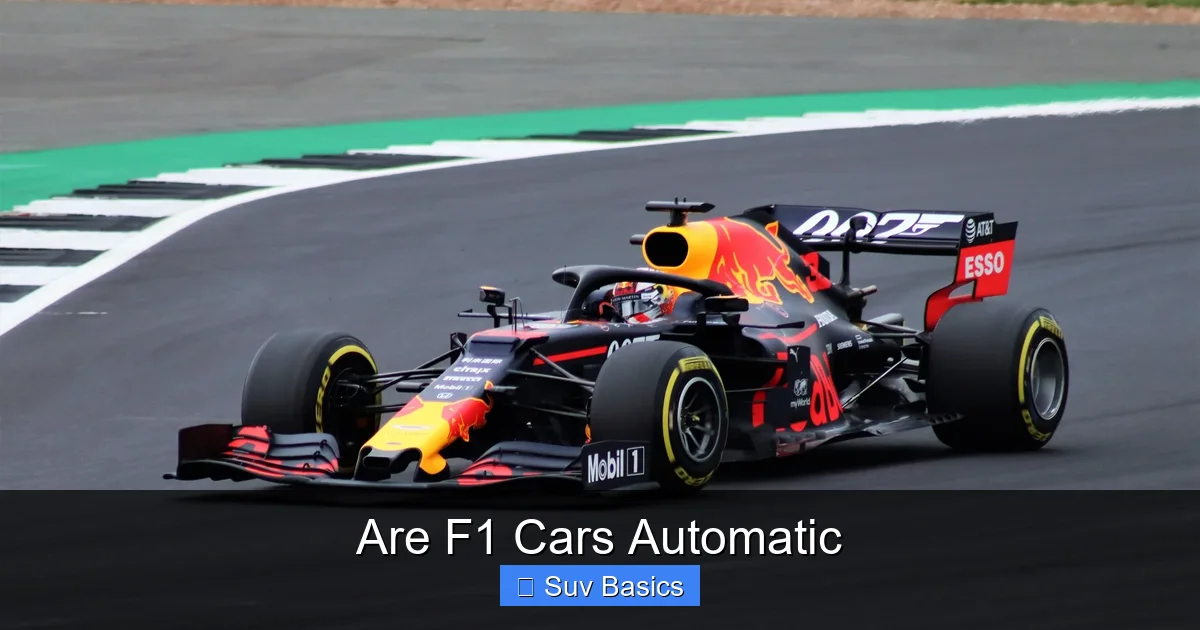
Visual guide about Are F1 Cars Automatic
Image source: publicdomainpictures.net
So, if F1 cars aren’t automatic, how exactly do drivers change gears? The answer lies in the paddle shifter system, one of the most iconic features of modern Formula 1 cockpits.
Located just behind the steering wheel, the paddle shifters are within easy reach of the driver’s fingers. To shift up, the driver pulls the right paddle; to shift down, the left. These paddles are connected to the car’s electronic control unit (ECU), which sends signals to hydraulic or electromagnetic actuators inside the gearbox. These actuators then engage the next gear in sequence—no clutch pedal needed.
One of the most impressive aspects of this system is its speed. Modern F1 gearboxes can complete a shift in as little as 0.05 seconds—faster than the blink of an eye. This allows drivers to maintain optimal engine RPM and maximize acceleration out of corners. The system also prevents accidental shifts, ensuring that drivers can’t skip gears or shift at the wrong time.
The Role of the Clutch
You might be wondering: if there’s no clutch pedal, how does the car start moving? That’s a great question. While the clutch isn’t used during normal driving, it’s still essential for starting the car and during pit stops.
At the beginning of a race or after a pit stop, the driver uses a small clutch paddle (also behind the steering wheel) to engage the clutch and get the car moving. Once the car is in motion and the engine is running smoothly, the clutch is no longer needed. The semi-automatic system takes over, allowing seamless gear changes without interruption.
This design reduces driver workload and minimizes the risk of stalling—a critical advantage in a sport where every second counts.
Sequential vs. H-Pattern Gearboxes
Another key feature of F1 transmissions is that they use a sequential gearbox, not the traditional H-pattern found in most manual cars.
In an H-pattern transmission, the driver moves a gear stick in a specific pattern—forward and back, side to side—to select different gears. This allows for non-sequential shifts, like jumping from first to third gear. But in a sequential system, gears are arranged in a straight line, and the driver can only shift one gear at a time, in order.
For example, if the car is in third gear, the driver can only shift to second or fourth—not directly to first or fifth. This might seem limiting, but in the high-speed, high-precision world of Formula 1, it’s actually a major advantage. Sequential shifting is faster, more reliable, and better suited to the rapid acceleration and deceleration of a race car.
Why Sequential Is Better for Racing
Sequential gearboxes are lighter, more compact, and easier to operate under extreme conditions. They also allow for quicker shifts, which is crucial when exiting a corner or overtaking a competitor. In F1, where races are often won by fractions of a second, every millisecond matters.
Additionally, the sequential design reduces the chance of driver error. There’s no risk of selecting the wrong gear or grinding the transmission—common issues with H-pattern systems under stress.
The Evolution of F1 Transmissions
The way F1 cars change gears has evolved dramatically over the years. In the early days of Formula 1, drivers used traditional manual transmissions with clutch pedals and gear sticks. Shifting was slow, physically demanding, and prone to mistakes.
The shift began in the 1980s, when teams started experimenting with semi-automatic systems. The breakthrough came in 1989, when Ferrari introduced the first fully electronic semi-automatic gearbox in the F1-89. This revolutionary system used paddle shifters and electronic actuators, allowing for faster, more precise gear changes.
Since then, the technology has only improved. Modern F1 gearboxes are made from lightweight carbon fiber, can withstand extreme forces, and are integrated with advanced telemetry systems that monitor performance in real time. Teams spend millions developing custom gearboxes tailored to their car’s aerodynamics, engine characteristics, and driver preferences.
Customization and Team Strategy
Each F1 team designs its own gearbox, often in collaboration with specialized manufacturers. The number of gears, shift timing, and even the feel of the paddle shifters can vary from team to team. Some drivers prefer quicker shifts, while others want more feedback from the system.
This level of customization ensures that the car performs at its peak, but it also means that drivers must adapt to their team’s specific setup. A driver moving from one team to another may need time to adjust to a new gearbox configuration.
Driver Skill vs. Automation
With all this advanced technology, it’s tempting to think that F1 drivers are just along for the ride. But that couldn’t be further from the truth. While the semi-automatic system handles the mechanics of shifting, the driver’s skill and timing are still critical.
Shifting at the right moment—especially when exiting a corner or under braking—can make the difference between winning and losing. Drivers must also manage engine revs, traction, and tire wear, all while navigating at speeds over 200 mph. The paddle shifters may do the work, but the driver calls the shots.
Moreover, F1 cars are incredibly sensitive to input. A mistimed shift can cause wheel spin, loss of traction, or even a crash. That’s why drivers spend countless hours in simulators, practicing gear changes under race conditions.
Just as drivers rely on skill, SUV owners often look for reliable models; see our guide on luxury SUV comparisons.
The Human Element
Despite the automation, F1 remains a driver’s sport. The best pilots combine instinct, experience, and split-second decision-making to extract maximum performance from their cars. The semi-automatic transmission enhances their abilities—it doesn’t replace them.
Common Misconceptions About F1 Transmissions
There are several myths surrounding F1 gearboxes that are worth clearing up. One of the most common is that F1 cars are “fully automatic” because they shift so smoothly. As we’ve seen, this isn’t true—the driver still controls every shift.
Another misconception is that F1 cars have infinitely variable transmissions (CVTs), like some modern road cars. In reality, F1 gearboxes have a fixed number of gears—usually 8 forward gears and 1 reverse. The FIA (Fédération Internationale de l’Automobile) regulates this to ensure fairness and maintain the sport’s technical challenge.
Finally, some people assume that because the car shifts gears automatically, the driver doesn’t need to know how to drive a manual car. While F1 drivers may not use a clutch pedal during races, most still train on manual transmissions to understand the fundamentals of vehicle dynamics.
Conclusion
So, are F1 cars automatic? The answer is a clear no—but they’re not fully manual either. They use a semi-automatic sequential transmission that combines driver control with electronic precision. This system allows for lightning-fast gear changes, reduced driver workload, and maximum performance on the track.
From paddle shifters to carbon fiber gearboxes, the technology behind F1 transmissions is a marvel of engineering. But at the heart of it all is the driver—the human element that turns technology into triumph. Whether you’re a seasoned F1 fan or just discovering the sport, understanding how these incredible machines shift gears adds a new layer of appreciation for the skill and innovation that define Formula 1.
Frequently Asked Questions
Are F1 cars automatic or manual?
F1 cars are neither fully automatic nor traditional manual. They use a semi-automatic sequential transmission that allows drivers to shift gears using paddle shifters, with electronic systems handling the actual gear engagement.
Do F1 drivers use a clutch?
F1 drivers do not use a clutch pedal during normal driving. The clutch is only used at startup and during pit stops, typically activated by a small paddle or button on the steering wheel.
How fast do F1 cars shift gears?
Modern F1 gearboxes can shift gears in as little as 0.05 seconds, making them some of the fastest-shifting transmissions in the world. This speed helps maintain optimal engine performance and acceleration.
Can F1 drivers skip gears?
No, F1 cars use sequential gearboxes, meaning drivers can only shift one gear at a time in order. They cannot skip from first to third gear, for example.
How many gears do F1 cars have?
Most F1 cars have 8 forward gears and 1 reverse gear, as regulated by the FIA. The exact configuration may vary slightly between teams based on their design choices.
Do F1 drivers need to know how to drive a manual car?
While F1 drivers don’t use manual transmissions during races, most still learn to drive manual cars to understand vehicle dynamics, clutch control, and gear management fundamentals.