

Not all SUVs come with four-wheel drive. Many modern SUVs use front-wheel or all-wheel drive instead. Understanding the difference helps you pick the right vehicle for your lifestyle and driving conditions.
For a comprehensive overview, see our guide on SUVs explained.
Key Takeaways
- Not all SUVs are 4-wheel drive: Many SUVs use front-wheel drive (FWD) or all-wheel drive (AWD) instead of traditional 4WD.
- 4WD is best for off-roading: True four-wheel drive systems are ideal for rugged terrain, towing, and extreme weather.
- AWD offers better on-road traction: All-wheel drive automatically powers all four wheels for improved grip in rain or snow, without driver input.
- FWD SUVs are fuel-efficient and affordable: Front-wheel drive models are lighter, cheaper, and more fuel-efficient for city and highway driving.
- Check the specs before buying: Always review the drivetrain details in the owner’s manual or manufacturer website.
- Your driving needs matter most: Choose based on climate, terrain, and how you plan to use the SUV.
📑 Table of Contents
- Are All SUVs 4 Wheel Drive? The Short Answer
- What Is 4-Wheel Drive (4WD)
- All-Wheel Drive (AWD): The Smart Middle Ground
- Front-Wheel Drive (FWD): The Efficient Choice
- Rear-Wheel Drive (RWD): The Overlooked Option
- How to Choose the Right Drivetrain for Your Needs
- Common Misconceptions About SUV Drivetrains
- Final Thoughts: Make the Right Choice
Are All SUVs 4 Wheel Drive? The Short Answer
If you’re shopping for a sport utility vehicle (SUV), you might assume that all SUVs come with four-wheel drive (4WD). After all, the rugged image of an SUV—climbing hills, hauling gear, and handling rough roads—seems to demand extra traction. But here’s the truth: **not all SUVs are 4-wheel drive**. In fact, many of today’s most popular SUVs run on front-wheel drive (FWD) or all-wheel drive (AWD), not true 4WD.
This common misconception comes from the SUV’s origins. Early SUVs, like the Jeep Wagoneer or Ford Bronco, were built on truck platforms and came standard with four-wheel drive. They were designed for off-road adventures and heavy-duty tasks. But as SUVs evolved into family-friendly vehicles, automakers began offering more efficient, car-based models. These newer SUVs prioritize fuel economy, comfort, and city driving—leading to a shift away from standard 4WD.
What Is 4-Wheel Drive (4WD)
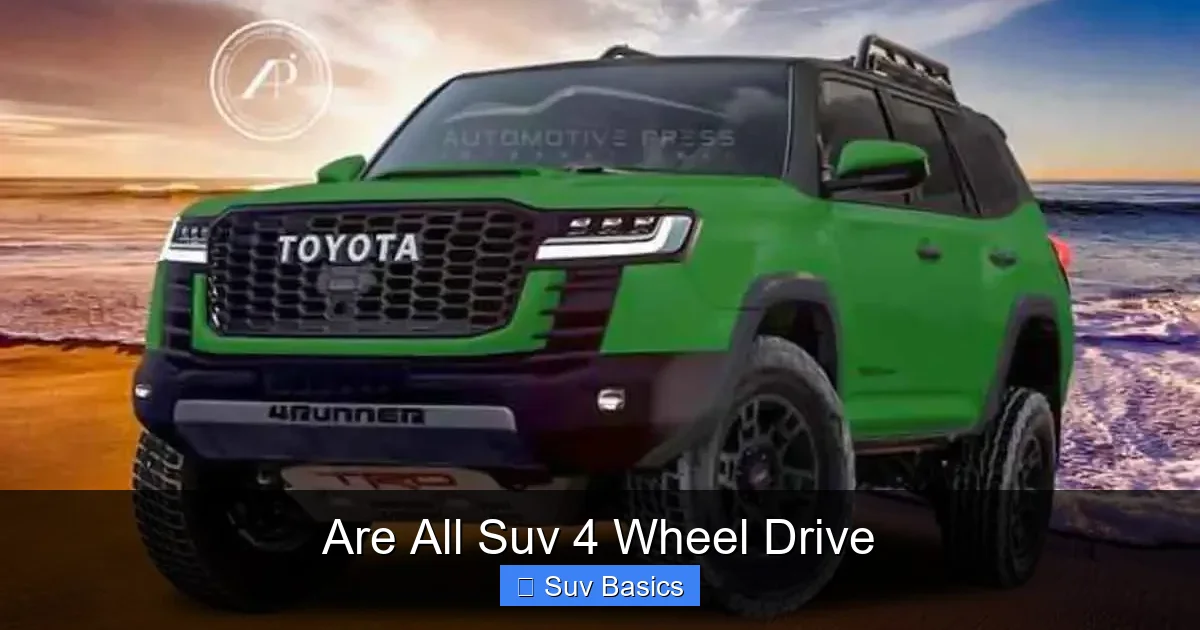
Visual guide about Are All Suv 4 Wheel Drive
Image source: i0.wp.com
Four-wheel drive, often called 4WD or 4×4, is a system that sends power to all four wheels simultaneously. Unlike front- or rear-wheel drive, which only power two wheels, 4WD provides maximum traction by engaging both axles. This makes it ideal for challenging conditions like mud, snow, rocks, or steep inclines. For a deeper look at how SUVs have evolved over time, check out our article on the invention of the SUV.
How 4WD Works
In a 4WD system, the engine’s power is split between the front and rear axles using a transfer case. Most 4WD systems are part-time, meaning the driver must manually switch between 2WD (usually rear-wheel drive) and 4WD using a lever or button. Some advanced systems, like Jeep’s Selec-Trac or Land Rover’s Terrain Response, offer full-time 4WD that automatically adjusts based on conditions.
Best Uses for 4WD
4WD shines in off-road environments. If you frequently drive on unpaved roads, tow heavy loads, or live in an area with deep snow or muddy trails, 4WD can be a game-changer. For example, the Toyota 4Runner and Ford Bronco come standard with 4WD and are built for adventure.
However, 4WD isn’t always necessary. On dry pavement, running in 4WD can cause drivetrain binding and increase wear. That’s why most drivers only engage it when needed. Also, 4WD typically reduces fuel efficiency due to added weight and mechanical complexity.
All-Wheel Drive (AWD): The Smart Middle Ground
All-wheel drive (AWD) is often confused with 4WD, but it’s a different system designed for on-road performance. AWD automatically sends power to all four wheels when needed, without requiring driver input. It’s commonly found in crossovers and car-based SUVs.
How AWD Differs from 4WD
Unlike 4WD, AWD systems are always active and use sensors to detect wheel slip. If one wheel loses traction—like on a wet road or icy patch—the system redirects power to the wheels with grip. This happens seamlessly, so you don’t have to think about it.
AWD is great for everyday driving in variable weather. For instance, the Subaru Outback uses its Symmetrical AWD system to provide confidence in rain, snow, or light off-roading. It’s not built for rock crawling, but it handles most real-world conditions well.
Types of AWD Systems
There are two main types: full-time and part-time AWD. Full-time AWD powers all wheels all the time, offering consistent traction. Part-time AWD usually runs in two-wheel drive (often front-wheel) and only engages the rear wheels when slip is detected. Both are effective, but full-time AWD offers better performance in slippery conditions.
Front-Wheel Drive (FWD): The Efficient Choice
Many modern SUVs—especially compact and midsize models—come standard with front-wheel drive (FWD). In this setup, only the front wheels receive power from the engine. It’s the same system used in most sedans and hatchbacks.
Why Choose FWD?
FWD SUVs are lighter, simpler, and more fuel-efficient than their 4WD or AWD counterparts. Without the extra components needed to power the rear wheels, they cost less to build and maintain. For city driving, highway commutes, and light errants, FWD is more than adequate.
For example, the Honda CR-V and Toyota RAV4 are available in FWD versions that deliver excellent gas mileage—often over 30 mpg on the highway. These models are perfect for drivers who rarely face snow or rough terrain. If you’re interested in luxury options, see our list of the Top 5 Luxury SUVs of 2024.
Limitations of FWD
The downside? FWD struggles in low-traction situations. If the front wheels lose grip—like on a steep, icy hill—the vehicle may not move at all. Also, FWD can feel less balanced when towing or carrying heavy loads, since weight shifts to the rear.
Still, for most people, FWD is a practical and economical choice. It’s worth noting that many FWD SUVs offer AWD as an optional upgrade, giving buyers flexibility.
Rear-Wheel Drive (RWD): The Overlooked Option
While less common in SUVs, rear-wheel drive (RWD) is still used in some models, especially larger or performance-oriented ones. In RWD, power goes to the rear wheels only.
Where You’ll Find RWD SUVs
Luxury brands like Mercedes-Benz and BMW often use RWD as a base for their SUVs, adding AWD as an option. For example, the Mercedes GLE starts with RWD, while the BMW X5 offers it in certain trims. These systems provide better weight distribution and a sportier driving feel.
RWD can also be found in truck-based SUVs like the Chevrolet Tahoe or GMC Yukon. These vehicles often have optional 4WD, but the default is RWD for better fuel economy on paved roads.
Pros and Cons of RWD
RWD offers improved handling and acceleration, especially in dry conditions. However, it can be slippery in snow or rain, where front wheels have more traction. That’s why RWD SUVs are often paired with AWD or 4WD systems for added safety.
How to Choose the Right Drivetrain for Your Needs
With so many options, how do you decide? The answer depends on your lifestyle, climate, and driving habits.
Ask Yourself These Questions
- Do you live in a snowy or rainy area?
- Do you frequently drive on unpaved roads or trails?
- Will you be towing a trailer or boat?
- Do you prioritize fuel economy and low maintenance?
- How important is off-road capability?
If you answered “yes” to off-roading or towing, 4WD is likely worth the extra cost. For drivers in mild climates who want better traction in bad weather, AWD is a smart upgrade. If you mostly drive on highways and city streets, FWD may be all you need. For more guidance, see our Ultimate 2024 Evaluation Guide.
Real-World Examples
Let’s say you live in Seattle, where rain is common but snow is rare. An AWD SUV like the Subaru Forester would give you confidence in wet conditions without sacrificing fuel economy. On the other hand, if you’re in Colorado and ski every weekend, a 4WD Jeep Grand Cherokee might be a better fit.
For a family in Texas with long highway commutes, a FWD Toyota Highlander could save hundreds in fuel and maintenance over time.
Common Misconceptions About SUV Drivetrains
There are a few myths that keep circulating about SUV drivetrains. Let’s clear them up.
Myth 1: “SUV = 4WD”
As we’ve seen, this isn’t true. Many SUVs are FWD or AWD. The term “SUV” refers to body style and size, not drivetrain.
Myth 2: “AWD Is the Same as 4WD”
They’re similar but not identical. AWD is for on-road traction and is automatic. 4WD is for off-road power and often requires manual engagement.
Myth 3: “You Need 4WD to Drive in Snow”
Not necessarily. AWD or even FWD with good winter tires can handle light snow. 4WD helps, but tire quality matters more than drivetrain in many cases.
Myth 4: “4WD Makes You Invincible Off-Road”
4WD helps, but it doesn’t replace skill, ground clearance, or proper tires. Overconfidence can lead to getting stuck or damaging your vehicle.
Final Thoughts: Make the Right Choice
So, are all SUVs 4-wheel drive? The answer is a clear **no**. While 4WD is available on many models, it’s not standard—and not always necessary. Today’s SUVs come with a range of drivetrains to match different needs, from fuel-efficient FWD crossovers to rugged 4WD trail machines.
The key is to match the vehicle to your life. If you’re an outdoor enthusiist, 4WD might be worth the investment. If you’re a city dweller who values comfort and economy, FWD or AWD could be perfect. Always check the specs, test drive different models, and consider your typical driving conditions.
Remember, the best SUV isn’t the one with the most gears or the biggest engine—it’s the one that fits your lifestyle. Whether you choose FWD, AWD, or 4WD, understanding your options puts you in the driver’s seat.
Frequently Asked Questions
Are all SUVs 4-wheel drive?
No, not all SUVs are 4-wheel drive. Many modern SUVs use front-wheel drive (FWD) or all-wheel drive (AWD) instead. Only certain models, especially those designed for off-roading, come with 4WD.
What’s the difference between AWD and 4WD?
AWD automatically powers all four wheels for better on-road traction and is ideal for rain or light snow. 4WD sends power to all wheels and is better for off-roading, towing, and extreme conditions, often requiring manual activation.
Can I drive an FWD SUV in the snow?
Yes, you can drive an FWD SUV in light snow, especially with good winter tires. However, it may struggle on steep, icy hills compared to AWD or 4WD vehicles.
Is AWD worth the extra cost?
It depends on your needs. If you live in an area with frequent rain, snow, or variable weather, AWD can improve safety and confidence. For dry climates, it may not be necessary.
Do all 4WD SUVs have low fuel economy?
Generally, yes. 4WD systems add weight and mechanical complexity, which reduces fuel efficiency. However, some modern 4WD systems are more efficient than older models.
Can I switch between 2WD and 4WD while driving?
It depends on the system. Some part-time 4WD systems require you to stop before switching, while full-time or automatic systems allow on-the-fly changes. Always check your owner’s manual.