
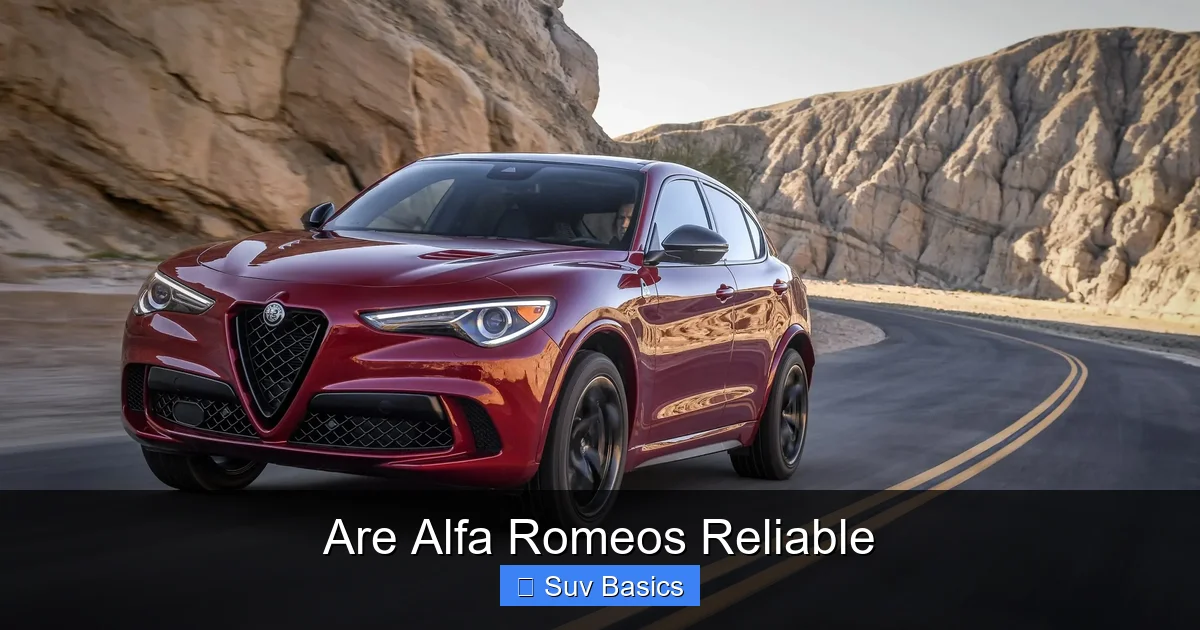
Alfa Romeos blend Italian style with performance, but their reliability has been a mixed bag. While recent models show improvement, they still lag behind German rivals in long-term dependability—especially without proper maintenance. Learn more about the history of SUVs.
Key Takeaways
- Historical reputation for unreliability: Older Alfa Romeos were known for electrical glitches and mechanical issues, hurting their long-term dependability scores.
- Recent improvements in quality: Since Fiat Chrysler (now Stellantis) took over, build quality and reliability have steadily improved across the lineup.
- Higher maintenance costs: Parts and labor can be pricier than mainstream brands, and specialized mechanics are often required.
- Strong performance and driving dynamics: Alfa Romeos excel in handling and engine responsiveness, making them fun to drive despite reliability concerns.
- Warranty and ownership experience: Newer models come with competitive warranties, but owner satisfaction varies based on service quality and location.
- Best suited for enthusiasts: Ideal for drivers who prioritize style and driving feel over bulletproof reliability.
- Regular maintenance is critical: Staying on top of scheduled service greatly reduces the risk of major breakdowns.
📑 Table of Contents
- Are Alfa Romeos Reliable? The Honest Truth
- A Look at Alfa Romeo’s Reliability History
- Common Reliability Issues in Alfa Romeos
- Alfa Romeo SUV Reliability: Focus on the Stelvio and Tonale
- Ownership Costs and Maintenance Tips
- What Owners Are Saying
- Final Verdict: Should You Buy an Alfa Romeo?
Are Alfa Romeos Reliable? The Honest Truth
If you’ve ever admired an Alfa Romeo gliding down the street—its sculpted hood, aggressive grille, and unmistakable Italian flair—you’re not alone. These cars turn heads. But behind that stunning design lies a long-standing question: Are Alfa Romeos reliable?
For decades, Alfa Romeo built a reputation for passionate engineering and breathtaking style, but also for frustrating breakdowns and quirky electronics. Owners often joked that you didn’t just buy a car—you adopted a project. But times have changed. With new ownership under Stellantis (the parent company of Jeep, Dodge, and Peugeot), Alfa Romeo has undergone a major transformation. Today’s models are more refined, better built, and increasingly dependable.
So, are Alfa Romeos reliable now? The short answer: they’re better than ever, but they’re not quite on par with Toyota or Honda when it comes to long-term reliability. If you’re considering an Alfa Romeo—especially one of their SUVs like the Stelvio—it’s important to go in with your eyes open. This article breaks down everything you need to know about Alfa Romeo reliability, from common issues to real owner experiences, so you can decide if this Italian stallion is right for you.
A Look at Alfa Romeo’s Reliability History
Visual guide about Are Alfa Romeos Reliable
Image source: motorbiscuit.com
To understand where Alfa Romeo stands today, it helps to look back. Learn more about the invention of the SUV. In the 1980s and 1990s, Alfa Romeos were legendary for their beauty and driving excitement—but also for their tendency to leave owners stranded. Electrical gremlins, rust issues, and finicky engines were common complaints. Reliability surveys from J.D. Power and Consumer Reports consistently ranked Alfa Romeo near the bottom.
Even into the 2000s, models like the 156 and 147 struggled with build quality and component failures. The brand became synonymous with “love-hate” relationships—people either adored their Alfas or swore they’d never own another.
But the tide began to turn in the 2010s. When Fiat (later Fiat Chrysler Automobiles) took control, they invested heavily in modernizing Alfa’s production lines, updating engineering practices, and improving quality control. The launch of the Giulia sedan in 2016 and the Stelvio SUV in 2017 marked a new era. These vehicles were built on a fresh platform, shared some components with Jeep and Maserati, and featured more rigorous testing.
How Recent Models Stack Up
Today’s Alfa Romeos—especially the Stelvio and the newer Tonale—score much better in reliability studies. For example, the 2022 Alfa Romeo Stelvio earned a “Above Average” rating from J.D. Power, a significant jump from past years. Similarly, Consumer Reports noted improvements in build quality and fewer reported problems in the first three years of ownership.
That said, Alfa Romeo still doesn’t top the charts. In the 2023 J.D. Power Vehicle Dependability Study, Alfa Romeo ranked 24th out of 32 brands—better than Land Rover and Jaguar, but well behind Lexus, Toyota, and Mazda. This tells us that while progress has been made, there’s still room for improvement.
Common Reliability Issues in Alfa Romeos
No car is perfect, and Alfa Romeos are no exception. While newer models are more dependable, some issues still pop up more often than in mainstream brands. Knowing what to watch for can save you time, money, and frustration.
Electrical and Infotainment Glitches
One of the most frequently reported problems in recent Alfa Romeos involves the infotainment system. Owners have complained about screens freezing, Bluetooth disconnecting, or navigation systems failing to load. In some cases, the entire Uconnect system—shared with Dodge and Jeep—needs a software update or reboot to function properly.
These issues are usually fixable with a dealer update, but they can be annoying, especially on long trips. Some owners recommend performing a system reset every few months to keep things running smoothly.
Transmission and Drivetrain Concerns
The Alfa Romeo Stelvio and Giulia use an 8-speed automatic transmission made by ZF, the same supplier used by BMW and Audi. In general, this transmission is robust and well-regarded. However, some early Stelvio models (2018–2020) experienced rough shifting or hesitation, particularly in cold weather.
Alfa issued technical service bulletins (TSBs) to address these issues, and most were resolved with software updates. Still, if you’re buying a used Stelvio, it’s wise to check the service history and ensure all updates have been applied.
Suspension and Brake Wear
Alfa Romeos are built for performance, which means they come with sport-tuned suspensions and high-performance brakes. While this makes them thrilling to drive, it also means components wear out faster than on a typical SUV.
Owners report that brake pads and rotors may need replacement sooner than expected—sometimes as early as 20,000 to 30,000 miles, especially if you drive aggressively. Similarly, suspension bushings and shocks can show wear earlier than on softer-riding competitors like the Lexus RX or Acura RDX.
Engine Reliability: The 2.0L Turbo Four-Cylinder
Most current Alfa Romeos—including the Stelvio and Tonale—use a 2.0-liter turbocharged four-cylinder engine. This engine is actually quite reliable when properly maintained. It’s based on a Fiat design but has been refined for Alfa’s performance needs.
The key to keeping it running smoothly? Oil changes. This engine is sensitive to oil quality and change intervals. Skipping or delaying oil changes can lead to premature wear or even turbocharger failure. Alfa recommends synthetic oil and changes every 7,500 miles or 12 months—whichever comes first.
Alfa Romeo SUV Reliability: Focus on the Stelvio and Tonale
Since you’re reading this in the “SUV basics” category (SUV guide), let’s zoom in on Alfa Romeo’s SUV offerings. The Stelvio has been the brand’s flagship SUV since 2017, and the newer Tonale arrived in 2022 as a more compact, hybrid-friendly option.
Alfa Romeo Stelvio: Performance Meets Practicality
The Stelvio is often called the “driver’s SUV”—and for good reason. It handles like a sports car, with sharp steering, minimal body roll, and a thrilling exhaust note. But how reliable is it?
Overall, the Stelvio has proven to be reasonably dependable, especially in recent model years. The biggest concerns center around the infotainment system and occasional transmission hiccups, as mentioned earlier. However, major mechanical failures are rare if the vehicle is well-maintained.
One real-world example: A 2021 Stelvio owner in California reported driving over 60,000 miles with only routine maintenance—oil changes, tire rotations, and brake inspections. No major repairs were needed. That said, another owner in Michigan experienced a faulty alternator at 35,000 miles, which was covered under warranty.
Alfa Romeo Tonale: The New Kid on the Block
The Tonale is Alfa’s first plug-in hybrid SUV, and it represents the brand’s push toward electrification and improved efficiency. Early reviews praise its stylish design, improved interior materials, and smoother ride compared to the Stelvio.
Reliability data for the Tonale is still limited since it’s so new, but early signs are promising. There have been no widespread recalls or major reported issues. However, as with any new model, it’s wise to monitor owner forums and wait for a few years of real-world data before making a long-term commitment.
One thing to note: The Tonale’s hybrid system adds complexity. While this can improve fuel economy, it also introduces more components that could potentially fail down the line. Regular maintenance and software updates will be key to keeping it running smoothly.
Ownership Costs and Maintenance Tips
Let’s talk money. Are Alfa Romeos expensive to maintain? The answer is: yes, compared to mainstream brands (luxury SUV comparisons), but not as much as you might think.
Parts and Labor Costs
Alfa Romeo parts are generally more expensive than those for Toyota or Honda. For example, a set of brake pads for a Stelvio can cost $200–$300, compared to $100–$150 for a Honda CR-V. Labor rates at Alfa dealerships also tend to be higher, especially if you need specialized diagnostics. See also our luxury SUV comparisons for broader context.
Extended Warranties and Certified Pre-Owned (CPO)
If you’re worried about reliability, consider an extended warranty or buying a Certified Pre-Owned (CPO) Alfa Romeo. CPO vehicles come with a thorough inspection, warranty coverage, and often include roadside assistance.
Alfa’s CPO program offers up to 6 years/100,000 miles of coverage, which can provide peace of mind. Just be sure to read the fine print—some exclusions apply.
DIY Maintenance Tips
You can save money and improve reliability by doing some maintenance yourself. Simple tasks like checking fluid levels, inspecting belts and hoses, and cleaning the throttle body can go a long way.
One pro tip: Use only high-quality synthetic oil and OEM or OEM-equivalent filters. Cheap oil can lead to sludge buildup, especially in turbocharged engines.
Also, keep your software up to date. Alfa frequently releases updates for the infotainment and engine control systems. Visit your dealer or check online for the latest versions.
What Owners Are Saying
To get a real sense of Alfa Romeo reliability, it helps to hear from the people who live with them every day.
On forums like AlfaBB and Reddit’s r/AlfaRomeo, owners are passionate—and honest. Many praise the driving experience, calling the Stelvio “the most fun SUV they’ve ever owned.” Others admit to frustration with minor electrical issues but say the joy of driving outweighs the hassles.
One owner wrote: “I’ve had my Stelvio for three years and 45,000 miles. I’ve had the infotainment reboot twice and replaced the rear wiper motor. But every time I drive it, I smile. It’s not perfect, but it’s alive.”
Another said: “I love the way it looks and drives, but I wouldn’t recommend it to someone who just wants a car to get from A to B. You have to be willing to put in a little extra care.”
These sentiments echo across owner reviews: Alfa Romeos are not for everyone, but for the right person, they’re deeply rewarding.
Final Verdict: Should You Buy an Alfa Romeo?
So, are Alfa Romeos reliable? The answer depends on your expectations and lifestyle (SUV evaluation guide).
If you’re looking for a bulletproof, low-maintenance SUV that will run for 200,000 miles with minimal fuss, an Alfa Romeo might not be your best bet. Brands like Toyota, Honda, or Subaru still lead in long-term reliability.
But if you value driving excitement, Italian design, and a car that feels alive on the road, an Alfa Romeo—especially the Stelvio or Tonale—could be a fantastic choice. Just be prepared to stay on top of maintenance, budget for slightly higher repair costs, and embrace the occasional quirk.
In short: Alfa Romeos are more reliable than they used to be, but they’re not yet class leaders. For enthusiasts who prioritize passion over perfection, they’re worth considering.
Frequently Asked Questions
Are Alfa Romeos reliable long-term?
Long-term reliability has improved significantly in recent years, but Alfa Romeos still trail behind top brands like Toyota and Lexus. With proper maintenance, many owners report trouble-free driving for 100,000+ miles.
Do Alfa Romeos break down a lot?
Older models were prone to breakdowns, but newer Alfa Romeos—especially post-2017—are much more dependable. Common issues today are usually minor, like infotainment glitches, rather than major mechanical failures.
Are Alfa Romeo SUVs expensive to maintain?
Yes, maintenance and repair costs are higher than average. Parts and labor can be pricier, and specialized mechanics may be needed. Budgeting for regular service helps avoid surprise expenses.
Is the Alfa Romeo Stelvio reliable?
The Stelvio is one of Alfa’s most reliable models, particularly in 2021 and newer versions. It scores well in dependability studies, though some owners report minor electrical or transmission quirks.
Should I buy a used Alfa Romeo?
Yes, if it’s a well-maintained, late-model example with a full service history. Avoid high-mileage or poorly serviced vehicles. A CPO warranty is highly recommended for peace of mind.
Do Alfa Romeos have good resale value?
Resale values are improving but still lag behind mainstream brands. Strong demand for used Stelvios helps, but depreciation is faster than Toyota or Honda SUVs.